• العربية
  • فارسی
Brand
  • Iran Insight
  • Politics
  • Economy
  • Analysis
  • Special Report
  • Opinion
  • Podcast
  • Iran Insight
  • Politics
  • Economy
  • Analysis
  • Special Report
  • Opinion
  • Podcast
  • Theme
  • Language
    • العربية
    • فارسی
  • Iran Insight
  • Politics
  • Economy
  • Analysis
  • Special Report
  • Opinion
  • Podcast
All rights reserved for Volant Media UK Limited
volant media logo

Iranian Regime Hangs Two More Protesters, Defying World Outcry
Jan 7, 2023, 08:32 GMT+0Updated: 09:35 GMT+0
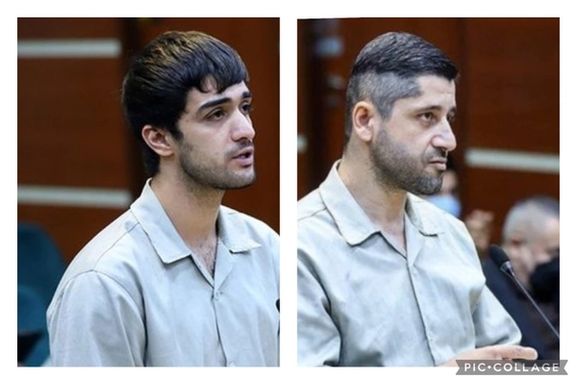
Mohammad Mehdi Karami and Seyyed Mohammad Hosseini, hanged on January 7, 2023

The clerical regime in Iran hanged two men on Saturday for allegedly killing a Basij agent during antigovernment protests near the capital Tehran in October.

"Mohammad Mehdi Karami and Seyyed Mohammad Hosseini, main perpetrators of the crime that led to the unjust martyrdom of Ruhollah Ajamian were hanged this morning," the judiciary said in a statement carried by the official IRNA news agency.

Karami was 22 years old, and Hosseini 39 were tried without having access to attorneys of their choosing, as almost all other dissidents and protesters arrested during the demonstrations. The circumstances related to the killing of Ajamian are not clear, as often the Basij paramilitary forces take the lead to attack protesters and use deadly force.

The convictions were not based on a criminal charge related to the murder per se, but they were charged with ‘moharebeh’, meaning “war against God”, a vague religious concept. The Islamic Republic applies the charge to people who might get into a confrontation with security forces during protests.

“I met with Seyed-Mohammad Hosseini at Karaj Prison. He cried through his account of tortures, being beaten with tied hands and legs and blindfolded, to being kicked in the head and losing consciousness, the soles of his feet being beaten with an iron rod to being tased in different parts of the body,” Ali Sharifzadeh Ardakani who says he has just recently been allowed to represent Hosseini tweeted on December 18.

Despite widespread international attempts to stop the executions, the regime decided to implement the verdict reached in November. Officials say death sentences for three others in the same case have been canceled.

So far, the government has executed four protesters and eleven others have received the death penalty, some for much less charges than murder, while at least 100 protesters face charges that could end in death sentences for them, an Iranian human rights group based in Oslo has reported.

The first two hangings triggered strong international condemnations and hundreds of lawmakers in Europe and Australia began sponsoring Iranian detainees in danger of execution to generate publicity and impact their fate.

French lawmaker Aude Luquet had taken on Hosseini’s political sponsorship and called for an immediate halt to all executions in Iran. Hosseini is also sponsored by Austrian parliamentarian Harold Truch.

Mohammad-Mehdi Karami was sponsored by Helge Limburg, member of the German parliament. “The regime in Iran assumes that he was involved in a killing. In truth he should die because he stands up for democracy and human rights. His execution would be a judicial killing,” Limburg tweeted December 12.

Activists had earlier called for protests in Iran and abroad on Sunday, January 8, the third anniversary of the downing of a Ukrainian airliner over Tehran by the Revolutionary Guard that killed all 176 people onboard. The executions on Saturday will add fuel to people's anger and big protests can take place as early as today.

Dozens of prisoners are either on hunger strike or suffer from life-threatening illnesses that are not treated by prison authorities and some are deprived of life-saving medications.


Most Viewed

Iran negotiators ordered to return after internal rift over Islamabad talks
1
EXCLUSIVE

Iran negotiators ordered to return after internal rift over Islamabad talks

2
EXCLUSIVE

Iran’s central bank warns economy may take 12 years to rebuild after war

3
INSIGHT

Iran's digital economy battered by prolonged blackout

4
ANALYSIS

US blockade enters murky phase as tankers spoof signals and buyers hesitate

5
ANALYSIS

Why the $100 billion Hormuz toll revenue is a myth

Banner
Banner

Spotlight

  • Hardliners push Hormuz ‘red line’ as US blockade tests Iran’s leverage
    INSIGHT

    Hardliners push Hormuz ‘red line’ as US blockade tests Iran’s leverage

  • Ideology may be fading in Iran, but not in Kashmir's ‘Mini Iran'
    INSIGHT

    Ideology may be fading in Iran, but not in Kashmir's ‘Mini Iran'

  • War damage amounts to $3,000 per Iranian, with blockade set to add to losses
    INSIGHT

    War damage amounts to $3,000 per Iranian, with blockade set to add to losses

  • Why the $100 billion Hormuz toll revenue is a myth
    ANALYSIS

    Why the $100 billion Hormuz toll revenue is a myth

  • US blockade targets Iran oil boom amid regional disruption
    ANALYSIS

    US blockade targets Iran oil boom amid regional disruption

  • Iran's digital economy battered by prolonged blackout
    INSIGHT

    Iran's digital economy battered by prolonged blackout

•
•
•

More Stories

Iranian Regime Agents Threaten Dissident Expats In Europe

Jan 7, 2023, 03:14 GMT+0
•
Iran International Newsroom

An audio file shared on social media has revealed that the regime threatens Iranians abroad for taking part in anti-government protests and expressing opposition.

In the audio file published by the VOA Farsi service on Thursday, a security agent of the Islamic Republic, who introduces himself as an agent of the intelligence ministry, threatens "Massi Kamri", an Iranian activist living in France, saying if she does not stop acting against the regime, they will imprison her parents and family members in Iran.

Apparently, she participated in rallies against the Islamic Republic’s bloody crackdown on antigovernment protests that have engulfed Iran following the death in custody of 22-year-old Mahsa Amini. 

Using an insulting tone, the agent tells Kamri if she cares about her family and does not want them to be taken to the notorious Evin prison in Tehran she should not engage in anti-Islamic Republic activities.

The agent also says she must stop sharing Instagram stories and posts that encourage people in Iran to chant slogans and hold protests.

In another part of the recording, Kamri says her Instagram page is private and no one except her followers could see her posts, but the person from the intelligence ministry claims he has access to her page, saying “it’s right now open in front of me!”

Kamri insists that she has not done anything wrong according to the laws of France, where she is a permanent resident, but the agent says what she is doing is against the Islamic Republic. She told the regime’s agent that nowhere in the world do authorities hold accountable the family members of someone who commits a crime, but the agent replied this is Iran and they can do whatever they like. 

This is not the first time Iranian agents threaten people living abroad for expressing their opinions. The Daily Telegraph recently reported that the Islamic Republic uses mosques and political institutions in the United Kingdom as part of its “spying system” to target dissidents.

Canada's spy agency also launched an investigation into what it calls multiple "credible" death threats from Iran aimed at individuals in Canada.

In November, Israel’s Mossad informed Britain’s spy agency about an impending Iranian plot to carry out terrorist attacks against Iran International’s journalists based in London. 

According to information obtained by Iran International, threats against its journalists came from the same team that sought to target Israel’s former consul general in Istanbul, Yosef Levi Sfari, who was rescued by authorities and sent back to Israel.

Faced with nationwide antigovernment protests since mid-September, the Islamic Republic has blamed foreign-based Persian broadcasters such as BBC Persian and Iran International of “fomenting unrest”, while all media in the country are under tight government control and present protesters as “rioters” and “terrorists”. The Islamic Republic is notorious for tormenting the families of dissidents in every way it can think of, from abducting the bodies of the dead ones and burying them in undisclosed locations -- such as the case of late journalist Reza Haqiqatnejad -- to detaining and calling in family members for interrogations to warn them of talking to media about their loved ones. 

Iran’s Intelligence Minister Esmail Khatib on November 9 said the Islamic Republic regards Iran International as “a terrorist organization,” adding that its workers and anyone affiliated with the channel will be pursued by the Ministry of Intelligence.

Iran has a long record of targeting dissidents and independent journalists who found refuge in other countries. In the latest example of terror operations abroad, Iranian intelligence abducted dissident journalist Ruhollah Zam who was visiting Iraq in 2019 and took him back to Iran where he was executed in 2020.

Ukraine Crisis Shakes Up US, Iran Calculations

Jan 6, 2023, 19:50 GMT+0
•
Iran International Newsroom

The United States Treasury Friday designated six executives or board members of an Iranian company it said were involved in supplying military drones to Russia.

Qods Aviation Industries was itself sanctioned in November. The US also designated Friday the director of Iran’s Aerospace Industries Organization over its role in manufacturing Iran’s ballistic missiles.

“We will continue to use every tool at our disposal to deny [Russian President Vladimir] Putin the weapons that he is using to wage his barbaric and unprovoked war on Ukraine,” Treasury Secretary Janet Yellen in a statement. The action was taken, said the Treasury, under Executive Order 13382, from 2005, ‘Blocking Property of Weapons of Mass Destruction Proliferators and Their Supporters.’

The US argues that supply of drones from Iran violates a provision in United Nations Security Council Resolution 2231, which barred Tehran from trading certain kinds of weapons – including drones “capable of delivering at least a 50kg payload to a range of at least 300km.”But the drones the US and Ukrainian say Iran have sent carry a slightly lighter load.

Iranian Shahed-136 drones used by Russia in Ukraine
100%
Iranian Shahed-136 drones used by Russia in Ukraine

While Friday’s action may do little - any US assets of those designated can be frozen - it illustrates the Ukraine crisis changing calculations in Washington over Iran policy. The administration of President Joe Biden took office in January 2021 ostensibly committed to restoring the 2015 Iran nuclear agreement, but has shifted its focus towards sanctions over Tehran’s links with Russia and its treatment of internal protests.

‘Pure damage’

In Tehran, opponents of the 2015 agreement, the JCPOA (Joint Comprehensive Plan of Action) take heart. Saeed Jalili, top security official under President Mahmoud Ahmadinejad, has argued the JCPOA brought little inward investment and was “pure damage” even before the US withdrew in 2018.

Jalili advocates a ‘resistance economy,’ based on domestic production and lowering import dependence. But while Iranian domestic employment picked up slightly after the US in 2018 left the JCPOA and imposed ‘maximum pressure’ sanctions according to government figures, some economists suggested this was more reaction to circumstance, including the falling rial, than any strategy.

Likewise, with ‘maximum pressure’ stymying the Rouhani government’s efforts of attracting western European investment, including energy majors, Iran turned elsewhere, an approach crystalized in President Ebrahim Raisi championing a ‘turn east.’

Iranian foreign minister Hossein Amir-Abdollahian with his Chinese counterpart in Beijing, in January 2022
100%
Iranian foreign minister Hossein Amir-Abdollahian with his Chinese counterpart in Beijing, in January 2022

But many analysts argue that the Ukraine crisis – although regime officials forlornly hoped it would make Europe desperate for Iranian energy – has accelerated Iran-Russia rapprochement, which both sides say they would like to base on economics as well as security.

Stoking Iranian skepticism towards Russia

The Washington Institute this week published a policy paper by senior fellow Henry Rome arguing the US should “stoke longstanding Iranian skepticism towards Russia” to combat the “tightening of ties” triggered by the Ukraine crisis. Rome cited November’s statement from 35 former Iranian diplomats calling Tehran’s reaction a “grave mistake” and reiterated allegations that Russia had leaked to the media details about shipments of Iranian drones.

The US, Rome argued, should “emphasize the potential for friction and mistrust between the two partners” to “generate the most intense reaction in Tehran,” as well as extending sanctions over drone shipment, and encouraging European States to designate Iran’s Revolutionary Guards (IRGC) to “impose a greater economic cost on Tehran for supporting Russia.”

European Union foreign ministers are expected to discuss new Iran sanctions at the end of January. In letter published in the newspaper Volkskrant on Friday, leaders of ten Dutch parliamentary parties called for the IRGC to be designated along with officials and their families.

Netanyahu the mediator?

In other fall-out from Ukraine, an aide to President Volodymyr Zelenskyy told Israeli television Thursday that new Prime Minister Benjamin Netanyahu was a potential mediator with Russia. Mykhailo Podolyak said he had “no doubt” Netanyahu “understands precisely what modern wars are and what is the essence of mediation under these conditions.”

While the Ukraine war has boosted Israeli arms sales due to poorly-performing Russian weapons, Netanyahu - who touted his warm relationship with Putin in 2019 elections by slapping a giant picture of the Russian president outside the Likud Party headquarters - has said he was approached while in opposition to mediate but deferred to the government.

Islamic Republic Arrests Another Journalist

Jan 6, 2023, 16:44 GMT+0

The Islamic Republic has arrested another journalist, bringing the number of detained reporters and photographers over the ongoing protests to well over 70. 

Mehdi Beyk, the political editor of reformist Etemad newspaper, was arrested on Thursday. 

Earlier in the week, the regime’s security forces arrested two other journalists -- Mehdi Ghadimi and Milad Alavi, both working for reformist media outlets. 

On Sunday, regime’s agents raided the house of Mehdi Ghadimi’s father in Karaj, west of Tehran, and arrested the journalist who used to work for several dailies in Iran including Etemad and Shargh, both ‘reformist’ publications.

Tehran Journalists Association says at least 73 journalists and photographers have been arrested in the past four months, around the time when 22-year-old Mahsa Zhina Amini was killed in police custody triggering the current wave of antigovernment protests. 

Niloufar Hamedi, Elaheh Mohammadi, Nazila Maroufian, the three journalists who broke the news of her death, covered her funeral and interviewed her father were also arrested. 

The Brussels-based International Federation of Journalists said in mid-December that at least 57 journalists had been arrested in Iran since September. The international NGO also noted that only 30 of the 57 detained journalists have been reportedly released so far.

There are no exact figures on the number of people arrested during the protests, but some sources say nearly 20,000 people have been detained, more than 500 killed by security forces and many received serious injuries, such as losing their eyes when they were targeted by shotguns.

Iran's New Central Bank Chief Says 'Economic Indicators Improving'

Jan 6, 2023, 14:54 GMT+0

The new chairman of the Central Bank of Iran (CBI), amid a serious economic crisis, said Friday that macroeconomic indicators show signs of improvement.

Mohammad-Reza Farzin, appointed last week, did not explain which economic indicators show improvement. His predecessor was sacked because of a serious financial and currency crisis.

The Iranian rial has lost 50 percent of its value since mid-2021 and 30 percent this year, raising fears of higher inflation. Iran’s annual inflation rate is al,ost 50 percent, with food prices averaging 78 percent increase in the past 12-month period.

The financial crisis comes at a time of antigovernment protests, instilling anger among the population impoverished in the past five years after the United States imposed sanctions on Iran’s economy.

Farzin was speaking at his first meeting of a government outfit called “Headquarters for Economic Information and Propaganda” established in 2018 to fight against “psychological warfare” in markets. Iranian officials often blame poor economic performance on “enemy” conspiracies.

Farzin strongly intervened in the currency market on December 31 as the rial sank to 440,000 to the US dollar last week. The amount of foreign currency injected into the market was kept secret, but the rial regained close to 10 percent of its value but remained at almost an all-time low of 400,000 to the US dollar. Subsequent interventions only had a temporary impact.

The rial has been steadily losing value since the Islamic Republic was established in 1979, when the dollar equaled just 70 rials.

Iran's Top Sunni Cleric Again Slams Government In Fiery Sermon

Jan 6, 2023, 13:43 GMT+0
•
Maryam Sinaiee

Sunni worshippers took to the streets for the 14th week in Zahedan after Friday prayers during which the popular cleric Abdolhamid delivered another fiery sermon.

“Whether facing gallows or prison, we will stand firm until the end!” a video posted on twitter shows protesters in Zahedan, capital of the southwestern province of Sistan-Baluchestan, chanting. In another video they are seen chanting “Down with the executioner Republic!”

Two young Baluch protesters, Mansour Dehmardeh and Ebrahim Narouei, were sentenced to death on charges of “corruption on earth” Tuesday. According to the Baluch Activists Campaign (BAC), a rights group, the 22-year-old Dehmardeh who has physical disabilities has also been brutally tortured in detention.

Videos also show protesters chanting against the newly appointed governor of the province. “We don’t want a Daish-i governor!” Brigadier General Mohammad Karami, the former commander of Revolutionary Guards (IRGC) ground forces in the region, was recently appointed as governor in the restive province.

In his sermon this Friday, Mowlavi Abdolhamid protested to the “mass arrests on the streets” in the Sunni-majority province and accused the authorities of torturing detainees until they accept crimes that they never committed. “The Sharia does not sanction forced confessions which the Constitution does not endorse either,” he said while demanding the release of all detainees.

People in Zahedan carrying placards. One message says, "Oppression cannot last"
100%
People in Zahedan carrying placards. One message says, "Oppression cannot last"

“You have put [protesters] in prison, executed them, and the problem was not solved with these executions, imprisonments and heavy sentencing … Listen to the voice of the people if you want to solve the problems,” he told the authorities.

IRGC-affiliated Fars news website quickly responded to Abdolhamid, publishing remarks by conservative regime insider Javad Larijani, brother of former parliament speaker Ali Larijani, who harshly attacked the Sunni cleric.

“It is about time for the revolutionary forces to set aside niceties with Abdolhamid. He cannot be in Iran and say we are Iranians, but pursue the policies of Iran’s enemies,” Larijani said.

Abdolhamid, officially known as Mowlana Abdolhamid Esmail-Zehi, also noted the anniversary of the Revolutionary Guards downing a Ukrainian commercial flight over Tehran with missiles on January 8, 2020, that killed all 176 onboard. “The government was definitely responsible for this tragedy but did not accept its fault. You weren’t honest with the people,” he said.

“The strength of the system does not ensue from nuclear weapons or military [power]… Strength comes from accepting faults and carrying out justice,” Abdolhamid told the thousands who had gathered at Jameh Mosque of Makki in Zahedan to pray and to take part in the weekly protests that have been held regularly after the Friday prayers since September 30.

The crackdown on protesters on September 30 during which 90-96 Baluch worshippers including children were killed and around 300 were injured has come to be known as the “Bloody Friday of Zahedan”.

Local sources say the IRGC and other security forces set up check points in some areas of Zahedan on Friday to stop the flow of people to the prayers and arrested at least nine youths after the prayers. According to Halvash, a website dedicated to news in the province, the outspoken Abdolhamid has been under pressure from intelligence and security organizations to stop his popular Friday prayers and fiery sermons.

Local sources also say security forces arrested tens of Baluch residents, including teenagers, ahead of this week’s Friday prayers. Some activist groups such as BAC put the number of detainees in the past few days at “hundreds”.

Many of the detainees have been accused of “hooliganism” or connections with foreign countries and “a terrorist group”, presumably the militant Jaish ul-Adl which has a history of deadly operations in the southwestern Sistan and Baluchestan province.






