• العربية
  • فارسی
Brand
  • Iran Insight
  • Politics
  • Economy
  • Analysis
  • Special Report
  • Opinion
  • Podcast
  • Iran Insight
  • Politics
  • Economy
  • Analysis
  • Special Report
  • Opinion
  • Podcast
  • Theme
  • Language
    • العربية
    • فارسی
  • Iran Insight
  • Politics
  • Economy
  • Analysis
  • Special Report
  • Opinion
  • Podcast
All rights reserved for Volant Media UK Limited
volant media logo

Iran Says Possible To ‘Bring The Loose Ends Together’ In Nuclear Talks
Iran International Newsroom
Aug 4, 2022, 21:34 GMT+1Updated: 17:33 GMT+1
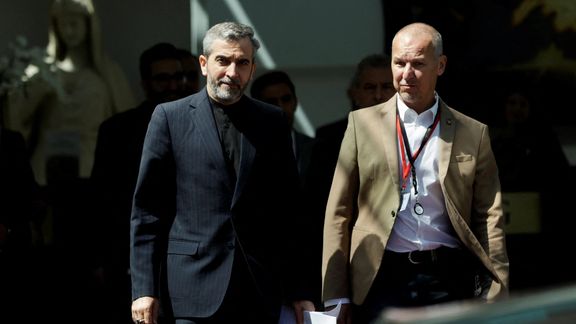
Iran's Chief Nuclear Negotiator Ali Bagheri-Kani leaves the Palais Coburg, the venue where closed-door nuclear talks take place in Vienna, August 4,2022.

Talks over Iran’s nuclear program resumed in Vienna Thursday with Enrique Mora, the senior European official, set mediating between Iran and the United States.

The European Union has played an active role in continuing efforts to revive the 2015 Iran nuclear deal, the JCPOA (Joint Comprehensive Plan of Action) since year-long Vienna talks between Iran and six world powers paused in March. The new Vienna round appears to focus on a text produced in late July by EU foreign policy chief Joseph Borrell.

Mora Thursday met twice with Ali Bagheri Kani, the lead Iranian negotiator, according to a journalist at the Palais Coburg hotel and the official Iranian news agency IRNA, which also reported Mora met Rob Malley, the lead US negotiator.

IRNA quoted Bagheri Kani that Iran had presented “to the other sides our ideas, in terms of format and proposals, to make it possible to conclude the Vienna negotiations” and that he believed it possible “to bring the loose ends together in a short time if the other side is ready for a similar step.”

Thorny differences remain between Washington and Tehran. Speaking to al-Jazeera television Thursday, Mohammad Marandi, advisor-cum-spokesman for the Iranian negotiators, referring to the US leaving the JCPOA in 2018, said Washington had to give “the necessary assurances, so the Iranians are not fooled again.”

Marandi denied Iran had ever asked for guarantees over a future US presidency or that it had set as a precondition for JCPOA restoration the removal of Washington’s 2019 designation of Iran’s Revolutionary Guards (IRGC) as a ‘foreign terrorist organization.’

Marandi said Iran needed “assurances that the United States does not [again] violate the deal without paying a heavy price…” Asked if Americans would agree to this, the advisor replied: “That’s what they are going to be negotiating about.”

Reuters quoted an anonymous Iranian official that among Iran “own suggestions” raised in Vienna, apparently in addition to Borrell’s proposals, was “lifting sanctions on the Guards gradually.”

Step by step?

There has been speculation as to whether Borrell’s proposals might include a step-by-step approach to reviving the JCPOA, with sanctions lifted in stages as Iran stepped down its nuclear program, which has expanded since 2019 including enriching uranium to 60 percent and using advanced centrifuges barred under the deal.

Iran’s atomic chief Mohammad Eslami Thursday reiterated Tehran’s demand that the International Atomic Energy (IAEA) should accept Iran’s explanations over nuclear work before 2003, a demand that many reports have suggested Tehran sees as a precondition for restoring the JCPOA.

Emphasizing domestic pressure on President Joe Biden over his approach to Iran, Senator Bob Menendez, Democrat Chairman of the Senate Foreign Relations Committee, repeated his view that the JCPOA was dead.

Return to JCPOA ‘a fantasy’

“A return to the 2015 deal is not only unrealistic and unproductive, it is a fantasy,” Menendez said. “Iran is drawing out negotiations with delaying tactics and brinkmanship…It is time for us to send a message that we will do whatever is necessary to defend the national interest of the United States and to ensure than Iran never achieves a nuclear weapon.”

Menendez was addressing, virtually, the ‘International Convention for a Free Iran,’ which is sponsored by the Mujahideen-e Khalq, the Iranian opposition group once allied to Saddam Hussein and which Tehran regards as a ‘terrorist’ organization. Menendez praised Maryam Rajavi, the MEK co-leader, and condemned Iran’s “push towards a nuclear weapon.”

A poll by Data For Progress published Wednesday found 42 percent of Americans likely to vote in November’s mid-term elections were “very concerned” or “somewhat concerned” over Iran “developing the ability to produce a nuclear weapon.” Seventy-eight percent favored using “all our best diplomatic tools to put an end to Iran’s nuclear weapons program,” with 12 percent favoring “war with Iran…to slow down its nuclear weapons development.”

Most Viewed

Iran negotiators ordered to return after internal rift over Islamabad talks
1
EXCLUSIVE

Iran negotiators ordered to return after internal rift over Islamabad talks

2
ANALYSIS

US blockade enters murky phase as tankers spoof signals and buyers hesitate

3
ANALYSIS

Why the $100 billion Hormuz toll revenue is a myth

4

US tightens financial squeeze on Iran, warns banks over oil money flows

5
INSIGHT

Ideology may be fading in Iran, but not in Kashmir's ‘Mini Iran'

Banner
Banner

Spotlight

  • Hardliners push Hormuz ‘red line’ as US blockade tests Iran’s leverage
    INSIGHT

    Hardliners push Hormuz ‘red line’ as US blockade tests Iran’s leverage

  • Ideology may be fading in Iran, but not in Kashmir's ‘Mini Iran'
    INSIGHT

    Ideology may be fading in Iran, but not in Kashmir's ‘Mini Iran'

  • War damage amounts to $3,000 per Iranian, with blockade set to add to losses
    INSIGHT

    War damage amounts to $3,000 per Iranian, with blockade set to add to losses

  • Why the $100 billion Hormuz toll revenue is a myth
    ANALYSIS

    Why the $100 billion Hormuz toll revenue is a myth

  • US blockade targets Iran oil boom amid regional disruption
    ANALYSIS

    US blockade targets Iran oil boom amid regional disruption

  • Iran's digital economy battered by prolonged blackout
    INSIGHT

    Iran's digital economy battered by prolonged blackout

•
•
•

More Stories

Saudi Arabia Reiterates Worries Over Iran’s Nuclear Program

Aug 4, 2022, 19:13 GMT+1

Saudi Arabia has reiterated worries over Iran’s lack of transparency with international nuclear inspectors, and its non-compliance with obligations under international nuclear agreements.

Speaking at NPT Review Conference in New York on Wednesday, Saudi Arabia’s new permanent representative to the UN Abdulaziz Al-Wasil warned of the repercussions of "Iran's nuclear practices" and Israel's non-accession to the Treaty on the Prohibition of Nuclear Weapons.

"Iran's lack of transparency with the IAEA violates the UN Charter," he said, adding that "transparency is necessary for the peaceful use of nuclear energy". "The danger of nuclear weapons spread threatens the Middle East and the world."

Noting that the Islamic Republic’s nuclear activities constitute a threat to the non-proliferation regime and to international peace and security, he expressed his country’s “deep concerns” over Iran’s nuclear program.

Citing the recent International Atomic Energy Report which cast doubt on the supposed peaceful nature of Tehran’s plans, he added, “The Kingdom of Saudi Arabia supports all international efforts to prevent Iran from possessing nuclear weapons.”

In a ministerial statement released for the Tenth NPT Review Conference on Monday, August 1, the United States, France, and the United Kingdom also reiterated their position that the Islamic Republic should never achieve the capability to build nuclear weapons, saying that said the Nuclear Non-Proliferation Treaty has reduced the risk of a devastating nuclear war, and further reduction of that risk must be a priority for all NPT states parties.

Late in July, Iraqi Foreign Minister Fuad Hussein announced that Saudi Arabia and Iran have agreed to hold the first public meeting at the level of foreign ministers in Baghdad following rounds of closed reconciliation meetings.

Diplomats Whirl In Meetings As Iran Nuclear Talks Restart

Aug 4, 2022, 12:31 GMT+1
•
Iran International Newsroom

A round of meetings began Thursday in Vienna as various accounts emerged on what has or has not been agreed over restoring the 2015 Iran nuclear deal.

The official Iranian news agency IRNA was moved to cite “an informed source close to Iran’s negotiating team” denying a Wall Street Journal report that Tehran had dropped its demand that the United States remove Iran’s Revolutionary Guards (IRGC) from its list of ‘foreign terrorist organizations.’

The designation – made by President Donald Trump in 2019 – has been widely reported as a stumbling block in the talks, which began in April last year, but it is caught up in wider issues of Iran’s access to world trade as stipulated by the 2015 agreement, the JCPOA (Joint Comprehensive Plan of Action).

The Wall Street Journal’s formulation that Iran is “still calling for stronger guarantees that Washington won’t abandon the pact again or reimpose sanctions on Tehran” suggests Iran might swallow the FTO designation in return for other US concessions.

IRNA’s source said the onus lay with the US to “take advantage of the opportunity JCPOA participants have offered.” The US left the JCPOA in 2018 and will part in the Vienna talks indirectly, with Iran refusing to meet face-to-face.

Sword of Damocles

There have been wide reports that Iran is insisting on the International Atomic Energy Agency (IAEA) dropping enquiries into uranium traces found in sites used before 2003 and undisclosed to the agency as nuclear-related.

Bagheri Kani meeting with EU's Mora in Vienna, August 4, 2022
100%
Bagheri Kani meeting with EU's Mora in Vienna, August 4, 2022

Mohammad Marandi, advisor-cum-spokesman to Iranian negotiators, tweeted Thursday that the IAEA could “no longer be used as the sword of Damocles.” Iran and the IAEA are at odds over explanations Iran has given over the pre-2003 work, with the agency’s dissatisfaction prompting France, Germany, the UK, and the US to successfully move a resolution at the agency’s governing board in June censuring Iran.

In Tehran, Mohammad Eslami, Iran’s nuclear chief, told IRNA that Iran had no reason to respect JCPOA nuclear limits, given the deal was “quasi-obsolete,” and that it expected an end to “false claims,” a reference to the pre-2003 work.

In his tweet Marandi highlighted Iran’s demand for guarantees that the US and Europeans respect Iran’s access to world markets as required under the JCPOA, suggesting they could not hope to both restore the 2015 deal and “keep a wrecking ball at hand…able to expand the sanctions regime at will.”

Which sanctions are ‘nuclear related,’ and which are not, has been a central theme of talks, both in Vienna, where the process paused in March, and in a bilateral US-Iran round in Qatar June mediated by the European Union.

Asl and Bagheri Kani active

Mohsen Naziri Asl, Iran’s recently appointed ambassador to the IAEA, emerged Thursday in Vienna as a leading participant, while Iran’s chief negotiator Ali Bagheri Kani met Enrique Mora, the EU chair of the talks, and the Russian IAEA ambassador Mikhail Ulyanov, who in past rounds of negotiations has been an enthusiastic tweeter.

Previous Vienna talks followed a format where remaining JCPOA signatories – China, France, Germany, Iran, Russia, and the United Kingdom – met formally under JCPOA auspices, with the US participating indirectly. There were also constant bilateral meetings of various parties - other than between Iran and US, as Iran refuses to meet US diplomats.

The resumption of talks in Vienna, surprising observers after a five-month gap, comes after EU foreign policy chief Josep Borell circulated in late July a written text outlining a possible path to agreement.

Washington confirmed Wednesday that Rob Malley, its chief negotiator and special Iran envoy, would be in Vienna. Malley tweeted that while he welcomed “a good faith attempt to reach a deal,” US “expectations are in check.”

Long-Time Iranian Nuclear Weapons Expert Working On Detonators - Source

Aug 3, 2022, 23:18 GMT+1
•
Iran International Newsroom

An Iranian specialist of nuclear detonators, who was previously working at a secret nuclear weapons development test site in Iran, is said to be still working for the defense ministry on nuclear weapons.

According to information obtained by Iran International, Saeed Borji is working to develop nuclear detonators for the ministry’s Organization of Defensive Innovation and Research -- or SPND. 

A protege of the once-top Iranian nuclear weapons scientist and a senior member of Iran's Revolutionary Guard, Mohsen Fakhrizadeh -- who was assassinated in November 2020 – Borji runs a front company named Azar Afrouz Saeed Engineering Company, specializing in explosives. The company is a subsidiary of SPND. 

The explosives and metals expert for Shahid Karimi Group, also a subsidiary of SPND, has been associated with "possible military dimensions of the Iranian nuclear program," according to the International Atomic Energy Agency (IAEA), and has assisted SPND’s efforts to procure equipment used for containing explosions.

100%

Borji, who has a PhD in chemical engineering from Malek Ashtar University of Technology, has previously worked in Parchin military complex with Russian-born former Soviet scientist Vyacheslav Danilenko – with an extensive expertise in the development of nuclear detonators – and Vladimir Padalko on projects about explosive chambers for nuclear weapons. 

The Abadeh site is an important site for conducting large-scale high explosive tests for developing nuclear weapons under the Amad Plan, which was Iran’s project during the early 2000s to build five nuclear weapons and later was reoriented to a smaller, better camouflaged nuclear weapons program. Abadeh was first identified as a weapons site in October 2019 by Israeli Prime Minister Benjamin Netanyahu. The site was built in the mid-1990s by companies controlled by the Islamic Revolutionary Guard Corps

The Abadeh site also called Marivan site in the southwestern Fars province, is one of the places that the IAEA found traces of undeclared uranium and demanded explanation from the Islamic Republic. Iran said the origin of the particles is "unknown" and insisted the site was used for "the exploitation of fireclay through a contract with a foreign company decades ago."

100%

Borji was sanction by the United States on March 22, 2019 as a Specially Designated National (SDN) by the US Department of the Treasury's Office of Foreign Assets Control (OFAC) pursuant to Executive Order 13382, which targets proliferators of weapons of mass destruction and their delivery system. 

Late in July, two Telegram channels with links to IRGC suggested that Iran may build nuclear warheads “in the shortest possible time” if attacked by the US or Israel, which has repeatedly threatened in recent months to use all means at its disposal to prevent Iran from becoming a nuclear threat, and has said its armed forces are preparing for action if necessary.

“The nuclear facilities of Fordow have been built deep under mountains of Iran and are protected against trench-busting bombs and even nuclear explosion… all infrastructures required for nuclear breakout have been prepared in it,” the video by Bisimchi Media (Radioman Media) Telegram channel said while adding that the facilities at Natanz may be highly vulnerable to a possible attack by Western powers and Israel but Fordow will immediately assume war footing and begin the nuclear breakout project within a short time if Natanz comes under missile attack.

EMAD, another form of an earlier weapons program, AMAD, refers to Iran’s purported secret nuclear effort, which started in 1989 under the leadership of Fakhrizadeh and according to the UN nuclear watchdog IAEA, stopped in 2003. According to a IAEA director general’s report in 2015, Iran specifically denied the existence of the AMAD Plan and the ‘Orchid Office’ as elements of such a program.

Iran has now enough uranium enriched to 60 percent purity and if further enriched to 90 percent, the fissile material will be sufficient for a nuclear bomb within a few weeks.

Iran Nuclear Talks Resume With More Questions Than Answers

Aug 3, 2022, 20:00 GMT+1
•
Iran International Newsroom

United States and Iranian officials played down prospects as they headed to Vienna for the resumption of nuclear talks on Thursday.

“Our expectations are in check, but the United States welcomes EU [European Union] efforts and is prepared for a good faith attempt to reach a deal,” Rob Malley, the US special envoy for Iran and lead nuclear negotiator, wrote on Twitter. “It will shortly be clear if Iran is prepared for the same.”

“[Iranian negotiator Ali] Bagheri Kani will leave Tehran in a few hours,” said Iran’s foreign ministry spokesman Nasser Kanaani in Tehran. “In this round of talks, which will be held as usual with the co-ordination of the European Union, ideas presented by different sides will be discussed.”

The talks are expected to focus on a written text submitted July 20 by Joseph Borrell, the EU foreign policy chief. The resumption of talks aimed at restoring the 2015 Iran nuclear deal, the JCPOA (Joint Comprehensive Plan of Action) was announced earlier Wednesday by Enrique Mora, the senior EU official who coordinated year-long Vienna meetings between Iran and six world powers, which paused in March.

‘Ominous legacy’

“Heading to Vienna to advance the negotiations,” Bagheri Kani tweeted. “The onus is on those who breached the deal & have failed to distance from ominous legacy…The US must seize the opportunity offered by the JCPOA partners’ generosity; ball is in their court to show maturity & act responsibly.”

But on August 1 Iran said it started feeding fuel into “hundreds” more IR-1 & IR-6 centrifuges – devices used to enrich uranium – as part of a plan for a capacity of at least 190,000 SWU (separative work units), a measurement of efficiency in enrichment. Under the JCPOA Iran was allowed only 6,104 of the less advanced 6,104 and no IR-6s.

It is as unclear whether the resumed talks will resume the Vienna set-up – with formal, direct talks involving Iran, China, France, Germany, Russia and the United Kingdom; and with the US participating indirectly.

Reuters quoted one un-named Iranian official that the talks would be “in the format of the Doha meeting,” referring to June’s two-day indirect bilateral US-Iran talks in the Qatari capital, when the US and Iran conferred through EU mediator. Tehran has ruled out face-to-face meetings.

Russia ‘ready for talks’

Mikhail Ulyanov, Russia’s envoy to the Vienna-based International Atomic Energy Agency (IAEA), suggested in a tweet that the talks were restoring the Vienna process “after a break” of five months with Russian negotiators were “ready for constructive talks in order to finalise [sic] the agreement.”

Both the Vienna talks and the Doha round failed to bridge gaps between the US and Iran over which American sanctions violate the JCPOA and should be lifted for Iran to downsize its nuclear program to JCPOA limits. The US left the JCPOA in 2018, imposing ‘maximum pressure’ sanctions and prompting Iran by 2019 to begin expanding its atomic work and to reduce IAEA monitoring to that is required under the Nuclear Non-Proliferation Treaty.

With the US and Iran blaming each other for lack of agreement over renewing the JCPOA, Iran’s nuclear chief Mohammad Eslami said Wednesday that Tehran saw no reason to accept any of the deal’s limits. The US Treasury has also in recent days announced further action, under ‘maximum pressure’ powers introduced by President Donald Trump, to sanction companies from China, the Emirates and Singapore it said were involved in exporting Iranian petrochemicals.

Iranian Analyst Says West Thinks Iran Can't Build Nuclear Bomb

Aug 3, 2022, 15:52 GMT+1
•
Iran International Newsroom

An Iranian international affairs analyst says the West does not pay attention to bragging by Iranian officials about their capablity to build a nuclear bomb.

Analyst and former diplomat Ali Bigdeli said in an interview with Didban Iran [Iran Monitor] website: “Thanks to its knowledge of the requirements for bomb making, the West knows that Iran is not about to build a nuclear weapon.”

At the same time, he said such statements are simply rhetoric and they do not reflect Iran’s political position. The latest comments about Iran’s capabilities came from nuclear chief Mohammad Eslami and lawmaker Mohammad Reza Sabbaghian who said on Monday that “If the West’s outrageous behavior continues, we will ask the Supreme Leader to reverse his ban on making nuclear bombs.”

Bigdeli said that such comments are attempts that could be defined as sabre rattling by Iranian officials with the aim of getting concessions in nuclear talks. But the West does not react to those comments despite the excitement created by the media. He said those comments are not likely to change the West’s view about the negotiations.

Bigdeli also opined, however, that the Israel's provocative remarks about an attack on Iranian nuclear facilities should be taken seriously although such an attack would be foolish. Israelis cannot do anything against Iran without US support he argued and added that Washington would not welcome a war in the region while there is a war in Ukraine. So, Israel is bluffing.

The analyst went on to say Iran’s biggest problem is that its chief negotiator Ali Basgheri-Kani is not flexible and knowledgeable enough in his role.

Iranian analyst and former diploma Ali Bigdeli
100%
Iranian analyst and former diploma Ali Bigdeli

Meanwhile, in a commentary published on Monday, conservative Nameh News website suggested that Iran should not miss the new opportunity for reaching an agreement with the United States based on the proposal made by EU Foreign Policy Chief Josep Borrell.

The website wrote that although most Iranian conservative media are adamant that Tehran should insist on it maximal demands, this could be a risky approach if it is not combined with intelligent efforts by the negotiators.

The commentary expressed optimism that the upcoming meeting between Bagheri and his EU counterpart Enrique Mora in Vienna can pave the way for the revival of the JCPOA.

Nameh News at the same time pointed out that some Iranian conservative media have opined that if Iran can expand its ties with Russia, China, Venezuela, Iraq and India, then it will no longer need to sit at the negotiating table with the United States. The daily concluded that the clock is ticking in Iran’s favor.

This comes while many politicians and analysts believe Iran is in a dire economic situation and badly needs a rapprochement with the United States as a requirement for lifting the sanctions and improving the economy.

On Monday, Iranian lawmaker Ghasemfar Saedi said in an interview with Rouydad24 news website that Iranians are losing their patience and government officials need to take the realities of the society into account while making decisions.

Saedi also called on government spokesman Ali Bahadori to apologize for saying that Iranians are very patient vis-a-vis economic problems.

“On the contrary, the people’s patience is wearing seriously thin in this regard,” said the lawmaker. He added that the Raisi administration should come to its senses before it is too late and begin to control the markets as the people are really worried about their livelihood.

“The government’s performance has led to a decline in people’s trust in the government and their hope in the future.”