• العربية
  • فارسی
Brand
  • Iran Insight
  • Politics
  • Economy
  • Analysis
  • Special Report
  • Opinion
  • Podcast
  • Iran Insight
  • Politics
  • Economy
  • Analysis
  • Special Report
  • Opinion
  • Podcast
  • Theme
  • Language
    • العربية
    • فارسی
  • Iran Insight
  • Politics
  • Economy
  • Analysis
  • Special Report
  • Opinion
  • Podcast
All rights reserved for Volant Media UK Limited
volant media logo

Iran Says ‘No Reason’ To Accept Any JCPOA Limits
Iran International Newsroom
Aug 3, 2022, 11:46 GMT+1Updated: 17:26 GMT+1
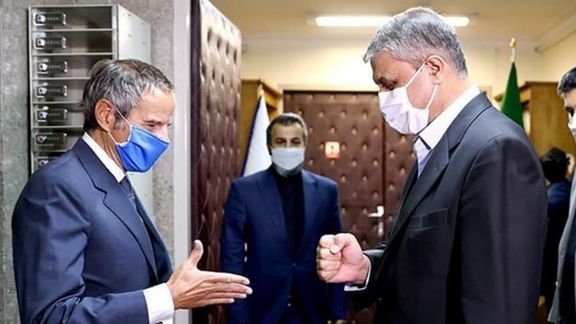
Rafael Grossi (L) meeting Mohammad Eslami in Tehran on March 5, 2022

Tehran will not “shy away from any action aimed at removing sanctions” and has “no reason” to abide by the 2015 nuclear deal, its atomic chief said Wednesday.

Mohammad Eslami, head of the Atomic Energy Organization of Iran, told a cabinet meeting that June’s removal of some cameras of the International Atomic Energy Agency was in line with the parliament decision, taken in December 2020 , to reduce agency monitoring to that required by the Nuclear Non-Proliferation Treaty (NPT) rather than the extensive monitoring required under the 2015 nuclear deal, the JCPOA (Joint Comprehensive Plan of Action).

“When the other side is not in JCPOA, we have no reason to abide by a quasi-obsolete commitment,” Eslami said. “The cameras will not go back until they return to JCPOA and stop making false accusations.”

The United States – which left the JCPOA in 2018, imposing ‘maximum pressure’ sanctions – and three European states successfully moved a resolution at the IAEA board in June censuring Iran over what the agency regards as unsatisfactory explanations of pre-2003 nuclear work.

Eslami stressed that following legislation passed in December 2020, Iran had begun using “advanced centrifuges,” devices used for uranium enrichment barred under the JCPOA. “We will not shy away from any action aimed at removing sanctions,” Eslami said.

Agency informed on nuclear expansion

During a press briefing in New York Tuesday evening, Rafael Mariano Grossi, the IAEA director-general, was asked by Iran International’s Maryam Rahmati about Eslami’s statement earlier Tuesday that Iran was preparing new centrifuges, including relatively advanced IR-6s.

Grossi confirmed Iran had briefed the IAEA. “Our inspectors are mobilized and they are going to be looking into this when this happens,” he said. “Not all of them have been prepared – just part of them – and we are going to be informing the Board of Governors soon about this.”

Grossi reiterated that the agency’s “visibility” had been “significantly reduced” by Iran’s decision in June to remove 27 cameras in “certain facilities.” He expressed particular concern over the agency’s lack of knowledge of Iran’s manufacturing activities – where access is not required under the JCPOA. “We will have to come to terms with Iran to account for them when, if and when, they agree on reviving the JCPOA,” Grossi said.

Knowledge of the amount and kinds of centrifuges manufactured, even if not in use, is seen by the agency as important part in assessing the nuclear program, particularly with Iran enriching to 60 percent, close to 90 percent ‘weapons grade’ and far above the 3.67 percent JCPOA limit.

IRGC designation

In Washington Tuesday, John Kirby, the National Security Council Coordinator for Strategic Communications, in a press briefing largely about the US drone strike killing Ayman al-Zawahiri, the al-Qaeda leader, in Afghanistan, reiterated President Joe Biden’s commitment not to lift the US Foreign Terrorist Organization’ (FTO) designation of Iran’s Revolutionary Guards (IRGC) as part of negotiations to restore the JCPOA.

Eslami said at the cabinet meeting that the designation had “not been the main issue in the talks.” Disagreements between Iran and the US over JCPOA restoration – both in year-long talks in Vienna paused in March, and in the June round in Qatar – have centered on which US sanctions violate the 2015 agreement. Tehran argues that the administration of President Donald Trump introduced sanctions under various rubrics, including the IRGC designation. as part of its ‘maximum pressure.’


Most Viewed

US blockade enters murky phase as tankers spoof signals and buyers hesitate
1
ANALYSIS

US blockade enters murky phase as tankers spoof signals and buyers hesitate

2

US tightens financial squeeze on Iran, warns banks over oil money flows

3
INSIGHT

Ideology may be fading in Iran, but not in Kashmir's ‘Mini Iran'

4
INSIGHT

Hardliners push Hormuz ‘red line’ as US blockade tests Iran’s leverage

5
VOICES FROM IRAN

Hope and anger in Iran as fragile ceasefire persists

Banner
Banner

Spotlight

  • Hardliners push Hormuz ‘red line’ as US blockade tests Iran’s leverage
    INSIGHT

    Hardliners push Hormuz ‘red line’ as US blockade tests Iran’s leverage

  • Ideology may be fading in Iran, but not in Kashmir's ‘Mini Iran'
    INSIGHT

    Ideology may be fading in Iran, but not in Kashmir's ‘Mini Iran'

  • War damage amounts to $3,000 per Iranian, with blockade set to add to losses
    INSIGHT

    War damage amounts to $3,000 per Iranian, with blockade set to add to losses

  • Why the $100 billion Hormuz toll revenue is a myth
    ANALYSIS

    Why the $100 billion Hormuz toll revenue is a myth

  • US blockade targets Iran oil boom amid regional disruption
    ANALYSIS

    US blockade targets Iran oil boom amid regional disruption

  • Iran's digital economy battered by prolonged blackout
    INSIGHT

    Iran's digital economy battered by prolonged blackout

•
•
•

More Stories

US Asks To Seize Boeing 747 In Argentina Linked To Iran's IRGC

Aug 3, 2022, 08:20 GMT+1
•
Iran International Newsroom

The United States Tuesday asked permission to confiscate an Iranian plane impounded in Argentina on suspicions of links to international terrorist groups.

Argentina grounded the 747 cargo plane after its unannounced arrival from Mexico to an airport in Buenos Aires on June 8. The plane originally belonged to Iran’s Mahan airline affiliated with Iran’s Revolutionary Guard (IRGC) and sanctioned by the US for transporting arms to Syria and supporting terrorism.

The plane had arrived in Argentina with a crew of 19 people, including five Iranians, some with clear ties to the IRGC. Argentina confiscated their passports. In recent days, a judge ordered the release of 12 crew members after weeks of being denied permission to leave Argentina.

In June, Gerardo Milman, an Argentine lawmaker, told Iran International that Iranians aboard the Venezuelan plane planned “attacks on human targets.” Contrary to Iran’s claim June 13 that the plane was not owned by an Iranian company, Milman said the pilot was “a senior official of Qods (Quds) force,” Tehran’s extraterritorial intelligence and secret ops outfit listed as a terrorist organization by the United States.

Early in 2022, a Venezuelan government company decided to set up a cargo division that came to be called Emtrasur Cargo and its first plane was the Boeing 747-300M bought or leased from Mahan airlines and christened ‘Louisa Caceres Arismendi.’

The grounding of the 747 sparked weeks of intrigue as well as concern within the Argentine government over its ties to Iran and Venezuela and companies sanctioned by the US.

Agentinian lawmaker Gerardo Milman
100%
Agentinian lawmaker Gerardo Milman

The confiscation request by the US Department of Justice followed the unsealing of a July 19 warrant for the plane's seizure in the US District Court for the District of Columbia, which alleged that the aircraft could be confiscated because it violated export control laws, the DOJ said.

The DOJ said the US-origin Boeing 747-300 aircraft is subject to sanctions as its sale from Iran's Mahan Air to Emtrasur last year, part of the Venezuelan Consortium of Aeronautical Industries and Air Services (Conviasa), violates U.S. export laws. Both companies are sanctioned by the United States for alleged collaboration with terrorist organizations.

"The Department of Justice will not tolerate transactions that violate our sanctions and export laws," said Assistant Attorney General Matthew Olsen of the DOJ's National Security Division in the statement.

The US move comes amid stalled talks to revive the 2915 Iran nuclear agreement, JCPOA. Apparently, after 16 months of indirect talks between Iran and the US, Tehran insists that the IRGC should be removed from the US list of Foreign Terrorist Organizations (FTO).

One intriguing part of the nearly two-month-long saga was the identity of the plane’s Iranian pilot. Shortly after the plane was impounded it became clear that the pilot was Gholamreza Ghasemi, a known IRGC Qods Force operative and reportedly a relative of Iran’s current interior minister Ahmad Vahidi. The other Iranians were also linked to IRGC or its terror-linked companies.

Mahan Air is sanctioned for ties to the Islamic Revolutionary Guard Corps-Quds Force (IRGC-QF), a US-designated terrorist organization. The US sanctioned Conviasa in 2019 for its ties to Venezuelan President Nicolas Maduro's government.

"The seizure of this aircraft demonstrates our determination to hold accountable those who seek to violate US sanctions and export control laws," said U.S. Attorney Matthew Graves.

Fourteen Venezuelans and five Iranians were traveling on the plane when it arrived in Buenos Aires. Seven of them are still detained in Argentina.

Argentina's Foreign Ministry did not immediately respond to a request for comment.

With reporting by Reuters

Iran’s Nuclear Program Moving Ahead Very Fast – IAEA

Aug 2, 2022, 21:56 GMT+1

IAEA Director General Rafael Mariano Grossi says that “good words” from the Islamic Republic are not enough to satisfy international inspectors

Grossi expressed hope on Tuesday that Tehran is ready to be transparent about its nuclear program, which was “moving ahead very, very fast”.

When asked about the IAEA's role in monitoring any revival of Iran's 2015 nuclear deal with world powers under which it curbed its nuclear program in return for economic sanctions relief, he said Iran must grant IAEA inspectors access “commensurate to the size” of its uranium enrichment program if the agency is to credibly assure that it is peaceful.

“When it comes to nuclear, good words will not do it. What you need to do is to be transparent and compliant and work with us. We are ready and I hope they will be as well,” Grossi told reporters at the United Nations.

“They have a very ambitious nuclear program that needs to be verified in the appropriate way. The program is moving ahead very, very fast and not only ahead, but sideways as well, because it's growing in ambition and in capacity.”

Iran's nuclear chief Mohammad Eslami told reporters in Tehran on Mondaythat Iran is technically capable of building a nuclear bomb; a statement that has been made before by at least two other Iranian officials and has been generally taken as a defiant signal from Tehran. President Ebrahim Raisi also reiterated last week that the people of Iran have told him they want to resist rather than sign an agreement with the United States.

Business Leader Says If No Sanctions Iran Can Double Trade With China

Aug 2, 2022, 17:58 GMT+1
•
Mardo Soghom

Iran can double its trade with China if US sanctions are lifted, but it would need 8 years to regain the economic status of 2010, a Tehran business leader says.

China has been Iran’s top trading partner in recent years and has helped with its overt and covert oil purchases since 2018 when the United States withdrew from nuclear deal known as JCPOA and imposed crippling sanctions on Iran.

The head of Iran-China chamber of commerce in Tehran, Majidreza Hariri told the Iranian Student News Agency (ISNA) in an interview that although China has taken a public stance against US sanctions, “but economic relations have their own characteristics and Iran should have its own special plans for neutralizing sanctions.”

Hariri in the past one year has repeatedly hinted at the economic benefits of lifting US sanctions, without commenting directly on the nuclear talks that have dragged on for 16 months without a result, keeping sanctions on Iran’s oil exports and international banking.

In April, the business leader said that if US sanctions are lifted, annual trade with China could top $60 billion. Last November he warned that Iran’s economy was at a dangerous juncture, with high inflation and a host of other problems. Since then, the national currency has lost more value and inflation has climbed to an annual rate of 54 percent.

Hariri also said that Iran would need eight years once sanctions are lifted to regain the same economic footing it had in 2010, when first international sanctions were imposed for its nuclear program.

Hariri told ISNA, “Despite many slogans, the economy was never a priority for Iran’s economic decision makers, and this has made current conditions so difficult.” He pointed out that while Iran’s oil and petrochemical products in the past had a strong market in China, now it has lost its position to others.

As an example of how sanctions impact ties with China, Hariri said that when a large Chinese operator of ports has 18 ventures in different countries, it cannot risk being targeted by secondary US sanctions. Nevertheless, he added, “China has shown cooperation with Iran for many years.”

Asked if a nuclear agreement is the only salvation for the economy, the businessman said that any agreement needs a 50-50 compromise and talks should continue to fruition, however Iranian officials in charge of the economy should also pursue other avenues to “neutralize sanctions,” to be able to emerge from the current “deadlock”.

Officials, particularly the followers of Supreme Leader Ali Khamenei’s hardline policies, who are currently in charge, often speak of “defeating sanctions” but in essence their efforts have marginal results. Most countries and international corporation shun business with Iran, which for more than a decade has attracted little foreign investment or large joint projects.

Russia on paper has promised many investments, or Iranian officials have claimed, but nothing significant has materialized. Recently, Moscow’s ambassador in Tehran complained that Iran owes Russia more than $700 million.

Iran last year signed a 25-year “strategic cooperation” agreement with China, which includes no specific provision for projects or investments. Officials in Tehran have said that the document is a framework based on which specific deals can be reached, but so far there is no sign of any large Chinese investments that Iran needs.

Resuscitating Iran’s Nuclear Deal Is Fool’s Errand – Senior US Senator

Aug 2, 2022, 15:36 GMT+1

A senior US Republican senator says the insistence by the European Union and President Joe Biden on rejoining Iran’s nuclear deal – or the JCPOA – is a fool’s errand. 

Senate Foreign Relations Committee Ranking Member Jim Risch (R-Idaho) made the remarks in a tweet on Monday, criticizing the proponents of restoring the nuclear agreement despite everything the Islamic Republic is doing. 

“From assassination plots of former US officials, attacks on Americans, to disabling IAEA (International Atomic Energy Agency) monitors and continued support for regional terrorism... it’s time to walk away from a bad deal with Iran,” he said. 

Recently, media with links to Iran’s Revolutionary Guard have suggested that Iran may build nuclear warheads “in the shortest possible time” if attacked by the US or Israel. Iran has now enriched enough uranium to 60 percent that if further enriched to 90 percent, the fissile material will be sufficient for a nuclear bomb within a few weeks.

Some Iranian officials have suggested that Iran is a nuclear threshold state but does not want or need a nuclear weapon and is only enriching uranium for energy and other civilian uses. They often add that Iran's Supreme Leader has declared that the production, stockpiling and use of nuclear weapons are all forbidden under Islam (haram), in a fatwa, or religious edict, first revealed in a statement from Iran to the IAEA in Vienna in August 2005.

On Tuesday, Iranian lawmaker Mohammad-Reza Sabbaghian Bafghi said, "We will ask the Supreme Leader to change his fatwa and strategy on the prohibition of producing nuclear weapons if the enemies of the Islamic Republic continue their threats.”

Feeding Hundreds Of New Centrifuges Response To US Sanctions – Iran FM

Aug 2, 2022, 13:52 GMT+1

Iran’s foreign minister says Tehran’s move to feed fuel into “hundreds” more centrifuges to enrich uranium was a response to new US sanctions on entities supporting oil and petrochemical trade. 

Hossein Amir-Abdollahian said on Tuesday that “In response to the new US sanctions, we started pumping gas into hundreds of new generation centrifuges. We acted based on the decision made. The Americans shouldn’t think they can get concessions from Iran at the negotiating table with these measures.”

He described it as startling that the US proposed a resolution in the International Atomic Energy Agency while “we repeatedly received goodwill messages from US President Joe Biden through mediators.” 

On Monday, August 1, the US Treasury sanctioned several companies it said were involved in the sale of Iranian petroleum and petrochemicals.

Announcing Tehran’s latest steps beyond the limits of the 2015 Iran nuclear deal, the JCPOA (Joint Comprehensive Plan of Action), Behrouz Kamalvandi, spokesman for the Atomic Energy Organization of Iran, said on Monday that Iran has started pumping uranium gas into hundreds of IR-1s & IR-6 centrifuges as part of its plan to reach uranium enrichment capacity of at least 190,000 SWU (separative work units), a measurement of efficiency in enrichment. Under the JCPOA Iran was allowed only 6,104 SWU and no IR-6s.

Amir-Abdollahian added that Tehran is reviewing the recent proposals by the European Union to take forward talks over renewing the 2015 Iran nuclear deal. The US State Department spokesman has said Washington also is reviewing proposals made by Joseph Borrell, the European Union foreign policy chief.





