• العربية
  • فارسی
Brand
  • Iran Insight
  • Politics
  • Economy
  • Analysis
  • Special Report
  • Opinion
  • Podcast
  • Iran Insight
  • Politics
  • Economy
  • Analysis
  • Special Report
  • Opinion
  • Podcast
  • Theme
  • Language
    • العربية
    • فارسی
  • Iran Insight
  • Politics
  • Economy
  • Analysis
  • Special Report
  • Opinion
  • Podcast
All rights reserved for Volant Media UK Limited
volant media logo

Iranian Analyst Says West Thinks Iran Can't Build Nuclear Bomb
Iran International Newsroom
Aug 3, 2022, 15:52 GMT+1Updated: 17:40 GMT+1
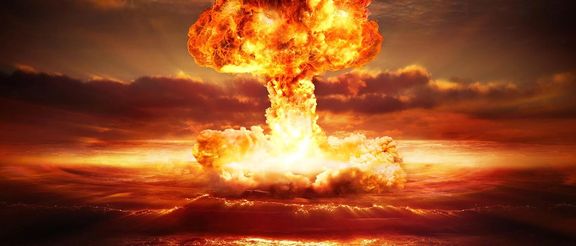
A generic depiction of a nuclear blast

An Iranian international affairs analyst says the West does not pay attention to bragging by Iranian officials about their capablity to build a nuclear bomb.

Analyst and former diplomat Ali Bigdeli said in an interview with Didban Iran [Iran Monitor] website: “Thanks to its knowledge of the requirements for bomb making, the West knows that Iran is not about to build a nuclear weapon.”

At the same time, he said such statements are simply rhetoric and they do not reflect Iran’s political position. The latest comments about Iran’s capabilities came from nuclear chief Mohammad Eslami and lawmaker Mohammad Reza Sabbaghian who said on Monday that “If the West’s outrageous behavior continues, we will ask the Supreme Leader to reverse his ban on making nuclear bombs.”

Bigdeli said that such comments are attempts that could be defined as sabre rattling by Iranian officials with the aim of getting concessions in nuclear talks. But the West does not react to those comments despite the excitement created by the media. He said those comments are not likely to change the West’s view about the negotiations.

Bigdeli also opined, however, that the Israel's provocative remarks about an attack on Iranian nuclear facilities should be taken seriously although such an attack would be foolish. Israelis cannot do anything against Iran without US support he argued and added that Washington would not welcome a war in the region while there is a war in Ukraine. So, Israel is bluffing.

The analyst went on to say Iran’s biggest problem is that its chief negotiator Ali Basgheri-Kani is not flexible and knowledgeable enough in his role.

Iranian analyst and former diploma Ali Bigdeli
100%
Iranian analyst and former diploma Ali Bigdeli

Meanwhile, in a commentary published on Monday, conservative Nameh News website suggested that Iran should not miss the new opportunity for reaching an agreement with the United States based on the proposal made by EU Foreign Policy Chief Josep Borrell.

The website wrote that although most Iranian conservative media are adamant that Tehran should insist on it maximal demands, this could be a risky approach if it is not combined with intelligent efforts by the negotiators.

The commentary expressed optimism that the upcoming meeting between Bagheri and his EU counterpart Enrique Mora in Vienna can pave the way for the revival of the JCPOA.

Nameh News at the same time pointed out that some Iranian conservative media have opined that if Iran can expand its ties with Russia, China, Venezuela, Iraq and India, then it will no longer need to sit at the negotiating table with the United States. The daily concluded that the clock is ticking in Iran’s favor.

This comes while many politicians and analysts believe Iran is in a dire economic situation and badly needs a rapprochement with the United States as a requirement for lifting the sanctions and improving the economy.

On Monday, Iranian lawmaker Ghasemfar Saedi said in an interview with Rouydad24 news website that Iranians are losing their patience and government officials need to take the realities of the society into account while making decisions.

Saedi also called on government spokesman Ali Bahadori to apologize for saying that Iranians are very patient vis-a-vis economic problems.

“On the contrary, the people’s patience is wearing seriously thin in this regard,” said the lawmaker. He added that the Raisi administration should come to its senses before it is too late and begin to control the markets as the people are really worried about their livelihood.

“The government’s performance has led to a decline in people’s trust in the government and their hope in the future.”


Most Viewed

US blockade enters murky phase as tankers spoof signals and buyers hesitate
1
ANALYSIS

US blockade enters murky phase as tankers spoof signals and buyers hesitate

2

US tightens financial squeeze on Iran, warns banks over oil money flows

3
INSIGHT

Ideology may be fading in Iran, but not in Kashmir's ‘Mini Iran'

4
INSIGHT

Hardliners push Hormuz ‘red line’ as US blockade tests Iran’s leverage

5
VOICES FROM IRAN

Hope and anger in Iran as fragile ceasefire persists

Banner
Banner

Spotlight

  • Hardliners push Hormuz ‘red line’ as US blockade tests Iran’s leverage
    INSIGHT

    Hardliners push Hormuz ‘red line’ as US blockade tests Iran’s leverage

  • Ideology may be fading in Iran, but not in Kashmir's ‘Mini Iran'
    INSIGHT

    Ideology may be fading in Iran, but not in Kashmir's ‘Mini Iran'

  • War damage amounts to $3,000 per Iranian, with blockade set to add to losses
    INSIGHT

    War damage amounts to $3,000 per Iranian, with blockade set to add to losses

  • Why the $100 billion Hormuz toll revenue is a myth
    ANALYSIS

    Why the $100 billion Hormuz toll revenue is a myth

  • US blockade targets Iran oil boom amid regional disruption
    ANALYSIS

    US blockade targets Iran oil boom amid regional disruption

  • Iran's digital economy battered by prolonged blackout
    INSIGHT

    Iran's digital economy battered by prolonged blackout

•
•
•

More Stories

Iran Nuclear Talks To Resume In Vienna Thursday

Aug 3, 2022, 15:02 GMT+1

The senior European official chairing Iran nuclear talks in Vienna tweeted Wednesday he was heading to the Austrian capital to resume discussions.

“On my way to Vienna to discuss JCPOA back to full implementation on the basis of the coordinator’s text tabled on 20 July,” Enrique Mora tweeted. Axios website cited a US official confirming the US and Iran would “resume indirect talks” Thursday.

The European foreign policy chief Joseph Borrell has circulated written proposals for concluding year-long Vienna talks between Iran and world powers, paused in March, aimed at restoring the 2015 Iran nuclear agreement, the JCPOA (Joint Comprehensive Plan of Action). Neither these talks, nor a bilateral round in Qatar in June, bridged differences between Iran and the United States.

Mora’s tweet did not explain whether resumed Vienna talks would involve all earlier participants – China, France, Germany, Russia, and the United Kingdom, as well as Iran and the US. All have ambassadors to United Nations bodies in Vienna who cover the International Atomic Energy Agency. In neither the Vienna nor Qatar negotiations did American and Iranian officials meet, with contacts mediated largely by European officials.

“We are headed back to Vienna with low expectations but are going to make a good faith effort,” the US official told Axios. President Joe Biden, who faces domestic criticism over his approach to Iran, has recently tightened sanctions, while Borrell in a Financial Times article July 26 suggested his new text offered “the best possible deal” and that “decisions need to be taken now.”

Iran Says ‘No Reason’ To Accept Any JCPOA Limits

Aug 3, 2022, 11:46 GMT+1
•
Iran International Newsroom

Tehran will not “shy away from any action aimed at removing sanctions” and has “no reason” to abide by the 2015 nuclear deal, its atomic chief said Wednesday.

Mohammad Eslami, head of the Atomic Energy Organization of Iran, told a cabinet meeting that June’s removal of some cameras of the International Atomic Energy Agency was in line with the parliament decision, taken in December 2020 , to reduce agency monitoring to that required by the Nuclear Non-Proliferation Treaty (NPT) rather than the extensive monitoring required under the 2015 nuclear deal, the JCPOA (Joint Comprehensive Plan of Action).

“When the other side is not in JCPOA, we have no reason to abide by a quasi-obsolete commitment,” Eslami said. “The cameras will not go back until they return to JCPOA and stop making false accusations.”

The United States – which left the JCPOA in 2018, imposing ‘maximum pressure’ sanctions – and three European states successfully moved a resolution at the IAEA board in June censuring Iran over what the agency regards as unsatisfactory explanations of pre-2003 nuclear work.

Eslami stressed that following legislation passed in December 2020, Iran had begun using “advanced centrifuges,” devices used for uranium enrichment barred under the JCPOA. “We will not shy away from any action aimed at removing sanctions,” Eslami said.

Agency informed on nuclear expansion

During a press briefing in New York Tuesday evening, Rafael Mariano Grossi, the IAEA director-general, was asked by Iran International’s Maryam Rahmati about Eslami’s statement earlier Tuesday that Iran was preparing new centrifuges, including relatively advanced IR-6s.

Grossi confirmed Iran had briefed the IAEA. “Our inspectors are mobilized and they are going to be looking into this when this happens,” he said. “Not all of them have been prepared – just part of them – and we are going to be informing the Board of Governors soon about this.”

Grossi reiterated that the agency’s “visibility” had been “significantly reduced” by Iran’s decision in June to remove 27 cameras in “certain facilities.” He expressed particular concern over the agency’s lack of knowledge of Iran’s manufacturing activities – where access is not required under the JCPOA. “We will have to come to terms with Iran to account for them when, if and when, they agree on reviving the JCPOA,” Grossi said.

Knowledge of the amount and kinds of centrifuges manufactured, even if not in use, is seen by the agency as important part in assessing the nuclear program, particularly with Iran enriching to 60 percent, close to 90 percent ‘weapons grade’ and far above the 3.67 percent JCPOA limit.

IRGC designation

In Washington Tuesday, John Kirby, the National Security Council Coordinator for Strategic Communications, in a press briefing largely about the US drone strike killing Ayman al-Zawahiri, the al-Qaeda leader, in Afghanistan, reiterated President Joe Biden’s commitment not to lift the US Foreign Terrorist Organization’ (FTO) designation of Iran’s Revolutionary Guards (IRGC) as part of negotiations to restore the JCPOA.

Eslami said at the cabinet meeting that the designation had “not been the main issue in the talks.” Disagreements between Iran and the US over JCPOA restoration – both in year-long talks in Vienna paused in March, and in the June round in Qatar – have centered on which US sanctions violate the 2015 agreement. Tehran argues that the administration of President Donald Trump introduced sanctions under various rubrics, including the IRGC designation. as part of its ‘maximum pressure.’

Iran’s Nuclear Program Moving Ahead Very Fast – IAEA

Aug 2, 2022, 21:56 GMT+1

IAEA Director General Rafael Mariano Grossi says that “good words” from the Islamic Republic are not enough to satisfy international inspectors

Grossi expressed hope on Tuesday that Tehran is ready to be transparent about its nuclear program, which was “moving ahead very, very fast”.

When asked about the IAEA's role in monitoring any revival of Iran's 2015 nuclear deal with world powers under which it curbed its nuclear program in return for economic sanctions relief, he said Iran must grant IAEA inspectors access “commensurate to the size” of its uranium enrichment program if the agency is to credibly assure that it is peaceful.

“When it comes to nuclear, good words will not do it. What you need to do is to be transparent and compliant and work with us. We are ready and I hope they will be as well,” Grossi told reporters at the United Nations.

“They have a very ambitious nuclear program that needs to be verified in the appropriate way. The program is moving ahead very, very fast and not only ahead, but sideways as well, because it's growing in ambition and in capacity.”

Iran's nuclear chief Mohammad Eslami told reporters in Tehran on Mondaythat Iran is technically capable of building a nuclear bomb; a statement that has been made before by at least two other Iranian officials and has been generally taken as a defiant signal from Tehran. President Ebrahim Raisi also reiterated last week that the people of Iran have told him they want to resist rather than sign an agreement with the United States.

Resuscitating Iran’s Nuclear Deal Is Fool’s Errand – Senior US Senator

Aug 2, 2022, 15:36 GMT+1

A senior US Republican senator says the insistence by the European Union and President Joe Biden on rejoining Iran’s nuclear deal – or the JCPOA – is a fool’s errand. 

Senate Foreign Relations Committee Ranking Member Jim Risch (R-Idaho) made the remarks in a tweet on Monday, criticizing the proponents of restoring the nuclear agreement despite everything the Islamic Republic is doing. 

“From assassination plots of former US officials, attacks on Americans, to disabling IAEA (International Atomic Energy Agency) monitors and continued support for regional terrorism... it’s time to walk away from a bad deal with Iran,” he said. 

Recently, media with links to Iran’s Revolutionary Guard have suggested that Iran may build nuclear warheads “in the shortest possible time” if attacked by the US or Israel. Iran has now enriched enough uranium to 60 percent that if further enriched to 90 percent, the fissile material will be sufficient for a nuclear bomb within a few weeks.

Some Iranian officials have suggested that Iran is a nuclear threshold state but does not want or need a nuclear weapon and is only enriching uranium for energy and other civilian uses. They often add that Iran's Supreme Leader has declared that the production, stockpiling and use of nuclear weapons are all forbidden under Islam (haram), in a fatwa, or religious edict, first revealed in a statement from Iran to the IAEA in Vienna in August 2005.

On Tuesday, Iranian lawmaker Mohammad-Reza Sabbaghian Bafghi said, "We will ask the Supreme Leader to change his fatwa and strategy on the prohibition of producing nuclear weapons if the enemies of the Islamic Republic continue their threats.”

Feeding Hundreds Of New Centrifuges Response To US Sanctions – Iran FM

Aug 2, 2022, 13:52 GMT+1

Iran’s foreign minister says Tehran’s move to feed fuel into “hundreds” more centrifuges to enrich uranium was a response to new US sanctions on entities supporting oil and petrochemical trade. 

Hossein Amir-Abdollahian said on Tuesday that “In response to the new US sanctions, we started pumping gas into hundreds of new generation centrifuges. We acted based on the decision made. The Americans shouldn’t think they can get concessions from Iran at the negotiating table with these measures.”

He described it as startling that the US proposed a resolution in the International Atomic Energy Agency while “we repeatedly received goodwill messages from US President Joe Biden through mediators.” 

On Monday, August 1, the US Treasury sanctioned several companies it said were involved in the sale of Iranian petroleum and petrochemicals.

Announcing Tehran’s latest steps beyond the limits of the 2015 Iran nuclear deal, the JCPOA (Joint Comprehensive Plan of Action), Behrouz Kamalvandi, spokesman for the Atomic Energy Organization of Iran, said on Monday that Iran has started pumping uranium gas into hundreds of IR-1s & IR-6 centrifuges as part of its plan to reach uranium enrichment capacity of at least 190,000 SWU (separative work units), a measurement of efficiency in enrichment. Under the JCPOA Iran was allowed only 6,104 SWU and no IR-6s.

Amir-Abdollahian added that Tehran is reviewing the recent proposals by the European Union to take forward talks over renewing the 2015 Iran nuclear deal. The US State Department spokesman has said Washington also is reviewing proposals made by Joseph Borrell, the European Union foreign policy chief.





