• العربية
  • فارسی
Brand
  • Iran Insight
  • Politics
  • Economy
  • Analysis
  • Special Report
  • Opinion
  • Podcast
  • Iran Insight
  • Politics
  • Economy
  • Analysis
  • Special Report
  • Opinion
  • Podcast
  • Theme
  • Language
    • العربية
    • فارسی
  • Iran Insight
  • Politics
  • Economy
  • Analysis
  • Special Report
  • Opinion
  • Podcast
All rights reserved for Volant Media UK Limited
volant media logo

Politician Lashes Out At Iran's ‘Revolutionary’ MPs For Profiteering
Iran International Newsroom
May 28, 2022, 08:45 GMT+1Updated: 17:42 GMT+1
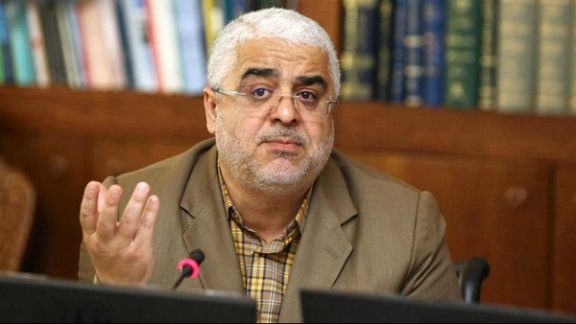
Former member of Iran's parliament, Gholasmali Jafarzadeh Imanabadi

A former lawmaker has called on the Iranian parliament to pass strict legislation banning any activity by members that could represent a conflict of interest.

Gholasmali Jafarzadeh Imanabadi, a staunch critic of Majles Speaker Mohammad Bagher Ghalibaf and his self-proclaimed “revolutionary” parliament said in an interview with moderate news website Rouydad24 that new legislations are needed to define the word “revolutionary” so that lawmakers who are not revolutionaries could be dealt with.

A few weeks ago, the representatives of university students asked Supreme Leader Ali Khamenei not to label the Majles “revolutionary” following the scandal of Ghalibaf’s family taking a controversial luxury shopping trip to Turkey in April.

In a speech during another meeting with Iranian lawmakers on Wednesday, Khamenei said that although they chanted revolutionary slogans during their election campaigns, what is important is continuing to remain a revolutionary rather than claiming to be one.

Earlier this week, an IRGC general who spoke on Iranian state television also questioned officials’ claim of being revolutionaries, charging that some 4,000 children of senior officials are living a luxurious life in other countries, mainly in the United States, Canada and Europe.

Referring to the argument of some officials saying that their children are “independent,” Imanabadi said that if there were conflict-of-interest laws, officials could no longer claim that their private life was separate from their revolutionary facade.

Iranian lawmakers during a session in January 2022
100%
Iranian lawmakers during a session in January 2022

He said that lawmakers should not try to complicate the conflict-of-interest issue, prolonging the legislative process and evading their responsibility. He referred to Khamenei’s remarks and said “we need a law to restrict their activities” in cases of conflict of interest.

“This means a lawmaker cannot use government properties for personal use. A lawmaker should not accumulate wealth in illegitimate ways. Lawmakers should not have business interests, and their close relatives cannot shop for their babies abroad, or buy houses in a foreign country,” Imanabadi said in a clear reference to Ghalibaf’s case.

During the past years many Iranian officials were said to have sent their family members abroad where they live a luxurious life at a time when people in Iran are facing a more than 40-percent inflation rate and rising poverty.

Among these officials, it was only Seyyed Morteza Saqqaian Nelda the Mayor of Qom who acknowledged that six of his children are living in the United States. As photos on social media showed them in typical Western recreational activities last year, the mayor said that his children are living abroad to propagate the ideology of the Islamic Republic.

Mehr news agency reporting about the mayor’s children in America teased the mayor by saying that he should be the mayor of Washington DC rather than the mayor of Qom.

Imanabadi further said in the interview, “The people believe officials have a good life and that they do not understand their difficult economic situation.”

He further argued that if there were laws about conflict of interest, lawmakers could no longer own big companies given to them by the state at low prices, “they could no longer take hefty loans [from government banks] to buy luxurious homes and they would know that they cannot have salaries higher than a cabinet level official, and they cannot give good jobs to their relatives or take them on luxury trips to other countries.”

Also mentioning the case of a former lawmaker, who got an extremely well-paid job at the oil ministry at the end of his four-year term, although he was previously a teacher, Imanabadi said that members of parliament are not entitled to such tailored-made jobs. He stressed: “Serving as a lawmaker is not an investment!”


Most Viewed

US blockade enters murky phase as tankers spoof signals and buyers hesitate
1
ANALYSIS

US blockade enters murky phase as tankers spoof signals and buyers hesitate

2
INSIGHT

Ideology may be fading in Iran, but not in Kashmir's ‘Mini Iran'

3
INSIGHT

Hardliners push Hormuz ‘red line’ as US blockade tests Iran’s leverage

4
VOICES FROM IRAN

Hope and anger in Iran as fragile ceasefire persists

5

US sanctions oil network tied to Iranian tycoon Shamkhani

Banner
Banner

Spotlight

  • Hardliners push Hormuz ‘red line’ as US blockade tests Iran’s leverage
    INSIGHT

    Hardliners push Hormuz ‘red line’ as US blockade tests Iran’s leverage

  • Ideology may be fading in Iran, but not in Kashmir's ‘Mini Iran'
    INSIGHT

    Ideology may be fading in Iran, but not in Kashmir's ‘Mini Iran'

  • War damage amounts to $3,000 per Iranian, with blockade set to add to losses
    INSIGHT

    War damage amounts to $3,000 per Iranian, with blockade set to add to losses

  • Why the $100 billion Hormuz toll revenue is a myth
    ANALYSIS

    Why the $100 billion Hormuz toll revenue is a myth

  • US blockade targets Iran oil boom amid regional disruption
    ANALYSIS

    US blockade targets Iran oil boom amid regional disruption

  • Iran's digital economy battered by prolonged blackout
    INSIGHT

    Iran's digital economy battered by prolonged blackout

•
•
•

More Stories

Multiple Challenges Show Disarray In Iranian Media, Politics

May 27, 2022, 08:37 GMT+1
•
Iran International Newsroom

Chaos and confusion are noticeable in Iran’s government-controlled media and among politicians in recent days, as multiple crises have converged to present unprecedented challenges.

One major factor is the Iranian government's haphazard implementation of a policy eliminating food subsidies in a bid to deal with a 50-percent budget deficit. The population pressed by years of hardship took the measure as the ultimate insult and government inability to run the country.

Protests that followed a sudden jump in food prices were dealt with using force, further alienating many people. The last incident portraying the government as corrupt and inept was the collapse of a high-rise building in Abadan that was built by a well-connected insider who ignored construction regulations and mysteriously disappeared after the incident.

Wednesday evening hundreds of Abadan resident came into streets to mourn the victims of the incident but soon began chanting anti-government slogans.

Mehr news agency, which belongs to the Islamic Propagation Organization, a seminary-affiliated office under Supreme Leader Ali Khamenei's direct supervision, pulled a controversial commentary on Thursday, May 26, that said eliminating subsidies, rising prices and "the dissemination of news about widespread corruption even among the Leader's inner circle" have prompted even family members of military and security forces to stand against the government.

Mehr pulled the story after several social media users including prominent journalists such as Reza Haghighatnejad wrote about it in a series of tweets. For a few hours, although the story was pulled, readers could still find it by using search engines and keywords from social media posts. But finally, Mehr, changed the story in a way that all links to the commentary directed readers to an irrelevant story about the availability of wheat.

The commentary said that "the poorly planned and hastily implemented policy of changing the subsidy system has even brought the miliary and police forces among the ranks of dissidents."

The commentary added that "The pilot plan for distribution of subsidized bread has failed because of lack of preparedness and technical capability on the part of the government." The commentary added that "This comes while, the subsidy, which was allocated to bakers has not reached them. At the same time, some officials are demanding that the decision should be reversed."

Mehr added that "Initial estimates indicated the new policy might lead to a 20-60 percent rise in bread prices, but in practice, the price of bread and other goods rose four to six-fold. Some items are even being sold at ten times of their previous price."

The commentary concluded that as a result of the rise in dissent, the regime is getting closer to the abyss on a daily basis." The commentary further suggested that those who have been ruling for more than thirty years should leave the government to others.”

In the Iranian political jargon, any reference to 40 years means from the start of the Islamic revolution in 1979, but references to 30 years, indicate that the author is talking about Khamenei's role as Supreme leader. So, the commentary could be taken as opposition to Khamenei's rule in the circle of Seminarians.

Later on Thursday, Mehr finally acknowledged that the story was on its website and was pulled later, because its website was “hacked by counter-revolutionaries.”

Iran Speaker Wins Re-Election As Khamenei Calls For Less Infighting

May 26, 2022, 10:52 GMT+1
•
Iran International Newsroom

In one of the most lackluster elections in Iran's parliament (Majles), Mohammad Bagher Ghalibaf was re-elected as the speaker of parliament for the third time.

While he was elected twice with 230 votes out of 290 in the previous two years, he won the speakership with only 193 votes on Wednesday.

The highest number of votes ever won by a parliament (Majles) speaker in annual elections was 237 votes cast for former speaker Ali Larijani in 2016 and the lowest number was 140 votes cast in favor of Akbar Hashemi Rafsanjani in the second year of the first round of the parliament in Iran in 1980.

Many Iranian lawmakers and political observers had said during the past week that despite a scandal about Ghalibaf family’s luxury shopping trip to Turkey in April and his involvement in a major financial corruption case, he was poised to get re-elected. Several politicians had opined that the fate of this year's election was going to be determined outside the Majles, meaning at Supreme Leader Ali Khamenei's office.

Other members of the Majles presidium were also re-elected in their posts although there was very little information in Tehran media about the tally of the votes. Most posts in the presidium, including those of the two vice speakers went to the ultraconservative Paydari party. The combination could indicate that Paydari knew Ghalibaf was the predetermined speaker, so it settled for keeping what they already had as their share of power.

Nonetheless, the decline in support for Ghalibaf by around 40 votes is a bad sign for him that could indicate he would be in trouble at critical times to garner support for key bills, unless Khamenei signals his preference to lawmakers as he did many times including in the case of a motion to impeach President Raisi's cabinet ministers. The Majles listened to Khamenei and shelved the impeachment motion.

Following the election, members of the Majles rushed to a meeting with Khamenei, officially announced as an event on the liberation of Khorramshahr in 1982 during the 8-year war with Iraq.

Khamenei said during the meeting that many criticized him for calling the Majles a "revolutionary parliament." However, he insisted that he still believes that the lawmakers are "young revolutionaries." He had characterized parliament members the same way a few weeks ago when during a meeting with university students, a student representative said current lawmakers were not revolutionaries and their luxury lifestyle undermined their revolutionary credentials.

Ironically, Khamenei was calling lawmakers revolutionary when the public, several lawmakers, and even the strictly controlled Iranian media were discussing Ghalibaf family's shopping scandal.

Khamenei, clearly feeling the mood in the country amid economic crisis tried to defend his ‘revolutionary’ agenda. "The slogans of the Revolution are beneficial to the country, despite what some profess that the Islamic Revolution creates problems for Iran. No, it is the other way around. The Revolution and paying attention to these ideals are cures for the country’s sufferings."

Also, perhaps sensing tension in the air, Khamenei cautioned the lawmakers to avoid attacking each other and stressed that the Majles should be different from social media where anyone might say anything.

Khamenei said elsewhere in his speech that managing the affairs of the state has become increasingly complicated as hostile rivalry between nuclear powers, military moves in Europe where wars arise, new contagious diseases, threats of food shortages—such conditions in the world affect the fate of nations." He advised that under the circumstances, "the country's managers should know what great tasks await them."

Iran’s Vice President Says Another Difficult Year Ahead For Economy

May 25, 2022, 15:35 GMT+1

Vice President for Economic Affairs Mohsen Rezaei says Iran is facing yet another difficult year, as recent price hikes led to several days of protests.

During a visit to Khuzestan Province on Monday, he also said that Iran has been experiencing a 40 percent inflation rate for several years now.

Rezaei argued that the people should be convinced the government has an economic plan and is trying to solve their problems. His remarks contradicted many Iranian analysts and politicians including several lawmakers who have charged that the Raisi administration does not have an economic plan and it is his economic team's ad-hoc decisions that have led to an economic crisis.

Rezaei told Friday prayers imams of Khuzestan that the government is trying to gradually reform the economy and that President Ebrahim Raisi has asked several think tanks to write a document about “this evolution.” He further claimed that in the past 26 years Supreme Leader Ali Khamenei has repeatedly called on successive governments to start economic reforms, but nothing has been done.

Rezaei, a military man with no experience in running the economy, made uncalculated comments a few months ago, which led to an unofficial ban on him to declare economic policies. His comments on Monday coincided with president Raisi being absent, on a visit to Oman.

Mohesen Rezaei meeting with officials in Abadan to discuss rescue efforts. May 24, 2022
100%
Mohesen Rezaei meeting with officials in Abadan to discuss rescue efforts. May 24, 2022

The vice president was last seen Tuesday morning sitting on the floor of a building in Abadan with Interior minister Ahmad Vahidiand a group of local officials, reportedly leading a meeting about relief work following the collapse of a high rise building which killed 16 people, and tens of others injured or gone missing.

Saeed Hafezi, a local reporter, told the Iran International TV Tuesday afternoon that the owner of the collapsed Building Hossein Abdolbaghi was linked to Mohsen Rezaei, adding that while Abdolbaghi was reportedly arrested, it was said after Rezaei's arrival in Abadan that he was killed under the debris.

Meanwhile, commenting on Rezaei's remarks on the Iranian economy during the year, Reza Gheidi, an economic journalist in Tehran told Iran International TV that Iranians no longer believe or trust remarks or promises by state officials, mainly because they constantly contradict themselves.

Gheidi added that the situation is marked by the people's disillusionment and disappointment about state officials' ability to deal with the economic crisis. Iranians are currently thinking of food not as something that can keep them healthy, but as something that can simply fill their stomach, as prices have doubled and tripled in recent weeks.

Meanwhile, Ahmad Alirezabeigi, a lawmaker for Tabriz has harshly criticized state officials "for insulting Iranians' intelligence when talking about the economy and the causes of protests from 2018 to 2022."

The lawmaker said that the people are feeling the pressure of rising prices with their flesh and bones as the impact of the government's policy of removing food subsidies has given rise to further inflation. He characterized state officials’ promises about no further price rises as "nonsense."

While the government insists that it has hiked the price of a few food items, another lawmaker, Hassan Lotfi, said on 21 May that price rises have already impacted a range of some 700 household items.

Authorities Accused Of Cover Up In Deadly Building Collapse In Iran

May 25, 2022, 01:47 GMT+1
•
Maryam Sinaiee

A journalist in Iran has accused authorities of covering up the escape of the owner of a building that collapsed in Abadan Monday, and claiming that he is dead.

The Iranian Red Crescent has reported eleven deaths and warned about the collapse of the rest of the building. So far 39 have been pulled from the rubble alive. Rescue operations cintinued Tuesday as there were as many as 50 people buried under the rubble. Three rescue workers were injured on Tuesday when another part of the building collapsed.

Saeed Hafezi, a journalist and whistle-blower, claims that Hossein Abdolbaghi, owner of one of the ten-story Metropol twin towers which collapsed Monday, was seen leaving the building half an hour before it collapsed, and authorities are lying about his death in the accident. Hafezi says he has personally spoken to a witness.

Radio Goosheh Kenar, a local internet radio station run by Hafezi, on Tuesday published an audio file sent by a man claiming to be an employee of the Abadan coroner’s office who claims officials of the coroner’s office were pressured by unidentified authorities to issue a death certificate in Abdolbaghi’s name for an unidentifiable body they brought in. The man whose voice was altered in the recording says the coroner’s office has so far not relented to outside pressure and declined to issue a death certificate.

Abdolbaghi the well-connected owner of the building who is ither dead or alive. FILE
100%
Abdolbaghi the well-connected owner of the building who is ither dead or alive

Initially, suspicions arose right after the collapse of the building on Monday when media, including the official news agency (IRNA), reported Abdolbaghi’s arrest but on Tuesday prosecutor general of Khuzestan province, Sadegh Jafari-Chegeni, told the judiciary’s news agency, Mizan News, that he died in the incident. Abdolbaghi’s identity papers were discovered on a very badly damaged and unidentifiable body in the rubble, he said, and the body was eventually identified as belonging to him, officials claimed, without saying who made the identification.

A photo taken from CCTV footage in the area has also been circulating on social media allegedly showing Abdolbaghi running away after the incident. Dariush Memar, a journalist currently residing in London, in a tweet Monday said he had met Abdolbaghi in Iran many times and he can confirm that the man in the photo is highly likely to be him, “unless a photo of his body is shown at the coroner’s office by the justice department of Abadan.”

Abdolbaghi, 40, is a well-known entrepreneur in Khuzestan with alleged strong connections with influential officials and centers of power. In 2018 the ministry of industries, mines and trade named him as the top entrepreneur of the Arvand Free Zone in Khuzestan.

In an article published in August 2020 in Feydus, an Iranian news website, Memar accused Abdolbaghi of corruption. “His formula for amassing wealth, like many others in Iran today, is very simple: Clever management of connections and opportunities based on rente.” ‘Rente’ is a French word used in Persian to imply privileges resulting from undue influence.

He also had close connections with the police and security forces who once gave an award.

The head of Iran’s Construction Engineering Organization, Hamzeh Shakib, on Monday said adding three extra stories to the original plan built illegally had caused the tragedy of the building’s collapse. He also said the organization had several times reported critical faults in the construction of the building, including in their most recent report, but the municipality of Abadan which was responsible for stopping the construction ignored the warnings.

Authorities say they have arrested ten officials including the current mayor of Abadan and two former mayors, for negligence leading to the tragedy of the building’s collapse.

Iran General Claims 4,000 Relatives Of Top Officials Live In West

May 24, 2022, 23:59 GMT+1

General Morteza Mirian, commander of Iran’s Revolutionary Guards’ ground operations, has claimed that 4,000 relatives of “senior officials” live in the United States, Canada, and Europe.

Mirani said during a live television show Tuesday they should be “tracked” so as not to be allowed back to Iran to take up managerial positions. He drew a parallel with the 1980-88 war with Iraq, saying that no Iranian official would have allowed family members to live with Saddam Hussein, the Iraqi president, comparing him as an enemy with the West. Mirian suggested that what amounted to an exodus of these Iranians resulted from a weak commitment to revolutionary ideology.

A figure of 5,000 “descendants” of senior officials living abroad was cited in 2020 by Mohammad Gharazi, communications minister between 1985 and 1997 who was at the time considered a presidential hopeful. In November 2021, Alireza Salimi, a member of parliament, suggested that officials from the previous administration, under President Hassan Rouhani, including deputy ministers had moved to Europe due to fears they would be banned from leaving the country.

In 2019, Brian Hook, special representative for Iran (from 2018 to 2020) under President Donald Trump told Iran International that “children of Islamic Republic officials live rich and comfortable lives in the United States and other countries while Iranian people live in terrible conditions.” Hook said this showed “the regime’s hypocrisy.”