• العربية
  • فارسی
Brand
  • Iran Insight
  • Politics
  • Economy
  • Analysis
  • Special Report
  • Opinion
  • Podcast
  • Iran Insight
  • Politics
  • Economy
  • Analysis
  • Special Report
  • Opinion
  • Podcast
  • Theme
  • Language
    • العربية
    • فارسی
  • Iran Insight
  • Politics
  • Economy
  • Analysis
  • Special Report
  • Opinion
  • Podcast
All rights reserved for Volant Media UK Limited
volant media logo

Iran Speaker Wins Re-Election As Khamenei Calls For Less Infighting
Iran International Newsroom
May 26, 2022, 10:52 GMT+1Updated: 17:30 GMT+1
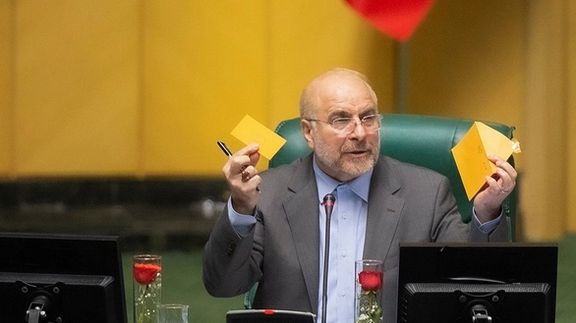
Iran's parliament speaker Ghalibaf during voting on May 25, 2022

In one of the most lackluster elections in Iran's parliament (Majles), Mohammad Bagher Ghalibaf was re-elected as the speaker of parliament for the third time.

While he was elected twice with 230 votes out of 290 in the previous two years, he won the speakership with only 193 votes on Wednesday.

The highest number of votes ever won by a parliament (Majles) speaker in annual elections was 237 votes cast for former speaker Ali Larijani in 2016 and the lowest number was 140 votes cast in favor of Akbar Hashemi Rafsanjani in the second year of the first round of the parliament in Iran in 1980.

Many Iranian lawmakers and political observers had said during the past week that despite a scandal about Ghalibaf family’s luxury shopping trip to Turkey in April and his involvement in a major financial corruption case, he was poised to get re-elected. Several politicians had opined that the fate of this year's election was going to be determined outside the Majles, meaning at Supreme Leader Ali Khamenei's office.

Other members of the Majles presidium were also re-elected in their posts although there was very little information in Tehran media about the tally of the votes. Most posts in the presidium, including those of the two vice speakers went to the ultraconservative Paydari party. The combination could indicate that Paydari knew Ghalibaf was the predetermined speaker, so it settled for keeping what they already had as their share of power.

Nonetheless, the decline in support for Ghalibaf by around 40 votes is a bad sign for him that could indicate he would be in trouble at critical times to garner support for key bills, unless Khamenei signals his preference to lawmakers as he did many times including in the case of a motion to impeach President Raisi's cabinet ministers. The Majles listened to Khamenei and shelved the impeachment motion.

Following the election, members of the Majles rushed to a meeting with Khamenei, officially announced as an event on the liberation of Khorramshahr in 1982 during the 8-year war with Iraq.

Khamenei said during the meeting that many criticized him for calling the Majles a "revolutionary parliament." However, he insisted that he still believes that the lawmakers are "young revolutionaries." He had characterized parliament members the same way a few weeks ago when during a meeting with university students, a student representative said current lawmakers were not revolutionaries and their luxury lifestyle undermined their revolutionary credentials.

Ironically, Khamenei was calling lawmakers revolutionary when the public, several lawmakers, and even the strictly controlled Iranian media were discussing Ghalibaf family's shopping scandal.

Khamenei, clearly feeling the mood in the country amid economic crisis tried to defend his ‘revolutionary’ agenda. "The slogans of the Revolution are beneficial to the country, despite what some profess that the Islamic Revolution creates problems for Iran. No, it is the other way around. The Revolution and paying attention to these ideals are cures for the country’s sufferings."

Also, perhaps sensing tension in the air, Khamenei cautioned the lawmakers to avoid attacking each other and stressed that the Majles should be different from social media where anyone might say anything.

Khamenei said elsewhere in his speech that managing the affairs of the state has become increasingly complicated as hostile rivalry between nuclear powers, military moves in Europe where wars arise, new contagious diseases, threats of food shortages—such conditions in the world affect the fate of nations." He advised that under the circumstances, "the country's managers should know what great tasks await them."


Most Viewed

State media slam Araghchi's Hormuz tweet, say it let Trump claim victory
1

State media slam Araghchi's Hormuz tweet, say it let Trump claim victory

2

Iran International says it won’t be silenced after London arson attack

3
INSIGHT

How Tehran bends its own red lines to boost state rallies

4
OPINION

The Hormuz get out of jail card turned to a grave

5

Iran halts petrochemical exports to supply domestic market

Banner
Banner

Spotlight

  • Too early to tell who is winning Iran war, experts say
    PODCAST

    Too early to tell who is winning Iran war, experts say

  • How Tehran bends its own red lines to boost state rallies
    INSIGHT

    How Tehran bends its own red lines to boost state rallies

  • Iran blackout cripples freelancer, small business incomes
    VOICES FROM IRAN

    Iran blackout cripples freelancer, small business incomes

  • Ideology may be fading in Iran, but not in Kashmir's ‘Mini Iran'
    INSIGHT

    Ideology may be fading in Iran, but not in Kashmir's ‘Mini Iran'

  • US blockade enters murky phase as tankers spoof signals and buyers hesitate
    ANALYSIS

    US blockade enters murky phase as tankers spoof signals and buyers hesitate

  • Why the $100 billion Hormuz toll revenue is a myth
    ANALYSIS

    Why the $100 billion Hormuz toll revenue is a myth

•
•
•

More Stories

Iran’s Vice President Says Another Difficult Year Ahead For Economy

May 25, 2022, 15:35 GMT+1

Vice President for Economic Affairs Mohsen Rezaei says Iran is facing yet another difficult year, as recent price hikes led to several days of protests.

During a visit to Khuzestan Province on Monday, he also said that Iran has been experiencing a 40 percent inflation rate for several years now.

Rezaei argued that the people should be convinced the government has an economic plan and is trying to solve their problems. His remarks contradicted many Iranian analysts and politicians including several lawmakers who have charged that the Raisi administration does not have an economic plan and it is his economic team's ad-hoc decisions that have led to an economic crisis.

Rezaei told Friday prayers imams of Khuzestan that the government is trying to gradually reform the economy and that President Ebrahim Raisi has asked several think tanks to write a document about “this evolution.” He further claimed that in the past 26 years Supreme Leader Ali Khamenei has repeatedly called on successive governments to start economic reforms, but nothing has been done.

Rezaei, a military man with no experience in running the economy, made uncalculated comments a few months ago, which led to an unofficial ban on him to declare economic policies. His comments on Monday coincided with president Raisi being absent, on a visit to Oman.

Mohesen Rezaei meeting with officials in Abadan to discuss rescue efforts. May 24, 2022
100%
Mohesen Rezaei meeting with officials in Abadan to discuss rescue efforts. May 24, 2022

The vice president was last seen Tuesday morning sitting on the floor of a building in Abadan with Interior minister Ahmad Vahidiand a group of local officials, reportedly leading a meeting about relief work following the collapse of a high rise building which killed 16 people, and tens of others injured or gone missing.

Saeed Hafezi, a local reporter, told the Iran International TV Tuesday afternoon that the owner of the collapsed Building Hossein Abdolbaghi was linked to Mohsen Rezaei, adding that while Abdolbaghi was reportedly arrested, it was said after Rezaei's arrival in Abadan that he was killed under the debris.

Meanwhile, commenting on Rezaei's remarks on the Iranian economy during the year, Reza Gheidi, an economic journalist in Tehran told Iran International TV that Iranians no longer believe or trust remarks or promises by state officials, mainly because they constantly contradict themselves.

Gheidi added that the situation is marked by the people's disillusionment and disappointment about state officials' ability to deal with the economic crisis. Iranians are currently thinking of food not as something that can keep them healthy, but as something that can simply fill their stomach, as prices have doubled and tripled in recent weeks.

Meanwhile, Ahmad Alirezabeigi, a lawmaker for Tabriz has harshly criticized state officials "for insulting Iranians' intelligence when talking about the economy and the causes of protests from 2018 to 2022."

The lawmaker said that the people are feeling the pressure of rising prices with their flesh and bones as the impact of the government's policy of removing food subsidies has given rise to further inflation. He characterized state officials’ promises about no further price rises as "nonsense."

While the government insists that it has hiked the price of a few food items, another lawmaker, Hassan Lotfi, said on 21 May that price rises have already impacted a range of some 700 household items.

Authorities Accused Of Cover Up In Deadly Building Collapse In Iran

May 25, 2022, 01:47 GMT+1
•
Maryam Sinaiee

A journalist in Iran has accused authorities of covering up the escape of the owner of a building that collapsed in Abadan Monday, and claiming that he is dead.

The Iranian Red Crescent has reported eleven deaths and warned about the collapse of the rest of the building. So far 39 have been pulled from the rubble alive. Rescue operations cintinued Tuesday as there were as many as 50 people buried under the rubble. Three rescue workers were injured on Tuesday when another part of the building collapsed.

Saeed Hafezi, a journalist and whistle-blower, claims that Hossein Abdolbaghi, owner of one of the ten-story Metropol twin towers which collapsed Monday, was seen leaving the building half an hour before it collapsed, and authorities are lying about his death in the accident. Hafezi says he has personally spoken to a witness.

Radio Goosheh Kenar, a local internet radio station run by Hafezi, on Tuesday published an audio file sent by a man claiming to be an employee of the Abadan coroner’s office who claims officials of the coroner’s office were pressured by unidentified authorities to issue a death certificate in Abdolbaghi’s name for an unidentifiable body they brought in. The man whose voice was altered in the recording says the coroner’s office has so far not relented to outside pressure and declined to issue a death certificate.

Abdolbaghi the well-connected owner of the building who is ither dead or alive. FILE
100%
Abdolbaghi the well-connected owner of the building who is ither dead or alive

Initially, suspicions arose right after the collapse of the building on Monday when media, including the official news agency (IRNA), reported Abdolbaghi’s arrest but on Tuesday prosecutor general of Khuzestan province, Sadegh Jafari-Chegeni, told the judiciary’s news agency, Mizan News, that he died in the incident. Abdolbaghi’s identity papers were discovered on a very badly damaged and unidentifiable body in the rubble, he said, and the body was eventually identified as belonging to him, officials claimed, without saying who made the identification.

A photo taken from CCTV footage in the area has also been circulating on social media allegedly showing Abdolbaghi running away after the incident. Dariush Memar, a journalist currently residing in London, in a tweet Monday said he had met Abdolbaghi in Iran many times and he can confirm that the man in the photo is highly likely to be him, “unless a photo of his body is shown at the coroner’s office by the justice department of Abadan.”

Abdolbaghi, 40, is a well-known entrepreneur in Khuzestan with alleged strong connections with influential officials and centers of power. In 2018 the ministry of industries, mines and trade named him as the top entrepreneur of the Arvand Free Zone in Khuzestan.

In an article published in August 2020 in Feydus, an Iranian news website, Memar accused Abdolbaghi of corruption. “His formula for amassing wealth, like many others in Iran today, is very simple: Clever management of connections and opportunities based on rente.” ‘Rente’ is a French word used in Persian to imply privileges resulting from undue influence.

He also had close connections with the police and security forces who once gave an award.

The head of Iran’s Construction Engineering Organization, Hamzeh Shakib, on Monday said adding three extra stories to the original plan built illegally had caused the tragedy of the building’s collapse. He also said the organization had several times reported critical faults in the construction of the building, including in their most recent report, but the municipality of Abadan which was responsible for stopping the construction ignored the warnings.

Authorities say they have arrested ten officials including the current mayor of Abadan and two former mayors, for negligence leading to the tragedy of the building’s collapse.

Iran General Claims 4,000 Relatives Of Top Officials Live In West

May 24, 2022, 23:59 GMT+1

General Morteza Mirian, commander of Iran’s Revolutionary Guards’ ground operations, has claimed that 4,000 relatives of “senior officials” live in the United States, Canada, and Europe.

Mirani said during a live television show Tuesday they should be “tracked” so as not to be allowed back to Iran to take up managerial positions. He drew a parallel with the 1980-88 war with Iraq, saying that no Iranian official would have allowed family members to live with Saddam Hussein, the Iraqi president, comparing him as an enemy with the West. Mirian suggested that what amounted to an exodus of these Iranians resulted from a weak commitment to revolutionary ideology.

A figure of 5,000 “descendants” of senior officials living abroad was cited in 2020 by Mohammad Gharazi, communications minister between 1985 and 1997 who was at the time considered a presidential hopeful. In November 2021, Alireza Salimi, a member of parliament, suggested that officials from the previous administration, under President Hassan Rouhani, including deputy ministers had moved to Europe due to fears they would be banned from leaving the country.

In 2019, Brian Hook, special representative for Iran (from 2018 to 2020) under President Donald Trump told Iran International that “children of Islamic Republic officials live rich and comfortable lives in the United States and other countries while Iranian people live in terrible conditions.” Hook said this showed “the regime’s hypocrisy.”

Can Iran Survive Yet Another 'Economic Surgery', Media Ask

May 23, 2022, 01:53 GMT+1
•
Iran International Newsroom

Iranian president Ebrahim Raisi's painful 'economic surgery' would not have been possible without the full support of the hardliner parliament, the media say.

Unlike all previous conservative dominated parliaments which obstructed plans by successive presidents to change the system of subsidizing essential commodities, the current ultraconservative parliament helped the Raisi government to do away with the heavy subsidies.

Moderate conservative Khabar Online website quoted economists in a new report published on Sunday, that without this support, Raisi would have faced the same obstacles as former Presidents Mohammad Khatami, Mahmoud Ahmadinejad and Hassan Rouhani.

The website argued that President Akbar Hashemi Rafsanjani (1988-1997) had managed to further his post-war reconstruction plans thanks to the people and the parliament's support, but he did not eradicate the subsidy system.

In fact, none of Iran’s post-war presidents were able to reduce the government’s role in the economy and stop cash handouts and subsidies, which in a way are part of the same state-centric economic model.

Khabar Online however argued that pragmatic President Hassan Rouhani (2013-2021) managed to further the nuclear talks with the West in his first term (2013-2017) thanks to the people's support.

However, the website did not mention that the talks could have not been furthered without the support of Supreme Leader Ali Khamenei and help by former parliament (Majles) Speaker Ali Larijani who had the nuclear agreement famously ratified within 20 minutes.

The Rouhani administration also tried to deal with the issue of state subsidies and its first step was to increase fuel prices, which led to Iran’s biggest anti-government protests in November 2019 during which security forces reportedly killed some 1,500 protesters.

This stopped any attempt to overhaul the subsidies until 2022, when the Raisi administration called on the ultraconservative-dominated parliament to allow a deep change. The surgery proved to be so painful that thousands of Iranians took to the streets in protest to rising prices and the administration banned using the term "economic surgery" by the media.

While anecdotal reports indicate that Raisi's recent remarks about imminent "tough decisions" are about the next step to further fuel prices hikes, reformist Sharq newspaper warned in an article by lawyer Siamak Qajar Qiunlu that this might not be the last surgery aimed at correcting Iran's ailing economy. The article quoted former conservative Majles Speaker Gholam Ali Haddad Adel as saying that "No patient should be annoyed by tough surgeries because without them the patient will not be cured."

Qiunlu called Haddad's remarks an attempt at "justification" and asked: "What will remain of a patient who has been undergoing surgical operations by domestic and foreign surgeons for years?"

He then went on to argue that Iran’s confrontation with the West and the ensuing years of sanctions were also “surgeries” that ruined the lives of countless Iranians.

Sharq asked in a metaphorical style: "Will this latest operation cure Iran's ailing economy?" The paper added that Iran's history is full of stories about such surgical operations and the process appears to be endless. "But can we ask why we have fallen ill? What has caused the illness? Can anyone explain why the latest attempts to cure the patient had worsened his condition? And what is to be done if the patient can no longer take it and knows that another operation will kill him?"

Iran Exempts Armed Forces, Intel Ministry, Nuclear Organization From Transparency

May 22, 2022, 14:16 GMT+1

The Iranian parliament has exempted the Armed Forces, the Intelligence Ministry and the nuclear organization from a plan aimed at augmenting transparency of the executive, legislative and judicial branches of the government. 

According to IRNA on Sunday, the National Security Council as well as the provincial and city security councils are also excluded from the plan that is expected to obligate members of parliament and state officials to make their votes and decisions available to the public. The details of the negotiations in various parliamentary committees will also be available to the public.

The parliament also makes the publication of final rulings of the general and revolutionary courts conditional upon "observance of security standards".

Moreover, the Guardian Council and the Assembly of Experts are not included in the plan in the first place. 

However, according to the bill, all private institutions in charge of public services, including Iran Central Bar Association, Medical Council of the Islamic Republic, and Justice Experts' Association, as well as non-governmental organizations and charities will be included in the transparency plan and will be fined for non-compliance.

The measure also makes it mandatory for the entities as well as municipalities of cities with over one million population to register and regularly update data about their financial statements, budgetary performance, project investments, and number of employees.

According to the annual ranking of countries released by Transparency International earlier this year, Iran ranks 150 out of 180 countries in the 2021 Corruption Perceptions Index.





