• العربية
  • فارسی
Brand
  • Iran Insight
  • Politics
  • Economy
  • Analysis
  • Special Report
  • Opinion
  • Podcast
  • Iran Insight
  • Politics
  • Economy
  • Analysis
  • Special Report
  • Opinion
  • Podcast
  • Theme
  • Language
    • العربية
    • فارسی
  • Iran Insight
  • Politics
  • Economy
  • Analysis
  • Special Report
  • Opinion
  • Podcast
All rights reserved for Volant Media UK Limited
volant media logo

Iran’s Vice President Says Another Difficult Year Ahead For Economy
May 25, 2022, 15:35 GMT+1
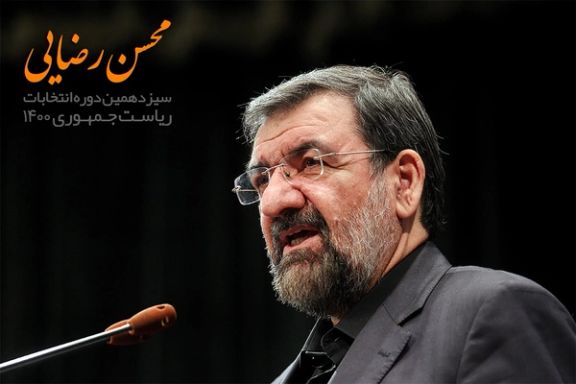
Mohsen Rezaei's campaign poster in June 2021 presidential election

Vice President for Economic Affairs Mohsen Rezaei says Iran is facing yet another difficult year, as recent price hikes led to several days of protests.

During a visit to Khuzestan Province on Monday, he also said that Iran has been experiencing a 40 percent inflation rate for several years now.

Rezaei argued that the people should be convinced the government has an economic plan and is trying to solve their problems. His remarks contradicted many Iranian analysts and politicians including several lawmakers who have charged that the Raisi administration does not have an economic plan and it is his economic team's ad-hoc decisions that have led to an economic crisis.

Rezaei told Friday prayers imams of Khuzestan that the government is trying to gradually reform the economy and that President Ebrahim Raisi has asked several think tanks to write a document about “this evolution.” He further claimed that in the past 26 years Supreme Leader Ali Khamenei has repeatedly called on successive governments to start economic reforms, but nothing has been done.

Rezaei, a military man with no experience in running the economy, made uncalculated comments a few months ago, which led to an unofficial ban on him to declare economic policies. His comments on Monday coincided with president Raisi being absent, on a visit to Oman.

Mohesen Rezaei meeting with officials in Abadan to discuss rescue efforts. May 24, 2022
100%
Mohesen Rezaei meeting with officials in Abadan to discuss rescue efforts. May 24, 2022

The vice president was last seen Tuesday morning sitting on the floor of a building in Abadan with Interior minister Ahmad Vahidiand a group of local officials, reportedly leading a meeting about relief work following the collapse of a high rise building which killed 16 people, and tens of others injured or gone missing.

Saeed Hafezi, a local reporter, told the Iran International TV Tuesday afternoon that the owner of the collapsed Building Hossein Abdolbaghi was linked to Mohsen Rezaei, adding that while Abdolbaghi was reportedly arrested, it was said after Rezaei's arrival in Abadan that he was killed under the debris.

Meanwhile, commenting on Rezaei's remarks on the Iranian economy during the year, Reza Gheidi, an economic journalist in Tehran told Iran International TV that Iranians no longer believe or trust remarks or promises by state officials, mainly because they constantly contradict themselves.

Gheidi added that the situation is marked by the people's disillusionment and disappointment about state officials' ability to deal with the economic crisis. Iranians are currently thinking of food not as something that can keep them healthy, but as something that can simply fill their stomach, as prices have doubled and tripled in recent weeks.

Meanwhile, Ahmad Alirezabeigi, a lawmaker for Tabriz has harshly criticized state officials "for insulting Iranians' intelligence when talking about the economy and the causes of protests from 2018 to 2022."

The lawmaker said that the people are feeling the pressure of rising prices with their flesh and bones as the impact of the government's policy of removing food subsidies has given rise to further inflation. He characterized state officials’ promises about no further price rises as "nonsense."

While the government insists that it has hiked the price of a few food items, another lawmaker, Hassan Lotfi, said on 21 May that price rises have already impacted a range of some 700 household items.


Most Viewed

Ideology may be fading in Iran, but not in Kashmir's ‘Mini Iran'
1
INSIGHT

Ideology may be fading in Iran, but not in Kashmir's ‘Mini Iran'

2
INSIGHT

Hardliners push Hormuz ‘red line’ as US blockade tests Iran’s leverage

3
VOICES FROM IRAN

Hope and anger in Iran as fragile ceasefire persists

4

Iran International says it won’t be silenced after London arson attack

5

US sanctions oil network tied to Iranian tycoon Shamkhani

Banner
Banner

Spotlight

  • Hardliners push Hormuz ‘red line’ as US blockade tests Iran’s leverage
    INSIGHT

    Hardliners push Hormuz ‘red line’ as US blockade tests Iran’s leverage

  • Ideology may be fading in Iran, but not in Kashmir's ‘Mini Iran'
    INSIGHT

    Ideology may be fading in Iran, but not in Kashmir's ‘Mini Iran'

  • War damage amounts to $3,000 per Iranian, with blockade set to add to losses
    INSIGHT

    War damage amounts to $3,000 per Iranian, with blockade set to add to losses

  • Why the $100 billion Hormuz toll revenue is a myth
    ANALYSIS

    Why the $100 billion Hormuz toll revenue is a myth

  • US blockade targets Iran oil boom amid regional disruption
    ANALYSIS

    US blockade targets Iran oil boom amid regional disruption

  • Iran's digital economy battered by prolonged blackout
    INSIGHT

    Iran's digital economy battered by prolonged blackout

•
•
•

More Stories

Tanker Carrying Iranian Crude Arrives In Venezuelan Waters

May 24, 2022, 10:12 GMT+1

An oil tanker carrying about one million barrels of Iranian crude arrived in recent days in Venezuelan waters for delivery to the country's largest refinery.

According to a shipping report seen by Reuters on Monday and vessel tracking data, Iran-flagged Suezmax tanker Silvia I, owned and operated by National Iranian Tanker Company, arrived on Sunday to an anchorage area near Venezuela's Amuay port.

The vessel departed in early April from Khor Fakkan, on the Gulf of Oman, and switched off its transponder when navigating near the Cape of Good Hope towards the Atlantic Ocean, according to Refinitiv Eikon monitoring data.

Weeks later, the vessel was seen in satellite pictures close to Venezuela's largest port, the Jose terminal, according to monitoring service TankerTrackers.com.

Iran and Venezuela, which have recently expanded a swap agreement signed last year, have increased the supply of Iranian heavy crude to Venezuela's El Palito refinery and Paraguana Refining Center (CRP).

Despite potential oil market competition, Iranian firms are planning to revamp Venezuela’s largest oil refinery in a deal that would deepen an energy relationship which has become a lifeline for Venezuela’s dilapidated oil industry amid a crisis caused by decades of mismanagement and lack of investments.

However, Iran’s Sharq newspaper reported on Sunday that Iran’s energy dealings with its South American ally have backfired, as Venezuela’s discounted oil exports have increased potentially taking market share from Iran.

Both countries are under American sanctions and try to sell their oil by illicit shipments mostly to China, which has increased its purchases since early 2021. Iranians do not hide that China is buying their oil, but the quantity and price remain a state secret.

Ten-Storey Building Collapses In Iran, 80 Trapped Under Rubble

May 23, 2022, 17:35 GMT+1

A 10-storey building in Iran's southern city of Abadan partly collapsed on Monday, killing at least five people and trapping over 80 people under the debris.

Operations are still going on to rescue the people buried in the rubble of the residential-commercial property named Metropol in the southwestern Khuzestan province.

A helicopter, seven rescue vehicles, and two teams of rescue dogs are also present at the site of the incident. The number of casualties is increasing every hour and no official estimate is still out from the damages.

According to reports, in addition to emergency teams from nearby cities of Khoramshahr, Mahshahr, and Shadegan , anti-riot forces are also dispatched to the scene as Abadan residents have gathered at the site and are shouting slogans against the city authorities and government.

The head of Khuzestan province's judiciary has ordered an investigation into the building's collapse, and its owner and the contractor who built it have been arrested, Abadan’s special prosecutor Hamid Maranipour said.

The owner and builder, Hossein Abdolbaghi, had previously received a safety award from police, and in 2018 was selected by the Industry Ministry as the "Top Entrepreneur of the Arvand Free Zone", an area of 37,400 hectares at the confluence of the Karun and Arvand (Shatt al-Arab) rivers in the province. He is known to be close to Iran’s security forces.

Videos posted on social media also showed a group of people protesting to Abadan Mayor Hossein Hamidpour, who was present at the scene. According to some reports, the mayor was beaten by the angry protestors.

Venezuela Boosting Oil Exports With Iranian Light Crude Supplies

May 23, 2022, 16:59 GMT+1
•
Mardo Soghom

Despite potential oil market competition, Iranian firms are planning to revamp Venezuela’s largest oil refinery, Reuters said Monday in an exclusive report.

The deal would deepen an energy relationship that has become a lifeline for Venezuela’s dilapidated oil industry amid a crisis caused by decades of mismanagement and lack of investments, Reuters said.

But Iran’s Sharq newspaper reported on Sunday that Iran’s energy dealings with its South American ally has backfired, as Venezuela’s discounted oil exports have increased potentially taking market share from Iran.

Both countries are under American sanctions and try to sell their oil by illicit shipments mostly to China, which has increased its purchases since early 2021. Iranians do not hide that China is buying their oil, but the quantity and price remain a state secret. One thing which is clear, Tehran has increased its shipments to more than 700,000-900,000 barrels per day in the past few months.

During the Trump administration, the United States confiscated Iranian fuel shipments on their way to Venezuela and auctioned the cargoes. The Biden administration has not enforced US sanctions vigoruously.

Russia, Iran’s other ally has entered the picture with its own discounted oil for China after Western countries imposed sanctions following the invasion of Ukraine.

Sharq newspaper in its report said that Iran’s deal to ship light crude oil – or gas condensate- to Venezuela has enabled Caracas to boost its crude exports. The Venezuelan oil is too heavy for easy shipping, but when it can mix its product with light Iranian oil, it is able to ship more.

The reason Iran is willing to give its potential competitor light crude, is that it has too much of it and cannot store it indefinitely. Gas condensate is a biproduct of natural gas production, and as long as Iran needs to take gas out of the ground, it has to also take the light crude.

Using Iranian shipments of light crude Venezuela has boosted its production from 450,000 barrels a day in early 2021, to 900,000 barrels in December. Sharq noted that around 600,000 barrels is available for export and China is willing to buy despite US sanctions.

Russia has started offering up to $20 discount on each barrel of its oil and Iranian indirect shipments to China are reported to be unsold on tankers or storage in Asia because China in March and April has shifted to importing Russian oil.

Hamid Hosseini a member of the Iranian association of oil biproducts and petrochemicals exporters, told Sharq that Iran has no space to store 300,000 barrels of light crude it has no markets for. As a result it sells as much as it can to Caracas and imports Venezuelan goods in return, but he did not explain what Venezuela, which itself is in dire economic conditions and shortages could supply to Iran.

In the past there were reports of Iran getting paid in gold for its goods and services by Venezuela, which senior officials in Tehran confirmed.

However, Caracas was able to double its oil exports to China in March, selling 248,000 barrels, according to Rifinitiv data company.

Other Iranian officials told Sharq that Venezuela’s limited oil exports are not a threat to Iran and in return for boosting its ally’s export potential, Tehran has received some “management” rights. Alireza Salehi, an Iranian oil official, said that “If a deal is a win-win arrangement it is defensible.”

Iran Officials Deflect Blame For Death Of Two Asiatic Cheetah Cubs

May 23, 2022, 02:06 GMT+1

Following the death of the second of three Asiatic cheetah cubs born in captivity in Iran and widespread criticism, the Department of Environment says no one was at fault in the process.

Ali Salajegheh representing the department said on Sunday that a fact-finding taskforce will assess and announce any shortcomings and negligence in dealing with the reproduction process.

Shifting the blame to the country’s lack of experts or veterinarians with experience in breeding carnivores in captivity, he said on Friday an Indonesian veterinarian will arrive in Iran to help keep the third cub alive.

"The cause of death of the cubs is being investigated and the result will be announced after the post mortem," said deputy environment minister Hassan Akbari on Wednesday after the death of the second cub, which was a blow to conservation efforts for the critically endangered subspecies.

Akbari said initial speculations of veterinarians suggest that poor quality milk has caused the death of the second cub.

The second offspring of the Asiatic cheetah, called Iran, happened just two weeks after the first cub from the litter died, purportedly due to “congenital malformation of the left lung”.

Iran’s cubs were born in the Touran Wildlife Refuge by caesarean section on May 1, in what the department said was the first birth of an Asiatic cheetah in captivity.

Iran is the last country in the world where the critically endangered Asiatic cheetah can be found in the wild, and authorities launched a United Nations-supported protection program in 2001. In January, Akbari said only a dozen individuals were left in the wild -- down from an estimated 100 in 2010.

Can Iran Survive Yet Another 'Economic Surgery', Media Ask

May 23, 2022, 01:53 GMT+1
•
Iran International Newsroom

Iranian president Ebrahim Raisi's painful 'economic surgery' would not have been possible without the full support of the hardliner parliament, the media say.

Unlike all previous conservative dominated parliaments which obstructed plans by successive presidents to change the system of subsidizing essential commodities, the current ultraconservative parliament helped the Raisi government to do away with the heavy subsidies.

Moderate conservative Khabar Online website quoted economists in a new report published on Sunday, that without this support, Raisi would have faced the same obstacles as former Presidents Mohammad Khatami, Mahmoud Ahmadinejad and Hassan Rouhani.

The website argued that President Akbar Hashemi Rafsanjani (1988-1997) had managed to further his post-war reconstruction plans thanks to the people and the parliament's support, but he did not eradicate the subsidy system.

In fact, none of Iran’s post-war presidents were able to reduce the government’s role in the economy and stop cash handouts and subsidies, which in a way are part of the same state-centric economic model.

Khabar Online however argued that pragmatic President Hassan Rouhani (2013-2021) managed to further the nuclear talks with the West in his first term (2013-2017) thanks to the people's support.

However, the website did not mention that the talks could have not been furthered without the support of Supreme Leader Ali Khamenei and help by former parliament (Majles) Speaker Ali Larijani who had the nuclear agreement famously ratified within 20 minutes.

The Rouhani administration also tried to deal with the issue of state subsidies and its first step was to increase fuel prices, which led to Iran’s biggest anti-government protests in November 2019 during which security forces reportedly killed some 1,500 protesters.

This stopped any attempt to overhaul the subsidies until 2022, when the Raisi administration called on the ultraconservative-dominated parliament to allow a deep change. The surgery proved to be so painful that thousands of Iranians took to the streets in protest to rising prices and the administration banned using the term "economic surgery" by the media.

While anecdotal reports indicate that Raisi's recent remarks about imminent "tough decisions" are about the next step to further fuel prices hikes, reformist Sharq newspaper warned in an article by lawyer Siamak Qajar Qiunlu that this might not be the last surgery aimed at correcting Iran's ailing economy. The article quoted former conservative Majles Speaker Gholam Ali Haddad Adel as saying that "No patient should be annoyed by tough surgeries because without them the patient will not be cured."

Qiunlu called Haddad's remarks an attempt at "justification" and asked: "What will remain of a patient who has been undergoing surgical operations by domestic and foreign surgeons for years?"

He then went on to argue that Iran’s confrontation with the West and the ensuing years of sanctions were also “surgeries” that ruined the lives of countless Iranians.

Sharq asked in a metaphorical style: "Will this latest operation cure Iran's ailing economy?" The paper added that Iran's history is full of stories about such surgical operations and the process appears to be endless. "But can we ask why we have fallen ill? What has caused the illness? Can anyone explain why the latest attempts to cure the patient had worsened his condition? And what is to be done if the patient can no longer take it and knows that another operation will kill him?"