• العربية
  • فارسی
Brand
  • Iran Insight
  • Politics
  • Economy
  • Analysis
  • Special Report
  • Opinion
  • Podcast
  • Iran Insight
  • Politics
  • Economy
  • Analysis
  • Special Report
  • Opinion
  • Podcast
  • Theme
  • Language
    • العربية
    • فارسی
  • Iran Insight
  • Politics
  • Economy
  • Analysis
  • Special Report
  • Opinion
  • Podcast
All rights reserved for Volant Media UK Limited
volant media logo

Iran Says Not Satisfied With Pace Of Nuclear Talks
Iran International Newsroom
Jan 10, 2022, 16:52 GMT+0Updated: 17:28 GMT+1
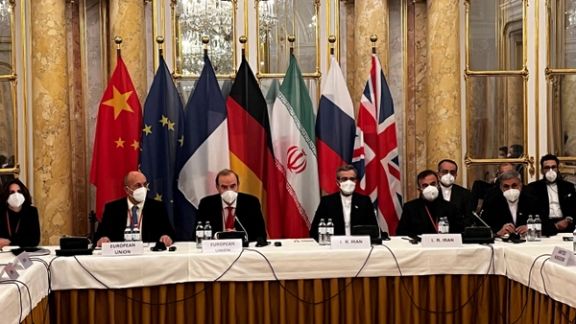
Nuclear negotiators in a formal session of talks in Vienna in December.

Iran’s foreign ministry spokesman said Monday Tehran is not satisfied with the pace of nuclear talks in Vienna but would not accept deadlines.

"Time is important to us, but it is not possible the other side moves like a turtle and we move at the speed of light," Saeed Khatibzadeh said.

He added that Iran wanted a “sustainable and reliable” agreement on reviving the 2015 nuclear deal with world powers, the JCPOA (Joint Comprehensive Plan of Action), with the talks encompassing “removal of sanctions, guarantees, verification, and nuclear issues.”

Khatibzadeh said Iran and the United States had exchanged views through informal written texts on all four issues. The US, which left the JCPOA in 2018 and imposed ‘maximum pressure’ sanctions on Iran, takes part indirectly in the Vienna process.

The spokesman emphasized that Iran would negotiate only with the JCPOA framework, and would not accept any intermediate steps towards reviving the 2015, nor enter into talks in Vienna over other matters. Khatibzadeh stressed the need to ensure Washington re-joined the JCPOA and did not again withdraw.

“We must all work to ensure that the United States’ return to the JCPOA is accompanied by necessary guarantees and verification,” he said. “The removal of sanctions should also be carried out effectively in accordance with the JCPOA. Such issues cannot materialize through an interim agreement.”

Bilateral and multilateral expert-level talks have been underway since the Vienna talks resumed on January 3 after a three-day break for New Year. The negotiation teams of Iran and Russia met Monday afternoon.

On Sunday, Iran's leader Ali Khamenei said that “holding talks and negotiating with the enemy at a certain juncture does not mean surrendering.” Khamenei ruled out direct talks with the US after President Donald Trump left the JCPOA in 2018, and Iran has insisted that talks on reviving the agreement take place within multilateral JCPOA structures.

There has been little news in the past week about the details of the negotiations. France and the United States have said there has been modest progress, although Iran and Russia have been insisting everything is on the right track.

The limited progress occurred after Western powers warned Iran that time is running out, and there are just “weeks not months” left to reach an agreement. Iran is enriching uranium while negotiations have continued for eight months. Growing stockpiles of fissile material can give Tehran more leverage in the talks.

The White house warned Tehran on Sunday against harming any US citizens, after top Iranian officials threatened revenge for the killing of Qasem Soleimani in a US drone strike in 2020.


Most Viewed

US blockade enters murky phase as tankers spoof signals and buyers hesitate
1
ANALYSIS

US blockade enters murky phase as tankers spoof signals and buyers hesitate

2

US tightens financial squeeze on Iran, warns banks over oil money flows

3
INSIGHT

Ideology may be fading in Iran, but not in Kashmir's ‘Mini Iran'

4
INSIGHT

Hardliners push Hormuz ‘red line’ as US blockade tests Iran’s leverage

5
VOICES FROM IRAN

Hope and anger in Iran as fragile ceasefire persists

Banner
Banner

Spotlight

  • Hardliners push Hormuz ‘red line’ as US blockade tests Iran’s leverage
    INSIGHT

    Hardliners push Hormuz ‘red line’ as US blockade tests Iran’s leverage

  • Ideology may be fading in Iran, but not in Kashmir's ‘Mini Iran'
    INSIGHT

    Ideology may be fading in Iran, but not in Kashmir's ‘Mini Iran'

  • War damage amounts to $3,000 per Iranian, with blockade set to add to losses
    INSIGHT

    War damage amounts to $3,000 per Iranian, with blockade set to add to losses

  • Why the $100 billion Hormuz toll revenue is a myth
    ANALYSIS

    Why the $100 billion Hormuz toll revenue is a myth

  • US blockade targets Iran oil boom amid regional disruption
    ANALYSIS

    US blockade targets Iran oil boom amid regional disruption

  • Iran's digital economy battered by prolonged blackout
    INSIGHT

    Iran's digital economy battered by prolonged blackout

•
•
•

More Stories

Israel Not Bound By Any Nuclear Deal With Iran, Free To Act, PM says

Jan 10, 2022, 12:49 GMT+0

Prime Minister Naftali Bennett said on Monday that Israel would not be bound by any nuclear deal with Iran and would continue to consider itself free to act "with no constraints" if necessary.

Indirect talks between Iran and the United States on salvaging the 2015 Iran nuclear deal resumed a week ago in Vienna. France's foreign minister said on Friday that progress had been made, although time is running out.

"In regard to the nuclear talks in Vienna, we are definitely concerned ... Israel is not a party to the agreements," Bennett said in public remarks, in a briefing to a parliamentary committee.

"Israel is not bound by what will be written in the agreements, if they are signed, and Israel will continue to maintain full freedom of action anywhere any time, with no constraints," he said.

Israel which considered the 2015 agreement, JCPOA, insufficient to stop Iran from acquiring nuclear weapons has said that any new agreement should permanently prevent Tehran from becoming a buclear power.

Israel has called on world powers to maintain a credible military option against Iran while they pursue an agreement.

Some experts have questioned whether Israel, on its own, has the military capabilities to halt what it says is an Iranian quest for nuclear weapons. Iran denies that it seeks atomic arms.

With reporting by Reuters

Vienna Talks Continue With Details Scarce As Two New Negotiators Join

Jan 9, 2022, 20:03 GMT+0

Negotiations to revive the nuclear deal between Iran and world powers continue in Vienna with daily meetings among diplomats without substantial news on details.

On Sunday, Iran’s negotiators held meetings with representatives from the three European signatories of the 2015 agreement as well as the European Union envoy Enrique Mora, who is the coordinator of the talks and head of the JCPOA Joint Commission.

Almost all the reports about the bilateral and multilateral expert-level talks are reiterations of the same statements sincethe eighth round resumed on January 3, after the New Year, with Tehran insisting on the verifiable removal of sanctions and others focusing on containing Iran’s nuclear progress.

The only concrete news about the talks is the appointment of new Garman and British representatives who joined the negotiations on Sunday.

Stephanie Al-Qaq -- the director of Middle East and North Africa department at the British foreign and commonwealth office -- is set to lead the UK negotiating team because the last negotiator retired. Tjorven Bellmann -- who served as press and political officer at the German Embassy in Tehran -- will be the German top negotiator because a new government has taken office.

As always, Russia’s top diplomat Mikhail Ulyanov is the most prolific source of news about the talks with regular tweets that only say some progress in being made.

Khamenei Signals Flexibility On Nuclear Talks, Reiterating Enmity With US

Jan 9, 2022, 15:22 GMT+0
•
Iran International Newsroom

Iran's leader Sunday showed the first public sign of readiness to compromise with the West over the nuclear issue, while maintaining enmity with the United States.

In a televised speech Sunday morning Ali Khamenei said that "Negotiations with the enemy at a certain juncture does not necessarily mean surrendering." The anti-Western ruler of Iran tried to convey the message to his hardliner supporters that although he is prepared for another round of "heroic flexibility"in a bid to have sanctions lifted, his opposition to the United States is unwavering.

"Not surrendering to the enemies, is one of the principles of the Islamic revolution. However, holding talks and negotiating with the enemy at a certain juncture does not mean surrendering to it. We have never surrendered so far, and we never will," Khamenei said.

Khamenei’s statement comes after many politicians and pundits in Iran and abroad have been saying for years that Iran should try direct negotiations with the US, but Khamenei explicitly banned it in 2018.

Portraying the United States as the Islamic Republic's biggest enemy, Khamenei said: "America’s deep hostility and spite toward Iran stems from the Iranian people’s revolutionary, religious viewpoint on the current issues of the world. That is why the US, the leading “arrogant power”, opposes the Islamic Republic of Iran."

Khamenei addressing supporters on Sunday. Jan. 9, 2022
100%
Khamenei addressing supporters on Sunday.

Claiming that US stances vis-a-vis Tehran is based on miscalculations, Khamenei reiterated: "The US system of calculation is defective. It cannot fathom the truths about Iran. When their calculation of the existing situation is wrong, their decisions are wrong too. This is why they have been unsuccessful so far and they will continue to be unsuccessful, God willing."
Based on his accounts of certain episodes in Iran's history in the 18th and 19th and 20th centuries, Khamenei said that only the grand ulema [prominent Shiite clerics] are capable of mobilizing masses of the people against big powers. Khamenei concluded that this reveals why "arrogant powers are against religion, clerics” and Shiite political Islam.

Khamenei reiterated: "The United States is basically against the Islamic regime in Iran because Washington knows that this system is the outcome of religion and is a manifestation of the Iranian nation's religious beliefs." He added: "Religious zeal based on reason turns threats into opportunities. An example of this is the war imposed by Saddam on Iran. The US, USSR, NATO, etc. united in this international war to defeat Iran, but the people’s zeal that is based on faith defeated all of them."

Meanwhile, expounding on his conspiracy theory about the West, Khamenei said that "The enemies are trying to erode Iranians' responsiveness to the principles of the Islamic revolution through a massive propaganda campaign on cyberspace and foreign-based [Persian] media. However, he did not mention that widespread and systematic corruption among clerics and officials has vastly contributed to the erosion of the underlying beliefs in the ruling system.

He also did not mention that many blame his regime's mismanagement for wasting a wealthy country’s resources, or criticism that his own unreasonable ambitions led to wasting billions of dollars on a nuclear program that has had no positive outcome for the people in more than four decades.

Nonetheless, he warned Iranian intellectuals that "It is unfair to say that the principles of the Islamic revolution do not serve the people's interest and do not guarantee their future."

Khamenei's critics even those such as former President Mahmoud Ahmadinejad have said on various occasions that nothing has remained of the main principles of the revolution, namely independence, freedom and an Islamic republic.

Critics have often argued that the regime's over-reliance on Russia and China and massive concessions to them has undermined Iran's independence. Meanwhile, thousands of political prisoners languishing in Iranian prisons, one of whom died in custody on Saturday because of neglect, bear witness that there is no freedom of expression in Iran. Critics say nothing has remained of the idea of a Republic in Iran particularly after the latest round of presidential election where everyone knew the winner months before the voting day.

US Envoy For Iran Briefs Saudi Diplomat On Vienna Talks

Jan 8, 2022, 09:31 GMT+0

US Special Envoy for Iran Rob Malley has met with Saudi Arabia’s ambassador to the international organizations to discuss the latest developments in Iran nuclear talks.

Prince Abdullah bin Khalid Al Saud met Malley on Friday after separate meetings with representatives of France and Russia this week.

The US State Department said earlier in the week that such periodic meetings “are part of the US commitment to consulting closely with our regional partners on the ongoing talks”.

Russian chief negotiator Mikhail Ulyanov tweeted a photo of his meetingwith the Saudi envoy, saying that he briefed the Saudi side on the latest developments in the Vienna talks.

Last week, Saudi Arabia’s foreign minister Prince Faisal bin Farhan Al Saud reiterated Riyadh’s concerns about Iran’s “destabilizing role” and “transgressions” in its nuclear program.

Riyadh and Tehran held talks last year to reduce tensions with the aim of restoring diplomatic ties broken since January 2016. So far, the talks have been exploratory with no tangible results.

The eighth round of talks to salvage the 2015 nuclear agreement, officially known as the Joint Comprehensive Plan of Actions, is underway in Vienna. However, Iranian and US officials don’t meet face-to-face, communicating through other participants.

White House Avoids Directly Implicating Iran In Attacks On US Bases

Jan 7, 2022, 08:52 GMT+0
•
Iran International Newsroom

As nuclear talks with Iran made “modest progress,” the White House Thursday refused to say who was behind the attacks on US bases in Iraq and Syria this week.

White House spokesperson Jen Psaki in her daily briefing evaded the question is Iran-backed groups were responsible for drone and rocket attacks against bases where US troops are stationed in Iraq and Syria.

“But here, officially, we don't have any specific attribution today, in terms of the particular group by name or groups who might be responsible for this. We don't have anything new on that front,” she said.

On Thursday, however, an Iraqi militant group tied to Iran had already claimed responsibility. In a statement published by al-Mayadeen, Qasem al-Jabbarin (which means Smasher of the Oppressors) claimed responsibility for the Wednesday attacks on Ain al-Asad air base west of Baghdad.

The White House appeared to be avoiding any statement that would directly implicate Iran in the attacks as nuclear talks continued in Vienna to find ways to revive the 2015 nuclear agreement known as JCPOA.

But Psaki did allude to the possibility that the attacks could be tied to the nuclear negotiations. “We can't say definitively who caused them or why the attacks seem to have stepped up. It is certainly possible that it can be related to the talks in Vienna or the anniversary of the Soleimani strike,” The spokesperson said. Psaki then referred reporters to statements made by the Pentagon, which also indirectly referred to Iran.

The State Department meanwhile reiterated that negotiators in Vienna have made “modest progress” and again warned that time is short as Iran makes more progress in its nuclear program.

“If we don’t soon reach an understanding on mutual return to compliance, Iran’s accelerating nuclear steps will hollow out those nonproliferation benefits the JCPOA conveyed, and we will have to consider a different path forward. That is a matter of weeks; it is certainly not a matter of months,” State Department spokesperson Ned Price said. But he made clear there are no definite deadlines as to when an assessment will be made that Iran’s nuclear progress has gone too far.

“But again, you have heard us speak to this not as a clock, as a standard clock, but rather on the basis of a technical assessment of Iran’s nuclear program rather than any sort of temporal clock with a date that has long been fixed,” Price said.

Critics have said that without a clear deadline, Iran can play for time and gain leverage by a far-advanced nuclear program. The United States and its three European allies in the talks – France, Germany and the United Kingdom – have been warning about time being short since early December.

Meanwhile, Iranian media on Friday continued to issue optimistic reports on the talks, saying that negotiators are maling progress.

Price, however, reiterated that if the US gets to the point where the JCPOA is deemed meaningless by Iran’s nuclear progress, “we will consider a different path.”

In an opinion article in the Wall Street Journalon Thursday, two authors argued that the United States should quickly prepare a military option to destroy Iran’s nuclear infrastructure and set back its program for years. The demonstration that Washington is serious about a military option, might coax Iran to negotiate seriously, and if all fails, President Joe Biden will have the option to act in a timely manner to stop Iran from building a bomb.