• العربية
  • فارسی
Brand
  • Iran Insight
  • Politics
  • Economy
  • Analysis
  • Special Report
  • Opinion
  • Podcast
  • Iran Insight
  • Politics
  • Economy
  • Analysis
  • Special Report
  • Opinion
  • Podcast
  • Theme
  • Language
    • العربية
    • فارسی
  • Iran Insight
  • Politics
  • Economy
  • Analysis
  • Special Report
  • Opinion
  • Podcast
All rights reserved for Volant Media UK Limited
volant media logo

White House Avoids Directly Implicating Iran In Attacks On US Bases
Iran International Newsroom
Jan 7, 2022, 08:52 GMT+0Updated: 17:34 GMT+1
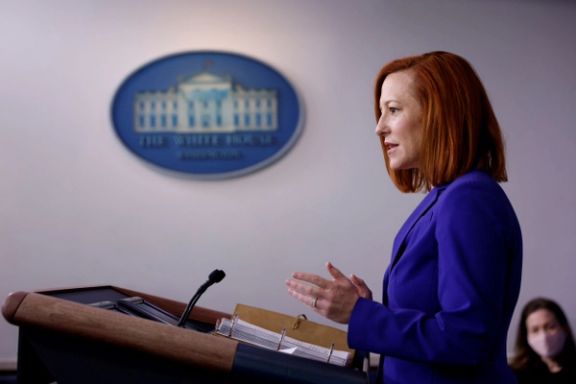
Jen Psaki, White House Spokesperson.

As nuclear talks with Iran made “modest progress,” the White House Thursday refused to say who was behind the attacks on US bases in Iraq and Syria this week.

White House spokesperson Jen Psaki in her daily briefing evaded the question is Iran-backed groups were responsible for drone and rocket attacks against bases where US troops are stationed in Iraq and Syria.

“But here, officially, we don't have any specific attribution today, in terms of the particular group by name or groups who might be responsible for this. We don't have anything new on that front,” she said.

On Thursday, however, an Iraqi militant group tied to Iran had already claimed responsibility. In a statement published by al-Mayadeen, Qasem al-Jabbarin (which means Smasher of the Oppressors) claimed responsibility for the Wednesday attacks on Ain al-Asad air base west of Baghdad.

The White House appeared to be avoiding any statement that would directly implicate Iran in the attacks as nuclear talks continued in Vienna to find ways to revive the 2015 nuclear agreement known as JCPOA.

But Psaki did allude to the possibility that the attacks could be tied to the nuclear negotiations. “We can't say definitively who caused them or why the attacks seem to have stepped up. It is certainly possible that it can be related to the talks in Vienna or the anniversary of the Soleimani strike,” The spokesperson said. Psaki then referred reporters to statements made by the Pentagon, which also indirectly referred to Iran.

The State Department meanwhile reiterated that negotiators in Vienna have made “modest progress” and again warned that time is short as Iran makes more progress in its nuclear program.

“If we don’t soon reach an understanding on mutual return to compliance, Iran’s accelerating nuclear steps will hollow out those nonproliferation benefits the JCPOA conveyed, and we will have to consider a different path forward. That is a matter of weeks; it is certainly not a matter of months,” State Department spokesperson Ned Price said. But he made clear there are no definite deadlines as to when an assessment will be made that Iran’s nuclear progress has gone too far.

“But again, you have heard us speak to this not as a clock, as a standard clock, but rather on the basis of a technical assessment of Iran’s nuclear program rather than any sort of temporal clock with a date that has long been fixed,” Price said.

Critics have said that without a clear deadline, Iran can play for time and gain leverage by a far-advanced nuclear program. The United States and its three European allies in the talks – France, Germany and the United Kingdom – have been warning about time being short since early December.

Meanwhile, Iranian media on Friday continued to issue optimistic reports on the talks, saying that negotiators are maling progress.

Price, however, reiterated that if the US gets to the point where the JCPOA is deemed meaningless by Iran’s nuclear progress, “we will consider a different path.”

In an opinion article in the Wall Street Journalon Thursday, two authors argued that the United States should quickly prepare a military option to destroy Iran’s nuclear infrastructure and set back its program for years. The demonstration that Washington is serious about a military option, might coax Iran to negotiate seriously, and if all fails, President Joe Biden will have the option to act in a timely manner to stop Iran from building a bomb.


Most Viewed

Iran International says it won’t be silenced after London arson attack
1

Iran International says it won’t be silenced after London arson attack

2
INSIGHT

Hardliners push Hormuz ‘red line’ as US blockade tests Iran’s leverage

3
VOICES FROM IRAN

Hope and anger in Iran as fragile ceasefire persists

4

US sanctions oil network tied to Iranian tycoon Shamkhani

5

Iran halts petrochemical exports to supply domestic market

Banner
Banner

Spotlight

  • Hardliners push Hormuz ‘red line’ as US blockade tests Iran’s leverage
    INSIGHT

    Hardliners push Hormuz ‘red line’ as US blockade tests Iran’s leverage

  • Ideology may be fading in Iran, but not in Kashmir's ‘Mini Iran'
    INSIGHT

    Ideology may be fading in Iran, but not in Kashmir's ‘Mini Iran'

  • War damage amounts to $3,000 per Iranian, with blockade set to add to losses
    INSIGHT

    War damage amounts to $3,000 per Iranian, with blockade set to add to losses

  • Why the $100 billion Hormuz toll revenue is a myth
    ANALYSIS

    Why the $100 billion Hormuz toll revenue is a myth

  • US blockade targets Iran oil boom amid regional disruption
    ANALYSIS

    US blockade targets Iran oil boom amid regional disruption

  • Iran's digital economy battered by prolonged blackout
    INSIGHT

    Iran's digital economy battered by prolonged blackout

•
•
•

More Stories

Group Linked To Iran Takes Responsibility For Attack On US Base

Jan 6, 2022, 17:51 GMT+0

Shiite paramilitary group Qasem al-Jabbarin with links to Iran-backed militias has taken responsibility for the recent attacks on bases hosting US forces in Iraq.

In a statement published by al-Mayadeen, Qasem al-Jabbarin (which means Smasher of the Oppressors) claimed responsibility for the Wednesday attacks on Ain al-Asad air base west of Baghdad.

The group said they launched a dozen rockets from a vehicle in the Bastamiya village, 25 kilometers west of the al-Heet (Hit) district in Iraq’s Al-Anbar Governorate.

US sources said the closest impact was around 2 kilometers (1.2 miles) from the base.

According to a profile on the group by the Washington Institute, Qasem al-Jabbarin is a front group directed by Kataib Hezbollah that specializes in roadside bombings against Iraqi supply trucks servicing the US military in Iraq.

Kataib Hezbollah, itself is part of the Iran-backed Popular Mobilization Forces, led by former Iraqi militia commander Abu Mahdi al-Muhandis before he was killed alongside Qasem Soleimani in January 2020 by a US drone strike.

Pentagon Press Secretary John Kirby said in a briefing on Wednesday that the pace and frequency of such attacks have increased.

Iraqi militia groups aligned with Iran vowed to retaliate for the targeted killings Soleimani and al-Muhandis.

Iran Says Seoul Must Free Blocked Funds Irrespective Of Nuclear Talks

Jan 6, 2022, 17:09 GMT+0

Iran's chief envoy in Vienna nuclear talks says South Korea must release Tehran's frozen funds no matter the outcome of the negotiations to restore the JCPOA.

According to the official government news website IRNA, Ali Bagheri-Kani made the remarks on Thursday as he met with Korean Vice Foreign Minister Choi Jong-Kun on the sidelines of the official negotiations.

He added that "unilateral US sanctions cannot justify the non-payment of debts to Iran".

The Korean diplomat said in a tweeton Thursday, “We exchanged views on our bilateral relationship including the frozen fund. Korea and Iran will work together and preserve our historically important relationship.”

Washington says it will waive sanctions on South Korea over frozen Iranian assets only with “everything” agreed in Vienna nuclear talks.

Since introducing ‘maximum pressure’ sanctions and leaving the JCPOA in 2018, the US has imposed banking sanctions on Iran. Two South Korea banks hold $7-9 billion of Iranian money, owed for oil imports.

Iran has funds frozen not just in South Korea but in Japan, Iraq, India, and China, mainly for oil and gas deliveries. The semi-official Iranian Students News Agency (ISNA) reported November 13 that Iran's assets frozen abroad totaled $50 billion, with $8 billion in South Korea, $3 billion in Japan, and $6 billion in Iraq.

Four Nations Vow Action Against Iran Over Reparations For Downed Jet

Jan 6, 2022, 13:36 GMT+0

Canada, Britain, Sweden and Ukraine on Thursday said they had abandoned efforts to talk to Tehran about reparations for an airliner downed by Iran and would try to settle the matter according to international law.

Most of the 176 people killed when Iran shot down the Ukrainian jet in January 2020 were citizens from those four countries, which created a coordination group that seeks to hold Tehran to account.

"Despite our best efforts over the past two years and multiple attempts to resolve this matter through negotiations, the Coordination Group has determined that further attempts to negotiate with Iran ... are futile," it said in a statement.

"The Coordination Group will now focus on subsequent actions to take to resolve this matter in accordance with international law," it continued, but did not give details.

Tehran says Revolutionary Guards accidentally shot down the Boeing 737 jet and blamed a misaligned radar and an error by the air defense operator at a time when tensions were high between Tehran and the United States.

A court in Ontario, Canada, this week awarded C$107 million ($83.8 million), plus interest, to the families of six people who died.

Report by Reuters

Korean Diplomat In Vienna As Russia Holds The Ring In Iran Nuclear Talks

Jan 6, 2022, 13:04 GMT+0
•
Iran International Newsroom

Seeking progress in reviving the 2015 Iran nuclear agreement, a senior South Korean diplomat has met representatives of world powers in Vienna.

As a major past buyer of Iranian oil, Seoul holds around $7 billion in payments owed to Iran for purchases made before the United States imposed sanctions on Tehran’s international banking transactions. Washington began its ‘maximum pressure’ in 2018 as it left the 2015 nuclear deal, the Joint Comprehensive Plan of Action (JCPOA).

The South Korean foreign ministry said Thursday that Choi Jong-kun, first vice foreign minister, had called for “positive progress” with talks at "a critical juncture.” In meetings with – among others – Robert Malley, US special envoy for Iran, and Enrique Mora, the senior European Union official chairing formal talks in Vienna, Choi had “reaffirmed that our government will continue diplomatic efforts for progress…[and] actively play any role that it can possibly play.”

While two Korean banks hold money owed Iran for oil sales before ‘maximum pressure’ kicked in, the resulting stand-off with Tehran has disrupted previously lucrative bilateral trade, with Tehran restricting imports of Korean consumer durables.

Ulyanov tweeting photos

With both US spokesman Ned Price Tuesday and chief Iranian negotiator Ali Bagheri-Kani Wednesday intimating talks were progressing, Russia’s lead negotiator in Vienna Mikhail Ulyanov tweeted Wednesday a photo showing remaining JCPOA participants, without Iran, meeting the US delegation.

As the US left the JCPOA in 2018, formal talks involve remaining signatories – China, France, Germany, Iran, Russia, and the United Kingdom – with Washington taking part only indirectly. Sticking to JCPOA structures and to its insistence that the US as the party leaving the agreement should mend its ways before re-joining, Tehran refuses face-to-face meetings with Washington.

Ulyanov tweeted that the process was moving “slowly but steadily.” The Russian negotiator, who is Moscow’s ambassador to the International Atomic Energy Agency, seems to have taken on a greater liaison role with tensions rising, at least in public, between Iran and the ‘E3’ of France, Germany and the United Kingdom.

“Regular meetings of JCPOA participants (without Iran) and the US after 6pm provide a good opportunity to take stock of the latest developments in the course of the Vienna talks,” Ulyanov tweeted.

The Russian envoy also noted that any deadlines for the talks were fluid, apparently distancing himself from European pronouncements that time is running out due to Iran’s continuing expansion its atomic program under steps began in 2019 beyond JCPOA limits.

‘European spies’

In Washington this week, German Foreign Minister Annalena Baerbock said Tehran had squandered trust and that limited time remained to save the JCPOA. After transatlantic tensions during the administration of Donald Trump (2016-20), Europe has sought a more positive relationship with President Joe Biden.

Baerbock tweeted Wednesday a picture with Antony Biden, US Secretary of State, with a message that there was “no alternative to dialogue” and that the two sides had agreed to “collaborate closely” over Russia, presumably a reference to tensions over Ukraine rather than to the Vienna talks.

The latest Iranian broadside aimed at the Europeans came from Mahmoud Abbaszadeh Meshkini, spokesman of parliament’s National Security and Foreign Policy Commission, in an interview with the official news agency IRNA published Thursday.

Meshkini said that with Vienna talks reaching “the content of the proposals” Iranian negotiators would not be deterred by “European spies” or by talk of deadlines.

Meshkini suggested discussions were continuing on proposals put forward by Iran and by others. The Vienna talks, which began back in April, have struggled to agree which US sanctions breach the JCPOA and exactly how Iran’s nuclear program, expanded and refined since 2019, could be brought back within JCPOA limits.

US Coalition Condemns Iran-Backed Attacks On Bases In Iraq, Syria

Jan 5, 2022, 21:18 GMT+0
•
Iran International Newsroom

The US coalition operating in Syria and Iraq has condemned Iran for attacks on its bases as repeated strikes have hit sites near American forces in the region.

Maj. Gen. John W. Brennan, Jr., commander, Combined Joint Task Force - Operation Inherent Resolve said in a statement that the “inaccurate and indiscriminate indirect fire attacks pose a serious threat to innocent civilians because of their lack of discrimination”.

"The Coalition reserves the right to defend itself and partner forces against any threat, and will continue to do everything within its power to protect those forces," said Brennan. "Our Coalition continues to see threats against our forces in Iraq and Syria by militia groups that are backed by Iran. "

After the statement, Katyusha rockets hit Iraqi military bases hosting US forces near Baghdad's international airport and west of Baghdad on Wednesday, Iraqi military sources said.

Five rockets landed near Iraq's Ain al-Asad air base, which hosts U.S. and other international forces west of Baghdad, leaving no casualties, a coalition official told Reuters on Wednesday.

The closest impact was around 2 kilometers (1.2 miles) from the base, the official added. Iraqi army officials told Reuters the rounds fired were Katyusha rockets.

Iraqi security sources said there were no damage or casualties in both attacks.

The Iraqi military said that it started a search operation after "outlaw elements" fired five rockets which landed near the perimeters of the air base.

While there were no immediate claims of responsibility for recent attacks, Iraqi militia groups aligned with Iran vowed to retaliate for killing Soleimani and Iraqi militia commander Abu Mahdi al-Muhandis.

Wednesday's attack is the second one this week targeting the base near Baghdad's international airport after an attack by two drones was foiled on Monday.

The rocket attack near Ain al-Asad comes on day after two explosive-laden drones were also shot down on Tuesday by Iraq's air defenses as they approached the Ain al-Asad air base, which hosts U.S. forces, west of Baghdad.

US officials in recent weeks had warned of more attacks against in Iraq and Syria, in part because of the second anniversary of the killing of top Iranian general Soleimani.

Soleimani who was Iran’s top military and intelligence operator in the Middle East, organizing anti-American and anti-Israeli militant groups, was killed by a targeted US drone strike on January 3, 2020, directly ordered by former US president Donald Trump.

Iranian President Ebrahim Raisi said on Monday that Trump must face trial for the killing or Tehran would take revenge.

Separately, the US-led coalition said its forces had been targeted with eight rounds at the Green Village in Syria over the past 24 hours and while there were no casualties, the attack did cause minor damage.

"The Iran-supported malign actors fired on the Coalition and SDF (Syrian Democratic Forces) from within civilian infrastructure with no regard for civilian safety," the coalition said in a statement.

The statement added that the coalition responded by firing six artillery rounds and had earlier carried additional strikes.

On Wednesday, pro-Iran militia fighters fired shells toward a US base in eastern Syria's Al-Omar oil field in eastern Deir Ezzor region, causing damage but no casualties.

The attacks came as nuclear talks continued with Iran in Vienna that seem to be making some progress. Critics of the talks to restore the 2015 nuclear agreement known as JCPOA say that even if negotiations prove successful, they will not impact Iran's aggressive behavior in the region and its network of militant proxies attacking US and allied interests.