Iran mobilisation drive extends to children under 15
Children carrying rifles take part in a Janfada mobilisation rally in Iran, September 18, 2026
The spokesman for Iran’s mass mobilisation campaign said children under 15 could be introduced to military concepts, while denying that minors were receiving formal weapons training as authorities expand a civilian defence drive launched during the war.
Sasan Zare, spokesman for the Janfada campaign, said the main organisation of volunteers would be based around adults aged 18 and over, but acknowledged that younger people were also being brought into the initiative.
“The stronger their value system is formed from childhood, and the more familiar they become with concepts such as patriotism and self-sacrifice, the more significant the impact can be on their future,” Zare told the Iranian news agency ILNA.
Those registered with the campaign were over 15, he said, while women taking part in its training courses were over 18. For children below that age, Zare said the emphasis should be on patriotism, responsibility, first aid, safety and what he called a “culture of self-sacrifice and resistance.”
The Islamic Republic has stepped up a broad campaign to mobilise civilians since the US-Israeli war began in February.
The Janfada initiative was launched in late March, and authorities have since promoted registration through mosques, Basij bases and public events, alongside plans for military and emergency-response training.
The campaign has drawn scrutiny over the involvement of minors, with rights groups accusing Iranian authorities of recruiting children into the Basij and using them at checkpoints.
Amnesty International said in April that Iranian law allows children under 15 to join as ordinary Basij members, while those aged 15 and over can become active Basij members and collaborate with the Revolutionary Guards on assigned missions.
The rights group said it had verified evidence of children as young as 12 deployed at checkpoints and patrols, including some carrying rifles.
Iran International has separately received accounts from several provinces describing children and teenagers taking part in checkpoint operations and handling weapons at state-sponsored gatherings.
Asked specifically about teenagers being used at checkpoints, Zare said he did not know how such deployments were being carried out because checkpoints fell under the authority of local police and security bodies.
His campaign, he said, provided training related to urban and public security, while the units deploying volunteers would decide whether they were used at checkpoints.
Iran has executed a man it accused of passing information about missile sites in Isfahan to Israel's Mossad, the judiciary said on Saturday, the latest in a series of espionage executions that rights groups say rest on confessions extracted in detention.
The judiciary's news agency, Mizan, identified him as Hossein Pedaran and said he had been convicted of espionage and intelligence cooperation with Israel and sentenced to death, with the sentence upheld by the Supreme Court. He had been arrested in Isfahan on charges related to the war.
Mizan published a long account of what it described as Pedaran's confessions. According to that account, he first messaged the CIA offering to cooperate and received no reply, then contacted Mossad and was answered days later by an officer who introduced himself as "Ben" using a Dutch WhatsApp number.
The agency said he sent encrypted reports on military facilities and on staff who worked at them, including personal details and their spouses' phone numbers, used numerous SIM cards registered to others, and was given a remote-control device capable of taking hidden photographs.
It said he was paid in euros collected from a magnetic box behind a guardrail near a Tehran bridge and, on another occasion, from a coffee shop bathroom, and that a notebook on missile subjects marked "highly confidential" was found at his home.
Mizan said Pedaran had cut contact before the war and tried to reach Mossad again by Telegram once it began, and was arrested. It said he had a lawyer, that a forensic examination found no impairment of his judgment, and that the court held his information had contributed to strikes in which personnel were killed or wounded.
None of these claims can be independently verified, and Mizan did not provide any evidence for the allegations.
Iran's espionage cases are heard by Revolutionary Courts, which operate without public scrutiny of the evidence, and the state routinely broadcasts and publishes confessions that defendants and their families have later said were obtained through torture, prolonged solitary confinement and threats against relatives.
Rights organizations have documented the pattern for years, and have recorded cases in which people detained during protests were subsequently charged with working for Israel.
Iran has executed at least a dozen people on espionage or Mossad-collaboration charges since the June 2025 war with Israel, according to human rights groups, and the pace has increased since the recent war began in February.
Those executed this year include Ali Ardestani in January, Mehdi Farid, a former employee of the atomic energy organization, in April, and Omid Behzad and Pouria Safvat in August. Iran Human Rights recorded at least 1,639 executions in the country in 2025, the highest annual total since 1989.
Twin sisters: one sentenced to death, the other to decades in prison in Iran.
An Iranian woman sentenced to death over January’s anti-government protests is struggling to walk but has been denied hospital treatment despite a prison doctor saying she urgently needs an MRI, her family told Iran International.
Taraneh Rahimi, 20, is being held alongside her twin sister Romina at Dowlatabad Prison in Isfahan. Their cousin, Masoud Nourmohammadi, told Iran International’s Eye for Iran that Taraneh’s condition has deteriorated as her lawyers race to appeal her death sentence.
“Taraneh could not walk,” Nourmohammadi said. “The (hospital) doctor says you have to go to the hospital and be hospitalized and get an MRI to see what’s going on with your leg because it is in bad shape,” he said.
Nourmohammadi said the doctor considered the treatment urgent, but prison authorities refused to allow Taraneh to leave for hospital.
Her family also purchased medical equipment and medication for her and brought the supplies to the prison, he said, but authorities did not allow them to reach her.
The allegations come days after Nourmohammadi told Iran International that prison authorities had stopped providing Taraneh with food, forcing her to rely on leftovers shared by other prisoners.
“They stopped giving Taraneh food a few days back,” he said. “They ask her to use other people’s leftovers and eat those. Who does that?”
‘If you don’t confess, we’re going to rape your sister’
The new allegations come as lawyers for the twins have finally been given access to their case file after months of waiting, according to Nourmohammadi.
He said the lawyers found no substantive evidence tying Taraneh or Romina to violence during the January protests and are now preparing an appeal.
“Their consensus is that there’s no evidence against those two girls in the case,” he said. “The only thing that is left … is basically their confession.”
The family says those confessions were obtained through torture and threats of sexual violence.
“They told Taraneh, ‘If you don’t confess, we’re going to rape your sister in front of you,’” Nourmohammadi said.
He said lawyers are also filing a complaint over the alleged torture and sexual abuse of the sisters while in custody.
Human Rights Watch and the Abdorrahman Boroumand Center for Human Rights in Iran have documented allegations of torture, coerced confessions and serious due-process violations involving defendants in the Shohada Square case.
Taraneh and Romina were among 16 defendants prosecuted over events surrounding protests in Isfahan in January. Ten of the defendants, including Taraneh, received death sentences, while Romina was sentenced to decades in prison.
The defendants faced charges including moharebeh, or “waging war against God,” destruction of public property, assembly and collusion against national security and propaganda against the state.
Rights groups have said none of the 16 defendants was charged with murder, despite prosecutors linking the case to incidents in which two people died.
‘A few days left’ to appeal
Nourmohammadi said the family believes only days remain in the formal window for lawyers to appeal Taraneh’s death sentence, adding that the family remains deeply concerned that authorities could move more quickly.
“You never know with that regime,” he said. “Anything can happen. It’s unpredictable.”
The sisters were 19 when security forces arrested them separately on January 24, weeks after they joined demonstrations around Isfahan’s Shohada Square. They have since turned 20 in prison.
Before her arrest, Taraneh was an equestrian and horse trainer. She had previously undergone surgery on her leg following a riding injury, according to her family.
Nourmohammadi alleges interrogators knew about the injury and deliberately targeted the same leg during torture.
When the twins’ mother was eventually permitted to see her daughters after roughly three months without knowing where they were being held, Nourmohammadi said Taraneh was already limping.
He said she also had broken fingers and knuckles and alleged that both sisters had lost much of their hair after being dragged between cells by their hair.
‘She wanted a life for her kids’
The twins’ mother raised Taraneh and Romina as a single parent.
For roughly three months after their arrests, she did not know where her daughters were being held. Family members searched hospitals, courthouses and prisons, at times waiting outside detention facilities seeking information.
When their mother was eventually allowed to see them, Nourmohammadi said the twins had swollen faces, bruises and significant hair loss.
After Taraneh was sentenced to death, he said his aunt was so devastated that she has barely been able to speak.
Instead, she wrote a message about raising her daughters and working to give them a future.
“She was a single mom. She worked really hard for her kids,” Nourmohammadi said. “She wanted a life for her kids. She didn’t want a prison or execution and a rope around their neck.”
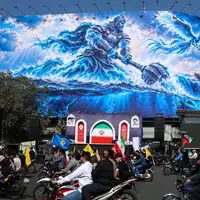
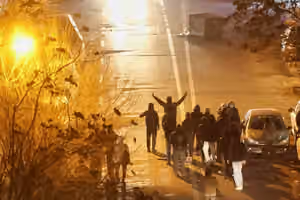
Supporters of the Islamic Republic wave Iranian flags during the 200th consecutive night of pro-state rallies in Tehran, September 17, 2026.
Iran’s nightly pro-government rallies have become an increasingly visible show of political force, occupying streets and squares for 200 consecutive nights and, more recently, turning their fire on rivals within the Islamic Republic itself.
For critics of the government, the gatherings have long carried a message beyond support for Iran during the war: that the street belongs to supporters of the Islamic Republic.
Coming after the mass protests of January, critics have viewed their nightly presence as a form of intimidation and a way of denying public space to potential dissent. For many, the effect is more mundane but relentless: late-night loudspeakers, road closures and disruption to daily life.
But the rallies have increasingly taken on another function. Participants have chanted against Parliament Speaker Mohammad-Bagher Ghalibaf, Foreign Minister Abbas Araghchi, President Masoud Pezeshkian and former presidents Hassan Rouhani and Mohammad Khatami.
Some gatherings have also featured demands for strict enforcement of Iran’s controversial hijab law, whose implementation has been held back following a decision by the Supreme National Security Council amid concerns over public backlash.
The shift has prompted warnings that gatherings promoted as demonstrations of national unity are becoming arenas for political score-settling.
The Supreme National Security Council-linked Nour News website described videos showing increasingly harsh slogans at recent gatherings as a “worrying shift in Iran’s political scene.”
“When street gatherings become a place for ‘death to’ and ‘down with’ slogans against domestic political figures, the first sign of a shift in the direction of popular reactions—from the foreign enemy to the domestic rival—becomes apparent,” Nour News wrote.
That shift is particularly significant because hardline media have portrayed the nightly gatherings as a measure of national opinion.
The hardline Hamshahri newspaper marked the 200th night with an article titled “200 Nights of Referendum,” presenting continued participation as an answer to politicians who have called for the public to be consulted over the country’s direction.
“Two hundred nights of participation in nighttime gatherings are a completely clear response to the doubts of some politicians who believe that the people should be consulted and a referendum held in order to continue the resistance,” it wrote.
The article was referring to Rouhani’s recent suggestion that continuing the war and confrontation with the United States and Western countries should be subject to consultation with the public.
The reformist Shargh newspaper warned that a social gathering that began in the name of “patriotism” could acquire a different meaning if it became a place for deciding “who has the right to speak about the country’s policies and who does not.”
Even the conservative daily Khorasan, considered close to Ghalibaf, called for a review of how the gatherings are organised in an article titled “200 Nights of Taking the Field.”
It questioned the use of the gatherings to promote hijab-related demands that it said exacerbate social divisions. It also highlighted complaints about the disruption the gatherings cause to residents and traffic.
“What image of these gatherings forms in citizens’ minds when the sound of loudspeakers keeps a sick person in a nearby home awake late into the night, or when hastily organized vehicle convoys create severe traffic jams and leave a driver exhausted after a day’s work stuck in traffic?” the newspaper asked.
Similar complaints have appeared on social media.
One X user urged supporters of the rallies to ask shopkeepers, residents and taxi drivers what they thought of the disruption, asking: “What has that taxi driver done to deserve sitting in traffic because of 30 government supporters?”
Another user, Morteza Rezazadeh, pointed to the changing targets of the slogans: from Israel and the United States to Iran’s president and parliament speaker. Mossad can “rest easy,” he quipped, because those chanting were doing its work for it.
After 200 consecutive nights, the dispute over the gatherings is therefore no longer simply about noise, traffic or even demonstrations of support for the state. It has become a dispute over who controls the street, who can claim to speak for the public and who inside the Islamic Republic is considered a legitimate political voice.
Iranian state authorities organized a systematic, high-level campaign of murder, torture, and sexual violence to crush the 2022 Woman, Life, Freedom uprising, according to a 1,000-page investigation published by Amnesty International on Wednesday.
The report states that senior officials directed, executed, and subsequently covered up acts that constitute crimes against humanity.
The findings are based on interviews with 270 witnesses, analysis of over 2,000 videos, and leaked official Iranian government documents.
"Amnesty International unequivocally opposes violations of international law by all parties and rejects any attempt to instrumentalize the suffering of victims of human rights violations in Iran to justify unlawful attacks that inflict further civilian harm," said Secretary General Agnès Callamard at the report's press launch, addressing both state repression and broader regional conflict.
Amnesty International identified 87 Iranian officials, including top IRGC and police commanders, who it said should be investigated for crimes against humanity under superior responsibility principles. Amnesty said that it shared its findings and the list of identified officials with Iran's leadership prior to publication but received no response.
"This investigation exposes the layers of command and coordination behind the Iranian authorities' deadly protest crackdowns," Callamard said. "The agents on the streets operated within a hierarchical and coordinated chain of command linking them to officials who directed, enabled, facilitated and supported crimes committed on a massive scale. It is beyond time to establish an international criminal justice mechanism for Iran before another protest massacre."
The report warned that impunity for the 2022 crackdown directly enabled subsequent mass atrocities, warning that state suppression of demonstrations earlier this year bore the same hallmarks on an even wider and deadlier scale. Amnesty urged the UN General Assembly to establish an independent international criminal justice mechanism to prosecute responsible officials.
High-ranking officials named for criminal investigation
Among the top-tier officials listed for criminal investigation under command responsibility principles are Supreme Leader Ali Khamenei, who was killed on February 28, 2026, during military strikes, and former Armed Forces Chief of Staff Mohammad Bagheri, who died on June 13, 2025.
Other key figures identified in the report include Ahmad Vahidi, who served as Minister of Interior during the 2022 crackdown and was subsequently appointed General Commander of the IRGC, Deputy Interior Minister for Security Majid Mir-Ahmadi, Tehran IRGC Commander Hassan Hassanzadeh, and Tehran Deputy Prosecutor Mohammad Shahriari.
Leaked documents show early surveillance directives
Minutes from confidential security meetings show that within 48 hours of Mahsa Amini’s death in custody on September 16, 2022, state officials focused on controlling the public narrative and suppressing online protests. Security chiefs discussed strategies to secure public statements from Amini's father to support the official explanation of her death.
A government resolution dated September 18, 2022, assigned the Islamic Revolutionary Guard Corps (IRGC) intelligence unit to monitor athletes and political figures. The same document tasked the Ministry of Intelligence with tracking actors, artists, and opposition movements.
Written orders drove escalation of lethal force
Written instructions issued by the General Staff of the Armed Forces on September 21, 2022, ordered security forces nationwide to deliver a "firm and severe response" to demonstrations. Of the 326 fatalities documented during protest dispersals or in militarized zones, 178 occurred within the first two weeks of the crackdown.
Amnesty documented a total of 377 protest-related deaths, including 56 children. State authorities have officially acknowledged only 202 deaths and falsely attributed most fatalities to "rioters" or "armed terrorists" despite overwhelming evidence to the contrary.
Security forces used assault rifles, machine guns, and shotguns loaded with metal pellets at close range, while kinetic impact munitions caused severe long-term physical injuries and loss of vision among survivors.
Disproportionate impact on ethnic minorities
Baluchi and Kurdish protesters and bystanders accounted for 62% of all recorded deaths during protest dispersals, despite representing a much smaller share of Iran's overall population.
Operational guidelines detailed the deployment of Basij militia units and motorcycle patrols of up to 40 vehicles per battalion to maintain street control and prevent anti-government slogans from being written in urban centers.
The investigation documented widespread torture, beatings, rape, and sexual assault against detained protesters, including minors. Internal judicial communications show that prosecutors classified formal rape complaints against IRGC agents as "completely secret" and instructed staff to close files over time without citing security agencies.
When lower courts delivered murder convictions against security personnel, higher authorities intervened to overturn the verdicts, reclassify the killings as unintentional, or reduce prison sentences. State courts also penalized bereaved families by withholding statutory financial compensation and attempting to coerce false television confessions attributing deaths to opposition groups.
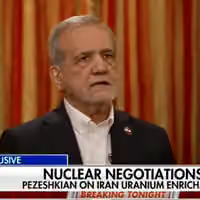
Iran's president Masoud Pezeshkian attends an event celebrating pensioners in Tehran, Iran, September 14, 2026
Renewed talk among Iranian hardliners of removing President Masoud Pezeshkian has revived comparisons with Iran’s only presidential impeachment, but there is little evidence so far of a coordinated effort capable of unseating him.
Instead, the latest speculation fits a pattern that has followed Pezeshkian since taking office in 2024: recurring calls for resignation or impeachment that intensify during periods of political, economic or geopolitical pressure.
The latest round was partly triggered by cryptic comments from Qom MP Mojtaba Zarei referring to a possible “coup” or coordinated political move against Pezeshkian.
Rouydad24 examined whether hardline networks, particularly Sharyan—the Persian acronym for the Strategic Network of Islamic Revolution Supporters—and allies of Saeed Jalili, Pezeshkian’s rival in the 2024 presidential election, were seeking early presidential elections.
The outlet presented no formal evidence of such a plan but pointed to repeated calls by radical lawmakers to invoke Article 89 of the Constitution, under which parliament can declare a president politically incompetent.
Mohsen Gharavian, a seminary and university lecturer, described the campaign to portray Pezeshkian as politically incompetent as a “targeted political conspiracy” and a soft “coup.”
Writing for Khabar Online, he argued that ultra-conservatives angered by their 2024 electoral defeat were using political networks and sustained media pressure to weaken the government.
In a separate Khabar Online report, moderate politician Hassan Rasouli criticised proposals to impeach Pezeshkian or transfer executive authority to First Vice President Mohammad Reza Aref.
Rasouli said such moves, particularly amid heightened national security pressures, amounted to “a direct attack on high-level governance cohesion.” He dismissed comparisons with the 1981 removal of Iran’s first president, Abolhassan Banisadr, as political theatre rather than a serious legal pathway.
Threats to use parliament against sitting presidents have a long history in the Islamic Republic.
During Akbar Hashemi Rafsanjani’s second term from 1993 to 1997, conservative opponents mounted sustained pressure on his government, including the impeachment of cabinet ministers.
Hassan Rouhani also faced repeated impeachment threats during his presidency, particularly from opponents of his diplomatic engagement with Washington.
The only successful precedent remains Banisadr in 1981. Parliament declared him politically incompetent during the Iran-Iraq war, after which Ayatollah Ruhollah Khomeini formally dismissed him.
Banisadr’s removal has since become a recurring reference point in disputes over presidential authority. Hardline lawmakers have invoked his case in attacks on Pezeshkian, particularly over diplomacy, economic policy and the conduct of the war.
But invoking Article 89 and successfully removing a president are different things. There is currently no indication that Pezeshkian’s opponents have assembled the parliamentary support required to declare him politically incompetent.
Opposition to Pezeshkian has nevertheless persisted since he took office following Ebrahim Raisi’s death in 2024. Calls for his resignation, comparisons with Banisadr and threats to invoke Article 89 have resurfaced during periods of economic turmoil, currency volatility and war.
The repeated threat of impeachment can serve a political purpose even without enough votes to remove the president: keeping his competence under question and constraining his room for manoeuvre on economic and diplomatic policy.
This week’s talk of a “coup” and renewed debate over presidential competence therefore appears less a new escalation than the latest iteration of a political struggle that has accompanied Pezeshkian for much of his presidency.