• العربية
  • فارسی
Brand
  • Iran Insight
  • Politics
  • Economy
  • Analysis
  • Special Report
  • Opinion
  • Podcast
  • Live TV
  • Iran Insight
  • Politics
  • Economy
  • Analysis
  • Special Report
  • Opinion
  • Podcast
  • Live TV
  • Theme
  • Language
    • العربية
    • فارسی
  • Iran Insight
  • Politics
  • Economy
  • Analysis
  • Special Report
  • Opinion
  • Podcast
  • Live TV
All rights reserved for Volant Media UK Limited
volant media logo
OPINION

Iran’s oil industry has too many masters

Mehdi Moslehi
Mehdi Moslehi

Risk management and energy market consultant

Sep 27, 2026, 00:36 GMT+1
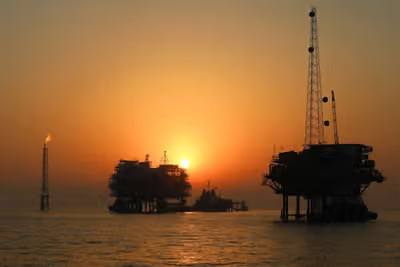
 The P4 offshore platform at Iran’s Reshadat oil field in the Persian Gulf, June 2026
The P4 offshore platform at Iran’s Reshadat oil field in the Persian Gulf, June 2026

The problem facing Iran’s oil industry is not just sanctions or a shortage of investment. It is a question of governance: who makes decisions, who signs contracts, who receives the money and, ultimately, who is accountable?

Iran’s oil industry is more than a collection of wells, pipelines and refineries. What turns those assets into an industry is an integrated chain of reservoir expertise, production planning, engineering, safety, financing, sales and accountability.

That chain has been badly fragmented. In the past two decades, especially under President Mahmoud Ahmadinejad, projects have been handed to military institutions, shares and assets transferred to pension funds and quasi-state bodies, and even oil cargoes used to cover budget shortfalls in organizations outside the Oil Ministry.

Unless a future Iran addresses that fragmentation, billions of dollars in investment and the most advanced technology could simply reproduce the old disorder on a larger scale.

From privatization to quasi-state ownership

The Ahmadinejad government accelerated the sale of state assets in the name of privatization, but much of the process did not produce an independent private sector.

Academic Kevan Harris has described the process as a form of pseudo-privatization: assets and privileges moved from one part of the state to pension funds, foundations, affiliated companies and military institutions without producing genuinely competitive markets, transparent ownership or public accountability.

In oil and gas, the Oil Ministry and its subsidiaries lost some of their practical authority over contractors, projects, procurement and, at times, the sale of oil.

One of the starkest examples was the decision to give oil cargoes to Iran’s police force to sell. Esmail Ahmadi-Moghaddam, then commander of Iran’s police, acknowledged in 2014 that during Ahmadinejad’s presidency the force had been given two oil cargoes to sell, with some of the proceeds intended to cover a salary shortfall.

The budgets of the police, ministries or pension funds should be recorded in the state budget and paid through the treasury, not financed by giving individual institutions a company, refinery, oilfield or oil cargo. Such arrangements erase the boundaries between owner, policymaker, client, contractor and seller.

Khatam al-Anbiya: one name, a network of interests

Khatam al-Anbiya Construction Headquarters is the economic and engineering arm of the Islamic Revolutionary Guard Corps, but it should not be understood as a conventional, integrated company.

It serves as an umbrella over numerous holdings, affiliated companies and subcontractors. Reuters reported in 2015 on the extensive network of companies linked to the IRGC and the difficulty of identifying their ultimate owners. A “contract with Khatam,” therefore, did not necessarily mean a clear chain of command, auditing and responsibility.

Under Ahmadinejad, the network received major contracts without effective competition. In 2011, Reuters reported that two pipeline contracts, each worth $1.3 billion, had been awarded to Khatam. Development of phases 15 and 16 of the South Pars gas field had also been awarded to the organization.

The result was multiple centers of power, allowing projects to be divided among different entities and responsibility to become diluted along the chain.

The consequences were technical as well as financial. Oil production requires reservoir engineers, drilling specialists, safety personnel and procurement departments to work under common standards and a coherent system.

Fragmenting projects among institutions with different missions and unclear accountability also fragments expertise and decision-making.

‘One sheikh in Bahrain, forty sheikhs in Iran’

I saw something of this problem during my own time working for Shell in the Netherlands.

I once asked the Dutch manager responsible for Iran why Shell had ended its activities in the country. I remember the essence of his answer like this: “We went to Bahrain because there we dealt with one sheikh; in Iran, we had to deal with forty sheikhs.”

Khatam might formally be the contracting party on a project, he explained, but another unit within the same network could then say it was responsible for security along part of the pipeline and demand a separate payment.

His point, as I understood it, was that instead of one accountable client, a foreign company could find itself dealing with multiple centers making separate demands for payment.

This is my recollection of an unrecorded conversation, not documentary evidence explaining Shell’s departure from Iran. The public record points principally to sanctions and political pressure: Reuters reported in 2008 that Shell withdrew from a planned Iranian gas project amid US pressure.

But sanctions and domestic disorder are not mutually exclusive explanations. Sanctions raised the cost of entering Iran; multiple centers of power raised the cost of staying.

The conversation illustrated the problem: when the contractual counterparty is known but the number of parties making demands is not, neither the true cost of a project nor responsibility for it can easily be calculated.

The Baku lesson

Another experience may offer a useful lesson for Iran’s future.

While working for BP, I travelled to Baku on a short assignment concerning contractor-selection models. An Azerbaijani colleague described how the country had used foreign partnerships after the collapse of the Soviet Union to modernize technology and develop its domestic workforce.

Azerbaijan did not hand its oil industry to BP. Under a production-sharing agreement signed in 1994, BP became operator of the Azeri, Chirag and deepwater Gunashli fields, while Azerbaijan’s state oil company SOCAR remained the principal domestic partner.

More important for Iran was the emphasis on local capacity. Training technicians, developing local suppliers and progressively replacing foreign personnel with Azerbaijani workers became part of the project. BP says it now directly employs around 2,380 Azerbaijani citizens, while Azerbaijanis have made up around 90% of its professional workforce in the country.

The lesson is not that Iran should hand management of its oil industry to BP. It is that an international operator can be selected for a particular project, targets set for training and localization, and domestic personnel left with greater technological knowledge and experience.

An architecture for Iran’s oil industry

Rebuilding Iran’s oil industry should begin with rebuilding its institutions, not redistributing the spoils.

Oil and gas should remain public assets. Parliament should establish the legal and financial framework, the government determine energy policy, and an independent professional regulator oversee licensing, safety, reservoir protection and environmental standards.

The referee must also be separated from the player. The National Iranian Oil Company should operate as a commercial and technical enterprise rather than simultaneously acting as regulator, client, partner, supervisor and arbiter of disputes.

Military and non-specialist institutions should gradually be removed from the industry. The process should be legal, audited and phased so existing projects are not abandoned.

Specific fields, refineries and infrastructure projects could instead be offered through transparent international tenders. Foreign companies could compete to operate or participate in individual projects, but no company or country should acquire a monopoly over the industry.

Contracts should be time-limited and contain measurable requirements for costs, production, environmental standards, Iranian employment and technology transfer, with extensions dependent on independent assessments rather than political connections.

Contracts, ownership, payments, costs, production and project revenues should generally be public, with auditing independent of the Oil Ministry, NIOC and contractors.

Contracts, ownership, payments, costs, production and project revenues should generally be public, with auditing independent of the Oil Ministry, NIOC and contractors.

Iran will also have to reassemble its human capital. Specialists inside the country, Iranian oil professionals abroad and a younger generation of engineers should be connected through a national program of training and succession. Foreign contractors should be required to build Iranian counterpart teams, not foreign islands inside the industry.

Rebuilding trust

Iran will need foreign investment and technology to restore production and modernize its refineries. But the need for capital should not be confused with surrendering sovereignty.

A homeowner can hire international architects and contractors without handing them ownership of the house. A future Iranian government can similarly benefit from competition among foreign companies while keeping ownership of resources, policymaking and ultimate authority in Iranian hands.

Iran’s oil can become a national asset again only when every contract has an accountable party, every project an auditable account and every decision a clearly defined legal authority.

The answer to the problem of “forty sheikhs” is not to create a new sheikh, Iranian or foreign. It is to build a single, transparent and professional system in which no commander, foundation, ministry or foreign company stands above the law.

Most Viewed

Iran’s oil industry has too many masters
1
OPINION

Iran’s oil industry has too many masters

2
INSIGHT

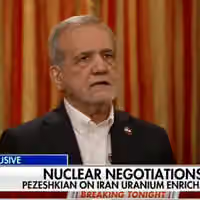
Pezeshkian’s Fox News nuclear overture draws hardline backlash

3

Tehran seeks negotiated way out as Washington maintains pressure

4
ANALYSIS

Why Trump said no to Iran’s Hormuz proposal

5
PODCAST

Trump may be buying time on Iran until after the midterms

Banner
Banner

Spotlight

  • Why Trump said no to Iran’s Hormuz proposal
    ANALYSIS

    Why Trump said no to Iran’s Hormuz proposal

  • Iran’s oil industry has too many masters
    OPINION

    Iran’s oil industry has too many masters

  • Iran wrong to expect midterms to restrain Trump, former US official says

    Iran wrong to expect midterms to restrain Trump, former US official says

  • Trump may be buying time on Iran until after the midterms
    PODCAST

    Trump may be buying time on Iran until after the midterms

  • Pezeshkian’s Fox News nuclear overture draws hardline backlash
    INSIGHT

    Pezeshkian’s Fox News nuclear overture draws hardline backlash

  • US and Iran want a deal, but neither wants to move first
    ANALYSIS

    US and Iran want a deal, but neither wants to move first

Banner
Banner
•
•
•

More Stories

Iran threatens regional air travel as US sanctions cut its flight links

Sep 25, 2026, 12:25 GMT+1
100%
An Iranian passenger carrying luggage leaves Najaf International Airport after arriving on an AVA Airlines flight, in Najaf, Iraq, September 23, 2026.

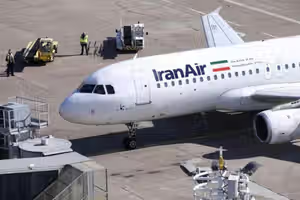
Iran threatened to disrupt regional air travel if its airlines lose access to flights and airport services, as Iraq's Najaf, Erbil and Sulaimaniya joined other destinations restricting Iranian connections under mounting US sanctions pressure.

“If Iran cannot fly and receive airport services, no country in the region will have that possibility either,” supreme leader adviser Mohammad Mokhber wrote in a post on Friday. He did not explain how Tehran would enforce the threat.

His remarks echoed Supreme National Security Council secretary Mohsen Rezaei, who warned Wednesday that neighboring airports would be unable to operate if they cooperated with Washington’s campaign. Rezaei also warned neighboring countries against joining further US military action.

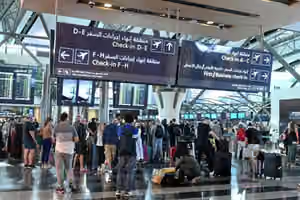
Airports in Najaf, Erbil and Sulaymaniyah have suspended flights to and from Iran, further narrowing air links with Iraq following restrictions at Baghdad airport. Najaf’s suspension took effect at 2 a.m. Friday until further notice, closing an alternative Iranian authorities had considered for diverted Baghdad-bound services.

  • Flying to or from Iran? What to know as US pressure squeezes air links

    Flying to or from Iran? What to know as US pressure squeezes air links

  • Iran warns it would disrupt regional airports if its flights are barred

    Iran warns it would disrupt regional airports if its flights are barred

Flights to Baghdad and Muscat were canceled on September 23. Iraqi aviation sources told Reuters that Baghdad’s suspension followed government instructions; Iranian aviation spokesman Majid Akhavan said Tehran was discussing Muscat’s restrictions with Oman.

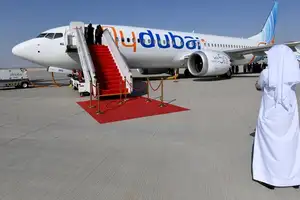
The UAE suspended Iranian airlines’ flights Thursday, explicitly citing US sanctions. Azerbaijan halted services by Iranian carriers Tuesday, while affected airlines stopped flying to Georgia from September 21.

A Tehran-Dushanbe flight also turned back Thursday after Turkmenistan denied permission to cross its airspace. Mahan Air suspended Turkey and Oman services; travel agencies said it had lost ground-handling access in Turkey.

Washington sanctioned 36 aviation-related targets on September 8, including 27 carriers it described as Iran’s remaining unsanctioned airlines and three Turkey-based companies accused of serving Mahan. Treasury says Iranian aviation networks transport weapons, military personnel and illicit cargo.

  • Iran cancels Baghdad, Muscat flights as regional restrictions tighten

    Iran cancels Baghdad, Muscat flights as regional restrictions tighten

  • UAE says it suspended Iranian airline flights over US sanctions

    UAE says it suspended Iranian airline flights over US sanctions

Treasury Secretary Scott Bessent warned that foreign airports, fuel suppliers, ground handlers and ticket sellers servicing sanctioned carriers risked US penalties, including exclusion from the dollar system. He said Iranian airlines would effectively lose international operations from September 23.

Those measures do not automatically close foreign airspace. Their effect depends on governments and service providers, and some flights continued. Bloomberg reported at least six departures Wednesday to destinations including Bangkok, Phuket, Shanghai and Kabul.

Foreign carriers have separately withdrawn services. Turkish Airlines told Iran International it had no Iran flights scheduled before March 2027, with no guaranteed restart. Earlier Iranian announcements of continuing Istanbul flights referred to other carriers.

Emirates no longer serves Tehran. Lufthansa and Austrian suspended Iran flights through October 24, while Qatar Airways cited airspace restrictions and tentatively listed November 29 for resumption. Those dates remain uncertain.

Four travel agencies contacted September 21 reported unavailable services across several other routes. Some Pegasus bookings were subsequently canceled, although booking-platform listings were not guarantees of operation.

The disruption affects family visits, business and pilgrimage to Najaf and Karbala. Agencies described travelers flying to Turkey, then taking roughly 17 hours by bus to Van and another 16–17 hours onward to Tehran, excluding border delays.

The UAE also barred Bank Melli branches from Iran-related transactions Wednesday, including trade finance and transfers.

  • China shipments help sustain Iran’s weapons programs despite US pressure - WSJ

    China shipments help sustain Iran’s weapons programs despite US pressure - WSJ

Rezaei linked the aviation warning to Tehran’s broader negotiating position, giving Washington four to five days to accept conditions already sent to mediators before talks or Hormuz’s reopening. He did not list them, saying Foreign Minister Abbas Araghchi would convey them again in New York, and presented control of the strait as negotiating leverage.

China shipments help sustain Iran’s weapons programs despite US pressure - WSJ

Sep 24, 2026, 06:41 GMT+1
100%
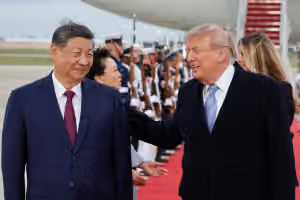
US President Donald Trump and Chinese President Xi Jinping react as Xi arrives ahead of a state visit at Joint Base Andrews, Maryland, US, September 23, 2026.

Chinese suppliers sent around 1,300 shipments of dual-use components to Iran’s defense ministry in the first half of 2026, helping sustain its weapons programs, The Wall Street Journal reported.

Iranian customs records showed one delivery arriving on June 17, when Washington and Tehran signed a 60-day truce and China promoted its peacemaking role. More than a dozen shipments followed two days later, carrying over $6 million in parts usable in drones.

The findings put Chinese support for Tehran at the center of Xi Jinping’s Washington visit this week, alongside trade, artificial-intelligence safety and Taiwan. Trump told aides that preserving relations with Xi was a priority, the Journal reported.

  • Iranian airlines continue foreign flights after US sanctions deadline - Bloomberg

    Iranian airlines continue foreign flights after US sanctions deadline - Bloomberg

  • Iran warns it would disrupt regional airports if its flights are barred

    Iran warns it would disrupt regional airports if its flights are barred

Records supplied by ImportGenius, covering January 2025 through June 2026, listed thousands of shipments to Iranian companies and the defense ministry, including GPS devices, motors and aircraft engine parts. Many cited Article 119, which exempts defense imports from tariffs.

Days before war began on February 28, China delivered 300 tons of chemical compounds to the ministry. Trade initially collapsed, and April’s US naval blockade restricted supplies further. Iran responded by expanding air connections.

US-sanctioned Mahan Air increased flights from Beijing, Shanghai and Guangzhou to Tehran from four weekly in early March to about 27 by late April, FlightRadar24 data showed. It operated 39 China–Iran flights in September’s first week, twice its prewar level. Several were unavailable for passenger bookings. China services continued despite announced suspensions to Oman and Turkey.

  • What Operation Economic Outcast means for Iran, and for everyone trading with

    What Operation Economic Outcast means for Iran, and for everyone trading with

CSIS researcher Kate Koren identified Chinese companies advertising sensitive electronics used in Shahed drones. Suppliers cultivated Iranian customers through trade fairs and Persian-language marketing.

Chinese chemical supplies also helped replenish missile production damaged by Israeli attacks in 2024. After reports of those exports in 2025, US forces raided a ship carrying dual-use components from China to Iran.

In a December letter, sanctioned Chinese company Haokun Energy said it had coordinated confidential export licensing for sodium perchlorate, used in missile propellant, and created a Beijing shell company for the transaction. The Journal verified the company’s registration but could not establish whether the deal proceeded.

  • Iran bets on China to blunt Trump’s economic offensive

    Iran bets on China to blunt Trump’s economic offensive

  • Xi’s BRICS peace call sparks debate in Iran over China’s role in war

    Xi’s BRICS peace call sparks debate in Iran over China’s role in war

Washington also targeted networks seeking newer Chinese shoulder-fired missile systems for Iran, which manufactures versions based on older Chinese designs. One unsuccessful effort sought delivery through Belarus to conceal Iran’s Center for Innovation and Technology Cooperation as the recipient. Tasnim separately published footage of IRGC personnel training with portable launchers.

Iran's biggest buyer

China became Iran’s dominant oil buyer after Trump’s 2018 “maximum pressure” campaign; the countries signed a 25-year pact in 2021. US lawmakers put China’s share above 80% of Iranian crude exports. Banks and shell companies have facilitated payments, including in yuan, US officials and other sources told the Journal.

One arrangement involved Iranian petrochemical sales to Egypt through Banque Misr’s UAE branch. After US objections to dollar payments, proposed transactions shifted to yuan through China’s Cross-Border Interbank Payment System. Washington intervened, stopping the plan, and later moved to restrict the branch’s dollar access.

  • Iran routed up to $2.5 billion via China sanctions workaround in past year - Reuters

    Iran routed up to $2.5 billion via China sanctions workaround in past year - Reuters

  • Tehran sees ‌Beijing as potential bridge to Washington

    Tehran sees ‌Beijing as potential bridge to Washington

Egypt and the bank said they were engaging US authorities; the bank affirmed regulatory compliance. Beijing suspected Egyptian officials had shared information with Washington, and Xi raised the matter in Cairo on September 1, the Journal reported.

US officials also linked Chinese satellite imagery obtained before and after a July 17 Iranian strike to the attack, which killed three American troops in Jordan. Washington had sanctioned three Chinese imagery companies in May.

Despite hundreds of sanctions, disagreements persisted inside Trump’s administration. Hegseth said China and Russia enabled Iran; Trump cited Xi’s assurances against weapons deliveries, saying: “I trust them.” Rubio said Chinese assistance had not changed the war’s trajectory.

July measures targeted Mahan-linked entities, including a Chinese sales agent. Late-August Operation Economic Outcast targeted a Chinese-owned tanker and procurement networks, but no major Chinese companies. Kpler recorded roughly four million barrels reaching China the following week.

  • Xi snub reignites Iran’s doubts about China

    Xi snub reignites Iran’s doubts about China

Lawmakers from both parties urged tougher action; Senator Elissa Slotkin called for Iran to become central to the summit. Rubio promised frank talks, while Treasury and the White House defended their enforcement efforts.

China rejected accusations of improper support, citing export controls and opposition to unilateral sanctions. Hong Kong said it implements UN sanctions only.

War deepens Iran’s energy crunch ahead of winter

Sep 24, 2026, 04:30 GMT+1
•
Dalga Khatinoglu
100%
Workers carry out maintenance at Platform 18A of Iran’s South Pars gas field, August 2026

Iran’s economy contracted sharply in the spring as war hit its oil and gas sectors, with new data pointing to an energy crunch that could force Tehran to balance gas exports against rising domestic demand as winter approaches.

Iran’s Statistical Center reported that gross domestic product contracted 10.1% year on year in the spring, with almost every major sector shrinking except agriculture.

The value added of the oil and gas extraction sector, measured at constant 2021 prices, fell 26.4%. Its share of Iran’s economy also declined from 26% in the spring of last year to 21% in the same period this year.

International Energy Agency data show that Iran produced an average of about 2.6 million barrels of crude oil per day between April and June, roughly corresponding to the spring quarter. That was more than 20% below the same period last year.

Average daily oil production fell further to around 2.3 million barrels in the summer. With the United States imposing a naval blockade on Iran from mid-July, the contraction in GDP is expected to be significantly sharper in the summer than in the spring.

Gas distribution

Statistical Center data show that the value added of the gas distribution sector, measured at constant 2021 prices, fell by more than 21% in the spring from a year earlier.

Israel targeted gas-processing facilities at South Pars, the field that accounts for around 70% of Iran’s gas production, on March 18. Since then, Iranian officials have given varying estimates of the decline in gas production, ranging from 100 million to 230 million cubic meters per day.

The International Energy Agency’s initial estimates, published in May, suggested that Iran’s daily gas production may have fallen by around 100 million cubic meters.

The Statistical Center did not specify the exact daily volume of gas distributed during the spring. However, an earlier report showed that Iran produced and injected around 726 million cubic meters per day of processed gas into the distribution network in the spring of last year.

Given the 21% decline in the sector’s value added at constant prices, this suggests that gas supplied to the domestic network fell by roughly 152 million cubic meters per day this spring, to around 573 million cubic meters.

The decline is particularly significant ahead of winter. Iran faces a severe natural gas deficit during the cold months, with the daily shortfall reaching as much as 250 million cubic meters during periods of peak demand.

The government has consequently been forced to restrict supplies to industries, power plants and the petrochemical sector to meet rising residential demand.

The gas export puzzle

Despite the decline in gas supplied to the domestic network, Iran increased exports to one of its two gas customers.

Data from Turkey’s energy market regulator (EMRA) show that Iranian gas exports to Turkey increased 27% between April and June to 30 million cubic meters per day. Iran also exports gas to Iraq, although comparable data for the same period have not been published.

The increase in exports to Turkey may have two main explanations.

First, domestic gas demand is lower during the warmer months than in autumn and winter. Second, Iran’s industrial and petrochemical sectors may have experienced a significant decline in gas consumption because of the war.

According to earlier Statistical Center data, Iran’s petrochemical sector and industries consumed about 82 million and 397 million cubic meters of gas per day, respectively, in the spring of last year.

Combined, that represented roughly 75% of domestic gas sales, excluding exports, transmission and distribution losses, and gas used to operate the network itself. The combined figure was equivalent to about 66% of the total processed gas injected into the network that spring.

Israel targeted parts of Iran’s petrochemical complexes in Asaluyeh and Mahshahr during the spring. Together, those facilities account for around 70% of Iran’s petrochemical production. Israel also targeted the Mobarakeh and Khuzestan steel complexes, which together account for about half of Iran’s steel production.

It is therefore likely that gas consumption by these industries fell sharply during and after the attacks, freeing up some gas for exports.

But the situation could change rapidly as temperatures fall.

Household gas consumption rises to roughly twice its spring and summer levels in autumn and more than three times the warm-season level in winter. Households accounted for 49% of Iran’s total gas consumption last winter, according to the Statistical Center.

It remains unclear whether Iran will be able to maintain gas exports to Turkey and Iraq once domestic demand surges in the coming months.

Iran warns oil pollution spreading along southern coast could last years

Sep 23, 2026, 12:30 GMT+1
100%

Oil pollution has spread along parts of Iran’s Hormozgan coast and reached the entrances of shrimp farming channels in Sirik, with environmental officials warning that some of the contamination could remain in the marine environment for years.

Tar balls have been reported in several parts of Hormozgan province, including Soro and Golshahr in Bandar Abbas, with additional sightings reported in Hormuz and Minab, ISNA said.

Habib Masihi Taziani, head of Hormozgan’s environmental protection department, told ISNA that the amount found in Sirik was substantial and that experts were still assessing the extent of the contamination.

“The volume of tar balls in Sirik is significant,” he said, adding that authorities had begun work to manage the pollution with fisheries officials, port authorities, the Sirik governor’s office and the provincial crisis management agency.

Pollution reaches shrimp farming channels

The spread to the entrances of shrimp farming channels in Sirik has raised concern because aquaculture facilities there are directly connected to coastal waters.

Masihi Taziani told ISNA that conventional suction equipment was not effective for removing the tar balls.

“Collecting these oil masses with suction equipment is difficult,” he said. “Efforts are continuing to contain them and collect them using absorbent pads and other equipment.”

Tar balls are weathered remnants of petroleum products that can travel across the sea before washing ashore.

Officials warn pollution could persist for years

Ahmadreza Lahijanzadeh, deputy head of Iran’s Department of Environment for marine affairs, told ISNA the tar balls could cause significant damage to coastal and marine ecosystems.

“These oil masses can cause considerable environmental damage, and the resulting pollution can affect coastal and marine ecosystems,” he said.

Lahijanzadeh said organic compounds and heavy metals contained in the material could gradually enter the water and spread through the marine environment.

“The effects of this type of pollution are not limited to the period when the tar balls are visible on the coast,” he told ISNA.

“The entry and accumulation of these materials can cause pollution to remain in the sea for a long time, even for years,” he added, calling for continued monitoring and measures to identify and contain it.

  • Oil slicks hit Qeshm mangroves and Oman coast in mounting war fallout

    Oil slicks hit Qeshm mangroves and Oman coast in mounting war fallout

The latest sightings follow several oil pollution incidents along Iran’s southern coastline in recent weeks.

In August, Iranian state news agency IRNA reported that oil had reached mangrove forests on Qeshm island after slicks appeared near Suza and Shib Deraz. Authorities said at the time that the source had not been determined.

Mehr news agency reported that the pollution had initially been detected along about one kilometer of coast near Suza before spreading toward Shib Deraz.

TankerTrackers.com later said the Qeshm pollution appeared to have come from an Iranian attack on the bulk carrier Minoan Pioneer off Oman on August 3, with the spill drifting across the Strait of Hormuz toward Iran. Iranian authorities did not confirm that assessment.

Tanker spills add to pollution concerns

A separate spill was reported off Oman after the tanker Caroline Bezengi, carrying Russian crude, ran aground.

The UN’s International Maritime Organization said oil from the vessel had begun reaching Oman’s mainland, while Oman’s Environment Authority said the slick covered about 150 square miles near the Hallaniyat Islands.

Reuters, citing maritime security sources, reported that the vessel’s crew had first reported difficulties off Yemen in June and that initial assessments pointed to an onboard blast.

Iran cancels Baghdad, Muscat flights as regional restrictions tighten

Sep 22, 2026, 20:40 GMT+1
100%
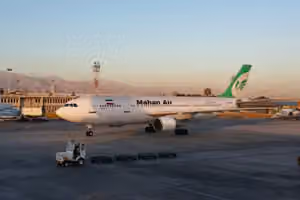
File photo: A Mahan Air Airbus a300 series at Tehran's Mehrabad airport

Iran has canceled flights from Tehran to Baghdad and Muscat from midnight Wednesday as regional airports begin restricting Iranian carriers under mounting US pressure aimed at cutting the country’s airlines off from international operations.

Iran’s Civil Aviation Organization said flights to the Iraqi and Omani capitals would be canceled from 12 a.m. local time on September 23, the semi-official Tasnim news agency reported Tuesday. Iranian authorities are working to divert Baghdad-bound flights to Najaf, it added.

The remaining international flights, including services to Istanbul, will operate according to schedule, Tasnim said.

Two sources at Iraq’s Civil Aviation Authority separately told Reuters that the Iraqi government had ordered authorities to suspend Iranian flights to Baghdad beginning at midnight Wednesday.

Two other sources familiar with the matter said Baghdad was discussing whether flights operated by Iranian airlines could instead be diverted to Najaf.

Majid Akhavan, spokesperson for Iran’s Civil Aviation Organization, also said Muscat airport would no longer accept Iranian passengers and that Tehran was holding talks with Omani authorities over the restrictions.

The cancellations are among the first visible consequences of Washington’s intensified campaign against Iran’s aviation sector.

US Treasury Secretary Scott Bessent said Monday that Iranian airlines would effectively be shut out of international operations from September 23, warning airports, fuel suppliers, ground-handling firms and other companies that providing services to sanctioned Iranian carriers could expose them to US penalties.

Iraq is particularly important for Iranian travelers because millions visit the country’s Shiite holy sites, especially Najaf and Karbala. Travel between the two countries increases sharply around religious occasions including the annual Arbaeen pilgrimage.

Iran’s international travel options were already narrowing before the latest restrictions.

Turkish Airlines, long one of the most widely used foreign carriers for Iranians traveling for tourism, business or onward connections, told Iran International on Monday that it had suspended all of its flights to Iran until at least March 2027, with no guarantee that services would resume then.

Tasnim’s statement that Istanbul flights remain scheduled refers to flights operated from Iran and does not mean Turkish Airlines has resumed its own Iran routes.

The US push threatens to further isolate Iranian aviation by targeting not only the airlines themselves but the foreign airports and companies needed to keep their international routes running.