Iran executes man it accused of spying for Israel on missile sites
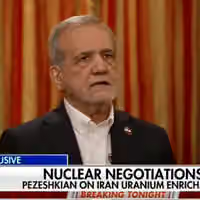
Hossein Pedaran during televised confession
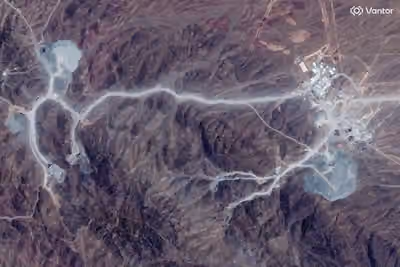
Iran has executed a man it accused of passing information about missile sites in Isfahan to Israel's Mossad, the judiciary said on Saturday, the latest in a series of espionage executions that rights groups say rest on confessions extracted in detention.
The judiciary's news agency, Mizan, identified him as Hossein Pedaran and said he had been convicted of espionage and intelligence cooperation with Israel and sentenced to death, with the sentence upheld by the Supreme Court. He had been arrested in Isfahan on charges related to the war.
Mizan published a long account of what it described as Pedaran's confessions. According to that account, he first messaged the CIA offering to cooperate and received no reply, then contacted Mossad and was answered days later by an officer who introduced himself as "Ben" using a Dutch WhatsApp number.
The agency said he sent encrypted reports on military facilities and on staff who worked at them, including personal details and their spouses' phone numbers, used numerous SIM cards registered to others, and was given a remote-control device capable of taking hidden photographs.
It said he was paid in euros collected from a magnetic box behind a guardrail near a Tehran bridge and, on another occasion, from a coffee shop bathroom, and that a notebook on missile subjects marked "highly confidential" was found at his home.
Mizan said Pedaran had cut contact before the war and tried to reach Mossad again by Telegram once it began, and was arrested. It said he had a lawyer, that a forensic examination found no impairment of his judgment, and that the court held his information had contributed to strikes in which personnel were killed or wounded.
None of these claims can be independently verified, and Mizan did not provide any evidence for the allegations.
Iran's espionage cases are heard by Revolutionary Courts, which operate without public scrutiny of the evidence, and the state routinely broadcasts and publishes confessions that defendants and their families have later said were obtained through torture, prolonged solitary confinement and threats against relatives.
Rights organizations have documented the pattern for years, and have recorded cases in which people detained during protests were subsequently charged with working for Israel.
Iran has executed at least a dozen people on espionage or Mossad-collaboration charges since the June 2025 war with Israel, according to human rights groups, and the pace has increased since the recent war began in February.
Those executed this year include Ali Ardestani in January, Mehdi Farid, a former employee of the atomic energy organization, in April, and Omid Behzad and Pouria Safvat in August. Iran Human Rights recorded at least 1,639 executions in the country in 2025, the highest annual total since 1989.
Twin sisters: one sentenced to death, the other to decades in prison in Iran.
An Iranian woman sentenced to death over January’s anti-government protests is struggling to walk but has been denied hospital treatment despite a prison doctor saying she urgently needs an MRI, her family told Iran International.
Taraneh Rahimi, 20, is being held alongside her twin sister Romina at Dowlatabad Prison in Isfahan. Their cousin, Masoud Nourmohammadi, told Iran International’s Eye for Iran that Taraneh’s condition has deteriorated as her lawyers race to appeal her death sentence.
“Taraneh could not walk,” Nourmohammadi said. “The (hospital) doctor says you have to go to the hospital and be hospitalized and get an MRI to see what’s going on with your leg because it is in bad shape,” he said.
Nourmohammadi said the doctor considered the treatment urgent, but prison authorities refused to allow Taraneh to leave for hospital.
Her family also purchased medical equipment and medication for her and brought the supplies to the prison, he said, but authorities did not allow them to reach her.
The allegations come days after Nourmohammadi told Iran International that prison authorities had stopped providing Taraneh with food, forcing her to rely on leftovers shared by other prisoners.
“They stopped giving Taraneh food a few days back,” he said. “They ask her to use other people’s leftovers and eat those. Who does that?”
‘If you don’t confess, we’re going to rape your sister’
The new allegations come as lawyers for the twins have finally been given access to their case file after months of waiting, according to Nourmohammadi.
He said the lawyers found no substantive evidence tying Taraneh or Romina to violence during the January protests and are now preparing an appeal.
“Their consensus is that there’s no evidence against those two girls in the case,” he said. “The only thing that is left … is basically their confession.”
The family says those confessions were obtained through torture and threats of sexual violence.
“They told Taraneh, ‘If you don’t confess, we’re going to rape your sister in front of you,’” Nourmohammadi said.
He said lawyers are also filing a complaint over the alleged torture and sexual abuse of the sisters while in custody.
Human Rights Watch and the Abdorrahman Boroumand Center for Human Rights in Iran have documented allegations of torture, coerced confessions and serious due-process violations involving defendants in the Shohada Square case.
Taraneh and Romina were among 16 defendants prosecuted over events surrounding protests in Isfahan in January. Ten of the defendants, including Taraneh, received death sentences, while Romina was sentenced to decades in prison.
The defendants faced charges including moharebeh, or “waging war against God,” destruction of public property, assembly and collusion against national security and propaganda against the state.
Rights groups have said none of the 16 defendants was charged with murder, despite prosecutors linking the case to incidents in which two people died.
‘A few days left’ to appeal
Nourmohammadi said the family believes only days remain in the formal window for lawyers to appeal Taraneh’s death sentence, adding that the family remains deeply concerned that authorities could move more quickly.
“You never know with that regime,” he said. “Anything can happen. It’s unpredictable.”
The sisters were 19 when security forces arrested them separately on January 24, weeks after they joined demonstrations around Isfahan’s Shohada Square. They have since turned 20 in prison.
Before her arrest, Taraneh was an equestrian and horse trainer. She had previously undergone surgery on her leg following a riding injury, according to her family.
Nourmohammadi alleges interrogators knew about the injury and deliberately targeted the same leg during torture.
When the twins’ mother was eventually permitted to see her daughters after roughly three months without knowing where they were being held, Nourmohammadi said Taraneh was already limping.
He said she also had broken fingers and knuckles and alleged that both sisters had lost much of their hair after being dragged between cells by their hair.
‘She wanted a life for her kids’
The twins’ mother raised Taraneh and Romina as a single parent.
For roughly three months after their arrests, she did not know where her daughters were being held. Family members searched hospitals, courthouses and prisons, at times waiting outside detention facilities seeking information.
When their mother was eventually allowed to see them, Nourmohammadi said the twins had swollen faces, bruises and significant hair loss.
After Taraneh was sentenced to death, he said his aunt was so devastated that she has barely been able to speak.
Instead, she wrote a message about raising her daughters and working to give them a future.
“She was a single mom. She worked really hard for her kids,” Nourmohammadi said. “She wanted a life for her kids. She didn’t want a prison or execution and a rope around their neck.”
he current price of gasoline at a filling station in San Diego, California, U.S., August 19, 2026.
Democrats are intensifying attacks on President Donald Trump over the Iran war as the midterm elections approach, seeking to tie the six-month conflict to an issue closer to American voters’ wallets: the rising cost of gasoline and everyday goods.
Democratic lawmakers have increasingly portrayed the war not simply as a foreign-policy dispute but as a contributor to the cost-of-living pressures weighing on American households.
“There’s no plan. No strategy,” Representative Jason Crow of Colorado said. “The President started a war with Iran that he doesn’t know how to win or get us out of. Americans are paying the price every day.”
The argument comes as disruptions to oil supplies and shipping through the Strait of Hormuz have pushed energy prices sharply higher, making gasoline an increasingly prominent political issue ahead of the November elections.
Representative Rosa DeLauro of Connecticut sought to connect those costs directly to the war, saying commuters were paying nearly $1 million more a day for gasoline than in July.
“This is a crisis that is only beginning,” she said. “We are about to enter a winter where millions of Americans will experience the disastrous effects of Trump’s illegal war in Iran.”
Public opinion suggests widespread concern over both the war and energy costs.
A Marquette Law School national poll conducted September 2-9 found that 80% of adults said gasoline prices had risen over the previous six months, including 55% who said they had risen “a lot.”
Only 20% approved of Trump’s handling of gasoline prices, while 80% disapproved. On Iran, 26% approved of his handling of the conflict and 73% disapproved, while 79% said the war had not been worth its cost.
Trump has continued to defend his approach while suggesting an end to the conflict may be approaching. He said this week that Iran wanted an agreement and that “hopefully we're toward the end of the war,” though negotiations remain stalled.
Vice President JD Vance has argued that ending US involvement could itself carry severe economic consequences, saying this week that leaving the region while Iran continued attacking shipping would risk a worldwide energy crisis.
Democrats, however, are increasingly trying to make the economic consequences of the war part of their argument to voters.
Representative Ro Khanna of California on Friday introduced what he called the Illegal War Refund Act, proposing $1,700 payments to taxpayers funded from the Defense Department budget.
“Trump’s illegal war in Iran has cost Americans in food and gas prices an estimated $230 billion,” Khanna said. “Today, I introduced the Illegal War Refund Act to put that money back in the pockets of Americans.”
The conflict continues more than six months after US and Israeli strikes on Iran began on February 28. The US naval blockade has sharply restricted Iranian oil exports, while attacks on shipping and disruption around the Strait of Hormuz have added pressure to global energy markets.
For Democrats, the prolonged war abroad and higher prices at home are increasingly becoming a single argument as the midterms approach.
Workers sort freshly harvested dates in a palm grove in Bushehr province, southern Iran, September 15, 2026
Iran’s economic hardship has grown so acute that senior government officials are increasingly acknowledging in public the scale of the pressure on ordinary households.
“We are ashamed that the public’s income does not cover their expenses, especially for wage earners,” First Vice President Mohammad Reza Aref said Thursday. “You cannot increase salaries by 20% when inflation is running above 60–70%.”
Government spokeswoman Fatemeh Mohajerani has disclosed a roughly 310-trillion-toman shortfall in expected tax revenues during the first half of the current year, while the head of the Food and Drug Administration says medicine prices have risen roughly 103% this year.
President Masoud Pezeshkian has offered an equally stark assessment of the public mood, invoking the 2019 fuel-price protests as a warning against imposing further economic pressure.
“People are now on the edge; if I impose another pressure, they may fall off,” he said.
The warning has not prevented the government from doubling the gasoline price for high-volume consumers, highlighting the difficult choices facing Tehran as it tries to contain household pressure while confronting the economic costs of war.
The household squeeze
The free-market dollar has traded at around 2.30–2.33 million rials this week, with the Iranian currency losing roughly 44% of its value against the dollar over the past six months.
Food and beverage inflation has officially exceeded 127% year on year, contributing to a sharp contraction in consumption of protein, dairy products and legumes among urban working-class households.
State-run ILNA has published unusually blunt reports on the cost of living, including unofficial bread-price increases in Tehran, families cutting meat from their diets and rents doubling.
The financial daily Donya-ye Eghtesad has warned of signs of a “new inflationary regime” in which persistent price rises are shaping contracts, expectations and everyday economic decisions, making confidence in the rial increasingly difficult to restore.
The approaching academic year provides another measure of the squeeze.
According to Donya-ye Eghtesad, equipping a single primary or secondary-school student with basic uniforms, a schoolbag, shoes and stationery now costs between 150 million and 200 million rials.
A basic pack of notebooks that cost around 3.5 million rials last year now costs approximately 15 million, forcing some lower-income families to reuse old school supplies.
War adds to the strain
Iranian oil exports have reportedly fallen from around 2 million barrels per day before the war to approximately 220,000–255,000 barrels per day in August, sharply reducing one of Tehran’s principal sources of foreign currency.
The Economy Ministry has established an “Economic War Headquarters” as officials increasingly frame the economic crisis as part of the broader confrontation with Washington. But falling oil revenues leave the government with fewer resources to cushion households against rising prices and a weakening currency.
Oil-industry workers have staged weekly Monday protests over pay and taxes at offshore platforms and in Assaluyeh, while nurses demonstrated in Kermanshah on September 8 over unpaid wages.
Accounts in Iranian media offer a more immediate picture of the pressure behind such discontent: street vendors struggling with higher rents, households going months without eating meat and parents weighing school expenses against basic food costs.
The combination of high inflation, declining purchasing power and sharply reduced oil revenues leaves Tehran with increasingly limited room to ask households to absorb further economic costs from the war.
A worker during maintenance operations at facilities in Iran's northeastern Khangiran gas field, September 13, 2026
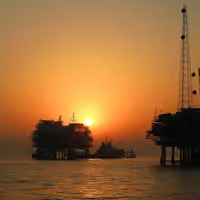
Iran is racing to restore gas infrastructure before winter after attacks knocked about 230 million cubic meters a day of gas-processing capacity offline, adding to shortages in an energy system already struggling to meet demand.
Iranian officials have said attacks knocked about 230 million cubic meters a day of gas capacity offline. Executive Vice President Mohammad Jafar Ghaempanah compared that figure with roughly 650 million cubic meters of daily gas production, although industry data indicate the two figures may refer to different stages of gas production and processing.
Tehran has begun trying to claw some of that capacity back. Officials have said roughly 100 million cubic metres a day could be restored in the coming months, still less than half the capacity reported lost.
But restoring production is only part of the problem. Rystad Energy estimated in April that repairing damage to Iran’s energy infrastructure could cost as much as $19 billion, affecting gas processing, refining and export facilities.
That figure covers physical repairs rather than the wider economic consequences of lost production, disrupted exports and industrial shutdowns. Rystad has also identified shortages of critical equipment and workers as major obstacles to recovery.
Winter could provide the first major test of whether Iran can repair enough of its energy system quickly enough to prevent wartime damage from developing into a broader economic crisis.
A system already under pressure
Iran entered the war with an energy system already struggling to match supply with demand.
The US Energy Information Administration has said sanctions slowed development of the country’s natural-gas infrastructure and that limited storage capacity left Iran poorly equipped to manage seasonal swings in consumption.
In 2022, residential and commercial consumers accounted for 33% of Iran’s gas consumption, industry including petrochemicals for 27%, and electricity generation for another 28%, according to the EIA.
Household and commercial gas consumption rises during winter, while demand from the electricity sector is highest during summer.
The loss of production capacity therefore leaves Tehran having to allocate a reduced supply among households, power stations, petrochemical plants and other industrial users.
The problem is not simply how much gas Iran has underground. Gas reserves alone do not guarantee reliable supply: the country also needs functioning processing plants, pipelines and storage facilities, as well as electricity, maintenance, equipment and skilled workers to keep the system operating.
Damage beyond gas
Reduced gas supplies to power plants could constrain electricity generation, while restrictions on industrial users could hit petrochemicals and energy-intensive sectors such as steel, aluminum and cement.
That means the eventual cost of the damage cannot be measured solely by the reconstruction bill. Lower production can also translate into weaker industrial output and exports at a time when Tehran needs resources to finance repairs.
Iran's broader energy sector is already under severe financial pressure. The war and US naval blockade have sharply curtailed Iranian oil exports, leaving tens of millions of barrels stranded in storage and depriving Tehran of crude export revenue.
The combination creates the risk of a cycle in which energy shortages constrain economic activity while reduced revenues make restoring the energy system more difficult.
A longer-term problem
The war has also magnified structural weaknesses that predate the conflict.
South Pars, which Iran shares with Qatar, is the country's largest non-associated natural-gas field and the centre of its gas industry. But the EIA had already warned before the war that without additional investment Iran could struggle to satisfy domestic demand while meeting its export commitments.
Sanctions have restricted access to foreign investment, technology and specialized equipment, leaving Tehran with an existing infrastructure challenge before US and Israeli attacks added an urgent reconstruction burden.
Rystad said delays in procuring critical equipment were likely to determine how quickly damaged energy infrastructure could be restored, while shortages of workers were another major obstacle.
The winter test
For Tehran, the immediate question is how much of the reported 230 million cubic meters a day of lost gas capacity can be restored before colder weather drives household demand higher. How severe the remaining deficit becomes will depend on demand, further repairs and whether additional infrastructure is damaged.
Tehran may have to balance household heating against industrial production and electricity generation while trying to rebuild infrastructure under sanctions.
Rystad's $19 billion estimate gives a sense of the potential physical repair bill. The larger test is whether Iran can restore enough of the system to prevent damaged gas infrastructure from feeding through into electricity shortages, industrial disruption and further economic pressure.
The coming winter should provide the clearest indication yet.
Iranian state authorities organized a systematic, high-level campaign of murder, torture, and sexual violence to crush the 2022 Woman, Life, Freedom uprising, according to a 1,000-page investigation published by Amnesty International on Wednesday.
The report states that senior officials directed, executed, and subsequently covered up acts that constitute crimes against humanity.
The findings are based on interviews with 270 witnesses, analysis of over 2,000 videos, and leaked official Iranian government documents.
"Amnesty International unequivocally opposes violations of international law by all parties and rejects any attempt to instrumentalize the suffering of victims of human rights violations in Iran to justify unlawful attacks that inflict further civilian harm," said Secretary General Agnès Callamard at the report's press launch, addressing both state repression and broader regional conflict.
Amnesty International identified 87 Iranian officials, including top IRGC and police commanders, who it said should be investigated for crimes against humanity under superior responsibility principles. Amnesty said that it shared its findings and the list of identified officials with Iran's leadership prior to publication but received no response.
"This investigation exposes the layers of command and coordination behind the Iranian authorities' deadly protest crackdowns," Callamard said. "The agents on the streets operated within a hierarchical and coordinated chain of command linking them to officials who directed, enabled, facilitated and supported crimes committed on a massive scale. It is beyond time to establish an international criminal justice mechanism for Iran before another protest massacre."
The report warned that impunity for the 2022 crackdown directly enabled subsequent mass atrocities, warning that state suppression of demonstrations earlier this year bore the same hallmarks on an even wider and deadlier scale. Amnesty urged the UN General Assembly to establish an independent international criminal justice mechanism to prosecute responsible officials.
High-ranking officials named for criminal investigation
Among the top-tier officials listed for criminal investigation under command responsibility principles are Supreme Leader Ali Khamenei, who was killed on February 28, 2026, during military strikes, and former Armed Forces Chief of Staff Mohammad Bagheri, who died on June 13, 2025.
Other key figures identified in the report include Ahmad Vahidi, who served as Minister of Interior during the 2022 crackdown and was subsequently appointed General Commander of the IRGC, Deputy Interior Minister for Security Majid Mir-Ahmadi, Tehran IRGC Commander Hassan Hassanzadeh, and Tehran Deputy Prosecutor Mohammad Shahriari.
Leaked documents show early surveillance directives
Minutes from confidential security meetings show that within 48 hours of Mahsa Amini’s death in custody on September 16, 2022, state officials focused on controlling the public narrative and suppressing online protests. Security chiefs discussed strategies to secure public statements from Amini's father to support the official explanation of her death.
A government resolution dated September 18, 2022, assigned the Islamic Revolutionary Guard Corps (IRGC) intelligence unit to monitor athletes and political figures. The same document tasked the Ministry of Intelligence with tracking actors, artists, and opposition movements.
Written orders drove escalation of lethal force
Written instructions issued by the General Staff of the Armed Forces on September 21, 2022, ordered security forces nationwide to deliver a "firm and severe response" to demonstrations. Of the 326 fatalities documented during protest dispersals or in militarized zones, 178 occurred within the first two weeks of the crackdown.
Amnesty documented a total of 377 protest-related deaths, including 56 children. State authorities have officially acknowledged only 202 deaths and falsely attributed most fatalities to "rioters" or "armed terrorists" despite overwhelming evidence to the contrary.
Security forces used assault rifles, machine guns, and shotguns loaded with metal pellets at close range, while kinetic impact munitions caused severe long-term physical injuries and loss of vision among survivors.
Disproportionate impact on ethnic minorities
Baluchi and Kurdish protesters and bystanders accounted for 62% of all recorded deaths during protest dispersals, despite representing a much smaller share of Iran's overall population.
Operational guidelines detailed the deployment of Basij militia units and motorcycle patrols of up to 40 vehicles per battalion to maintain street control and prevent anti-government slogans from being written in urban centers.
The investigation documented widespread torture, beatings, rape, and sexual assault against detained protesters, including minors. Internal judicial communications show that prosecutors classified formal rape complaints against IRGC agents as "completely secret" and instructed staff to close files over time without citing security agencies.
When lower courts delivered murder convictions against security personnel, higher authorities intervened to overturn the verdicts, reclassify the killings as unintentional, or reduce prison sentences. State courts also penalized bereaved families by withholding statutory financial compensation and attempting to coerce false television confessions attributing deaths to opposition groups.