Iran's president speaks at an even in Tehran, Iran, August 9, 2026
Masoud Pezeshkian may have a claim to being Iran’s unluckiest president, with his two years in office dominated by wars that have battered an already ailing economy to the point that keeping households above subsistence would count as an achievement.
Pezeshkian inherited years of accumulated economic problems, many created or left unresolved by previous administrations, before war deepened those structural weaknesses.
Two recent assessments of his record suggest the result is something larger than the difficulties of one presidency: the ambitions of government itself are contracting from development toward survival.
“Pezeshkian thinks the nation should thank him only because there is no famine in Iran yet,” said Nasrallah Pejmanfar, an ultraconservative cleric and lawmaker from Shiraz.
Pejmanfar intended the remark as an attack. But it echoed a more substantive criticism offered by sociologist Hamzeh Nozari in the moderate daily Shargh: that merely preventing extreme deprivation is increasingly becoming a measure of government success.
From development to survival
Nozari focused on the government’s emphasis on protecting “people’s livelihood” through subsidies, electronic coupons and efforts to secure basic goods.
Such policies may prevent extreme poverty, he argued, but they also reveal how far the ambitions of government have narrowed.
“Providing a minimal living and securing a hand-to-mouth existence is the ruling paradigm of the government, while concepts like welfare, progress and development are sidelined,” Nozari wrote.
He contrasted the current approach with previous periods when Iranian governments, however successfully, pursued broader ambitions: economic expansion in the late 1980s, greater political openness in the 1990s and redistribution in the following decade.
The question, he argued, is whether this “livelihood paradigm” is a temporary response to war and economic emergency or a more permanent retreat from development.
The economics of scarcity
Economist Teymour Rahmani, writing in Donya-ye Eghtesad, approached the same crisis from a different direction.
For Rahmani, the central problem is inflation, driven above all by a severe fiscal imbalance as government revenues decline while large and inefficient expenditures continue.
He rejected the common explanation that the falling rial is itself responsible for accelerating inflation. Currency depreciation and rising prices, he argued, are symptoms of the same underlying fiscal problem.
“The fact that inflationary force manifests first through the exchange-rate channel and that exchange-rate increases precede inflation spikes does not mean currency depreciation is the root cause,” he wrote.
The consequences are increasingly visible across the country. Rahmani pointed to point-to-point inflation of 112.4 percent in the western province of Ilam, with other poorer provinces including Lorestan, Kurdistan and Hormozgan also experiencing triple-digit inflation.
He argued that Iran has entered an inflationary environment unlike any in its modern history, while crediting experienced civil servants and residual public confidence in the monetary system with helping prevent a slide into full hyperinflation.
“We must understand that inflation is the primary issue of the Iranian economy,” Rahmani wrote, warning that the underlying fiscal imbalance must be addressed.
Administering scarcity
The two analyses approach Pezeshkian’s predicament from different directions but arrive at closely related conclusions.
Nozari describes the consequence: a government whose conception of success increasingly revolves around maintaining minimum living standards. Rahmani describes the economic machinery pushing it there: fiscal imbalance, declining revenues and inflation severe enough to overwhelm household purchasing power.
Neither problem began with Pezeshkian. He inherited years of accumulated economic weakness, while war and sanctions have sharply worsened the conditions under which his government operates.
But two years into his presidency, the distinction between emergency measures and a longer-term transformation is becoming harder to make.
A government occupied with keeping food affordable, financing subsidies and preventing inflation from becoming still more destructive has increasingly little room to pursue the growth, welfare and development promised in its economic plans.
Turkish President Tayyip Erdogan, Saudi Crown Prince Mohammed bin Salman, and Pakistan's Prime Minister Shehbaz Sharif pose after signing a joint defence agreement in Mecca, Saudi Arabia, August 7, 2026.
Iranian officials and analysts are publicly playing down the threat posed by a new defense pact between Saudi Arabia, Pakistan and Turkey, even as some commentators warn Tehran against underestimating an emerging regional alignment.
Foreign Ministry spokesman Esmail Baghaei said Monday that Iran had no reason to fear that the so-called Mecca Pact was directed against it, portraying the agreement instead as a response to Israeli ambitions and declining regional confidence in US security guarantees.
Seyed Abdollah Motavalian, a hardline commentator writing in the IRGC-affiliated Javan newspaper, similarly described the pact as having “considerable propaganda potential” but facing serious obstacles to becoming a strategic alliance.
He warned Tehran against making hasty decisions, particularly in negotiations with Washington, “based on fear of an alliance that has not yet taken shape amid propaganda hype.”
“Tehran’s strategic skill would be not to allow a political document, before it is tested against reality, to become an imaginary power in the calculations of decision-makers,” Motavalian wrote. “The first defeat in this arena may come not on the battlefield, but in the mind.”
Other Iranian commentary has emphasized the differing interests of the three countries and questioned whether Pakistan or Turkey would be willing to become directly involved in Saudi Arabia’s conflicts.
Their commitments, one analysis in Javan argued, may ultimately be limited to advisory support, weapons sales and joint exercises.
A retreat from Washington?
Iranian officials and state-affiliated media have also sought to interpret the agreement as evidence of Saudi Arabia’s frustration with Washington, particularly over what they describe as inadequate US protection against recent missile and drone attacks.
Tasnim, which is affiliated with the IRGC, argued that repeated attacks and Washington’s inability to contain the threat had pushed Riyadh to diversify its security relationships and reduce its reliance on the United States.
From Tehran’s perspective, that could carry potential benefits. A security architecture less dependent on Washington could weaken the United States’ traditionally dominant role in the region while creating additional complications for Israel.
The pact could also give Riyadh greater leverage in seeking stronger security guarantees from Washington, Iranian analysts said.
Pakistan or Turkey?
The involvement of Pakistan and Turkey nevertheless raises more complicated questions for Tehran.
Pakistan is a nuclear-armed power on Iran’s eastern border and has played an important role mediating between Tehran and Washington during the recent conflict.
Iranian commentators seeking to minimize the threat point out that Islamabad did not act against Iran during the 40-day Iran-US war despite its existing defense relationship with Saudi Arabia, instead helping mediate between the two sides.
Motavalian described Pakistan’s participation as part of “a multilayered deal and an increase in bargaining power,” rather than evidence of “the formation of a coherent war front.”
Turkey may present a different challenge.
Kamran Karami, a Persian Gulf security analyst writing for Donya-e Eqtesad, argued that Ankara’s participation could ultimately prove more consequential for Iran than Pakistan’s.
“For Iran, this development sends a clear message: Turkey is becoming one of the main poles of the Middle East’s new security architecture,” he wrote. Competition between Tehran and Ankara, he added, could gradually expand beyond economics and politics to “the design of the regional order.”
Others see Pakistan as the greater concern precisely because of its recent role as an intermediary with Washington. Tohid Javadi, a Middle East researcher, argued that turning a mediator into a rival security actor could complicate that relationship.
The possibility that other countries, including Egypt, could eventually join the arrangement has added to speculation that it might develop into a broader regional bloc.
Risks of underestimating pact
Not all Iranian commentary accepts the reassuring interpretation.
Asr-e Iran warned that dismissing the agreement as political theater could prove a mistake if it gradually develops military and security mechanisms capable of changing the regional balance.
Saudi Arabia brings financial resources, Pakistan military strength and nuclear capability, and Turkey one of the region’s most powerful armed forces, alongside considerable military experience and geopolitical reach.
Together, Asr-e Iran argued, they could eventually create a deterrent capable of limiting the room for maneuver of other regional powers, including Iran.
Fararu offered a similar warning, arguing that the significance of the pact is greater because it comes after a major Iran-US war whose underlying disputes remain unresolved.
The immediate purpose of such an alliance, it argued, need not be fighting a war. Its significance lies in changing the calculation before one begins.
“If Tehran, or any other actor, knows that an attack on Saudi Arabia could trigger a response from Turkey and Pakistan as well, the cost-benefit calculation of an attack changes,” the analysis said.
“In simple terms, the pact seeks to create a new equation: an attack on Saudi Arabia is no longer just an attack on Saudi Arabia.”
File photo shows IRGC officers during a naval drill in southern Iran
Iranian lawmakers are advancing a sweeping bill aimed at asserting greater control over the Strait of Hormuz, including restrictions on US and Israeli assets in a waterway through which about one-fifth of global oil and LNG supplies passed before the war.
The latest move came Monday, when parliament’s Internal Affairs and Councils Committee approved a provision banning the transit of assets and equipment owned by the United States, Israel and other countries Tehran “hostile,” committee spokesperson Valiollah Bayati said, according to parliament’s official news agency ICANA.
The restriction was among the first five articles approved as lawmakers began a detailed review of the proposed “Strategic Action to Ensure the Sustainable Security of the Strait of Hormuz and the Persian Gulf.”
Representatives from Iran’s Foreign Ministry, armed forces and parliament’s Research Center attended the meeting.
Bayati said the measure was adopted because the countries concerned had used the strait to carry out what he described as hostile actions and attacks against Iran. The remaining articles will be considered at future meetings.
Other provisions under consideration include tighter rules for vessels linked to countries Tehran regards as hostile and charges for maritime services provided to ships using the strait, lawmaker Sodeif Badri said Sunday.
Revenue would be directed toward security, monitoring and development infrastructure.
Badri said parliament was seeking a long-term legal framework for Iran’s management of Hormuz rather than relying on temporary policies, adding that the strait would not return to its pre-war conditions.
The legislation has not yet become law, and the provisions being considered by committees would still require parliamentary approval.
Parliament’s National Security and Foreign Policy Committee, which is leading the review, approved the bill’s general outlines Sunday without opposition among members present, spokesperson Hassan Ghashghavi said.
The Construction Committee has also backed the outlines, while the Internal Affairs and Councils Committee is reviewing parts of the legislation.
The parliamentary effort has gathered momentum since the war, with lawmakers increasingly presenting control of the strait as a strategic lever in Iran’s confrontation with the United States.
The legislation was formally submitted to parliament on July 13. A day later, Ebrahim Azizi, chairman of the National Security and Foreign Policy Committee, said lawmakers were standing firmly by their “red lines,” particularly over management of Hormuz.
“This is the first step,” Azizi wrote on social media, adding that further measures would “take sleep from the eyes of our enemies.”
By late July, 12 proposals had been referred to Azizi’s committee for consolidation into a single bill, according to parliament’s presiding-board spokesperson Abbas Goudarzi. Nine dealt directly with Hormuz and three proposed changes to Iran’s maritime zones law.
The proposals cover restrictions on navigation, penalties for violations and potential revenues from Iran’s management of the strait, suggesting lawmakers are seeking to turn wartime control of Hormuz into a more permanent legal framework.
File photo shows Hossein Taeb (right) and Mojtaba Khamenei (left)
Supreme Leader Mojtaba Khamenei appointed veteran intelligence official Hossein Taeb to lead the Basij, giving the former protest crackdown figure a mandate to expand the paramilitary force’s grassroots intelligence network and use of new technologies.
In his decree, Khamenei instructed Taeb to “strengthen the popular intelligence network,” improve training and skills and make greater use of new technologies for what he described as a “people-based” response to enemy threats.
The directive places intelligence gathering prominently among Taeb’s responsibilities at the Basij, whose branches extend through neighborhoods, universities, workplaces and other parts of Iranian society.
With Taeb’s appointment, Khamenei is returning a figure closely associated with the suppression of dissent and protests to a leading role in one of the Islamic Republic’s main domestic security and mobilization organizations.
Taeb previously commanded the Basij during the unrest surrounding the disputed 2009 presidential election, when the force played a major role in suppressing demonstrations.
Taeb’s career has been centered on Iran’s security and intelligence establishment for more than four decades.
Born in Tehran in 1963, the cleric joined the Revolutionary Guards in 1982 and served in IRGC units in Tehran, Qom and Khorasan before moving into the Intelligence Ministry, where he rose to a senior management position.
He also served in counterintelligence at the ministry and later headed the IRGC’s own intelligence protection apparatus.
Return to Basij
His Monday appointment brings him back to an organization he previously led.
Taeb, a longtime ally of Mojtaba Khamenei, was appointed commander of the Basij Resistance Force in 2008, before becoming head of the newly established IRGC Intelligence Organization in October 2009, shortly after the mass protests that followed that year’s presidential election.
He went on to lead IRGC Intelligence for more than a decade, making him one of the most influential figures in the Islamic Republic’s internal security apparatus. The organization grew during his tenure into a powerful intelligence body operating alongside the Intelligence Ministry and became heavily involved in cases concerning political activists, journalists, dual nationals and alleged espionage.
Khamenei’s decree also ordered Taeb to broaden the Basij’s reach under the slogan “Every Iranian, a Basiji,” expand neighborhood and sector-based units, deepen cooperation with state institutions and develop social-service networks centered on mosques. He was also tasked with promoting the Basij model of “popular resistance” abroad.
Taeb replaces Gholamreza Soleimani, who was killed in the US-Israeli war earlier this year.
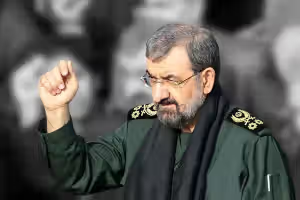
Mohsen Rezaei, a former commander-in-chief of Iran’s Islamic Revolutionary Guards Corps (IRGC), was appointed secretary of the Supreme National Security Council on August 9, 2026.
Mohsen Rezaei, whose four decades in Iran’s ruling establishment span the disputed Karbala-4 offensive, repeated failed presidential campaigns and an Interpol Red Notice over the AMIA bombing, returned to a top security post on Sunday.
The 71-year-old former commander-in-chief of the Revolutionary Guards was appointed secretary of the Supreme National Security Council after Mohammad Bagher Zolghadr resigned little more than four months into the job.
Supreme Leader Mojtaba Khamenei separately appointed Rezaei as his representative on the council, consolidating his position in a body central to decisions on war, diplomacy and Iran's confrontation with the United States.
The appointment adds another chapter to a career spanning command of the Revolutionary Guards through most of the Iran-Iraq war, decades in senior political institutions and four attempts to become president.
It also returns to prominence a figure whose record encompasses one of Iran's most disputed wartime operations, an Interpol Red Notice over the 1994 bombing of a Jewish community center in Argentina and years as a recurring subject of satire among Iranians online.
From Islamist militant to Guards commander
Born Mohsen Sabzevar Rezaei Mir-Ghaed in 1954, Rezaei became involved before the 1979 revolution with Mansouroun, an armed Islamist organization opposed to the monarchy.
Following the revolution, Mansouroun and six other Islamist organizations joined to form the Mojahedin of the Islamic Revolution Organization.
Rezaei's ascent through the new political order was rapid. Ruhollah Khomeini appointed him commander-in-chief of the Revolutionary Guards in 1981, when Rezaei was 27 and Iran was a year into its war with Iraq.
He remained in command until 1997, overseeing the Guards for almost the entire eight-year war and during its transformation from an armed organization into one of Iran's principal centers of military power.
Mohsen Rezaei (second from left) alongside Ali Khamenei (center) during the Iran-Iraq War.
Rezaei left military command in 1997 and moved into the Expediency Council, becoming its longtime secretary. He later served as vice president for economic affairs under President Ebrahim Raisi.
Politics did not deliver the electoral success he sought.
Rezaei entered presidential contests repeatedly, running in 2005 before withdrawing shortly before voting, and contesting elections in 2009, 2013 and 2021 without winning. His repeated appearances on presidential ballots eventually generated a running joke on Persian-language social media that wherever an election was taking place, Rezaei would inevitably become a candidate.
Mohsen Rezaei displays his identification document and inked finger as he registers to run in Iran’s presidential election.
Karbala-4 and a dispute that followed him for decades
No episode of Rezaei's military career has generated more lasting controversy inside Iran than Operation Karbala-4, launched against Iraqi forces in December 1986.
Rezaei was commander of the Revolutionary Guards when Iranian forces embarked on the operation. Accounts from commanders and participants later indicated that Iraqi forces had obtained advance knowledge of the offensive.
Akbar Hashemi Rafsanjani, who commanded Iran's war effort at the political level, later recalled learning shortly before the operation that it had been compromised.
Precise casualty figures remain disputed. Rafsanjani's wartime accounts put the toll at around 1,000 killed, 3,900 missing and 11,000 wounded.
The operation acquired renewed public significance decades later, particularly after the remains of 175 Iranian combat divers were returned to Iran in 2015.
File photo of Iranian forces preparing for Operation Karbala-4 during the Iran-Iraq War.
Rezaei reopened the controversy in 2018 when he wrote that Karbala-4 had been conducted to deceive Iraq before Iran launched the larger Karbala-5 offensive days later.
The description prompted criticism from veterans, former officials and military figures who argued that Karbala-4 had been designed as a genuine major offensive rather than a diversion.
Rezaei later clarified his remarks, saying Karbala-4 had indeed begun as a main operation but had subsequently been turned into a deception after the decision was made to withdraw.
An audio recording of Rezaei speaking to division commander Hossein Kharrazi during the opening phase also attracted attention because Rezaei could be heard instructing forces to continue advancing.
For critics, the episode became a wider argument over wartime accountability: whether commanders persisted with an operation despite evidence that Iraqi forces were prepared for it, and whether the later characterization of it as deception obscured the original plan.
Wanted in Argentina over AMIA bombing
Rezaei's years commanding the Guards also left him facing an international arrest request.
Argentina has sought him in connection with the July 1994 bombing of the AMIA Jewish community center in Buenos Aires, which killed 85 people and injured hundreds.
Interpol's Executive Committee approved a Red Notice for Rezaei and five other suspects in 2007 following a request from Argentina. Its General Assembly upheld the decision later that year.
Argentine authorities say Rezaei participated in a meeting at which the attack was decided. Rezaei and Iran have rejected Iranian responsibility.
His international travel has periodically revived the dispute. Argentina sought his arrest when he visited Qatar in 2022, without success.
Hostages for billions
Rezaei's public comments have also periodically generated controversy at home.
In 2015, he suggested that if the United States attacked Iran, Iranian forces could capture at least 1,000 Americans in the first week and demand billions of dollars for each one's release.
Mohsen Rezaei holds a banknote during a televised debate in Iran.
The proceeds, he suggested, could solve Iran's economic problems.
Such remarks, combined with his unsuccessful presidential campaigns and frequent television appearances, helped create a second public persona far removed from the image of the young wartime commander.
For some users on Persian-language social media, Rezaei became a stock character for political jokes.
That response resurfaced when Mojtaba Khamenei appointed him military adviser following the 2026 war. Users mocked everything from his return to office to the positioning of his belt buckle, which has itself become a longstanding internet meme.
Appointment revives criticism and ridicule online
Rezaei’s return to a senior security position prompted criticism and satire on X, where Iranian users revisited his wartime record, repeated presidential campaigns and controversial public remarks.
“Is Mohsen Rezaei’s military record, particularly during the war with Iraq, really defensible?” one user wrote. “Where does this extraordinary desire come from? From calling the Karbala-4 failure a deception operation, or from his idea of taking hostages to make money?”
Another user invoked the casualties of Karbala-4 more directly.
“Do you know that a huge number of young people in Operation Karbala-4 never saw the next morning?” the user wrote. “Yes, guess who the commander was. That’s right, Mohsen Rezaei.”
Some users instead interpreted the appointment through Iran’s internal power struggles.
One argued that the Revolutionary Guards had gained influence during the war while technocrats controlled the government, leaving the clergy with diminished power. The user portrayed Rezaei, a veteran Guards commander long removed from operational command, as a possible vehicle for restoring some of that influence.
Another suggested Rezaei’s appointment could strengthen parliament speaker Mohammad Bagher Ghalibaf, himself a former senior Guards commander.
Other posts sought to connect the reshuffle to reports of friction involving President Masoud Pezeshkian, with one user asking whether Rezaei’s appointment made previous reports about the president considering resignation more credible.
Mohsen Rezaei, Iran's new secretary of the Supreme National Security Council, speaks at an event.
Speculation over Pezeshkian’s position had begun before Rezaei’s appointment.
Mohammad Bagher Kharrazi, secretary-general of the Hezbollah of Iran political group, predicted the security council reshuffle in remarks circulated widely on social media, portraying it as part of an effort to constrain President Masoud Pezeshkian.
Kharrazi said that Pezeshkian had resigned or threatened to resign 28 times and that Supreme Leader Mojtaba Khamenei had grown frustrated with him and warned that another resignation would be accepted.
“That is why they are changing the Supreme National Security Council, moving Mr Zolghadr and replacing him with Mr Mohsen Rezaei,” Kharrazi said.
The prediction gained renewed attention after Zolghadr stepped down and Rezaei was appointed in his place.
Pezeshkian and Supreme Leader Mojtaba Khamenei’s office have denied accounts that the president repeatedly offered or threatened to resign.
A survivor returns
Rezaei's latest promotion comes at a markedly different moment from the one in which he first accumulated power.
The Supreme National Security Council has undergone rapid leadership changes following the killing of its former secretary Ali Larijani in March and Zolghadr's brief tenure afterward.
Rezaei now takes charge as Iran confronts the consequences of war and negotiations over the Strait of Hormuz, where he has taken an uncompromising public position.
He said in July that control over the waterway was “more important than dozens of atomic bombs,” and more recently said Iran would not accept an unauthorized shipping route through the Strait.
The appointment nevertheless puts a familiar figure back at the center of the system he helped build: a commander whose career has survived military setbacks, electoral defeats, international accusations and decades of political change, and who now again occupies one of the most consequential seats in Iranian national security policy.
A large banner depicting Iran's supreme leader Mojtaba Khamenei and his slain father and predecessor Ali Khamenei is displayed at an event marking religious processions of Arbaeen, in Iran, Iran August 3, 2026
Mojtaba Khamenei’s continued absence from public view has created an unusual system of authority in Tehran, where decisions are made and justified through written messages attributed to him while responsibility appears dispersed across a core establishment network.
With no public appearance or clear final word from Khamenei, competing figures can interpret his intentions differently, and those with the greatest institutional and military power are best placed to turn their interpretation into policy.
Khamenei has been absent from major political and personal events since becoming supreme leader, including the funeral of his wife and the extensive ceremonies marking his father’s death.
His disappearance has produced contradictory accounts about his condition, ranging from claims that he is in good health to reports of injuries or even the loss of a limb.
Officials and media close to the establishment have meanwhile cited extraordinary security precautions to explain why neither his image nor his voice has been released.
‘In principle’
Whatever the security rationale, Iranians have little means of assessing the new leader’s condition, capabilities or views for themselves. Instead, they encounter him largely through written statements and officials explaining what he means.
The clearest example came in a message attributed to Khamenei concerning negotiations and the memorandum of understanding with the United States.
He allowed President Masoud Pezeshkian to take responsibility for negotiations and effectively permitted the agreement to be signed, while saying that “in principle” he had held a different view.
Those two words immediately became a matter of political interpretation.
The IRGC’s political deputy rejected suggestions that they meant Khamenei fundamentally opposed negotiations. “This interpretation is incorrect and does not correspond with the existing realities,” he said.
But a military adviser to Khamenei offered a different reading: “When the Leader says, ‘in principle, I held a different view,’ it means the path that Agha had in mind was better than the path taken by the Supreme National Security Council.”
The same message could therefore be presented as permission for diplomacy or evidence of reservations about it, with figures claiming proximity to Khamenei effectively speaking on his behalf.
Speaking for the leader
The same process is helping construct Khamenei’s image as a wartime leader.
Ebrahim Jabbari, an adviser to the IRGC commander, has spoken of Khamenei’s “command and mastery” of military affairs and his management of expert meetings of the armed forces.
Supporters have also promoted the slogan “Khamenei has become young again,” presenting the succession as a renewal of leadership during war.
Such accounts give the military and security establishment an important role not merely in implementing the supreme leader’s decisions but in explaining his character, capabilities and intentions to the public.
Foreign leaders have inadvertently reinforced his position. Israeli Prime Minister Benjamin Netanyahu has publicly said Khamenei is alive, while US President Donald Trump has described him as “definitely and 100 percent” involved in negotiations between Tehran and Washington and even raised the possibility of meeting him.
Khamenei is thus presented by his subordinates as directing military affairs and confronting Iran’s enemies, while those same enemies publicly treat him as the ultimate decision-maker — even as he remains absent from public view.
Who decides?
That absence becomes more consequential as Iran confronts the choice between continued confrontation and diplomacy.
Khamenei has apparently authorized negotiations and the signing of an agreement, but messages attributed to him have also promised vengeance. Officials advocating different courses can therefore claim to be acting in accordance with the same leader.
Iran’s military and security institutions possess both the organizational power to act during wartime and an extensive presence in the state’s decision-making and media structures.
When Khamenei’s wishes are unclear, those institutions are better positioned than advocates of compromise to determine how they are translated into policy.
Majid Mousavi, commander of the IRGC Aerospace Force, has called on others to follow the supreme leader’s wishes as his forces carry much of the burden of the current war. Yet precisely what those wishes are remains unclear.
Policy instead emerges through written messages, competing interpretations and repeated invocations of the leader’s authority. Successes can be attributed to his leadership, while responsibility for costly decisions and their consequences is spread across a wider network.
The less Iranians see or hear from Mojtaba Khamenei, the more they must rely on others to tell them what he thinks. As the country weighs war against diplomacy, the question is increasingly not simply what Iran’s supreme leader wants, but who gets to decide what his wishes mean.