• العربية
  • فارسی
Brand
  • Iran Insight
  • Politics
  • Economy
  • Analysis
  • Special Report
  • Opinion
  • Podcast
  • Iran Insight
  • Politics
  • Economy
  • Analysis
  • Special Report
  • Opinion
  • Podcast
  • Theme
  • Language
    • العربية
    • فارسی
  • Iran Insight
  • Politics
  • Economy
  • Analysis
  • Special Report
  • Opinion
  • Podcast
All rights reserved for Volant Media UK Limited
volant media logo
EXCLUSIVE

IRGC personnel sheltered in Shiraz lodging complex were target of deadly strike

Shahed Alavi
Shahed Alavi

Iran International

Jun 24, 2026, 21:14 GMT+1
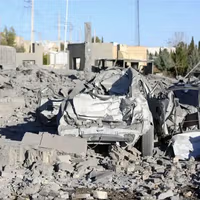
Aftermath of the March 2026 strike on the Zibashahr complex in Shiraz

IRGC personnel sheltering in a civilian lodging complex in Shiraz were the likely target of a strike that also killed nine civilians at a neighboring emergency center, an Iran International investigation found.

The March 5 strike hit several buildings inside the Zibashahr emergency lodging complex, where members of the Islamic Revolutionary Guard Corps and affiliated forces had taken shelter during the war, according to images from the site, open-source data, Iranian media reports, witness accounts and an expert assessment reviewed by Iran International.

The evidence suggests the strike was not a simple miss aimed at a nearby IRGC facility, but an attack on the lodging complex itself.

The site sat inside a civilian area, beside a local ambulance station that is part of Iran’s 115 emergency medical service, as well as service buildings and residential homes.

No party has claimed responsibility for the strike.

Fars provincial authorities later said 20 people had been killed and 30 wounded. At an official memorial ceremony in Zibashahr, however, only 16 names and photographs were released: seven IRGC and Basij members and nine civilians.

The civilians included two emergency technicians, a health worker, municipal employees and contractors, and a local shopkeeper.

The strike destroyed the ambulance station, a neighboring building and a larger structure to the east that formed part of the municipal emergency lodging complex. Nearby residential buildings were also damaged.

Aftermath of the March 2026 strike on the Zibashahr complex in Shiraz
100%
Aftermath of the March 2026 strike on the Zibashahr complex in Shiraz

Why the lodging complex was hit

The large destroyed building inside the Zibashahr complex was not an empty passenger facility or an unidentified structure.

The Student News Agency, linked to the Student Basij, published a video report from the site after the attack and said missiles had hit “dormitory and administrative buildings” in the complex. It also reported that military personnel had been killed and wounded.

The agency said the personnel were there for “training courses for border protection.”

But public mapping services, including Google Maps and the Iranian app Neshan, identify the site as an emergency lodging complex, not a military training facility.

The entrance of the Zibashahr complex
100%
The entrance of the Zibashahr complex

Verified images and videos from the area also show the lodging complex sign at the entrance. Iran International found no publicly available evidence that the site had previously functioned as a military training center.

Less than 200 meters away, across the highway, sits a large IRGC Ground Forces training and military complex. Open-source mapping also links the area to the IRGC’s 19th Fajr Division and an IRGC Aerospace Force unit in Shiraz. One officer killed in the Zibashahr strike was linked to the 19th Fajr Division.

Yet post-strike imagery showed no sign that the nearby IRGC complex itself had been destroyed.

That pattern is central to the investigation. If the intended target had been the formal IRGC facility, a miss of about 200 meters across the highway would have to explain several impacts on separate buildings inside the civilian lodging complex.

Wes Bryant, a former head of a US Air Force special targeting team and former Pentagon civilian-casualty assessment official, reviewed visual evidence from the site.

He assessed that the strike involved about 1,350 kilograms of munitions, including a weapon comparable to a 900-kilogram bomb against the larger eastern building and smaller munitions, comparable to 220-kilogram bombs, against two western structures, including the ambulance station.

With modern precision-guided munitions, Bryant said, a 200-meter error across a highway would be highly unlikely, particularly in several separate impacts.

His assessment supports the conclusion drawn from the other evidence: the lodging complex itself, or specific buildings inside it, was the likely target.

Aftermath of the March 2026 strike on the Zibashahr complex in Shiraz
100%
Aftermath of the March 2026 strike on the Zibashahr complex in Shiraz

A target among civilians

The evidence reviewed by Iran International points to a strike on a civilian lodging complex after IRGC personnel moved into it during the war.

That may explain why the Zibashahr complex, rather than the nearby formal IRGC facility, was hit. But the same evidence also shows that the targeted buildings stood inside a civilian setting, beside an ambulance station and near residential homes.

That leaves responsibility on the Iranian side.

By moving or allowing military personnel to shelter in a civilian lodging complex, next to an emergency medical site and homes, Iranian authorities placed civilians and medical workers in the path of a foreseeable strike.

It is not necessary to prove that civilians were intentionally used as shields to establish the consequence: the risk of war was shifted from a military facility into a place used by civilians.

That responsibility does not remove the attacker’s obligations.

Even if the presence of IRGC personnel made part of the lodging complex a military target, it did not automatically strip the neighboring ambulance station, surrounding buildings or nearby homes of protection.

A medical site loses its special protection only if it is itself used for acts harmful to the enemy; Iran International found no evidence in the material reviewed that the ambulance station was used in that way.

The strike therefore leaves two central facts in tension.

IRGC personnel appear to have taken shelter among civilians, turning part of the complex into a target. But the attack also destroyed an ambulance station and killed civilians in an area whose medical and residential character was visible in public maps and imagery.

In Zibashahr, the war moved from a military complex into a lodging site, an ambulance station and people’s homes.

Most Viewed

Ships face conflicting Iran, US instructions in Strait of Hormuz - FT
1

Ships face conflicting Iran, US instructions in Strait of Hormuz - FT

2

Banking disruption hits services at eight Iranian banks

3

US opens door to Iranian oil in historic sanctions rollback

4

Israel smuggled tens of thousands of Starlink systems into Iran, former PM says

5

Tehran bread prices jump up to 100% in latest increase

Banner
Banner
Banner

Spotlight

  • IRGC personnel sheltered in Shiraz lodging complex were target of deadly strike
    EXCLUSIVE

    IRGC personnel sheltered in Shiraz lodging complex were target of deadly strike

  • Don’t feed us, free us: Iranians hit back at Vance over 'hunger' remarks
    VOICES FROM IRAN

    Don’t feed us, free us: Iranians hit back at Vance over 'hunger' remarks

  • Opium for survival: Inside a shift in Iran’s Zagros villages
    EXCLUSIVE

    Opium for survival: Inside a shift in Iran’s Zagros villages

  • Tehran bread prices jump up to 100% in latest increase

    Tehran bread prices jump up to 100% in latest increase

  • Relief or resistance? Tehran dailies offer diverging readings of talks
    INSIGHT

    Relief or resistance? Tehran dailies offer diverging readings of talks

•
•
•

More Stories

Lufthansa rebuts Iran report suggesting return of flights

Jun 24, 2026, 18:11 GMT+1
Lufthansa rebuts Iran report suggesting return of flights
100%

Lufthansa Group pushed back against Iranian media claims that its airlines are preparing to return to Iran, saying flights to and from Tehran remain suspended until October 24 and any resumption depends on a security review.

Earlier on Wednesday, Mehr News Agency reported under the headline “Lufthansa returns to Iran” that a Lufthansa Group representative met Ramin Kashef-Azar, chairman and chief executive of Imam Khomeini Airport City, to discuss restoring flights and developing new routes.

The Iranian report said the representative had expressed interest by Lufthansa Group airlines, including Eurowings, Austrian Airlines and ITA Airways, in resuming flights to Iran. It also said Austrian Airlines would likely restart earlier than others and that Lufthansa was reviewing Iran flights for its winter schedule.

But in a written response to Iran International’s Germany correspondent Ahmad Samadi, Lufthansa described the meeting as a customary exchange and made clear that no return decision had been announced.

“The airlines of the Lufthansa Group have suspended all flights to and from Tehran up to and including October 24th, 2026,” the company said.

“We can confirm that a meeting with local representatives recently took place. Such exchanges are customary and form part of our ongoing assessment of operational and regulatory conditions,” Lufthansa added.

The company said any return to Iran would depend on a wider security review.

“Any decision regarding a resumption of services to Iran will be subject to a comprehensive security assessment and ongoing evaluation of the operational environment,” Lufthansa said. “The safety and security of our passengers and crews remain our highest priority.”

Lufthansa’s response did not confirm any restart date, winter schedule plan or specific return by any of its group airlines, sharply contrasting with the Iranian framing of the meeting as a sign of imminent normalization.

The exchange shows Tehran’s attempt to present routine aviation contacts as evidence that foreign carriers are returning after the war, while major airlines remain publicly cautious about security and operating conditions in Iran.

IAEA chief says inspectors will visit Iran enrichment sites under US-Iran MoU

Jun 24, 2026, 10:23 GMT+1
IAEA chief says inspectors will visit Iran enrichment sites under US-Iran MoU
100%
UN nuclear watchdog chief Rafael Grossi holds a press conference on the opening day of the International Atomic Energy Agency's (IAEA) quarterly Board of Governors meeting in Vienna, Austria, September 8, 2025.

UN nuclear watchdog chief Rafael Grossi said on Wednesday that IAEA inspectors would visit Iranian enrichment sites under a memorandum of understanding between Tehran and Washington.

The United States and Iran have given contradictory accounts about whether the sites would be inspected, but Grossi said the inspections were “going to happen.”

"I can understand political statements, they are part of the reality, but the fundamental thing I would like to remind you and draw your attention to is that there has been a memorandum of understanding, signed by both presidents," Grossi told journalists at a news conference at the Fukushima Daiichi nuclear power plant in Japan.

He said the agreement explicitly required IAEA supervision of nuclear activities involving Iran’s nuclear material and facilities.

"Obviously, to do that, we will have to inspect. Whether this happens the day after tomorrow or in one week or in 10 days, it's important, but not essential. This is going to happen," he said.

US President Donald Trump said on Tuesday that Iran had agreed to long-term, high-level nuclear inspections, adding that he would not allow further negotiations without such an agreement.

“Iran has fully and completely agreed to highest level Nuclear inspections long into the future (Infinity!!!). This will insure ‘Nuclear Honesty.’ If they did not agree to this, there would be no further negotiations,” he wrote in a post on Truth Social.

Meanwhile, Iran’s foreign ministry spokesperson Esmaeil Baghaei said that Tehran had no plans to allow IAEA inspectors to visit nuclear sites damaged in war.

His comments came a day after US Vice President JD Vance also said Iran had agreed to invite IAEA inspectors back into the country, describing it as a first step toward a broader nuclear settlement.

Qatar says US-Iran hotline essential to reopen Hormuz - FT

Jun 24, 2026, 09:51 GMT+1
Qatar says US-Iran hotline essential to reopen Hormuz - FT
100%
Vessels at the Strait of Hormuz, as seen from Musandam, Oman, June 18, 2026.

Qatar’s prime minister said a hotline between the US and Iran was essential to stop rogue actors from disrupting the reopening of the Strait of Hormuz, the Financial Times reported on Wednesday.

Sheikh Mohammed bin Abdulrahman al-Thani told the FT the hotline, agreed during US-Iran talks in Switzerland, was needed to counter "disinformation" and verify threats to ships as mines were cleared from the waterway.

"A challenge" was that people seeking to disrupt the deal could use shipping communications to issue false warnings, he said.

"The hotline’s purpose is to make sure that any ship that gets any type of threat is to be verified by Iran ... and to let the ship pass safely," Sheikh Mohammed said.

He said the waterway had remained open despite statements by Iran’s Revolutionary Guards that it would close again in response to Israeli strikes on Hezbollah in Lebanon. Mediators had checked with Iranian officials, who said no order had been issued to close it, he said.

LNG return

Qatar expects shipping through the strait to begin returning to normal in the first few weeks of the deal, though Sheikh Mohammed said restoring confidence would take time, the FT reported.

"It cannot be normal in one day, and it will take a lot of effort," he said.

Qatar would resume normal liquefied natural gas production "within a few weeks," except at damaged facilities, he said.

QatarEnergy suspended production after attacks on its Ras Laffan facilities during the war. The company will lift force majeure only when it judges it is safe to operate, Sheikh Mohammed said.

He said Doha would oppose any Iranian plan to charge ships fees to pass through the strait.

"We cannot accept a situation or a condition where our gateway to the world is controlled," he said.

The US and Iran agreed under their memorandum of understanding to extend a ceasefire by 60 days and begin nuclear talks, with Qatar and Pakistan mediating efforts toward a final settlement.

Don’t feed us, free us: Iranians hit back at Vance over 'hunger' remarks

Jun 24, 2026, 02:57 GMT+1
•
Saba Heidarkhani
Don’t feed us, free us: Iranians hit back at Vance over 'hunger' remarks
100%
Protesters scatter rice into the air in Abdanan during the January 2026 uprising, a scene that later became a symbol of dignity and defiance for many Iranians.

After Donald Trump said Iran has “a hunger problem” and JD Vance said unfrozen Iranian assets could help “feed the Iranian people,” Iranians pushed back, saying the country’s real crisis is repression, corruption and the fight for freedom, not hunger.

Speaking in Switzerland on Monday, Vance said Washington could agree to release frozen Iranian funds for purchases of US agricultural products such as wheat, corn and soybeans.

"If Iranian assets are ever unfrozen, they're going to go to make American farmers richer and to feed the Iranian people," Vance said.

He said the United States and Qatar would oversee the process, though Iranian officials have disputed that characterization.

Trump made similar remarks on Tuesday, saying money taken out of Iran would go to American farmers to provide “corn, soybeans, wheat to Iran.”

“They have a hunger problem, they have a food problem, they have a medicine problem, they got a lot of problems,” Trump said, adding that inflation in Iran had “hit 300%.”

  • Will the Islamic Republic trade with the 'Great Satan'?

    Will the Islamic Republic trade with the 'Great Satan'?

The remarks sparked widespread reactions from Iran International's viewers, many of whom said the country's struggle cannot be reduced to hunger.

"American officials talk about hunger in Iran as if our problem is a lack of food. Everything exists here. Government policies have made food unaffordable. Sending grain won't solve our problems," one viewer told Iran International.

While many respondents acknowledged the country's worsening economic crisis, they argued that inflation, corruption and decades of mismanagement—not a shortage of food—have made life increasingly difficult.

Others said they have little faith that any economic relief provided to the Islamic Republic would ultimately benefit ordinary citizens.

"Right now the Islamic Republic is probably figuring out how to send that wheat to Lebanon and Iraq," one viewer wrote.

The comment was a reference to the Islamic Republic's long-standing support for regional militant allies and proxy groups. Many respondents argued that Tehran has repeatedly prioritized its regional strategy over the welfare of its own citizens.

Several viewers also objected to what they saw as a portrayal of Iranians as a population waiting to be fed.

"The people of Iran are not hungry. They sacrificed their lives and shed blood for freedom," one respondent said.

Many pointed to the nationwide protests of January 2026, arguing that the movement was driven by demands for freedom and political change rather than economic assistance.

Some referenced the symbolic scene in Abdanan, where protesters threw rice into the air during demonstrations. Videos from the western city showed protesters throwing rice into the air, a gesture many interpreted as a rejection of the idea that their uprising was driven by hunger.

"Mr. Vance, you were not there during those January nights in Abdanan when grains of rice fell from the sky like snow," one citizen wrote.

For many respondents, the image symbolized dignity and defiance. They argued that while many Iranians are struggling economically, the country's crisis is ultimately one of governance and freedom.

They did not deny the depth of economic hardship, but said reducing Iran’s crisis to hunger ignored the political nature of their struggle.

Others stressed that Iran is not a poor country lacking resources.

"Our problem with the Islamic Republic is not only economic. It is a government that opposes human dignity, personal freedoms and Iran's ancient national culture. It is governed by ideology and follows a path separate from the Iranian people," one viewer wrote.

Another respondent was blunter.

"Mr. Vance, Iran is a rich country. If you don't believe me, ask Hezbollah, Hamas, the Popular Mobilization Forces and the Houthis."

The reactions reveal deep skepticism among Iranians who wrote to Iran International toward any agreement that could provide financial relief to the Islamic Republic. For them, the issue is not hunger alone, but freedom, dignity and who ultimately benefits when money flows back into the hands of Tehran.

Opium for survival: Inside a shift in Iran’s Zagros villages

Jun 23, 2026, 22:00 GMT+1
•
Saman Rahmatian
Opium for survival: Inside a shift in Iran’s Zagros villages
100%

Opium poppy cultivation in some villages of the Zagros mountains in western Iran has evolved from a hidden, scattered practice into an essential part of the rural subsistence economy, an Iran International investigation found.

On the rugged slopes of the Zagros, amid rocky plots and felled oak trees, opium poppy is no longer merely an illegal crop. It has become a sign of the economic deadlock facing villages where wheat, chickpeas and lentils no longer cover the costs of farming and daily life.

A few kilometers from the road, deep in the Zagros mountains, a small plot of land emerges from among cut-down oaks. Access to it is difficult, and it is barely visible from the village. Its owner prefers to watch over it from a distance.

He told Iran International that if authorities find the plot, it would be difficult for them to prove who owns the land.

Opium poppy plants have grown quietly in the Zagros, a crop now seen more often than before in some villages across the region.

Lancing season on the Zagros slopes

It is now the season for lancing poppy capsules in the Zagros range. Before the sun grows harsh over the plains, farmers make cuts in the poppy bulbs.

Hours later, a white sap seeps from the wounds, a substance that turns into opium once dried.

Farmers say poppy is usually planted in the region in two seasons. Some fields are cultivated in the first month of autumn, around September and October, and others in the second month of winter, around January and February. Harvesting continues from mid- to late-spring, roughly from April to late May.

'Poppy is our only hope'

Iran International’s investigations show that poppy cultivation in the Zagros has been expanding for more than 10 years.

Most poppy growers prefer to plant the crop on mountain slopes and in hard-to-reach areas, where the risk of detection is lower.

One farmer said poppy is suited to the region’s climate and can be grown even on rain-fed and rocky land.

“Planting in the heart of the mountain is hard, but we have no other choice,” he said. “Poppy is our only hope.”

Wheat no longer covers the costs

For years, wheat, chickpeas and lentils formed the backbone of village economies in the Zagros. But farmers tell Iran International rising production costs, consecutive droughts, declining land productivity and delays in government payments have changed the farming equation.

“Wheat no longer covers the cost of the land,” one farmer said. “Costs have risen so much that in the end, nothing is left for us — and that is if the government pays for the wheat on time.”

Academic research and international studies in poppy-producing regions confirm that drought, falling agricultural income and the lack of alternative economic options are among the main factors pushing farmers toward poppy cultivation.

The United Nations Development Program has also stressed that combating poppy cultivation will be difficult without creating sustainable economic alternatives.

The opium economy: A more profitable crop

The value of the opium market has risen in recent years. Some Iranian media outlets reported in April that the retail price of each gram of opium was about 250,000 tomans, roughly $1.6.

According to data from the United Nations Office on Drugs and Crime, poppy fields in climates similar to Iran’s typically produce between 20 and 30 kilograms of pure opium per hectare. In some regions, the figure exceeds 50 kilograms.

A comparison between income from poppy and wheat, one of the main agricultural products of western Iran, helps explain why some farmers have turned to the crop.

With wheat priced at about 49,500 tomans per kilogram and average production of 3.5 tons per hectare, the value of wheat from 1 hectare is estimated at around 173 million tomans (almost $1,081).

By contrast, a hectare of poppy producing 20 to 30 kilograms of opium could generate an estimated 5 billion to 7.5 billion tomans, or roughly $31,000 to $47,000, based on the reported retail price.

In higher-yield areas, where output can exceed 50 kilograms per hectare, the value could rise to about 12.5 billion tomans, or roughly $78,000. That means the estimated value of opium from 1 hectare could be about 29 to 72 times higher than wheat grown on the same area.

Cultivated area grows more than threefold

Signs of the spread of poppy cultivation can even be seen in remarks by some officials.

According to Mohammad Jamalian, a member of parliament’s Health and Medical Commission, the area under poppy cultivation in Iran has reached about 32,000 hectares — a figure he said is more than 3 times higher than in previous years.

Accurately estimating the total area under cultivation is difficult, because many poppy fields are set up in remote lands and places outside public view.

However, a review of reports published in recent years shows that the names of Zagros provinces appear more often than other regions in news about the discovery and destruction of poppy fields. These are provinces that are simultaneously grappling with drought, unemployment and livelihood crises.

Afghanistan’s shadow over the regional market

The story of poppy does not end in the Zagros fields. Hundreds of kilometers away, in Afghanistan, an unprecedented decline in poppy cultivation following the Taliban’s return to power has altered the dynamics of the market across the region.

Iran’s Drug Control Headquarters has said the sharp fall in poppy cultivation in Afghanistan has led to a noticeable decline in the entry and seizures of opium in Iran, and has even created problems in supplying raw materials for some medicines.

The recent war has added to these pressures and worsened Iran’s medicine supply crisis, with health officials reporting shortages of nearly 1,000 types of medication across the country.

Meanwhile, Iran remains one of the world’s largest opium consumer markets.

According to Health Ministry officials, in addition to the hidden number of drug users, about 3 million people in Iran are officially registered as addicts, and opium remains their main drug of use.

Western Iran is also located near one of the region’s key routes for the trafficking of opiates, a route that passes through Iraq and the Kurdistan Region and continues toward Turkey and Europe.

Although there is no evidence that the crop produced by poppy farmers in the Zagros is exported, the existence of a consumer market and the region’s sensitive geography are among the factors that could create fertile ground for the phenomenon to expand.

The blade drawn today across poppy capsules on the slopes of the Zagros reveals the trace of a crisis that began with drought and rising costs — and has now changed the path of livelihood in some of Iran’s villages.