• العربية
  • فارسی
Brand
  • Iran Insight
  • Politics
  • Economy
  • Analysis
  • Special Report
  • Opinion
  • Podcast
  • Iran Insight
  • Politics
  • Economy
  • Analysis
  • Special Report
  • Opinion
  • Podcast
  • Theme
  • Language
    • العربية
    • فارسی
  • Iran Insight
  • Politics
  • Economy
  • Analysis
  • Special Report
  • Opinion
  • Podcast
All rights reserved for Volant Media UK Limited
volant media logo

Tehran bread prices jump up to 100% in latest increase

Hooman Abedi
Hooman Abedi

Iran International

Jun 23, 2026, 13:13 GMT+1
A baker prepares traditional flatbread Barbari at a bakery in Iran.

Bread prices across Tehran province have risen by as much as 100%, pushing the cost of one of the most important staple foods sharply higher and raising fresh concerns over government plans to overhaul the country's subsidy system.

Residents arriving at bakeries on Tuesday found new official prices in effect following an order issued by Tehran provincial authorities and announced by the Iran Chamber of Guilds' flour and bread working group. Under the new rates, lavash flatbread now costs 27,000 rials (2 cents), yeast-leavened barbari 100,000 rials (6 cents) and sangak 155,000 rials (10 cents).

The average monthly wage in Iran is estimated at around $150. A family relying solely on bread for its food consumption would spend roughly $8-$17 per month, depending on the type of bread purchased.

The increase came only two days after Agriculture Minister Gholamreza Nouri Ghezeljeh said bread price rises were not under consideration and that the government was pursuing plans to transfer subsidies from bakeries to households through an expanded electronic voucher system.

The latest hike continues a trend that began during the presidency of the late Ebrahim Raisi and has accelerated under President Masoud Pezeshkian. Compared with less than a year ago, official price schedules show sangak prices have risen by 104%, barbari by 85% and lavash by 93%.

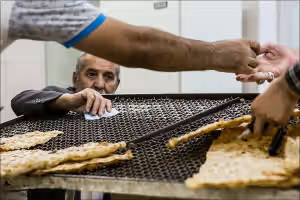
Freshly baked Sangak bread is displayed at a bakery in Iran (undated)
100%
Freshly baked Sangak bread is displayed at a bakery in Iran

Before September 2024, when the US dollar traded at around 600,000 rials on the free market, Lavash cost 5,000 rials ($0.008), while Barbari sold for 18,000 rials (3 cents) and Sangak for 30,000 rials (5 cents).

The increase follows similar price rises elsewhere in the country. Bread prices in West Azarbaijan province rose by 70% to 100% last month, while prices in Mashhad increased by an average of 49% in mid-June. Reports from other provinces have also pointed to either higher bread prices or reductions in dough weights, a practice some consumers and analysts describe as hidden inflation.

Card-based bread system

The latest increase comes as authorities continue to rely on the Nanino digital monitoring platform, introduced in 2022 to distribute subsidized flour based on bakery sales.

Many bakers say technical problems and disputed calculations have reduced their flour allocations. Although authorities insist there are no limits on bread purchases, consumers in many areas report restrictions as bakeries attempt to stretch subsidized flour supplies.

Subsidy cuts spark concern

The Pezeshkian administration has steadily reduced support for wheat and flour subsidies since taking office and is examining plans to integrate bread subsidies into the electronic voucher program, a move that could effectively end the current subsidy structure.

The proposal has generated concern even among media outlets generally supportive of state policies. News website Khabar Online warned that public tolerance for rising prices was wearing thin and that additional pressure linked to a staple as widely consumed as bread could provoke a strong public reaction.

"Public tolerance for price increases has reached its limit, and society may face severe tension and shock from any new pressure, particularly over a product such as bread that is consumed extensively across cities, villages and lower-income households," the outlet wrote.

Freshly baked lavash bread is displayed at a bakery in Iran. (undated)
100%
Freshly baked lavash bread is displayed at a bakery in Iran.

Bakery owners say they face growing costs for labor, utilities and raw materials while operating under regulated prices and delayed subsidy payments. Economists and labor activists warn that repeated increases in bread prices disproportionately affect low-income families because bread remains a key component of household consumption.

The price rise comes as inflation remains elevated. According to Iran's Statistical Center, consumer prices in May were 83.9% higher than a year earlier, while annual inflation reached 57.7%.

As the government moves ahead with subsidy reforms, the price of bread is increasingly becoming a measure of the economic strain facing millions of families across the country.

Most Viewed

Hardliners accuse negotiating team of ignoring Supreme Leader's objections
1

Hardliners accuse negotiating team of ignoring Supreme Leader's objections

2
INSIGHT

Will the Islamic Republic trade with the 'Great Satan'?

3

Israel reveals Iranian-designed Hezbollah ‘terror tunnel’ with large drone cache

4
OPINION

MoU's forgotten casualty is the Iranian people

5
INSIGHT

Iran's postwar rallies become flashpoint in diplomacy debate

Banner
Banner
Banner

Spotlight

  • Tehran bread prices jump up to 100% in latest increase

    Tehran bread prices jump up to 100% in latest increase

  • Rising gym fees push fitness beyond reach for many Iranians
    VOICES FROM IRAN

    Rising gym fees push fitness beyond reach for many Iranians

  • Relief or resistance? Tehran dailies offer diverging readings of talks
    INSIGHT

    Relief or resistance? Tehran dailies offer diverging readings of talks

  • Will the Islamic Republic trade with the 'Great Satan'?
    INSIGHT

    Will the Islamic Republic trade with the 'Great Satan'?

  • Iran's postwar rallies become flashpoint in diplomacy debate
    INSIGHT

    Iran's postwar rallies become flashpoint in diplomacy debate

  • MoU's forgotten casualty is the Iranian people
    OPINION

    MoU's forgotten casualty is the Iranian people

  • Rampant inflation may ignite bread riots in Iran, economist warns

    Rampant inflation may ignite bread riots in Iran, economist warns

  • Bread shortages, soaring prices strain households in Iran, residents say

    Bread shortages, soaring prices strain households in Iran, residents say

•
•
•

More Stories

Rising gym fees push fitness beyond reach for many Iranians

Jun 23, 2026, 10:38 GMT+1
•
Saba Heidarkhani
Rising gym fees push fitness beyond reach for many Iranians
100%
A man adjusts a treadmill at a gym in Iran.

Soaring gym fees and shrinking household budgets are forcing many Iranians to abandon sports and fitness activities, turning what was once a routine part of daily life into an unaffordable luxury, according to messages sent to Iran International.

Monthly gym memberships that were once within reach for many families now cost at least 20 million rials ($12.5) in smaller cities. In some gyms in Tehran and other major urban centers, 12 training sessions can cost as much as 200 million rials ($125). The average wage in Iran is $150.

Gym owners say inflation, rising rents, higher energy bills and the growing cost of imported equipment have left them little choice but to raise fees. For many households, however, food, housing and transportation now take priority over exercise.

Teen athletes forced to quit

Many of the messages received by Iran International on the issue came from teenagers who said financial pressures were disrupting their athletic ambitions.

A 15-year-old taekwondo athlete said she had spent months trying to save enough money to buy a punching bag. A 13-year-old basketball player said he had been forced to stop training indoors because of rising fees.

A university student in Mashhad said gym membership remained out of reach despite a strong interest in fitness.

“Registering at a gym and working out is something I still want to do, but my salary is so low that I cannot afford it,” the student said.

100%

The decline in participation is also hitting gym owners and coaches.

A gym manager in eastern Tehran said the number of clients at his facility had fallen to roughly one-third of previous levels, despite keeping membership fees unchanged.

Coaches in several cities said they had lost most of their students in recent months and lacked both fixed salaries and insurance coverage. Many warned that smaller sports businesses could face closure if the trend continues.

Rising costs beyond membership fees

The financial pressure extends beyond gym subscriptions. Coaches and athletes say the price of protein-rich foods and sports supplements has climbed sharply, making it harder to maintain training programs.

Citizens reported that whey protein now costs around 200 million rials ($125), while a 300-gram container of creatine sells for about 40 million rials ($25).

Football players also pointed to soaring equipment costs, saying cleats priced below 50 million rials ($31) have become difficult to find. One player said football field rental fees can also reach 50 million rials ($31).

Health experts have long warned that lower levels of physical activity can contribute to higher healthcare costs over time. For many Iranians, however, regular exercise is increasingly becoming a financial burden rather than a basic part of a healthy lifestyle.

Iran says no plan for UN nuclear inspections at bombed sites

Jun 23, 2026, 09:28 GMT+1
Iran says no plan for UN nuclear inspections at bombed sites
100%

Iran said on Tuesday it had no plan for UN nuclear inspectors to visit sites damaged in US and Israeli strikes, rejecting Vice President JD Vance’s statement that discussions on their return could begin as soon as Monday.

"Neither have we had a meeting with the director general of the IAEA, nor is there a plan for agency inspections of Iran's damaged nuclear facilities," Iranian Foreign Ministry spokesperson Esmail Baghai told a news conference.

"There is no protocol for this issue," he said.

Vance said on Monday that talks in Switzerland between US and Iranian officials had laid a "very good foundation" for a final agreement to end the war.

Asked when International Atomic Energy Agency inspectors could return, he said the process would start "at a minimum this week" and that conversations with the agency "could happen as soon as today."

President Donald Trump said on Monday that Iran "will agree to have Major Weapons Inspections."

Iran suspended IAEA access to sites hit during last summer’s 12-day war. The UN nuclear watchdog later withdrew its remaining inspectors from the country.

  • Relief or resistance? Tehran dailies offer diverging readings of talks

    Relief or resistance? Tehran dailies offer diverging readings of talks

Frozen funds and US farm sales

Baghaei also rejected the idea that Iran had agreed to use frozen funds to buy US agricultural goods, after Vance said the issue had come up in the talks.

Vance said the US had asked Qatar to help set up a mechanism to direct the money.

"We could ensure that the money goes where we want it to go," Vance said. "That will obviously be a big part of the negotiation in the days to come."

He said the arrangement would help "American farmers" and the people of Iran, but added that the funds would not be released unless Washington saw further progress.

Baghaei said Iran would decide how to use its assets based on national interests and needs.

"Any decision will be made based on the interests and welfare of the country," he said.

He said Iran’s agriculture ministry and other bodies would decide on purchases based on price and quality.

Missiles outside talks

Baghaei said Iran’s missile and defense capabilities were not part of the negotiations and would not be discussed.

"Iran's defensive and missile capabilities have absolutely not been part of our talks and will never be a subject of negotiation with any party," he said.

He said Iran and the US had no direct contact after the four-party meeting in Switzerland stopped, and that messages continued through mediators Qatar and Pakistan.

"After the decision to stop the four-party negotiations, we had no direct contact with the American side," Baghaei said.

He said the sides had not held detailed talks on nuclear issues in Switzerland.

"Apart from the general presentation of positions by the American side, no detailed discussion on the nuclear issue took place," he said.

  • Hope meets caution as Tehran weighs economic impact of US deal

    Hope meets caution as Tehran weighs economic impact of US deal

Oil waiver

The US Treasury on Monday issued a 60-day license allowing Iran to produce, sell and deliver crude oil and petrochemicals, with related banking, insurance and transport services.

Baghaei said the oil-sale authorization had taken effect and Iran could use released or previously blocked assets to buy goods it needed.

"What is important for us is access to assets that have been unjustly blocked," he said.

Treasury Secretary Scott Bessent said the waiver was linked to Iranian commitments to keep the Strait of Hormuz open and allow IAEA inspectors back into the country.

Lebanon mechanism

Baghai said Iran, the US, Qatar, Pakistan and Lebanon had agreed in principle to a mechanism to oversee the ceasefire in Lebanon and prevent further clashes.

"The details of this mechanism require further examination and work," he said.

Iranian Foreign Minister Abbas Araghchi has said Lebanon would be the first "real test" of the agreement.

Iran hardliners seek to stir unrest in parliament after US MoU, activist says

Jun 23, 2026, 06:32 GMT+1
Iran hardliners seek to stir unrest in parliament after US MoU, activist says
100%

A conservative Iranian activist accused hardline lawmakers of pushing to reopen parliament to inflame tensions and use its platform for factional purposes following the MOU between Tehran and Washington.

Mohammad Mohajeri said members of the hardline Paydari Front wanted to use parliament’s podium for their own political interests, citing recent remarks by lawmaker Mahmoud Nabavian, who has criticized Iran’s negotiating team.

Mohajeri likened the hardliners to Colonel Vladimir Liakhov, a Tsarist Russian military officer who bombarded and shut down Iran’s parliament in 1908, saying they also “want to bombard parliament.”

He also criticized the current parliament, calling it “one of the most ineffective parliaments in terms of a positive record.”

“It has done nothing useful and has only pursued noise and controversy,” he said.

He made the comments after MP Kamran Ghazanfari announced plans for a protest outside parliament, saying a group of lawmakers will stage a sit-in if the legislature remained closed.

The head of parliament’s Health and Treatment Committee previously criticized the continued closure of parliament, saying lawmakers had been sidelined amid the Islamic Republic’s talks with the US.

“They closed parliament so they could sign whatever they wanted,” Hosseinali Shahriari said.

Ships face conflicting Iran, US instructions in Strait of Hormuz - FT

Jun 23, 2026, 05:27 GMT+1
Ships face conflicting Iran, US instructions in Strait of Hormuz - FT
100%
Ships are seen near the Strait of Hormuz in a handout image released by Iranian state media on June 21, 2026.

Shipowners are facing confusion over the safest route out of the Persian Gulf as Iran, the United States and western insurers issue conflicting guidance on travel through the Strait of Hormuz, the Financial Times reported on Tuesday.

Shipping traffic through the strait has increased, but Iran has warned that vessels could face penalties or be forced to turn back if they do not seek advance permission from Tehran and sail close to the Iranian coast, the report said.

At the same time, the United States and some western insurers are advising ships to use a route protected by US air cover on the Omani side of the strait, the report said, citing three shipping executives.

The conflicting guidance has left shipowners unsure whether to risk possible Iranian interference or ignore advice from insurers and US authorities, it added.

“Shipowners and operators find themselves caught in a difficult position. If they follow the guidance of underwriters and US authorities by navigating closer to Oman, they risk interference, detention or potential hostile action from Iranian authorities,” said Dr SV Anchan, chair of the US shipping company Safesea Shipping.

Relief or resistance? Tehran dailies offer diverging readings of talks

Jun 23, 2026, 04:08 GMT+1
•
Behrouz Turani
Relief or resistance? Tehran dailies offer diverging readings of talks
100%
A paddleboarder moves through the waters of the Strait of Hormuz as a tanker sails in the distance, June 21, 2026

While much of Iran's political press focused on the diplomatic drama surrounding the latest round of US-Iran talks in Switzerland, several economic newspapers used Monday's coverage to highlight the country's deeper economic challenges and post-war uncertainties.

The talks ended with a joint statement from mediators Qatar and Pakistan announcing a roadmap toward a final agreement within 60 days, alongside plans for further technical negotiations.

Iranian officials have also highlighted progress on the release of frozen assets and the possibility of expanded trade.

On Monday, Iran's central bank chief Abdolnasser Hemmati said funds released under the emerging agreement would not necessarily be limited to essential goods and could be used to purchase other non-sanctioned products.

Iranian newspapers largely divided along familiar lines, with hardline outlets portraying the talks as a test of national resolve and moderate publications emphasizing the potential economic benefits of diplomacy.

Economic outlets, by contrast, focused on questions of market stability, sanctions relief and the country's long-term structural problems.

The prominent economic daily Donyaye Eghtesad argued that "a 60-day diplomatic stopgap cannot solve deep-seated, post-war structural challenges."

Its editorial noted that "the diplomacy of the mattress in Switzerland cannot mask the reality that a 60-day roadmap is a temporary truce, not a permanent architecture."

It warned that markets had reacted with immediate volatility to the diplomatic developments, underscoring the risks of managing the economy through short-term political decisions.

Oil-export waivers may provide temporary liquidity, the paper argued, but cannot by themselves resolve deeper structural problems or restore long-term confidence.

Resistance versus relief

The dominant hardline narrative remained one of resistance rather than compromise.

Kayhan argued that Iran's temporary reinstatement of restrictions on traffic through the Strait of Hormuz over the weekend had forced the United States "back to reality."

The newspaper wrote that the brief disruption "proved once again that the only language the Western front understands is the language of definitive leverage," adding that Parliament Speaker Mohammad Bagher Ghalibaf's reported walkout from negotiations demonstrated that Iran "does not negotiate under the shadow of social media threats."

Javan urged negotiators to remain cautious, describing the 60-day roadmap as "a tactical pause forced upon the Americans by the operational readiness of our armed forces."

But moderate voices offered a markedly different assessment.

Shargh described the outcome of the talks as "a fragile but essential window of relief," noting that concrete oil and petrochemical waivers had, for the first time, been linked to a diplomatic timetable.

At the same time, it cautioned that "the shadow of Donald Trump's erratic, transactional approach to international relations looms large," urging negotiators to secure technical and economic guarantees before the current opportunity closes.

Etemad focused on the domestic economy, arguing that Iran "desperately requires the structural stability these sanctions waivers promise" and portraying the developments in Switzerland as evidence that a pragmatic diplomatic framework remains viable.