• العربية
  • فارسی
Brand
  • Iran Insight
  • Politics
  • Economy
  • Analysis
  • Special Report
  • Opinion
  • Podcast
  • Iran Insight
  • Politics
  • Economy
  • Analysis
  • Special Report
  • Opinion
  • Podcast
  • Theme
  • Language
    • العربية
    • فارسی
  • Iran Insight
  • Politics
  • Economy
  • Analysis
  • Special Report
  • Opinion
  • Podcast
All rights reserved for Volant Media UK Limited
volant media logo

Is the US blockade working? It depends who you ask

Apr 27, 2026, 01:25 GMT+1
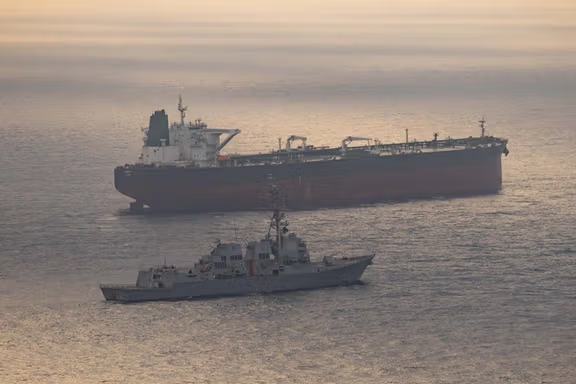
Guided-missile destroyer USS Rafael Peralta enforces the US blockade on Iranian ports against an Iranian-flagged ship, in this CENTCOM handout dated April 24, 2026

Recent tracking data suggesting Iran is still moving millions of barrels of crude despite a US naval blockade has raised fresh questions about the effectiveness of Washington’s effort to choke off Tehran’s oil exports.

TankerTrackers.com on Sunday cited satellite images that it said showed Iran loaded at least 4.6 million barrels of crude at export terminals in recent days, with another four million barrels appearing to have crossed the US blockade line.

The figures suggest Tehran retains at least some ability to keep oil flowing despite a US naval blockade launched nearly two weeks ago and repeated claims from Washington that the operation is crippling Iran’s maritime trade.

How effective has the blockade been?

US Central Command has portrayed the blockade as increasingly effective.

In its latest update on April 25, CENTCOM said US forces had “redirected” 37 vessels since the blockade began against ships entering or departing Iranian ports on April 13.

US forces have also expanded enforcement beyond the Persian Gulf, intercepting or seizing tankers in the Indian Ocean and Arabian Sea suspected of carrying Iranian crude.

Washington has framed the operation less as a hermetic seal than an economic squeeze. US officials argue the blockade’s effectiveness should be measured by whether Iran’s revenues are being cut.

Independent maritime trackers, however, paint a more complicated picture.

How is Iran still moving oil?

Shipping intelligence firm Lloyd’s List Intelligence reported this week that at least 26 vessels linked to Iran, including 11 oil and gas tankers and two very large crude carriers, have sailed in and out of Iranian ports since the blockade began.

The Financial Times, citing cargo tracking firm Vortexa, reported the figure could be as high as 34 Iran-linked tankers bypassing the blockade line in the Strait of Hormuz, including six outbound tankers carrying around 10.7 million barrels of crude.

Vortexa has also identified multiple fully laden tankers slipping past US warships. Bloomberg reported that a wider flotilla may have moved roughly nine million barrels around the blockade in recent days.

Iran’s so-called shadow fleet has long relied on tactics such as switching off AIS transponders, spoofing vessel locations, conducting ship-to-ship transfers, relabeling cargoes and using front companies to disguise ownership and destinations.

Since the blockade began, shipping analysts have observed vessels “going dark” near Iranian terminals before reappearing beyond the enforcement line.

Others have hugged coastal routes or moved through narrow shipping lanes where interception becomes more politically and operationally difficult.

What impact is the blockade having?

Even so, the blockade appears to be having an impact.

Traffic through the Strait of Hormuz has dropped sharply from normal levels, insurers have raised premiums, and some buyers have reportedly delayed or canceled purchases amid legal and logistical uncertainty.

Higher freight rates and longer voyages are also increasing costs for Iranian exports and for customers, chiefly in China.

The longer the blockade persists, the greater the chance Iran faces storage bottlenecks at export terminals or is forced to shut in production.

For now, the blockade appears to be functioning less as an impenetrable wall than as a bottleneck: slowing, complicating and raising the cost of Iran’s oil trade without stopping it entirely.

That may be enough for Washington to claim success and enough for Tehran to claim survival.

Most Viewed

The hidden target in US war on Iran may be China
1
PODCAST

The hidden target in US war on Iran may be China

2
PODCAST

US should use Iran talks leverage to help Iranian people, veteran journalist says

3

UK releases man jailed for spying on Iran International in 2023 terror plot

4
INSIGHT

Unity or fracture? Tehran battles Trump’s narrative of disarray

5

Is the US blockade working? It depends who you ask

Banner
Banner

Spotlight

  • Is Ghalibaf becoming Iran’s Khrushchev?
    INSIGHT

    Is Ghalibaf becoming Iran’s Khrushchev?

  • Iran’s new military-led order may mean greater dangers abroad
    ANALYSIS

    Iran’s new military-led order may mean greater dangers abroad

  • The hidden target in US war on Iran may be China
    PODCAST

    The hidden target in US war on Iran may be China

  • Unity or fracture? Tehran battles Trump’s narrative of disarray
    INSIGHT

    Unity or fracture? Tehran battles Trump’s narrative of disarray

  • Iran’s economy after the March war: how bad can it get?
    ANALYSIS

    Iran’s economy after the March war: how bad can it get?

  • Behind Tehran’s unity show: The secret letter to the shadow king
    INSIGHT

    Behind Tehran’s unity show: The secret letter to the shadow king

•
•
•

More Stories

The hidden target in US war on Iran may be China

Apr 26, 2026, 23:43 GMT+1
•
Negar Mojtahedi

As Washington and Tehran navigate a fragile ceasefire, one of the biggest questions looming over the conflict may not be about Iran at all—but China.

Chinese leader Xi Jinping this week publicly called for the Strait of Hormuz to reopen and urged an immediate ceasefire, his clearest intervention yet in the conflict and a sign Beijing is watching events closely.

Zineb Zineb Riboua, a research fellow at the Hudson Institute who specializes in Chinese influence in the Middle East and North Africa, told Eye for Iran that the broader significance of Operation Epic Fury—the US campaign against Ira—may lie in weakening China’s strategic position through its deep ties to the Islamic Republic.

“I am in the group of those who think it is about weakening China,” Riboua said. “I don't think the administration says it this way… but I think it's a very important one.”

Beijing forced into the open

For weeks, China had largely avoided direct public comment on the Hormuz crisis despite its dependence on Persian Gulf energy flows.

Riboua said Xi’s sudden remarks reflected Beijing’s anxiety and may also have exposed China’s limited leverage over Tehran.

“For a long time there was this assumption that the United States was in decline,” she said, adding that Xi’s intervention suggests Washington may be “breaking the status quo that benefited China.”

She added that Beijing remains dependent on US positions in the strait and may lack sufficient influence to pressure Tehran directly.

Why Iran matters to China

China remains a major buyer of Iranian crude and has long benefited from Tehran’s isolation.

“China benefited on three fronts,” Riboua said. “The first one is really the oil… It's 90% of Iran’s oil that goes to China and it goes with a discount.”

China is the world’s largest crude importer, bringing in roughly 11 million barrels per day, and is exposed to any disruption in Hormuz, through which about one-fifth of global consumption passes.

Chinese buyers reportedly took more than 80% of Iran’s exported crude in 2025, often at discounts of $8 to $10 below Brent, giving Beijing a valuable cheap supply.

Any prolonged US-Iran standoff or naval blockade in Hormuz could force China to replace cheaper Iranian oil with more expensive alternatives, while higher freight and insurance costs would add further pressure.

Riboua said Iran also serves as a testing ground for sanctions evasion and alternative financial channels.

“What the Islamic Republic was useful for China is really also the sanctions evasion laboratory.”

Chinese-linked networks have used front companies, ship-to-ship transfers, relabeled cargoes and alternative payment channels to keep Iranian oil flowing despite Western restrictions.

‘US trapped in Mideast’

Iran’s efforts to weaponize the Strait of Hormuz may also have hurt one of its own most important partners.

“The Islamic Republic thought that by weaponizing the Strait of Hormuz it could coerce the US president,” Riboua said. “But in the process, they've been hurting China.”

With China heavily reliant on regional energy flows, any prolonged disruption raises the stakes for Beijing.

Riboua argued the wider contest remains centered on Asia.

“You want the Americans to be trapped in the Middle East,” she said. “That’s a perfect scenario when you're thinking about invading Taiwan.”

If Riboua is right, Operation Epic Fury may prove to be more than a campaign to curb Iran. It may mark an early move in a broader contest over China’s reach in the Middle East—and beyond.

Iran’s economy after the March war: how bad can it get?

Apr 24, 2026, 21:17 GMT+1
•
Saeed Ghasseminejad

Iran’s economy is heading into a period of sharp deterioration following the March war, with mounting pressure from inflation, currency depreciation and damage to key industries raising the risk of a broader crisis.

Over the next two to four months, Iran’s economic conditions are expected to continue deteriorating sharply, with high inflation, rising unemployment, falling real incomes, and significant stress across key industries, the external sector, and the financial system, amounting to severe stagflation.

The economy entered the recent war from a weak starting point, and the combined effects of war-related damage, financial strain, and policy responses are likely to intensify these pressures.

Under a continued ceasefire, the deterioration is expected to be gradual but persistent; under a strictly enforced naval blockade, the adjustment is likely to be faster and more severe, with risks of very high inflation and broader economic disruption.

However, hyperinflation and full economic collapse are less likely in the next two to four months. An effectively enforced blockade, combined with military operations focused on reopening and securing the Strait of Hormuz, will push Tehran to the edge of economic collapse.

Starting point: A weak economy before the war

Iran entered the war from an already fragile position. By late 2025, inflation was elevated above 50 percent, the rial had lost substantial value, and the banking system was under visible strain, notably by the collapse of Bank Ayandeh. These pressures had already reduced household purchasing power and severely weakened business activity.

The continued depreciation of the currency, which saw the rial lose more than 20 percent in less than 20 days by the end of 2025, and worsening economic conditions contributed to widespread unrest across the country, which was ultimately suppressed. This left the economy highly vulnerable even before the war began.

Impact on income-generating industries

The war has directly affected Iran’s main sources of export revenue. Damage to industrial infrastructure—especially in petrochemicals and metals—has disrupted sectors that generated roughly $25–30 billion in exports in 2024 (petrochemicals: $13–17 billion; metals: $12–13 billion).

Production in these sectors is now constrained by:

  • Physical damage to facilities, and utility infrastructure
  • Shortages of inputs and spare parts
  • Limited access to financing and foreign exchange

Even partial restoration of operations is expected to take time, and exports from these industries are likely to decline sharply in the near term.

Spillovers to other sectors are also significant. In the agriculture sector, fertilizer shortages and disrupted logistics are expected to reduce output. Heightened uncertainty, combined with likely shortages of steel and possibly cement, is contributing to a significant slowing of activity in the construction sector, particularly in private projects. The auto sector is also likely to suffer a setback due to the lack of steel and aluminum.

Internet blackout and business disruption

Domestic policy responses have added further strain. The widespread internet blackout has severely disrupted economic activity, especially small and medium-sized businesses reliant on digital platforms.

According to NetBlocks, the economic cost of internet shutdowns in Iran has been estimated to be at least $37 million per day during recent outages.

The blackout has:

  • Disrupted online sales and payment systems
  • Interrupted supply chains and coordination
  • Reduced access to information and markets

These effects extend beyond online businesses and have slowed activity across the broader economy.

Financial system stress

The financial system, already under pressure before the war, is facing increased risks. The collapse of Bank Ayandeh in December 2025 highlighted underlying vulnerabilities in the banking sector. Other large banks were already under strain prior to the conflict.

Current conditions may lead to:

  • Reduced lending as banks conserve liquidity
  • Increased risk of bank distress if access to funding tightens
  • Potential loss of confidence affecting deposits and payment systems

The disruption of the private trade credit system—often based on post-dated checks—has further constrained business financing. Recent signals from the judiciary suggesting reduced legal consequences for unpaid checks have weakened enforcement, discouraging sellers from extending credit and further restricting transactions.

Impact on households

Households are expected to reduce spending significantly. Private consumption accounts for roughly 50 percent of the economy, so this contraction will have broad effects.

Key drivers include:

  • Rising prices and declining real incomes
  • Increased uncertainty leading to precautionary saving
  • Reduced access to credit
  • Wealth effect due to declines in asset values, particularly equities in sectors affected by the war and the closure of Tehran Stock Exchange.

These factors point to rising unemployment, a notable decline in private consumption, and a broad and significant decline in living standards.

Economic conditions over the next 2-4 months

Scenario 1: Continuation of ceasefire with the US and Israel

Under this scenario, large-scale hostilities do not escalate further, and oil exports continue, although under constraints. However, petrochemical and metals exports remain significantly disrupted due to infrastructure damage and ongoing restrictions on trade and financial channels, including limited access to regional intermediaries such as the UAE.

In this environment:

  • Oil revenues continue to provide limited foreign currency inflow
  • Inflation remains around current high levels due to currency weakness and supply disruptions
  • Industrial activity remains below capacity
  • The banking system remains under pressure but avoids immediate systemic collapse

Economic conditions continue to deteriorate, with persistent pressure on household incomes and employment. The rial is likely to remain under depreciation pressure, sustaining elevated inflation in the 50-60 percent corridor. Resource allocation is expected to be heavily tilted toward military rebuilding—particularly missile and defense capabilities—while remaining funds are directed toward essential imports such as food and medicine.

Scenario 2: Rigorously enforced naval blockade

Under this scenario, a naval blockade is strictly enforced following recent actions by the United States administration. Iran would be largely unable to export oil through the Persian Gulf, with only limited alternative channels (such as “ghost fleet” activity) available.

In this case:

  • Foreign currency inflows drop sharply
  • The rial depreciates further, leading to a rapid acceleration in inflation
  • Imports become severely constrained, limited to mainly essential goods
  • Industrial activity declines further due to lack of inputs and financing
  • Pressure on the banking system intensifies as liquidity conditions worsen

The loss of oil export revenue significantly weakens the government’s ability to stabilize the economy. Note that the “ghost fleet” overseas is likely to continue generating revenue for the next two to three months.

However, if the blockade is expected to continue, the government will ration this revenue for the near future. Inflation would rise sharply but most likely will not break the 100 percent ceiling, and the risk of broader economic breakdown increases, particularly if access to foreign currency becomes severely limited.

As in the first scenario, despite the dire economic situation, the government is expected to prioritize military spending to rebuild defense capabilities and prepare for future conflict.

Remaining resources would be directed toward securing basic goods such as food and medicine. Under a strict blockade, however, even if essential goods remain available, high inflation and rising unemployment would leave many households unable to afford them, sharply reducing living standards and intensifying public discontent. Even so, a full-scale economic collapse or hyperinflation is not expected within the next two to four months.

Scenario 3: Naval blockade plus major military operation in Iran's south

Under this scenario, strict enforcement of the naval blockade is coupled with a major military operation focused mainly on the south of Iran to reopen and secure the Strait of Hormuz.

Such an operation would render Iran not only unable to export oil but would also disrupt most of its trade through the Persian Gulf, including the import of food and other essential goods.

Securing basic goods would become extremely difficult for the government, which would be diverting its limited resources toward active military confrontation. Most economic activities are likely to come to a halt as inputs become extremely scarce and uncertainty rises sharply.

Inflation would spiral out of control, prompting the government to impose stricter limits on the payment system to prevent hyperinflation. These measures would, in turn, hinder economic activity even further. A full economic collapse within two to four months would not be inevitable, but it would remain a distinct possibility.
Starmer pledges to move on banning Iran's IRGC in next parliament session

Apr 24, 2026, 17:05 GMT+1

UK Prime Minister Keir Starmer pledged to introduce legislation to proscribe Iran’s Islamic Revolutionary Guard Corps (IRGC) in the next parliamentary session, in an interview with the Jewish Chronicle.

Starmer said legislation would be brought forward “in a few weeks” as parliament reconvenes.

“In relation to malign state actors more generally, proscription, we do need legislation in order to take necessary measures, and that is legislation that we're bringing forward as soon as we can.”

“We go into a new session in a few weeks' time, and we'll bring that legislation forward,” he said.

He also voiced concern over Tehran’s activities in the United Kingdom, saying he was “very worried” about the increasing use of proxies by the Islamic Republic.

Starmer made the remarks during a solidarity trip to Kenton United Synagogue on Thursday.

The visit came on the eve of the court appearance of two men accused of spying on Jewish and Israeli targets in London on behalf of the Iranian intelligence.

Nematollah Shahsavani, 40, and Alireza Farasati, 22, face charges under the UK’s National Security Act of engaging in conduct likely to assist a foreign intelligence service. Prosecutors allege the activity was carried out for Iran.

Growing threats

Starmer's pledge to ban Iran's IRGC comes at a time of growing concern about threats, intimidation, and violence affecting people linked to Iran in Britain.

On April 18, Iran International received reports that an Iranian man was violently assaulted in central London. The Metropolitan Police are understood to be investigating.

On April 17, British police charged three people over an attempted arson attack near the London offices of Iran International.

Police said a burning container was thrown towards the broadcaster’s headquarters in north-west London. No one was injured, but the case has added to concerns about the safety of Persian-language media in Britain.

Before that, in March 2026, an Iran-aligned group was reported to have claimed responsibility for an arson attack on Jewish ambulances in Golders Green, north London.

In May 2025, three Iranian men were charged under the National Security Act after a major counter-terrorism investigation. Prosecutors said one of the men had carried out surveillance, reconnaissance, and online research with the aim of committing serious violence against a person in the UK.

The other two were accused of similar activity intended to help others carry out serious violence. The Home Secretary said the case was part of a broader response to threats linked to the Iranian state.

British authorities have warned for several years that Iran poses a serious threat on UK soil.

Rapid deterioration of Iran-UAE ties threatens a critical trade lifeline

Apr 24, 2026, 03:01 GMT+1
•
Maryam Sinaiee

Iran-UAE ties have unraveled over the past two months, beginning with Iranian airstrikes on Emirati targets during the US-led war and escalating into a crisis that now threatens one of Tehran’s most vital trade and financial channels.

During the conflict, Iran struck civilian buildings, oil facilities, and sensitive infrastructure, including a data center linked to Oracle. In response, the UAE recalled its ambassador from Tehran, signaling a swift escalation in diplomatic tensions.

The diplomatic fallout deepened further this week when UAE state security authorities said they had arrested members of what they described as a “terrorist group linked to Iran’s ruling system” in Sharjah. The suspects were accused of planning attacks, undermining national security, and facilitating illicit financial transfers.

At the same time, Tehran has formally demanded compensation from several regional states, including the UAE, for allowing their airspace and bases to be used by the United States and Israel in strikes against Iran.

These developments have intensified a crisis that threatens to disrupt one of Iran’s most vital economic lifelines.

A deeply rooted economic partnership

Despite long-standing disputes, including disagreements over the islands of Abu Musa and the Greater and Lesser Tunbs, Iran and the UAE have built extensive and resilient economic ties over the past several decades.

Geographical proximity, advanced port infrastructure, and liberal trade regulations have transformed the UAE into a hub for Iranian commerce since the end of the Iran-Iraq War. Thousands of Iranian companies have established operations there, and a large share of Iran’s imports has flowed through re-export channels based in Dubai. Over time, the UAE became not just a trading partner but a critical gateway to global markets for heavily-sanctioned Iran.

For much of the past two decades, the UAE has ranked either first or second among Iran’s trading partners, often competing closely with China. Today, it remains one of the largest suppliers of goods to Iran, accounting for a significant share of its imports.

Roughly one-third of goods entering Iran—from mobile phones and electronics to auto parts, cosmetics, and clothing—have passed through the UAE, representing trade worth billions of dollars annually. The disruption of this flow is already being felt. In some sectors, such as mobile phones, prices have reportedly surged by 40 to 50 percent following the halt in imports.

With limited alternatives offering the same combination of proximity, infrastructure, and financial connectivity, any prolonged rupture could deepen Iran’s economic isolation and accelerate a costly realignment of its trade networks.

Trade imbalance and export structure

Iran’s exports to the UAE have largely consisted of oil products, petrochemicals such as fertilizers and industrial feedstocks, metals and minerals, agricultural goods including fresh produce and nuts, and construction materials like stone. However, much of this trade has been indirect, with the UAE serving as a re-export hub for Iranian goods destined for third markets.

At the same time, exports from the UAE to Iran have consistently exceeded Iran’s exports in the opposite direction, creating a significant trade imbalance. The UAE’s role as an intermediary—rather than a final destination—has been central to this asymmetry.

Sanctions and the UAE’s pivotal role

The importance of the UAE grew dramatically after the tightening of US and European sanctions on Iran, particularly following Washington’s withdrawal from the 2015 nuclear deal (JCPOA) in 2018. As direct trade routes narrowed, the UAE became the primary conduit for goods, capital, and financial flows into Iran.

Emirati exports to Iran rose from around $5.2 billion in 2018 to more than $20 billion in recent years. Dubai also became a financial hub for Iranian exchange houses, many of which played a key role in facilitating currency transfers and circumventing sanctions. Exchange rates set in Dubai’s markets often influenced the value of the Iranian rial domestically.

However, this system is now under pressure. UAE authorities have reportedly targeted Iranian exchange houses and so-called “trust companies,” freezing accounts, shutting offices, and detaining some operators. These actions could severely constrain Iran’s access to international financial channels.

Tehran stocks head for reopening, but it risks triggering a new crisis

Apr 23, 2026, 22:00 GMT+1
•
Mohamad Machine-Chian

After nearly two months of closure, Tehran’s stock market is preparing a phased reopening, but deep structural flaws, lack of transparency and uncertainty over US negotiations threaten to turn the restart into a fresh crisis.

Trading has been suspended for two months. Ticker symbols remain closed, and millions of retail investors have been unable to move their assets.

The head of the Securities and Exchange Organization said the market would reopen within ten to twelve days in phases. In the first stage, only companies not directly damaged by the war will resume trading, while steel and petrochemical firms that suffered losses will remain closed.

Reopening a damaged petrochemical company whose production has halted and whose recovery costs and timeline are unclear would likely trigger a sharp price drop and create a volatile market signal. Yet the current approach of prolonged closure presents deeper structural concerns.

There are three conceivable scenarios for reopening the Tehran Stock Market.

  • War or economic collapse: can Iran withstand the pressure?

    War or economic collapse: can Iran withstand the pressure?

Scenario one: Comprehensive deal with US

The first scenario envisions a comprehensive agreement and broad sanctions relief. In an optimistic case, Iran reconnects to the global financial system, oil and petrochemical exports face fewer restrictions, and foreign investment gradually returns. Market reopening could then mark the beginning of long-delayed reforms: transition from price controls to market pricing, reduced financial repression in banking, and transparent government balance sheets.

Export-oriented sectors such as steel, petrochemicals, and copper would benefit from renewed access to global markets. Banks could reassess their balance sheets and shift toward genuine credit evaluation. Foreign investors, absent for nearly two decades, might gradually return.

However, without internal coordination and structural reform, even sanctions relief would not rescue the TEDPIX.

  • Dollar-pegged pizza in Tehran points to a different kind of regime change

    Dollar-pegged pizza in Tehran points to a different kind of regime change

Scenario two: Limited military and regional agreement

A more likely scenario involves a limited agreement focused on military and regional tensions. Hostilities ease, but sanctions remain largely intact and foreign investment prospects stay uncertain.

Under these conditions, reopening may trigger a new crisis. Major export-driven firms would initially remain untradeable. Downstream industries would face raw material shortages and price spikes. The automotive sector, already loss-making before the war, would struggle with supply chain disruptions and accumulated losses.

Meanwhile, limited foreign currency inflows could push the government toward inflationary financing to fund reconstruction and subsidies, either through money creation or borrowing from banks already dependent on regulatory forbearance. With high inflation ahead, questions arise about how listed firms can generate sufficient value to remain profitable, especially amid infrastructure damage and seasonal energy shortages.

Investors, having endured months of uncertainty without clear disclosure of portfolio losses, may view reopening as an exit opportunity. Investment funds facing redemption waves would be forced into selling queues, amplifying downward pressure. The market could reopen with a heavy backlog of sell orders, and each negative headline could trigger further declines.

Scenario three: Continued conflict and further escalation

If negotiations fail and conflict intensifies, prolonged closure would likely continue. In such a scenario, Tehran Stock Exchange, under its current management and policy framework, could effectively cease to function as a credible capital market.

Policymakers may believe closure prevents price collapse, but in practice, investor confidence collapses instead. Alternative investment channels gain prominence: foreign currency, gold, real estate, consumer goods, or capital flight to neighboring countries.

  • US tightens financial squeeze on Iran, warns banks over oil money flows

    US tightens financial squeeze on Iran, warns banks over oil money flows

Iran’s economy before and after the war

Even before the recent conflict, Iran’s economy faced a structural crisis. Industrial capacity was constrained by aging machinery, energy imbalances, and sanctions. Institutional trust was at its lowest level in four decades. Key industries — steel, petrochemicals, automotive, and banking — were either loss-making or dependent on hidden subsidies. War in such an environment acts as a crisis accelerator, pushing uncertainty beyond policymakers’ management capacity.

Tools available for reopening — tighter price limits, sales restrictions, targeted liquidity injections, and market-maker intervention — can at best distribute the shock and manage short-term risk. They cannot substitute for honest disclosure of losses, independent audit assessments, and credible reconstruction plans.

Reopening the Tehran Stock Exchange alone will not resolve broader economic challenges. In the best-case scenario, it could form part of a larger reform package aligned with political agreement and foreign capital inflows. In the other two scenarios, reopening may merely accelerate the crisis cycle.

The core question facing policymakers is political rather than technical: are they willing to accept the real market value of shareholders’ assets, or will they postpone the cost through opacity and suspension, only to face a larger reckoning later.