Starmer pledges to move on banning Iran's IRGC in next parliament session
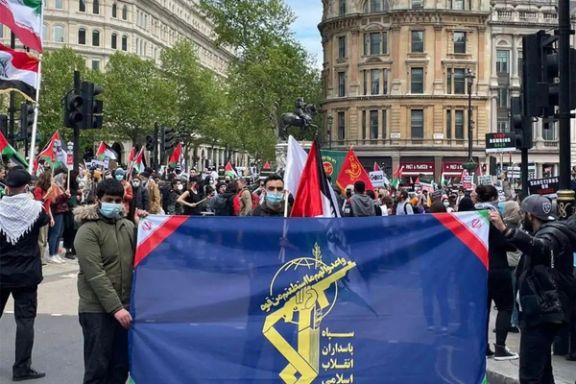
A group of Islamic Republic supporters holding a flag of the IRGC in London
UK Prime Minister Keir Starmer pledged to introduce legislation to proscribe Iran’s Islamic Revolutionary Guard Corps (IRGC) in the next parliamentary session, in an interview with the Jewish Chronicle.
Starmer said legislation would be brought forward “in a few weeks” as parliament reconvenes.
“In relation to malign state actors more generally, proscription, we do need legislation in order to take necessary measures, and that is legislation that we're bringing forward as soon as we can.”
“We go into a new session in a few weeks' time, and we'll bring that legislation forward,” he said.
He also voiced concern over Tehran’s activities in the United Kingdom, saying he was “very worried” about the increasing use of proxies by the Islamic Republic.
Starmer made the remarks during a solidarity trip to Kenton United Synagogue on Thursday.
The visit came on the eve of the court appearance of two men accused of spying on Jewish and Israeli targets in London on behalf of the Iranian intelligence.
Nematollah Shahsavani, 40, and Alireza Farasati, 22, face charges under the UK’s National Security Act of engaging in conduct likely to assist a foreign intelligence service. Prosecutors allege the activity was carried out for Iran.
Growing threats
Starmer's pledge to ban Iran's IRGC comes at a time of growing concern about threats, intimidation, and violence affecting people linked to Iran in Britain.
On April 18, Iran International received reports that an Iranian man was violently assaulted in central London. The Metropolitan Police are understood to be investigating.
On April 17, British police charged three people over an attempted arson attack near the London offices of Iran International.
Police said a burning container was thrown towards the broadcaster’s headquarters in north-west London. No one was injured, but the case has added to concerns about the safety of Persian-language media in Britain.
Before that, in March 2026, an Iran-aligned group was reported to have claimed responsibility for an arson attack on Jewish ambulances in Golders Green, north London.
In May 2025, three Iranian men were charged under the National Security Act after a major counter-terrorism investigation. Prosecutors said one of the men had carried out surveillance, reconnaissance, and online research with the aim of committing serious violence against a person in the UK.
The other two were accused of similar activity intended to help others carry out serious violence. The Home Secretary said the case was part of a broader response to threats linked to the Iranian state.
British authorities have warned for several years that Iran poses a serious threat on UK soil.
Speaker Mohammad Bagher Ghalibaf looks on from the dais as President Masoud Pezeshkian passes in the foreground during a parliamentary session in Tehran.
Iranian officials rushed to present a unified front after US President Donald Trump questioned who leads the Islamic Republic, highlighting sensitivities over internal divisions and uncertainty at the top of the political system.
Trump wrote on Truth Social on Thursday that Iran was struggling to determine its leadership, pointing to what he described as infighting between “hardliners” and “moderates.”
“Iran is having a very hard time figuring out who their leader is! They just don’t know!” Trump wrote, adding that internal divisions were “crazy” and tied to battlefield losses and political rivalries.
The remarks came as the continued absence of new Supreme Leader Mojtaba Khamenei from public view and reported disputes over engagement with Washington have drawn scrutiny to internal dynamics within the Islamic Republic.
Officials project unity after remarks
An account attributed to Mojtaba Khamenei reposted part of his Nowruz message warning of “enemy psychological operations” aimed at undermining national unity and security.
Senior officials echoed similar messaging in coordinated posts. President Masoud Pezeshkian and parliament speaker Mohammad Bagher Ghalibaf wrote that distinctions between political factions were invalid.
“In Iran there are no ‘hardliners’ or ‘moderates’… We are all Iranians and revolutionaries,” they wrote, adding that unity and obedience to the Supreme Leader would ensure victory.
Judiciary chief Gholamhossein Mohseni Ejei described such labels as “fabricated and baseless,” saying all factions operate cohesively under the leadership.
Other figures, including senior military commanders and advisers, issued similar statements stressing allegiance to “one leader,” in what appeared to be a coordinated response.
Divisions persist over policy and negotiations
Despite the messaging, recent developments suggest internal disagreements remain. In March, Pezeshkian apologized for attacks attributed to Iranian forces on neighboring countries, attributing them to actors operating independently, drawing criticism from military-linked figures.
Conflicting signals also emerged last week over maritime policy, when Foreign Minister Abbas Araghchi announced the reopening of the Strait of Hormuz before the Islamic Revolutionary Guards Corps indicated renewed restrictions due to ongoing pressures.
Reports have also pointed to disputes over nuclear negotiations with the United States. According to information received by Iran International, disagreements between officials aligned with the government and figures linked to Mojtaba Khamenei disrupted plans for talks in Islamabad.
Sources familiar with the matter said negotiators were instructed not to engage on the nuclear file, prompting Araghchi to describe participation as “essentially futile” and warning that such a stance would end the process.
Earlier reporting also indicated that Ghalibaf criticized opponents of a deal with Washington in internal discussions, describing them as contributing to the country’s decline.
Food prices surged and basic goods slipped out of reach across Iran, citizens told Iran International in recent days, describing shortages and daily price jumps following a ceasefire that has coincided with worsening economic conditions.
“Prices here have increased tenfold and rice and cooking oil are hard to find,” one resident wrote from Zahedan in southeastern Iran, pointing to worsening access to staple goods.
Other citizens described the rapid erosion of purchasing power. “We go to sleep and wake up to everything being twice as expensive,” one message said, reflecting widespread concern over accelerating inflation.
Food costs climb, access narrows
Messages from multiple cities highlighted steep increases in the cost of everyday items. Citizens said even the most basic foods were becoming unaffordable, with eggs, rice and cooking oil among the hardest hit.
“Eggs have become so expensive they are being removed from our tables,” one citizen wrote, describing the shrinking range of affordable protein options.
Shoppers queue at a butcher’s counter in Iran as food costs continue to climb.
Restaurant prices were also cited as an indicator of inflation. Citizens said a single serving of kebab now costs between 5,000,000 and 6,000,000 rials (about $3.10 to $3.75), while a plate of chicken with rice ranges from 3,000,000 to 4,000,000 rials (about $1.90 to $2.50). Soft drinks were reported to exceed 1,000,000 rials (about $0.60).
Based on an exchange rate of around 1,600,000 rials per dollar, the new minimum monthly wage of 162,550,000 rials is equivalent to roughly $104. This comes as annual inflation had already exceeded 70 percent before the start war on February 28, reaching its highest level since World War II.
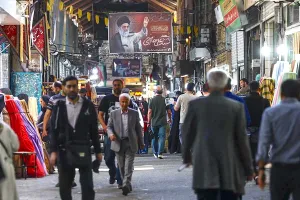
man sells fruit at the Grand Bazaar, amid the US-Israeli conflict with Iran, in Tehran, Iran, March 18, 2026.
As of late 2025/early 2026, average Iranian incomes have contracted to roughly $200 per month.
Shortages compounded the problem. Messages described difficulty finding chicken in distribution centers and limits on purchasing cooking oil in shops. Others pointed to disruptions in supply chains linked to industrial slowdowns and rising production costs.
Economic journalist Arash Azarmi said the surge in food prices was hitting lower-income households hardest. “Eggs priced at 200,000 rials ($0.12) each are shocking. This is a basic food item, especially for lower-income households, and it is effectively being pushed out of their consumption basket,” Azarmi said.
Official data, he added, already showed food inflation exceeding 112 percent, with some categories such as cooking oil rising by more than 200 percent.
Iran’s monthly minimum wage for workers is set at one of the lowest levels compared to many countries in the region. Among Oman, Saudi Arabia, Turkey, Iraq, Qatar, Pakistan and Lebanon, the lowest minimum wage belongs to Pakistan, where workers earn at least the equivalent of $133. This figure is about $201 in Lebanon, around $275 in Qatar, about $345 in Iraq, and $625 and $585 in Turkey and Oman, respectively.
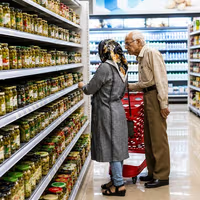
A woman shops for groceries in a store in Iran as prices continue to rise.
Pressure spreads beyond food
Beyond rising prices, citizens said financial obligations continued to tighten during and after the conflict period, adding to the strain on households and businesses.
A billboard about the Strait of Hormuz on a building in Tehran, April 22, 2026.
“During the war there was no tax relief, insurance was taken in full from the private sector, and all loans faced late penalties despite earlier promises,” one message said, describing continued pressure on businesses.
Another citizen pointed to mounting banking enforcement and legal follow-up tied to unpaid debts. “All checks were bounced, accounts were closed and legal action started. Loan installments were either collected with interest or deducted from guarantors,” the message read.
Business owners described a cycle of rising costs and falling demand. A clothing seller said prices for goods were increasing by around 35 percent each week, while customers’ ability to pay continued to decline.
A shopkeeper stands in his clothing store at the Grand Bazaar, amid the US-Israeli conflict with Iran, in Tehran, Iran, March 18, 2026.
Jobs scarce, costs rising
Citizens also pointed to a lack of job opportunities and growing difficulty in covering basic living expenses, including rent and utilities.
“There is no work and our savings are gone,” one citizen said, describing limited options for supplementing income.
Others reported rising bills even as businesses slowed or shut down. “We cannot pay rent, we cannot work,” another citizen wrote, pointing to disruptions affecting daily commerce.
Small business owners said they were increasingly operating at a loss. One restaurant operator said higher meat prices and reduced customer demand were pushing the business toward closure. “If this continues, we will shut down and pay rent from our own pockets,” the message read.
Experts warn of accelerating inflation
Economist Mohammad Machinechian said the pace of price increases had reached a point where monthly inflation was more relevant than annual figures.
“I’m no longer talking about annual inflation, but monthly inflation, and that is the reality we’re dealing with,” Machinechian said. “Even in the best-case scenario, inflation could average at least 5 percent a month, meaning prices rise around 80 percent over a year.”
Machinechian added that in a prolonged stalemate scenario, prices could triple over the year, while renewed conflict could push monthly inflation above 20 percent, leading to annual increases approaching 500 percent.
File photo of people shopping for eggs and bread at a street market in Iran amid rising food prices.
Azarmi described the situation as a “modern famine,” where goods remain available but are increasingly unaffordable for many households.
The accounts from citizens across the country depict an economy where rapid price increases, supply constraints and falling incomes are converging, leaving many struggling to secure even the most basic necessities.
A pink military-style vehicle moves through a street rally in Iran, carrying several women dressed in black chadors and hijabs.
Pink missiles, pink drones and pink firearms. Women with uncovered hair—braids, ponytails, short bobs—stood beside weapons, waved flags and smiled for cameras in scenes broadcast across Iranian media. Tehran appears willing to try almost anything to preserve power.
Critics say the imagery forms part of a new Islamic Republic campaign that pairs missiles with fashion, war with pop culture and force with softness.
Liora Hendelman-Baavur, author of Creating the Modern Iranian Woman, told Iran International the visuals resemble Japan’s “kawaii” culture — imagery built around cuteness — but applied here to rockets and war.
“I think it is trying to make violence look cute,” Hendelman-Baavur said. “It is trying to appeal to the youth, to Gen Z.”
She said the campaign appears aimed at a generation that has filled streets, campuses and online spaces during years of unrest.
“We hear a lot of very aggressive and violent language coming from officials,” she said.
“And we also see it in many of the posters and murals being displayed in Iran. Violence and missiles — with red as the central color — are meant to show they are invincible and victorious. And on the other hand, we have this very light, pinkish, idyllic way of presenting a different reality … to demonstrate a whole different picture of what is really going on.”
A pink-painted missile bearing Persian script sits on display, turning a weapon of war into a piece of stylized propaganda.
The result, she said, is two messages at once: murals, rockets and threats for one audience; pink colors, uncovered hair and festival scenes for another — a duality.
The campaign comes just over 100 days after one of the deadliest crackdowns in modern history, when at least 36,500 people were killed during the bloodiest days of the uprising on January 8 and 9 alone. The Islamic Republic continues to execute political dissidents linked to the January protests.
Any publicity — even negative — is good
For Iranian pop culture expert Siavash Rokni, the scenes are less about change than circulation.
He called the imagery a public relations stunt meant to fill feeds, group chats, broadcasts and headlines with new pictures after months of funeral processions, executions, arrests and mourning.
“With PR stunts, it doesn’t matter if it’s good or bad — what matters is that it circulates,” Rokni said.
He said many Iranians know the difference between staged images and daily life, but viewers abroad may not.
“What worries me isn’t Iranians — it’s people outside Iran who might see this and think everything is normal. That’s where it becomes dangerous.”
Others say the campaign also keeps state control over women at the center of public life. Even without hijab, women’s faces, hair and bodies remain tools in official messaging.
Retreat — for now — on Islamist ideology
It may also point to pressure inside the system itself.
Arash Azizi, author of What Iranians Want: Women, Life, Freedom, told Iran International the Islamic Republic was founded on the goal of building a uniformly Islamist society. If it now loosens one of its core social codes, he said, that carries meaning beyond style.
“They understand that they have to give up on this Islamist ideology,” Azizi said.
He also rejected claims that the war has produced a broad wave of new support for the state.
“There’s no evidence that tons of people were anti-regime before the war and are pro-regime now,” he said.
For now, the pink paint may soften the image, but it does not erase the prisons, the executions, the graves or the anger that still runs beneath the surface of Iran.
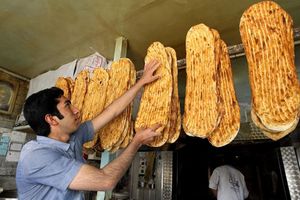
File photo of a baker arranging Barbari flatbread at a traditional bakery in Iran.
Bread shortages and steep price hikes are undermining access to a key staple for many in Iran, with citizen accounts received by Iran International describing long lines, flour shortages and prices far exceeding official rates.
“Many bakeries are facing flour shortages and cannot keep up with long lines of customers,” a resident from Malard west of Tehran said.
Another account said: “Right after the war, bread prices doubled. Barbari (a type of Iranian bread) is now 250,000 rials and Sangak is 350,000. Subsidized flour has been removed.”
The reported prices are far above official rates, with the latest approved price for Sangak at about 76,000 rials and Barbari around 55,000.
April 20 marks National Wheat and Bread Day in Iran, meant to highlight the central role of wheat in daily life, but accounts point to worsening conditions for a basic staple.
Conflicting claims on wheat supply
Wheat self-sufficiency has long been a goal promoted by many officials of the Islamic Republic. The first celebration of wheat self-sufficiency was held on November 16, 2004, during the presidency of Mohammad Khatami.
However, this self-sufficiency did not continue in subsequent years for various reasons, including water shortages, and Iran remained reliant on wheat imports. Still, the aspiration for self-sufficiency has continued to be repeated in officials’ statements.
Now, 22 years after the first “self-sufficiency celebration,” as buying bread is becoming an economic challenge for citizens, Ataollah Hashemi, head of the National Wheat Farmers Foundation, has once again reiterated the goal. Speaking on Saturday, April 18, he said: “The country will not need to import wheat this year.”
Yet official customs data shows Iran imported about 2.75 million tons of wheat worth nearly $1 billion in the 10 months to February 2026. The imports were sourced largely from Russia, as well as through intermediaries such as the United Arab Emirates and Turkey.
The reliance on intermediaries, which are not major wheat exporters themselves, points to complications tied to banking restrictions and payment channels, increasing costs through additional transport and fees.
The gap between official statements and import figures raises questions about the sustainability of domestic production and the credibility of self-sufficiency statements.
File photo of a baker handing stacks of Sangak flatbread to customers at a neighborhood bakery.
Rising costs and policy pressures
Bread prices have increased across provinces in the current Iranian year that began on March 21, following subsidy cuts and the move toward a single flour pricing system. Prices now vary depending on flour type and region, with some bakeries selling above official rates.
Despite parliament approving a budget that allocates more than 5,000 trillion rials (over $3 billion) for bread subsidies, no new national price list has been issued for the current year. As a result, last year’s rates remain in effect, while enforcement appears inconsistent.
Inflation and shortages
Before the latest conflict and US-Israeli strikes, annual inflation had already exceeded 70 percent, with food inflation reaching triple digits. Official data shows bread and cereals recorded year-on-year inflation of about 140 percent.
The removal or reduction of subsidized flour in parts of the market has added to the pressure, with more bakeries operating under higher-cost “free flour” systems.
Citizen reports suggest the combined impact of shortages and rising prices is becoming more visible. Long queues at bakeries and inconsistent supply have emerged alongside sharp increases in retail prices.
For many households, bread remains a primary food source, making these changes particularly significant.
The accounts from Tehran and other areas point to a broader strain across the country, where access to basic goods is increasingly shaped by rising costs, uneven supply, and policy shifts that have yet to stabilize the market.
As Washington signals that a deal with Tehran may be close, a central question remains unresolved: who, if anyone, is actually winning?
US President Donald Trump said on Friday he expects an agreement with Iran “in the next day or two,” even claiming Iran has “agreed to everything,” including halting uranium enrichment and transferring its highly-enriched uranium stockpiles to the US.
The remarks came hours after Iran announced the reopening of the Strait of Hormuz following weeks of disruption, an announcement that sparked rare public criticism from within the Islamic Republic targeting the negotiating team.
Despite Tehran's declared reopening of the strait, Trump said the US will continue blockading Iranian ports until a final deal is achieved.
Speaking at Iran International's English podcast Eye for Iran, maritime sanctions expert Charlie Brown framed the strategy behind the current US blockade as one that could either be about pressure to deal or pressure to collapse.
“I think it’s clear that the goal would be, you know, the first case is pressure to come to negotiate, but the other case would be pressure to collapse the regime system and make space for a new system,” said Brown, a senior advisor at United Against Nuclear Iran who tracks Iran’s shadow fleet and illicit tanker networks.
That dual objective, forcing negotiations while simultaneously weakening the system sits at the heart of the current moment. But whether it is working remains far less clear.
Pressure campaign vs. economic reality
At the center of that uncertainty is the Strait of Hormuz, where a US-led pressure campaign has targeted Iran’s oil exports — the Islamic Republic's economic lifeline.
Both Brown and energy expert Dr. Iman Nasseri, Managing Director for the Middle East at FGE, agreed the impact is real, but warned it is too early to measure its effectiveness.
“The effects of a blockade will definitely take time,” Brown said, cautioning against drawing quick conclusions.
Nasseri, one of the leading experts on Iran’s oil flows and regional energy markets, echoed that view, emphasizing that even under ideal conditions, economic pressure unfolds slowly.
“In normal conditions three to four weeks but in Iranian situation and sanctions evasion it could take up to three months for a cargo to land in the destination market,” he said.
That delay means Iran can continue generating revenue in the short term, even as restrictions tighten.
“Iran is still selling oil which is out there at sea today without loading anything,” Nasseri explained, underscoring how existing cargoes can sustain income flows even as new exports are disrupted.
Shipping data reinforces that point. According to TankerTrackers.com, 633 Iran-linked tankers have been tracked globally, with 397 sanctioned by US authorities. Yet dozens continue operating, including at least 72 vessels currently moving freely in the Middle East.
The system — built on ship-to-ship transfers, AIS spoofing and shadow banking remains active, even under pressure.
That raises a broader question: whether global markets can absorb the disruption long enough for pressure on Iran to fully materialize.
While the economic battle unfolds at sea, the nuclear file remains central to any potential deal and to competing claims of success.
Trump’s assertion that Iran has agreed to halt enrichment would represent a major concession. But nuclear experts caution that the reality is more complex.
“I’d say the probability the regime would want to build the bomb has gone up, but the probability that they can succeed has gone down,” said David Albright, founder of the Institute for Science and International Security.
Albright also warned that focusing only on Iran’s most enriched uranium stockpiles risks missing the bigger picture. Iran possesses thousands of kilograms of lower-enriched uranium that could be further processed if enrichment continues — meaning any deal that does not fully end enrichment could leave a pathway intact.
Taken together, his assessment points to a paradox: Iran may be more motivated than ever to pursue nuclear capability, even as its ability to do so has been degraded by military strikes.
That tension complicates any claim that diplomacy alone has resolved the nuclear threat.
Regional shifts and Iran’s influence
Beyond the nuclear and economic fronts, regional dynamics suggest Iran’s position may be shifting — though not collapsing.
One of the most significant developments has been direct diplomatic engagement between Lebanon and Israel, a move that signals potential decoupling from Tehran’s influence.
“This was the first time that the United States recognizes that the government of Lebanon is sovereign enough and adult enough to sit in face-to-face talks bilaterally without Saudis or Iranians or Syrians or anybody else in the room,” said Hussain Abdul Hussain, a research fellow at the Foundation for Defense of Democracies and author of the Arab Case for Israel.
A newly agreed ceasefire between Israel and Lebanon is set to last 10 days, with the possibility of being “extended by mutual agreement” if negotiations show progress
That shift challenges one of Iran’s long-standing pillars of regional power: its network of proxy forces.
For years, Lebanon has effectively been treated as an extension of Iran’s regional strategy through Hezbollah. But the current talks — taking place independently of Tehran — suggest a possible shift toward decoupling.
Abdul Hussain underscored that divide more directly, describing how Lebanon’s leadership is increasingly asserting its independence from Iran’s negotiations.
“You do you, we do Lebanon,” he said, characterizing the government’s stance as separate from Tehran’s diplomatic track.
A moment of uncertainty
Taken together, the developments across Hormuz, the nuclear file and the regional landscape point to a single conclusion: it is too early to declare a winner.
The United States has demonstrated its ability to impose pressure — militarily and economically — while Iran has shown it can still adapt, sustain revenue and shape the narrative.
For now, the outcome is not defined by victory, but by how long each side can sustain the pressure before it breaks.
You can watch Eye for Iran on YouTube or listen on any podcast platform of your choosing