• العربية
  • فارسی
Brand
  • Iran Insight
  • Politics
  • Economy
  • Analysis
  • Special Report
  • Opinion
  • Podcast
  • Iran Insight
  • Politics
  • Economy
  • Analysis
  • Special Report
  • Opinion
  • Podcast
  • Theme
  • Language
    • العربية
    • فارسی
  • Iran Insight
  • Politics
  • Economy
  • Analysis
  • Special Report
  • Opinion
  • Podcast
All rights reserved for Volant Media UK Limited
volant media logo

Exiled prince dismisses Iran negotiators as part of repression system

Apr 23, 2026, 09:57 GMT+1Updated: 12:24 GMT+1
Iran’s Prince Reza Pahlavi gestures as he speaks during a press conference at the House of the Bundespressekonferenz in Berlin, Germany, on April 23, 2026.

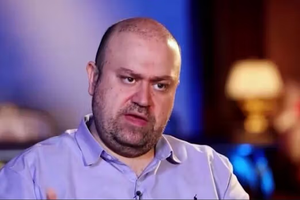
The Islamic Republic’s negotiators in talks with the US are “different faces of the same machine,” that suppresses the Iranian people, exiled Prince Reza Pahlavi said at a press conference in Berlin on Thursday.

“They are not pragmatists; they are not reformers,” he said, referring to lead negotiator Mohammad Bagher Ghalibaf and Foreign Minister Abbas Araghchi during his speech at the Haus der Bundespressekonferenz. “Neither are the IRGC killers behind the curtains.”

Pahlavi was in Berlin for meetings with German lawmakers and members of the press as part of a European trip focused on Iran’s political future.

The Iranian prince warned that continued rule by the Islamic Republic would lead to further conflict in the region as the authorities will continue to pose threats to the people, the region, and beyond as long as they remain in power.

“For 47 years, the world has known Iran through the actions of a regime that took a great nation hostage,” Pahlavi said. “No deal will solve this. No negotiations will solve this. It is in their DNA.”

‘Choosing free Iran over a dying regime’

Pahlavi further addressed Europe, saying it faces a choice between the current Iranian system and a free Iran that could become a partner for stability.

“The choice before Europe is not between war and peace. It is between a dying regime that endangers us all and a free Iran that can become a partner for stability,” he said.

The Iranian prince urged European authorities to seek “a new course” in dealing with Tehran, or keep facing “constant blackmail” from the Islamic Republic.

“European governments must stop appeasing this regime. Expel regime ambassadors, refuse to legitimize any arrangements that preserve the IRGC-centered power structure and prepare to recognize the transitional government when it is announced,” he said, addressing European powers.

‘Iranians don’t want to see regime legitimized’

Pahlavi referred to nationwide protests in Iran, saying the Iranian people demand world countries refrain from strengthening or legitimizing a government that terrorizes the nation.

“The Iranian people are not asking us to fight their revolution. They are already doing that, and with a courage that should humble all of us,” he said. “They are asking something far more modest: do not legitimize those who oppress them. Do not strengthen those who terrorize them.”

He said it was time for the world to “catch up with their courage,” noting that the international community’s contribution to their struggle could help bring about an end to the government's violence.

“If you stand with us, if you act in honor of those 40,000 innocent protesters, you will save lives, you will stop the flow of blood,” he said.

Pahlavi also touched upon the Iran war, saying the destruction of governmental infrastructure employed in suppressing dissent, could potentially facilitate protests aimed at subverting the government.

“The air cover campaign that included hitting the regime infrastructure and apparatus of repression was a necessary step to equalize the playing field for the Iranians who were getting massacred on the streets defenseless, by a regime that used military weapons to hit them on the streets,” Pahlavi said.

He argued that a democratic transition in Iran could reduce regional tensions and open the way for broader economic cooperation.

“A free Iran would be a stabilizing anchor for the entire Middle East, ending the proxy wars that have ravaged Lebanon, Yemen, Iraq, and Syria, and becoming a partner for regional economic integration,” Pahlavi said.


Most Viewed

IRGC-linked media hints at threat to Persian Gulf undersea internet cables
1

IRGC-linked media hints at threat to Persian Gulf undersea internet cables

2

Iran Guards say two ships seized in Hormuz after ceasefire extension

3
EXCLUSIVE

Strikes on petrochemical hubs leave Iran short of plastics

4
INSIGHT

War or economic collapse: can Iran withstand the pressure?

5

Iran executes former atomic agency employee over alleged spying for Israel

Banner
Banner

Spotlight

  • Tehran stocks head for reopening, but it risks triggering a new crisis
    ANALYSIS

    Tehran stocks head for reopening, but it risks triggering a new crisis

  • Power vacuum in Tehran emboldens hardliners
    INSIGHT

    Power vacuum in Tehran emboldens hardliners

  • Inflation spikes, basic goods slip out of reach for Iranians, citizens say
    VOICES FROM IRAN

    Inflation spikes, basic goods slip out of reach for Iranians, citizens say

  • Iran turns to citizenship and assets as tools of pressure beyond its borders

    Iran turns to citizenship and assets as tools of pressure beyond its borders

  • Who backs war now? Tehran flips the script
    INSIGHT

    Who backs war now? Tehran flips the script

  • As Tehran digs in, ordinary Iranians pay the price
    INSIGHT

    As Tehran digs in, ordinary Iranians pay the price

•
•
•

More Stories

Iran Guards say two ships seized in Hormuz after ceasefire extension

Apr 22, 2026, 10:30 GMT+1

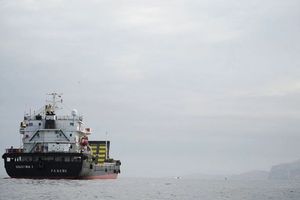
Iran’s Islamic Revolutionary Guard Corps Navy said it had seized two vessels in the Strait of Hormuz and directed them toward Iranian shores, hours after Donald Trump said the United States would extend a ceasefire with Iran.

In a statement, the Guards said the vessels, identified as MSC Francesca and Epaminodes, had violated maritime regulations and endangered navigation by manipulating their tracking systems.

It said the ships were detained and escorted to Iran’s coast, adding that disruption to security in the Strait of Hormuz was a “red line,” referring to the US blockade of Iranian ports.

Vessels under fire

The United Kingdom Maritime Trade Operations (UKMTO) said earlier on Wednesday that two cargo vessels were fired upon in separate incidents in the strait.

It said a container ship northeast of Oman reported being approached by an IRGC gunboat, which opened fire without radio contact, causing heavy damage to the vessel’s bridge. All crew were safe and no fire or environmental impact was reported.

In a separate incident west of Iran, an outbound cargo ship reported being fired upon and had stopped in the water. Its crew were safe and there was no reported damage, UKMTO said.

The IRGC-affiliated Fars News Agency said three vessels — Euphoria, MSC Francesca and Epaminodes — were targeted.

Trump said on Tuesday he would extend a fragile ceasefire with Iran indefinitely, even as plans for new talks stalled.

The incidents come amid heightened tensions in the Strait of Hormuz, a key global shipping route that previously handled about one-fifth of the world’s oil and gas flows.

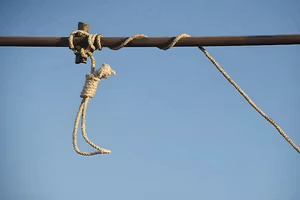
Iran executes former atomic agency employee over alleged spying for Israel

Apr 22, 2026, 08:21 GMT+1

Iran executed a man early on Wednesday after convicting him of spying for Israel, with the judiciary identifying him as Mehdi Farid and saying he had worked at a “sensitive organization” and maintained online contact with Mossad officers.

It said Farid headed a non-military defense management committee at one of the country’s sensitive organizations, without naming it, and had shared information including organizational structures, security arrangements and infrastructure.

Rights groups had earlier said Farid was arrested in 2023 and had been working at the Atomic Energy Organization of Iran. They said he was first held in Tehran’s Greater Tehran prison before being transferred to Evin prison.

Iran Human Rights had reported last year that he was “initially sentenced to 10 years in prison” and, after a retrial, “sentenced to death on charges of spying for Israel.”

The judiciary said Farid had connected internal servers to infected files on instructions from a Mossad officer and enabled outside access to systems using USB devices.

It added that Farid confessed during the case process to transferring information and had been promised payment and help to leave the country.

Rights groups have raised concerns about the use of forced confessions and due process in Iran.

  • Iran family says executed nuclear scientist confessed after threats to mother

    Iran family says executed nuclear scientist confessed after threats to mother

  • Iran executes nuclear engineer accused of spying for Israel - rights group

    Iran executes nuclear engineer accused of spying for Israel - rights group

Atomic-linked executions

Iran has carried out several executions in recent months in cases tied to its nuclear sector and alleged links to Israel.

In October, rights group Hengaw said Iran executed Javad Naeimi, described as a nuclear engineer working at the Natanz facility, after convicting him of spying for Israel.

The group said he was hanged in Qom Central Prison and that the execution was carried out in secrecy. Iranian state media reported the execution of a man on espionage charges at the time but did not identify him.

Hengaw said Naeimi had been arrested in February 2024 and sentenced to death after what it described as an opaque judicial process, adding that he was subjected to torture and coerced confessions during interrogation.

In August, Iran executed nuclear scientist Rouzbeh Vadi on similar charges. The judiciary said he had been recruited by Mossad and transferred classified information.

A relative told Iran International that Vadi confessed only after severe torture and threats against his mother, and said the case relied on a televised confession. Rights groups have long raised concerns about the use of forced confessions in such cases.

Following heightened tensions with Israel and the US, Iranian authorities have stepped up arrests, trials and executions in espionage cases, drawing criticism from rights groups and UN experts over due process.

Family told missing teen was alive, then received his body 60 days later

Apr 21, 2026, 12:33 GMT+1
•
Farnoosh Faraji

A 14-year-old student disappeared during protests near Tehran on January 8, only for his family to receive his body 60 days later with a gunshot wound to the temple, Iran International has learned.

Amir-Mohammad Shahkarami, an eighth-grade student, vanished as security forces suppressed demonstrations in Shahre Qods, located west of Tehran. For two months, his family faced a series of conflicting reports from Iranian authorities regarding his safety.

On January 10, two days after he went missing, the boy's mobile phone was turned on. Government agents used the device to contact the family and tell them he was alive. Officials at the local judiciary later supported this account, telling the parents that the teenager was in custody and that a court had already issued a sentence against him.

The family also tried to find information through the Department of Education, but officials there labeled his file as "confidential" and refused to speak.

A 'finish-off' shot

After 60 days of silence, forensic officials finally called the family to identify a body. The body of the 14-year-old was delivered to the family.

When the family examined the body, they found a gunshot wound to the temple, a type of injury often described by rights groups as a "finish-off" shot. Large bruises also covered his chest and side.

Patterns of deception

The teenager’s death highlights the uncertainty facing many families of young detainees who disappeared during the January protests. Despite the assurances given to his parents in the weeks following his disappearance, the physical evidence on his body pointed to a violent death.

Rights groups have documented cases where Iranian authorities provide families with false information about the health or legal status of detained relatives to delay public reporting or to manage the fallout of deaths in custody.

The Iranian government has not explained why various state agencies told the family the boy was alive and sentenced while he was either already dead or facing terminal abuse in custody.

Lights out, then gunfire: Witnesses recount Mashhad protest crackdown

Apr 21, 2026, 12:23 GMT+1
•
Hedieh Kimiaee

A 32-year-old protester in Mashhad, northeastern Iran, stood in the street as the lights flickered out and the mobile network went dead, believing he had only a one-in-five chance of making it out alive.

"I want this account recorded so that if I live, I can testify in any court, and if I do not, this narrative tells part of the crime that happened in those two nights in Mashhad... Our war with the Islamic Republic continues in the streets. I estimate my chances of staying alive in the coming days at about 20 percent."

These were the last words the young man shared with Iran International before he went missing a few days after the January massacre. There has been no news of his fate for more than eight weeks while the Iranian government continues to cut internet and phone lines.

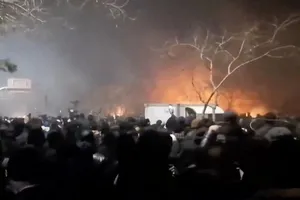
Witness accounts and reports reaching Iran International describe a coordinated massacre in the city on January 8 and 9, as security forces used a communications blackout to open fire on crowds with live ammunition.

Snipers on rooftops

On Tabarsi Street in Mashhad, members of the Revolutionary Guard took positions on rooftops starting at 9 p.m. Witnesses said they fired directly into the crowds. Plainclothes agents moved through the smoke of tear gas to kill protesters with handguns.

"From 10 p.m. onwards, the number of dead bodies lying on the ground was so high that the smell of blood was clearly felt in the air," one witness told Iran International. He added that security forces attacked an ambulance at midnight and killed or wounded protesters with "finish-off" shots.

  • 100 days on: why Iran’s January protests spread across social classes

    100 days on: why Iran’s January protests spread across social classes

  • A man, a dog, and a private wish turned public tragedy in Iran

    A man, a dog, and a private wish turned public tragedy in Iran

  • How images came to carry Iran’s protest dead

    How images came to carry Iran’s protest dead

Mass burials in secret

At Behesht-e Rezvan cemetery in Mashhad, a source familiar with the matter said the head of the facility reported that more than 400 bodies arrived on the night of January 9. Many could not be identified because they were shot in the face and neck.

Reports indicate that authorities carried out mass burials. The source who was present at the cemetery told Iran International that about 400 people were buried together in a single instance because their faces were unrecognizable from gunshot wounds.

Orders to spread fear

A source within the Khorasan Razavi Governor’s Office told Iran International that provincial leaders met on the morning of January 9. The instruction from higher authorities was to suppress the protests at any cost.

"It was stated that it does not matter how many are killed: 'Just scare the people in such a way that on January 10, no one dares to come to the street and protest,'" the source said.

Firefighters killed for helping

The crackdown also hit emergency workers. Firefighters in Mashhad were ordered by the municipality to participate in the suppression, but many refused and helped the protesters instead.

Hamid Mahdavi, a firefighter and athlete, was shot and killed while helping protesters. Other firefighters who refused the orders have been arrested.

At Farabi Hospital in Mashhad, a nurse said staff issued 500 death certificates between midnight and 7 a.m. on January 10.

In the courtyard of the Chamran clinic, a woman searching for her husband described seeing bodies in black covers stacked in three rows. She said a large trailer arrived and workers with covered faces began throwing more bodies from the vehicle onto the courtyard floor.

The Iranian government has maintained an internet and phone blackout for more than eight weeks. Iran International reports that the Islamic Republic killed more than 36,500 protesters across Iran during the two nights of Jan. 8 and 9.

Scam messages seek crypto for ships’ safe passage through Hormuz, firm warns

Apr 21, 2026, 08:52 GMT+1

Fraudulent messages offering ships safe passage through the Strait of Hormuz in exchange for cryptocurrency have been sent to some shipping companies, Reuters reported on Tuesday, citing a maritime security firm.

Greek risk management firm MARISKS said unknown actors posing as Iranian authorities had contacted companies whose vessels are stuck west of the strategic waterway, asking for transit fees in Bitcoin or Tether in return for “clearance.”

"These specific messages are a scam," the firm said in an alert, adding the communications did not originate from Iranian authorities.

The warning comes as the United States continues a blockade of Iranian ports, while Iran has imposed restrictions on the Strait of Hormuz, a key chokepoint through which about a fifth of global oil and liquefied natural gas once passed before conflict disrupted flows.

Amid ceasefire talks, Tehran has suggested collecting tolls from vessels seeking safe transit, contributing to uncertainty among shipowners.

  • Why the $100 billion Hormuz toll revenue is a myth

    Why the $100 billion Hormuz toll revenue is a myth

  • Iran floats Hormuz transit tolls as Persian Gulf states warn of military response

    Iran floats Hormuz transit tolls as Persian Gulf states warn of military response

Hundreds of vessels and roughly 20,000 seafarers remain stranded in the Persian Gulf due to the disruptions, according to the firm.

On April 18, when Iran briefly allowed limited passage subject to inspections, several ships attempted to transit, but at least two vessels, including a tanker, reported that Iranian boats fired shots, forcing them to turn back.

MARISKS said it believed at least one ship that came under fire while trying to leave the strait on Saturday may have been affected by the fraudulent scheme.

The messages cited by the firm said vessels would need to submit documents for review by Iranian security services, after which a cryptocurrency fee would be set before transit at a pre-arranged time.