• العربية
  • فارسی
Brand
  • Iran Insight
  • Politics
  • Economy
  • Analysis
  • Special Report
  • Opinion
  • Podcast
  • Iran Insight
  • Politics
  • Economy
  • Analysis
  • Special Report
  • Opinion
  • Podcast
  • Theme
  • Language
    • العربية
    • فارسی
  • Iran Insight
  • Politics
  • Economy
  • Analysis
  • Special Report
  • Opinion
  • Podcast
All rights reserved for Volant Media UK Limited
volant media logo
EXCLUSIVE

IRGC aerospace chief faces internal criticism over battlefield absence

Mar 21, 2026, 15:45 GMT

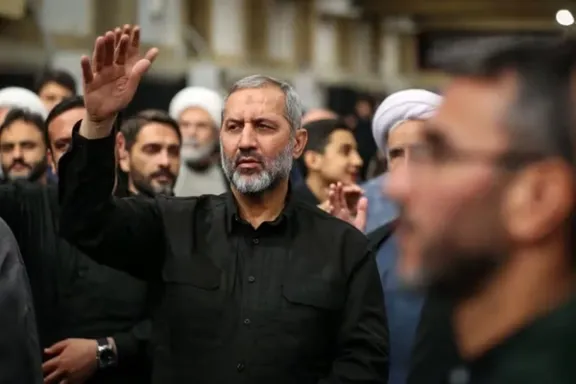
Revolutionary Guard Aerospace Force commander Majid Mousavi has come under criticism from senior IRGC officials for being absent during ongoing clashes and leaving his forces without leadership, sources with knowledge of the matter told Iran International.

The main criticism, according to the sources speaking to Iran International on condition of anonymity, centers on the commander’s lack of presence on the ground at a time when operational pressure has significantly intensified since the start of the war in late February.

Sources say that as casualties have mounted within the Aerospace Force—responsible for missile and drone launches—Mousavi’s absence has been cited as a key factor contributing to the deteriorating situation.

Aerospace Force operators have described the operational conditions as highly dangerous, with each missile launch mission carrying extreme risk and, in some cases, likened to near-suicidal operations, according to the informed sources.

At the same time, sources say families of some personnel have filed complaints with senior IRGC authorities, saying that the commander did not maintain an effective presence under dangerous conditions and that forces were effectively left without adequate support.

Additional allegations have also surfaced, including claims of mismanagement and the provision of inaccurate data regarding missile strikes and launch figures by the force.

Seyyed Hossein Mousavi Eftekhari, known as Majid Mousavi, is a brigadier general in the IRGC. He was appointed commander of the Aerospace Force on June 13, 2025, following the killing of his predecessor, Amir-Ali Hajizadeh, in an Israeli strike.

Prior to his appointment, Mousavi served from 2009 to 2025 as deputy commander of the Aerospace Force, where he played a key role in the development and management of Iran’s missile and drone programs.

The IRGC Aerospace Force is considered one of the Islamic Republic’s most important military branches, overseeing the country’s ballistic missile program, offensive drone capabilities, and parts of its air defense systems.

Mousavi is under US sanctions. On December 18, 2024, the US State Department announced sanctions against him over his role in the development of Iran’s ballistic missile and drone programs.

His appointment came at a time when the Aerospace Force was already under intense operational and security pressure. The force continues to play the most important role in the ongoing conflict.

Most Viewed

US terminates green cards of 3 Iranians tied to Islamic Republic
1

US terminates green cards of 3 Iranians tied to Islamic Republic

2
PODCAST

Worst outcome is Islamic Republic’s survival, ex-CIA official says

3
ANALYSIS

Iran brings unusually broad team to US talks to blunt future blame

4
INSIGHT

Tehran sends tough message but keeps diplomacy door open

5

Zoroastrian religious figure arrested in Iran

Banner
Banner

Spotlight

  • Tehran sends tough message but keeps diplomacy door open
    INSIGHT

    Tehran sends tough message but keeps diplomacy door open

  • Worst outcome is Islamic Republic’s survival, ex-CIA official says
    PODCAST

    Worst outcome is Islamic Republic’s survival, ex-CIA official says

  • Why the Iran-US truce is more likely to buy time than peace
    ANALYSIS

    Why the Iran-US truce is more likely to buy time than peace

  • Engaged but uncommitted: China watches Iran and US fight and talk
    ANALYSIS

    Engaged but uncommitted: China watches Iran and US fight and talk

  • A truce for the world, a reckoning for Iran’s economy
    ANALYSIS

    A truce for the world, a reckoning for Iran’s economy

  • Why the world failed to bypass the Strait of Hormuz
    ANALYSIS

    Why the world failed to bypass the Strait of Hormuz

•
•
•

More Stories

Tehran meeting struck by Israel likely tied to Iran’s atomic bomb plans

Mar 20, 2026, 07:10 GMT
•
Morad Vaisi

A meeting of senior Iranian officials that was hit by an Israeli airstrike on February 28 may have been linked to the Islamic Republic’s final deliberations over building a nuclear weapon.

On the last day of February, as reports emerged that Iran’s Supreme Leader Ali Khamenei had been killed in an Israeli bombardment, it was also announced that a meeting of the Defense Council had been struck.

Several senior figures were killed in the strike, the Israeli military confirmed on March 16.

Among those killed were Ali Shamkhani, a senior adviser to Khamenei and secretary of the Defense Council; Abdolrahim Mousavi, chief of staff of Iran’s armed forces; and Aziz Nasirzadeh, the defense minister.

Also killed were two figures associated with Iran’s Organization of Defensive Innovation and Research, known by its Persian acronym SPND, the direct successor organization to Iran’s pre-2004 nuclear weapons program.

The two figures were former SPND chief Brigadier General Reza Mozaffarinia and the organization’s new head Brigadier General Hossein Jabal Ameli.

Washington has sanctioned more than 30 SPND scientists and multiple affiliated entities, accusing the organization of overseeing “dual-use research and development activities applicable to nuclear weapons and nuclear weapons delivery systems.”

While Tehran denies pursuing a nuclear weapon, the UN nuclear watchdog and Western powers including the US and its European allies maintain that Iran's high-level uranium enrichment (up to 60%) has no credible civilian justification.

Iran currently possesses some 400 kg of near-bomb-grade enriched uranium. The US and Israel have in recent days discussed sending special forces into Iran to secure the stockpile at a later stage of the war, according to a report by Axios.

US War Secretary Pete Hegseth said Thursday that President Trump saw Iran advancing ever closer to nuclear capability and viewed it as unacceptable, prompting his decision to launch the war against Tehran.

Why A-bomb was focus of Defense Council meeting

There are four reasons suggesting the meeting of the Defense Council was likely related to the final stage of decision-making on constructing a nuclear weapon.

First, the composition of the gathering is a key indicator. The simultaneous presence of two former and current SPND chiefs alongside the defense minister — their superior — suggests the meeting concerned nuclear matters rather than battlefield operations. If the session had been focused on the war itself, senior operational or battlefield commanders would have been expected to attend instead of officials tied to the nuclear weapons industry.

Second, Ali Shamkhani had publicly spoken about nuclear weapons months earlier. Four months before his reported death, he said in an interview that if he could go back in time during his tenure as defense minister, he would build an atomic bomb.

Third, Shamkhani’s roles placed him at the center of coordination between multiple institutions. As Khamenei’s senior adviser and secretary of the Defense Council, as well as a former defense minister, he maintained extensive ties with officials within the ministry, including the department responsible for special weapons development, SPND.

He was also described as a senior commander overseeing Revolutionary Guard officers involved in nuclear weapons development and as the link between these networks and Khamenei himself.

Fourth, in one of his final public remarks, Shamkhani told Lebanon’s Al-Mayadeen television that a war with the United States and Israel was inevitable and that the Islamic Republic needed to prepare for it.

Taken together, these elements may indicate that the meeting struck in the bombardment may have been connected to the final stage of decision-making regarding nuclear weapons development.

It is unknown whether Israel was aware that the gathering concerned possible deliberations over building a nuclear weapon, or whether it targeted the meeting simply because senior Iranian officials were known to be present.

South Pars strike stirs debate among Iranians over impact and intent

Mar 19, 2026, 12:31 GMT

Messages sent to Iran International and posts on social media showed a split reaction to Wednesday’s strike on Iran’s South Pars gas field, with some welcoming the hit on state-linked assets and others warning of civilian costs.

Messages sent to Iran International and posts on social media were divided over Wednesday’s strike on the South Pars gas field in southern Iran, with some welcoming the hit on state-linked assets and others warning of civilian costs.

US President Donald Trump said Israel had struck Iran’s South Pars gas field “out of anger” over developments in the Middle East, describing the damage as limited and warning there would be no further attacks unless Iran targeted Qatar again.

The strike marked a shift in a conflict that has spread across the Persian Gulf, disrupting energy flows after Iranian missiles targeted facilities in Qatar and Saudi Arabia.

  • Iran floats Hormuz transit tolls as Persian Gulf states warn of military response

    Iran floats Hormuz transit tolls as Persian Gulf states warn of military response

Strike seen as blow to state-linked networks

Some messages sent to Iran International framed the attack as a setback for institutions tied to the Islamic Revolutionary Guards Corps.

“Israel, by hitting South Pars, saved us from more theft… the money was turned into bullets fired at our children,” one citizen wrote.

Another, who said he had worked on projects in the field, downplayed the long-term impact.

“Even with the complete destruction of all 24 gas refineries… they will return to production in less than three months,” he wrote, adding that supply lines from offshore platforms would shut automatically and protect reserves.

A separate message from an engineer challenged concerns about offshore facilities.

“The platforms are not even fully operational because of sanctions… after the Islamic Republic, they can be rebuilt better,” he wrote, contrasting them with higher-quality installations on the Qatari side.

Others shifted the focus away from infrastructure entirely.

“The main infrastructure was the young people they took from us… the rest can be rebuilt with better technology.”

Social media posts echoed that line in sharper language. “Don’t worry about infrastructure,” one post read. “What infrastructure are you talking about? What life was left that needed infrastructure?” it added.

Concerns over civilian impact

Other messages cautioned that strikes on energy infrastructure would translate directly into hardship for civilians.

“Don’t look at infrastructure so simply,” one user wrote. “Lack of electricity and gas means death – cold, hunger, medicine shortages.”

Another post rejected attacks on non-military targets. “Hitting Iran’s infrastructure by any side is condemnable. It belongs to all Iranians,” the message read.

Some called for limiting strikes strictly to military-linked targets. “Please just hit those responsible and leave non-military infrastructure alone.”

One message also questioned the timing. “Hitting South Pars at this moment is not the last and best solution,” it read.

Back to corruption and rebuilding

Even among those critical of the strike, some framed the debate through long-standing economic grievances.

“If infrastructure belonged to the people, no one would be searching in trash for food.”

Another argued that damaged facilities could ultimately be replaced. “That worn-out infrastructure… will be rebuilt better – but those lives won’t return,” the user wrote referring to thousands of people killed during the January protests.

Others pointed to historical reconstruction. “Germany and Japan were flattened in World War II – where are they now?” one user said.

Across the exchanges, a recurring thread linked both support for and opposition to the strike back to mistrust of the Islamic Republic, with many portraying the country’s energy wealth as mismanaged or diverted, and arguing that any future recovery depends less on infrastructure than on political change.

How could the war with Iran end?

Mar 19, 2026, 02:08 GMT
•
Ata Mohamed Tabriz

US president Donald Trump suggested this week that the war with Iran could end soon, but few can say with confidence how it will.

Wars rarely end on political will alone, and this conflict is constrained by a dense web of strategic, economic and security pressures that neither side can easily escape.

What began with stated goals—containing Iran’s nuclear program, degrading its missile and regional capabilities, and “helping” the Iranian people—has hardened into a confrontation between objectives that are arguably incompatible.

As the conflict spreads into the arteries of the global economy, ending it will require more than a shift in rhetoric—or even policy. A durable ceasefire would depend on mediators capable of sequencing reciprocal steps and bridging fundamentally incompatible aims.

More likely, the war will end not through decisive victory, but at the point where continued fighting no longer improves either side’s position and the mutual threat environment begins to recede.

Incompatible endgames

For the United States and Israel, the conflict forms part of a broader attempt to reshape the Middle East’s security architecture. Since October 7, Benjamin Netanyahu has repeatedly invoked a “new Middle East” in which Iran’s regional reach is sharply curtailed.

Drawing on past confrontations, including the 12-day war of June 2025, Washington and Tel Aviv appear to be seeking tangible outcomes: dismantling key military capabilities and preventing their reconstruction—an objective that may prove harder than the initial blow.

Iran’s logic is different. Tehran is pursuing what might be called coercive endurance: safeguarding regime survival while preserving deterrence by imposing high costs on its adversaries. Its demands—compensation and assurances against renewed war—serve not only strategic ends but domestic ones, helping sustain elite cohesion and legitimacy.

Regional actors, particularly Persian Gulf Arab states, and external powers with major energy interests remain cautious, oscillating between defensive positioning and watchful restraint. For now, mediation remains peripheral. The war is being shaped less in diplomatic forums than under fire.

A war of arteries

The Strait of Hormuz has evolved from a geographic chokepoint into a central strategic lever. Iran’s approach rests on the premise that disrupting this vital waterway transforms a bilateral confrontation into a global economic crisis.

Energy prices become not just an indicator but a weapon, intended to erode political will in Washington and its allies by destabilizing markets and raising costs worldwide.

Washington, in turn, has focused on Kharg Island—Iran’s primary oil export terminal and the loading point for roughly 90 percent of its crude exports. The threat to Kharg is a direct counter to Tehran’s Hormuz leverage. If Hormuz raises global costs, Kharg raises the cost of survival for Iran itself.

This duel points to a central constraint: the war will move toward closure only when both sides conclude that choking each other’s economic lifelines yields diminishing returns compared with the systemic risks to global energy markets.

Any durable settlement would therefore require a new security arrangement that guarantees safe passage through Hormuz while removing the threat to Iran’s export infrastructure.

Question of authority

The killing of senior political figures, including Ali Larijani, has raised concerns about gaps in coordination at the center of power. The question is whether an institutional structure still exists capable of accepting defeat—or even signing a ceasefire.

Yet the continuation of Iranian strikes suggests the system’s resilience does not rest on individuals alone. Tehran’s military order, shaped by a doctrine of decentralized “mosaic” defense, appears to have maintained operational coherence.

That resilience, however, raises doubts about whether a ceasefire could produce lasting stability while the machinery of war remains intact.

Inside Iran, external attacks appear to have strengthened nationalist sentiment among parts of society, yet leadership losses could also trigger fissures within the security establishment or embolden dissent. The balance between cohesion and fracture remains unclear.

For now, political and military leadership appear aligned in their belief that the situation remains manageable.

Some in Washington therefore see a more realistic objective not as immediate regime collapse but as forcing Tehran into a form of strategic accommodation—perhaps through the rise of more pragmatic figures capable of imposing restraint on military actors.

Such an outcome could allow Tehran to concede in practice while presenting the result domestically as survival or even victory.

Whether that path is viable remains uncertain. Internal purges, factional tensions and competing strategic visions continue to complicate any transition, even as some voices within Iran’s security establishment advocate widening the conflict.

Ultimately, how the war ends will depend not only on economic and regional pressures but on a deeper unknown: how much organizational capacity, military discipline and political authority remain in Tehran to accept a new strategic order.

Wars of this kind end when exhaustion converges with recognition. The decisive question is whether there remains a clear address in Tehran capable of signing—and enforcing—a ceasefire, and what form that political will ultimately takes.
Israel’s South Pars strikes push Iran conflict into energy war

Mar 18, 2026, 16:41 GMT
•
Umud Shokri

Israel’s strikes on Iran’s gas facilities mark a shift in the conflict from military confrontation to economic warfare centered on energy.

On March 18, Israeli strikes targeted facilities linked to South Pars and the onshore hub at Asaluyeh in Bushehr Province.

Qatar, which shares the reservoir, directly blamed Israel, while the United Arab Emirates branded the attack a "dangerous escalation" threatening global energy security.

Tehran responded with a swift call for the evacuation of energy infrastructure across the Persian Gulf, including in Qatar, Saudi Arabia and the United Arab Emirates.

South Pars is not simply another hydrocarbon asset. Together with Qatar’s North Dome, it forms the world’s largest natural gas field, holding an estimated 1,800 trillion cubic feet of gas and 50 billion barrels of condensate.

Iran’s share accounts for roughly 36 percent of its proven gas reserves and about 5.6 percent of global reserves, placing a central pillar of its economy at risk.

Asaluyeh serves as the operational core of this system, concentrating upstream, midstream and downstream infrastructure in a single coastal zone. Offshore production feeds into refineries, petrochemical complexes and export terminals that underpin Iran’s electricity generation, industrial base and energy exports.

This concentration creates both efficiency and vulnerability. A strike on Asaluyeh does not merely disrupt production; it threatens the entire value chain.

Positioned along the Persian Gulf and connected to export routes through the Strait of Hormuz, Asaluyeh sits at the intersection of production and transit. Any sustained disruption could compound supply shocks across global markets.

Israel has moved beyond military and nuclear assets to strike the economic core of Iran’s power, signaling a shift toward economic attrition in which energy systems become primary targets.

Iran’s response suggests escalation will not remain contained. Outlets linked to the Islamic Revolutionary Guard Corps have published lists of potential targets: Ras Laffan and Mesaieed in Qatar, the SAMREF refinery and Jubail petrochemical complex in Saudi Arabia, and the Al Hosn gas field in the United Arab Emirates.

The fallout is already visible. Iraq has reported a halt in Iranian gas supplies following the strike on South Pars, while Ras Laffan installations in Qatar are being evacuated.

The shared nature of the reservoir raises additional risks. Qatar’s North Dome underpins a significant share of global LNG supply to Europe and Asia. Instability on the Iranian side introduces concerns over reservoir management, operational safety and spillover effects.

Qatar’s swift condemnation reflects a clear calculation: escalation around the world’s largest gas field threatens global markets as much as regional stability.

The risks extend beyond the Gulf. Israel’s offshore gas fields—Leviathan, Tamar and Karish—are critical to domestic supply and regional exports and remain exposed to potential retaliation. Expanding the conflict to the Eastern Mediterranean would transform a regional confrontation into a multi-basin energy crisis.

The strike also exposes a strategic asymmetry. Israel has limited comparable domestic energy infrastructure vulnerable to direct retaliation, while Iran operates within a region where energy assets are densely clustered.

Tehran cannot easily mirror the strike, but it can impose costs across a wider regional system by targeting Gulf producers, shipping lanes or offshore infrastructure.

The choice of South Pars and Asaluyeh therefore reflects more than tactical targeting. It marks a deliberate shift toward pressure on economic systems and systemic vulnerability.

The immediate damage may prove limited. The strategic consequences are not. Once energy infrastructure becomes a battlefield, escalation thresholds shift, retaliation broadens, and interconnected energy systems become more fragile.

South Pars is not just a gas field; it anchors Iran’s economy and links directly to global energy markets. By placing it in the crosshairs, the conflict has entered a phase in which local strikes carry global consequences.

What the Balkans can tell Iranians about life after war

Mar 18, 2026, 07:23 GMT
•
Naeimeh Doostdar

Recent history in the Balkans may offer a useful lens for the postwar questions now confronting many ordinary Iranians.

That question has taken on added urgency after repeated suggestions by President Donald Trump this week that the war could end in the very near future.

Among the most instructive comparisons is the NATO intervention in Yugoslavia in 1999—a conflict that carried sharply different meanings depending on where it was experienced.

For many outside observers, the war began with NATO’s 78-day bombing campaign launched in March of that year after the collapse of peace talks. But for those on the ground in Kosovo, the conflict had already been unfolding for years.

It had taken shape not through airstrikes, but through a gradual tightening of control: checkpoints, dismissals from public jobs, the closure of Albanian-language schools and the growing presence of security forces.

By the time NATO intervened, many Kosovo Albanians saw the bombing not as the start of war but as a new phase of a conflict they had already been living through.

For many Kosovo Albanians, the bombing was accompanied by fear but also a measure of hope. By early 1999, large numbers of civilians were already fleeing violence, and accounts from refugee camps in Albania and North Macedonia often reflected a similar sentiment.

Fragments of those fears and hopes remain preserved in television reports from the time, now widely available online.

“We are afraid of the planes, but we are more afraid of the soldiers who burned our homes,” a young man from Prizren tells the BBC in one such report.

Another refugee says: “When we heard NATO had attacked, we thought maybe someone had finally come to stop this.”

For others, the calculus was more reluctant. A teacher later reflected: “We did not want war. But once it began, we felt it might be the only way for things to change.”

At the same time, civilians in Serbia experienced the war very differently.

In Belgrade, air raid sirens sent residents into shelters night after night as bridges, factories and military sites were targeted. In the early days, a sense of defiance took hold, with people gathering in public spaces despite the risk.

“We know it is dangerous, but we do not want to leave our city alone,” one student said.

As the bombing continued, defiance gave way to exhaustion. Power outages became more frequent, daily life more strained and uncertainty more acute.

“At first, people were angry. After a while, we were just tired,” one resident later said.

The Kosovo war illustrates how the same military intervention can carry entirely different meanings depending on lived experience.

For many Serbs, NATO’s campaign became a symbol of foreign aggression and national humiliation. For many Kosovo Albanians, it represented the possibility — however uncertain — that years of repression might finally end.

After 78 days, Yugoslav forces withdrew and international peacekeeping troops entered Kosovo. For many Kosovo Albanians, that marked the beginning of a return to homes that were often damaged or destroyed. For many Serbs, the war remained a defining national trauma.

The contrast endures in how the conflict is remembered.

“We hated the war,” one Kosovar later wrote. “But without it, we might still be living in that fear.”

A Serbian citizen offered a starkly different view: “For us, this war was neither freedom nor justice. It was simply bombing.”

As Iranians begin to consider what might follow the current conflict, the Balkan experience offers no simple answers—only a reminder that the meaning of war is rarely shared equally.

If the war does end soon, as Trump suggests, its consequences inside Iran may prove equally contested.