• العربية
  • فارسی
Brand
  • Iran Insight
  • Politics
  • Economy
  • Analysis
  • Special Report
  • Opinion
  • Podcast
  • Iran Insight
  • Politics
  • Economy
  • Analysis
  • Special Report
  • Opinion
  • Podcast
  • Theme
  • Language
    • العربية
    • فارسی
  • Iran Insight
  • Politics
  • Economy
  • Analysis
  • Special Report
  • Opinion
  • Podcast
All rights reserved for Volant Media UK Limited
volant media logo

Iran says gas network stable after Israeli attack on facilities

Mar 18, 2026, 17:46 GMT+0

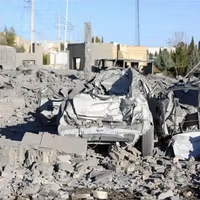
Iran’s National Iranian Gas Company says the country’s gas network remains stable following today’s attack on gas facilities in the south.

In a statement published by Tasnim news agency, the company said “part of the refining units” were damaged but gas production continues and teams are working to restore operations.

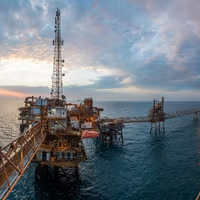
It added that a fire at the South Pars facility has been extinguished, with equipment cooling operations now under way.

Most Viewed

Behind Tehran’s unity show: The secret letter to the shadow king
1
INSIGHT

Behind Tehran’s unity show: The secret letter to the shadow king

2

Iran executes protester over January uprising

3
PODCAST

US should use Iran talks leverage to help Iranian people, veteran journalist says

4

Iranian national charged in US over migrant smuggling scheme

5

Starmer pledges to move on banning Iran's IRGC in next parliament session

Banner
Banner

Spotlight

  • US should use Iran talks leverage to help Iranian people, veteran journalist says
    PODCAST

    US should use Iran talks leverage to help Iranian people, veteran journalist says

  • Iran’s economy after the March war: how bad can it get?
    ANALYSIS

    Iran’s economy after the March war: how bad can it get?

  • Behind Tehran’s unity show: The secret letter to the shadow king
    INSIGHT

    Behind Tehran’s unity show: The secret letter to the shadow king

  • Rapid deterioration of Iran-UAE ties threatens a critical trade lifeline
    ANALYSIS

    Rapid deterioration of Iran-UAE ties threatens a critical trade lifeline

  • Tehran stocks head for reopening, but it risks triggering a new crisis
    ANALYSIS

    Tehran stocks head for reopening, but it risks triggering a new crisis

  • Power vacuum in Tehran emboldens hardliners
    INSIGHT

    Power vacuum in Tehran emboldens hardliners

  • Inflation spikes, basic goods slip out of reach for Iranians, citizens say
    VOICES FROM IRAN

    Inflation spikes, basic goods slip out of reach for Iranians, citizens say

•
•
•

More Stories

Trump yet to decide on ground troops in Iran - CBS

Mar 18, 2026, 17:14 GMT+0

President Donald Trump has not yet decided whether to send US forces into Iran to seize nuclear material, a move described as highly dangerous, according to CBS News, citing sources familiar with the matter.

In private conversations, Trump has told people close to him that he has “a lot of decisions to make,” as the Pentagon prepares multiple options for the next phase of the conflict.

After US strikes on three nuclear sites last June, the UN nuclear watchdog said it could not account for an estimated 400 kilograms of highly enriched uranium Iran had prior to the attacks.

Iran’s parliament speaker says ‘eye for an eye’ in effect

Mar 18, 2026, 17:02 GMT+0

Iran’s parliament speaker Mohammad Bagher Ghalibaf said after attacks on the country’s infrastructure that an “eye for an eye” approach was now in effect and a new level of conflict had begun.

“Last night, the people of Iran thwarted all the enemy’s plans,” Ghalibaf said on X.

“The equation of an eye for an eye is now in effect, and a new level of conflict has begun,” he added.

Israel’s South Pars strikes push Iran conflict into energy war

Mar 18, 2026, 16:41 GMT+0
•
Umud Shokri

Israel’s strikes on Iran’s gas facilities mark a shift in the conflict from military confrontation to economic warfare centered on energy.

On March 18, Israeli strikes targeted facilities linked to South Pars and the onshore hub at Asaluyeh in Bushehr Province.

Qatar, which shares the reservoir, directly blamed Israel, while the United Arab Emirates branded the attack a "dangerous escalation" threatening global energy security.

Tehran responded with a swift call for the evacuation of energy infrastructure across the Persian Gulf, including in Qatar, Saudi Arabia and the United Arab Emirates.

South Pars is not simply another hydrocarbon asset. Together with Qatar’s North Dome, it forms the world’s largest natural gas field, holding an estimated 1,800 trillion cubic feet of gas and 50 billion barrels of condensate.

Iran’s share accounts for roughly 36 percent of its proven gas reserves and about 5.6 percent of global reserves, placing a central pillar of its economy at risk.

Asaluyeh serves as the operational core of this system, concentrating upstream, midstream and downstream infrastructure in a single coastal zone. Offshore production feeds into refineries, petrochemical complexes and export terminals that underpin Iran’s electricity generation, industrial base and energy exports.

This concentration creates both efficiency and vulnerability. A strike on Asaluyeh does not merely disrupt production; it threatens the entire value chain.

Positioned along the Persian Gulf and connected to export routes through the Strait of Hormuz, Asaluyeh sits at the intersection of production and transit. Any sustained disruption could compound supply shocks across global markets.

Israel has moved beyond military and nuclear assets to strike the economic core of Iran’s power, signaling a shift toward economic attrition in which energy systems become primary targets.

Iran’s response suggests escalation will not remain contained. Outlets linked to the Islamic Revolutionary Guard Corps have published lists of potential targets: Ras Laffan and Mesaieed in Qatar, the SAMREF refinery and Jubail petrochemical complex in Saudi Arabia, and the Al Hosn gas field in the United Arab Emirates.

The fallout is already visible. Iraq has reported a halt in Iranian gas supplies following the strike on South Pars, while Ras Laffan installations in Qatar are being evacuated.

The shared nature of the reservoir raises additional risks. Qatar’s North Dome underpins a significant share of global LNG supply to Europe and Asia. Instability on the Iranian side introduces concerns over reservoir management, operational safety and spillover effects.

Qatar’s swift condemnation reflects a clear calculation: escalation around the world’s largest gas field threatens global markets as much as regional stability.

The risks extend beyond the Gulf. Israel’s offshore gas fields—Leviathan, Tamar and Karish—are critical to domestic supply and regional exports and remain exposed to potential retaliation. Expanding the conflict to the Eastern Mediterranean would transform a regional confrontation into a multi-basin energy crisis.

The strike also exposes a strategic asymmetry. Israel has limited comparable domestic energy infrastructure vulnerable to direct retaliation, while Iran operates within a region where energy assets are densely clustered.

Tehran cannot easily mirror the strike, but it can impose costs across a wider regional system by targeting Gulf producers, shipping lanes or offshore infrastructure.

The choice of South Pars and Asaluyeh therefore reflects more than tactical targeting. It marks a deliberate shift toward pressure on economic systems and systemic vulnerability.

The immediate damage may prove limited. The strategic consequences are not. Once energy infrastructure becomes a battlefield, escalation thresholds shift, retaliation broadens, and interconnected energy systems become more fragile.

South Pars is not just a gas field; it anchors Iran’s economy and links directly to global energy markets. By placing it in the crosshairs, the conflict has entered a phase in which local strikes carry global consequences.


Vatican urges Trump to end Iran war

Mar 18, 2026, 16:29 GMT+0

The Vatican’s top diplomat called on US President Donald Trump on Wednesday to end the expanding war involving Iran as soon as possible.

“I would say to finish it as soon as possible,” Cardinal Pietro Parolin, a senior advisor to Pope Leo, said.

“This message goes also to the Israelis,” he added.

US intel assessment: Iran war likely to reshape the region

Mar 18, 2026, 15:19 GMT+0

The latest Worldwide Threat Assessment by the US intelligence community says the economic, political and social drivers of discontent in Iran remain intact and could fuel further unrest.

The report says Iran’s economy continues to struggle with low growth, exchange-rate volatility and high inflation, trends likely to persist without sanctions relief.

The assessment also says Operation Epic Fury has “almost certainly” curtailed Iran’s ability to project power, though Tehran continues to rely on remaining capabilities—including advanced ballistic missiles, drones and allied regional networks.

Looking ahead, the report says the eventual end of the conflict with Iran could prompt major regional actors to reassess longstanding assumptions and alliances, including their relationships with Israel and their level of commitment to the US-backed Gaza peace initiative.

US intelligence analysts also assess that Israeli leaders are likely to continue proactive—and at times provocative—military action to deter regional adversaries. If Iran’s leadership endures, Israel is expected to use all available means to prevent Tehran from rebuilding capabilities degraded during the 12-Day War and Operation Epic Fury.