• العربية
  • فارسی
Brand
  • Iran Insight
  • Politics
  • Economy
  • Analysis
  • Special Report
  • Opinion
  • Podcast
  • Iran Insight
  • Politics
  • Economy
  • Analysis
  • Special Report
  • Opinion
  • Podcast
  • Theme
  • Language
    • العربية
    • فارسی
  • Iran Insight
  • Politics
  • Economy
  • Analysis
  • Special Report
  • Opinion
  • Podcast
All rights reserved for Volant Media UK Limited
volant media logo

Iran’s intelligence mocked by allies and foes over 'secret' Israel files

Maryam Sinaiee
Maryam Sinaiee

Iran International

Sep 27, 2025, 17:55 GMT+1Updated: 00:34 GMT

A documentary released by Iran’s Intelligence Ministry claiming infiltration into Israel has drawn ridicule from both opposition groups and hardline loyalists of the Islamic Republic who criticized it for relying on public images and exaggerating its claims.

The documentary, The Spider’s Hideout, aired on state television on September 24, presenting alleged intelligence on Israeli nuclear sites, including Dimona.

Intelligence Minister Esmaeil Khatib described it as "a major infiltration yielding a treasure of top-secret intelligence," seemingly in response to criticism of his ministry’s failures during Israel’s June campaign.

Independent reviews, however, revealed that most images were publicly available online. Critics noted some visuals depicted Israel’s nuclear research collaboration rather than weapons programs, and the individuals named were publicly known Israeli Atomic Energy officials.

The incident has raised concerns about the inefficiency of Iran's intelligence apparatus and its propaganda methods.

Mehdi Kharratian, head of an Iranian think tank close to power circles, wrote: "Superiority must be shown not in the media but in the field—by raising levels of deterrence and increasing the costs to any enemy that acts against the country's security."

He also urged the establishment of a fact-finding committee to address inefficiencies and security gaps within the intelligence apparatus.

Guards-linked outlets admit use of online photos

Fars News Agency, affiliated with the Revolutionary Guards (IRGC), acknowledged using archival images, describing the choice as “poor judgment” that allowed critics to call the documentary “fabricated.”

It confirmed that all images, including archived ones, were labeled as “exclusive photos.”

Mashregh News, also linked to the IRGC, claimed the documents came from human sources inside Israel and were used in targeting sites during the 12-day war.

While admitting some images were available online, it alleged Israel had waged a Persian-language social media campaign to discredit the documentary.

Social media reactions

Iranian media largely avoided direct criticism of the intelligence ministry probably due to fear of prosecution, but X users from opposition and Islamic Republic loyalists were scathing:

“The Islamic Republic’s problem is that it thinks it is ruling over people aged 5 to 10… This is how the clerics have driven a great country into ruin," one user said on X.

"Calling (the documentary) a media stunt would be generous — it was more like a media toy; like a rattle handed to a child to distract them," reads another post.

Ghasem Mohammadi, a supporter of the Green Movement leader Mir-Hossein Mousavi, lamented wasted resources, writing: “Once again the people’s money has been squandered.”

“It is truly upsetting to see the state of the country’s intelligence apparatus like this! Some things are a matter of dignity.”

“Believe me, if the enemy wanted to ruin an institution’s reputation with a media operation, they couldn’t have done better.”

Why are ultra-hardliners criticizing the ministry?

Some ultra-hardliners’ criticism may reflect a structural conflict between Iran’s Intelligence Ministry and the IRGC’s parallel intelligence network, which aligns more with hardline factions.

Although appointed with the Supreme Leader's approval, the Intelligence Minister formally reports to the president and is intended to serve as the country’s main civilian intelligence body, while the IRGC’s intelligence organization reports directly to the Supreme Leader and the Guards’ command.

This dual structure creates overlapping responsibilities and frequent rivalries, with the IRGC often acting independently of—or even in opposition to—the ministry’s priorities.

The ministry has supported President Masoud Pezeshkian’s push for social and cultural relaxation, including resisting the enforcement of the new Hijab law. These changes, now increasingly irreversible, are seen as undermining hardline influence.

Most Viewed

US terminates green cards of 3 Iranians tied to Islamic Republic
1

US terminates green cards of 3 Iranians tied to Islamic Republic

2
PODCAST

Worst outcome is Islamic Republic’s survival, ex-CIA official says

3
ANALYSIS

Iran brings unusually broad team to US talks to blunt future blame

4
INSIGHT

Tehran sends tough message but keeps diplomacy door open

5

Zoroastrian religious figure arrested in Iran

Banner
Banner

Spotlight

  • Tehran sends tough message but keeps diplomacy door open
    INSIGHT

    Tehran sends tough message but keeps diplomacy door open

  • Worst outcome is Islamic Republic’s survival, ex-CIA official says
    PODCAST

    Worst outcome is Islamic Republic’s survival, ex-CIA official says

  • Why the Iran-US truce is more likely to buy time than peace
    ANALYSIS

    Why the Iran-US truce is more likely to buy time than peace

  • Engaged but uncommitted: China watches Iran and US fight and talk
    ANALYSIS

    Engaged but uncommitted: China watches Iran and US fight and talk

  • A truce for the world, a reckoning for Iran’s economy
    ANALYSIS

    A truce for the world, a reckoning for Iran’s economy

  • Why the world failed to bypass the Strait of Hormuz
    ANALYSIS

    Why the world failed to bypass the Strait of Hormuz

•
•
•

More Stories

Trump’s path will 'set fire' to the region, Pezeshkian tells NBC

Sep 27, 2025, 07:40 GMT+1

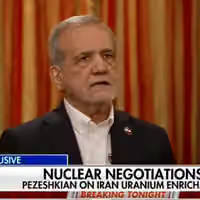
The Islamic Republic does not seek conflict but would respond forcefully to aggression, said Iranian President Masoud Pezeshkian in an interview with NBC on Friday.

“We’re not afraid of war. We do not seek war,” he told NBC’s Tom Llamas. “President Trump has said that his administration has come to create peace, but the path that they have embarked upon will set fire to the entire region.”

Iran would never initiate a conflict but would give “the strongest answer” to any attack, Pezeshkian said.

Tehran continues to build its defense capabilities to deter adversaries, he added.

On nuclear issues, he rejected suggestions that Iran is developing weapons, pointing to the Supreme Leader’s fatwa against weapons of mass destruction.

He said inspectors from the International Atomic Energy Agency were welcome to visit sites in Iran, dismissing reliance on satellite images as insufficient.

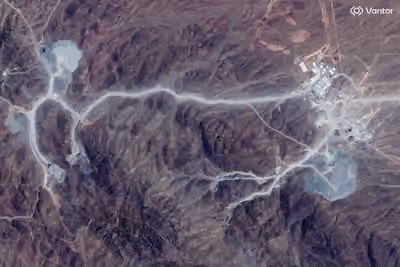
Iran has resumed construction at an underground mountain site following US and Israeli strikes on its nuclear facilities, with satellite imagery and analysts indicating the work may reflect efforts to rebuild its damaged nuclear program.

The president also commented on domestic unrest, saying Iranians “have a right to choose” in response to questions about the enforcement of hijab laws. He acknowledged mishandling of Mahsa Amini’s case but accused outside observers of exaggerating Iran’s record while ignoring civilian deaths in Lebanon, Gaza, Yemen, and Syria.

Supreme Leader Ali Khamenei has ruled out direct talks with the US on missiles and uranium enrichment.

The president also referred to an injury he sustained during Israeli strikes in June’s 12-day war, saying doctors drained fluid from his knee and that the wound was minor.

Economists sound crisis alarm as Iran braces for sanctions amid downturn

Sep 27, 2025, 07:30 GMT+1
•
Behrouz Turani

Iran is sliding into stagflation that could spark unrest, economists warn, as official data reveal the first economic contraction in four years on the eve of the UN sanctions returning.

Several Iranian economists say the downturn is already entrenched and that officials are underestimating the severity of the crisis.

Tehran University professor Albert Boghozian argued last week that Iran now shows the classic symptoms of stagflation—negative growth, high inflation, and rising unemployment.

“Officials must not ignore the danger of deepening stagflation, which is likely to intensify if the snapback proposed by the UK, France, and Germany is implemented,” he cautioned.

The Statistical Center of Iran reported that GDP shrank by 0.1% in the spring.

Excluding the petroleum sector, the contraction deepened to -0.4%. Agriculture was the hardest hit, with output falling 2.7%. This downturn marks the first time since 2021 that Iran’s economy has posted negative quarterly growth.

'Worse to come’

The reversal is striking given the 3.0% expansion recorded in the last full calendar year ending March 2025. That period, supported by high oil revenues and relative stability, allowed for modest but steady growth.

Ali Ghanbari, a macroeconomist and former deputy agriculture minister, predicted conditions will deteriorate further in the coming months.

“Iran is heading toward a more difficult economic period in the second half of the Iranian year (September 2025 to March 2026),” he told reporters in Tehran.

He forecast a contraction of 1–2% by March 2026 and inflation climbing above 54%.

“The downturn had been anticipated due to sanctions and political tensions,” he added, “but the scale of inflation will place even greater strain on household budgets.”

Such levels of inflation would erode real incomes and fuel social discontent — a sensitive issue for the government as it braces for renewed sanctions.

‘Sanctions hinder development’

The Majles Research Center has argued that renewed UN sanctions would be less damaging than existing US restrictions, which already limit Iran’s access to global markets and financial channels.

But economists such as Boghozian believe Tehran has few tools left to cushion the blow.

“The Iranian government cannot do much about the UN sanctions,”he warned. “Continued stubbornness will only deepen the suffering.”

Sweeping UN sanctions are set to be reimposed on September 27 following the end of the 30-day snapback period.

Boghozian warned that their return could have consequences far beyond economic hardship, setting the scene for more confrontation with Iran’s foes.

“With the threat of war, Iran cannot realistically pursue development,” he said. “War and sanctions will rob the country of opportunities. If we fail to take initiative, the other side will dictate the terms.”

‘Why bother going?’ Tehran’s moderates knock Pezeshkian's UN trip

Sep 25, 2025, 16:54 GMT+1
•
Maryam Sinaiee

President Masoud Pezeshkian’s speech at the United Nations drew an unusual split in Tehran: while conservatives and hardliners rallied behind him, many of his moderate supporters voiced sharp disappointment.

Parliament Speaker Mohammad Bagher Ghalibaf hailed Pezeshkian on X, saying he conveyed “the dignity and power of the Iranian nation at the UN” and exposed Israel as “child-killers.”

Ultra-hardliner Amir-Hossein Sabeti thanked him for recalling “the Zionist regime’s crimes,” while fellow lawmaker Hamid Rasaei called the address “worthy, good and influential.”

In his speech to the UN General Assembly on Wednesday, Pezeshkian denounced Israeli raids on Iran’s nuclear facilities in June as illegal and blasted European powers for triggering the return of UN sanctions.

“His duty was to deliver the nation’s positions to the world,” one pro-government user commented on Ghalibaf’s post. “Thank God he passed this test of Western charlatanism.”

‘Wish you didn’t go’

Moderates and reformists, by contrast, were left underwhelmed.

Former Chamber of Commerce head Hossein Selahvarzi dismissed the trip as pointless. “So far, the outcome of the New York trip can be summed up in one sentence: ‘Being there so that we weren’t absent.’”

Prominent academic Sadegh Zibakalam directly addressed Pezeshkian: “Mr. President, after the Leader’s speech yesterday, what was left for you to say in New York? I wish you hadn’t gone—unless you intended to say something different.”

Others offered a more tempered defense.

Prominent centrist and former editor Mohammad Atrianfar compared Pezeshkian’s remarks to former president Khatami’s early UN addresses, calling them “clear, meaningful, and forward-looking … consistent with the Leader’s instructions.”

Maziar Balaei of the Etemad Melli Party said that given recent Israeli and US military actions, “it was in fact a good address.”

‘Not our representative’

Some critics also objected to the president’s choice of symbolism.

By holding up photos of Iranians killed in the 12-day war with Israel, they argued, he ignored violence inside Iran.

“I wish the Iranian people also had a representative at the UN who held up the pictures of the children Khamenei killed and showed them to the world,” one user wrote.

A viewer told Iran International in a video message: “Who killed Kian Pirfalak, Hamidreza Rouhi, Hadis Najafi and the Zahedan worshippers? If there is justice, it must first be applied for the people of Iran before you talk about Lebanon and Palestine.”

‘Little impact’

Outside observers were skeptical of the speech’s significance.

Turkey-based analyst Rouhollah Rahimpour described it as “a softer and more diplomatic version of Khamenei’s harsh stance,” noting that Pezeshkian avoided taking a position on negotiations with the US.

On X, he added: “What is left unsaid matters as much as what is said … rejecting talks with one hand while reaching for them with the other.”

Germany-based analyst Ahmad Pourmandi was harsher, calling Khamenei’s remarks ahead of the trip “the final blow to fading hopes of resolving the snapback crisis.”

Pezeshkian’s mission, Pourmandi added, “was the final nail in the coffin of normalization—deepening Iran’s crisis and its march toward war.”

History repeating itself? Khamenei risks another 'poison chalice' moment

Sep 24, 2025, 01:00 GMT+1
•
Behrouz Turani

In Tehran today, debate over Supreme Leader Ali Khamenei’s hardline stance on nuclear negotiations carries an unmistakable echo of the end of Iran’s eight-year war with Iraq in 1988.

Then, as now, Iran faced a grinding impasse: Supreme Leader Ruhollah Khomeini resisted UN Resolution 598 which called for an end to hostilities until the cost of defiance became unbearable.

The resolution, passed on July 20, 1987, demanded a ceasefire, prisoner exchanges and a return to recognized borders.

Saddam Hussein accepted immediately. Khomeini refused, vowing that “the war should continue until the end of all seditions in the world.”

Washington warned of sanctions, and then-President Ali Khamenei told the UN General Assembly Iran was “determined to punish the aggressor.”

‘Poison chalice’

The war dragged on another year, draining finances and costing thousands more lives.

By August 1988, even then-Revolutionary Guards commander Mohsen Rezai conceded it was unsustainable. Morale had collapsed, tens of thousands were dead and Iran’s military capabilities shattered.

Khomeini finally relented, confessing that accepting Resolution 598 was “more deadly than drinking from a poisoned chalice.”

The phrase became a metaphor for concessions made too late, when pride collides with reality.

That poisoned chalice haunts Iran again.

No turning back

After the 12-day war with Israel, many in Tehran urged the leadership to abandon uranium enrichment and open direct talks with Washington, arguing only such a step can relieve Iran’s economic misery.

Yet Khamenei remains unmoved, caught between hardliners demanding defiance and moderates pleading for pragmatism.

Fond of channeling his predecessor, Khamenei had likened agreeing to a 2015 nuclear deal as drinking from that same poison chalice.

The IAEA continues to demand answers on uranium reserves. The Trump administration insists Iran’s nuclear program has been dismantled and warns against escalation.

Israel, emboldened by its strikes on Tehran and regional proxies, demands not only an end to Iran’s missile program but at times even regime change. Europe has its own conditions for halting or delaying the snapback of sanctions.

'Slap in the face'

On Tuesday, on the eve of President Masoud Pezeshkian’s address to the UN General Assembly, Khamenei poured cold water on any hope of reconciliation, effectively torpedoing the president’s diplomatic message before it was delivered.

Doubling down on a red line, he declared: “Negotiating with the United States under the current conditions carries harms for Iran, some of which are irreparable ... This is not negotiation, this is dictation.”

Hours earlier, Trump had mocked him at the UN as Iran’s “so-called” Supreme Leader. Khamenei shot back that Iranians would “give a slap in the face to the person" making arrogant demands of Iran.

Inside Iran, moderates call for dialogue, while hardliners close to Khamenei, including the editor of the state-funded Kayhan newspaper, deride them as “kissing Trump's bottom.”

The result is paralysis.

For Khamenei, the options appear stark: war or negotiation. A years-old quote of his "neither war nor negotiation" was not long ago plastered as a mural on a Tehran high-rise. But history suggests delay carries its own cost.

In 1988, the poisoned chalice was forced upon Khomeini only after Iran’s military was exhausted, its economy shattered, and its people demoralized.

Today, the risk is that Khamenei repeats the same mistake—clinging to defiance until the only choice left is abject humiliation.

Coupons and concerts: Tehran scrambles for quick fixes as sanctions loom

Sep 23, 2025, 16:15 GMT+1
•
Behrouz Turani

Officials in Tehran are scrambling to blunt the impact of impending UN sanctions later this month and avert another popular flare-up that even insiders warn is near.

Among the proposals floated by politicians and economists are issuing coupons or smart ration cards to placate the public—especially the younger generation.

Efforts to introduce coupons began nearly a decade ago but stalled as rival factions in parliament and the cabinet fought over control of lucrative contracts.

In recent weeks, however, the idea has regained traction, with President Masoud Pezeshkian publicly backing it.

“We have no choice but to raise prices as subsidies on fuel and other goods are cut,” Pezeshkian said last week. “Issuing coupons will help low-income workers afford essential items.”

The system was used successfully during the 1980s war with Iraq, and many Iranians still credit then-prime minister Mir Hossein Mousavi, who is now under house arrest for nearly 15 years for leading protests against the disputed 2009 election.

‘A silent crisis’

Analysts in Tehran predict another spike in exchange rates once sanctions return on September 27. The government is expected to face a severe shortage of hard currency as oil sales become increasingly difficult.

Tehran’s priority appears to be containing unrest.

On September 18, Vice President Mohammad Reza Aref instructed the Tax Office to ease pressure on businesses and “avoid making people feel oppressed by the government.”

Many firms have already shuttered in recent months due to prolonged power outages and water shortages.

Just hours before the UN vote to reinstate sanctions last week, the reformist website Rouydad24 ran a headline warning of “A Silent Crisis in Iran.”

“Persistent economic problems … and limited access to basic services like electricity and water have severely impacted daily life, fostered a sense of despair and eroded public trust in the government,” the editorial said.

‘Bread riots’

Several academics, including political scientist Ahmad Naghibzadeh and sociologist Taghi Azad Armaki, have warned of “blind protests” and “bread riots” as public dissatisfaction reaches a boiling point.

Yet as economic warnings mount, officials have leaned on cultural gestures many see as unserious.

One initiative was a proposed free-for-all concert by renowned vocalist Homayoun Shajarian at Tehran’s iconic Azadi Square. Hardliners blocked the event, citing security concerns, and also vetoed a proposed indoor venue.

Wooing exiled artists

Once the resolution to extend Iran’s sanctions relief was voted down, government officials floated another gesture: inviting Iranian expatriate singers in Los Angeles to return to Tehran.

“I know that some of them in Los Angeles are struggling financially,” Vice President Aref said. “I invite them to come back freely.”

The administration’s spokeswoman Fatemeh Mohajerani insisted groundwork was being laid for such a move: “God forbid we end up only seeing their bodies brought back to Iran,” she told reporters on Tuesday. “They should be able to come home while they’re alive.”

Since 1979, Los Angeles has been a hub for Iranian musicians, many banned from working in Iran, stripped of homes and assets, and still censored despite their music being widely played in cars, weddings,and parties. Most are now elderly, many no longer able to perform.

No artist has yet responded. Some young users have—wryly.

“You can’t fool the new generation,” one commented on the vice president’s remark. “Even if you brought Lady Gaga to Tehran, she couldn’t make people forget their financial hardships.”