Iran says it won’t surrender to bullies, will fight until attacks stop
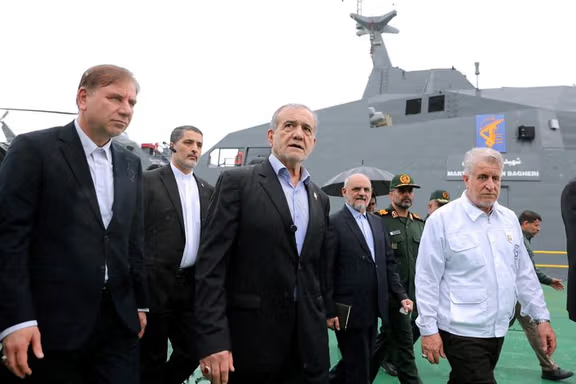

Iran's President Masoud Pezeshkian said Monday the country would not surrender to “bullies” and would continue fighting until attacks on its territory stop.
"Speaking of ending the war is meaningless until we ensure there will be no more attacks in our land in the future," Pezeshkian said in a post on X following his phone call with his French counterpart.
"The Islamic Republic of Iran will not surrender to bullies," he added.





European Union foreign ministers currently have no appetite to expand the bloc’s naval mission from the Red Sea to the Strait of Hormuz despite growing concerns over shipping disruptions linked to the Iran war, the EU’s top diplomat Kaja Kallas said Monday.
Speaking after a meeting of the EU’s Foreign Affairs Council in Brussels, Kallas said ministers discussed ways to protect maritime traffic but were reluctant to broaden the mandate of the EU naval operation known as ASPIDES.
“There was a clear wish to strengthen this operation,” she said, referring to the Red Sea mission, adding that it currently lacks sufficient naval assets.
However, when it came to extending the mission north toward the Strait of Hormuz, “there was no appetite from the member states to do that.”
Kallas said European governments are wary of becoming directly involved in the conflict. “As I said, nobody wants to go actively in this war."
Exiled Iranian Crown Prince Reza Pahlavi announced the creation of a committee to draft regulations for transitional justice in Iran, saying Nobel Peace Prize laureate Shirin Ebadi will lead the body.
In a statement on Monday, Pahlavi said the “Committee for Drafting Transitional Justice Regulations” would prepare the framework for both a court and a fact-finding commission aimed at addressing decades of alleged abuses under the Islamic Republic.
The committee will include several Iranian legal experts and activists from different generations and will be supported by prominent international jurists serving as advisers, according to Pahlavi.
He said the initiative was launched for those who “over the past five decades have been victims of injustice, torture and repression.”
“Truth will be revealed. Justice will be carried out,” he added.
President Trump said on Monday the United States does not know whether Iran's new supreme leader Mojtaba Khamenei is dead or alive.
"This one we haven't seen at all. So that could be for a lot of different reasons. We don't know if he's dead or not."
"A lot of people are saying that he's badly disfigured. They're saying that he lost his leg, one leg, and he's been hurt very badly. Other people are saying he's dead. Nobody's saying he's 100% healthy," he said.
President Donald Trump on Monday criticized some of the United States’ allies for not heeding his calls to help reopen the Strait of Hormuz, which has been effectively closed due to Iranian missile and drone attacks.
"Numerous countries have told me they're on the way. Some are very enthusiastic about it, and some are in. Some are countries that we've helped for many, many years. We've protected them from horrible outside sources, and they weren't that enthusiastic," he said in a news conference in Washington DC.
"The level enthusiasm matters to me. We have some countries where we have 45,000 soldiers, great soldiers, protecting them from harm's way, and we have done a great job. And well, we want to know, do you have any mine sweepers? Well, would rather not get involved, sir."
"For 40 years, we're protecting you, and you don't want to get involved in something that is very minor, very few shots going to be taken... But they said, we'd rather not get involved."
"When I've been a big critic of all of the protecting of countries, because I know that we'll protect them, and if ever needed, if we ever needed help, they won't be there for us," Trump said.
Iran’s top security official Ali Larijani on Monday accused Islamic countries of abandoning Iran during the war with the United States and Israel, singling out the United Arab Emirates for describing Tehran as an enemy after attacks on Emirati targets.
In a statement addressed to Muslims across the world and to the governments of Islamic countries, Larijani slammed the response of Muslim governments to the US-Israeli attacks which began in late February, regretting that "no Islamic government stood alongside the people of Iran except in rare cases and limited to political positions."
“Is the position of some Islamic governments not in contradiction with the words of the Prophet of Islam who said: ‘Whoever hears the cry for help of a Muslim and does not respond is not a Muslim’?” he said. “So what kind of Islam is this?”
In an apparent reference to the United Arab Emirates, Larijani said some governments had gone further by calling Iran an enemy because it targeted what he called "American bases and US and Israeli interests on their soil."
“Is Iran expected to sit idly by while American bases in your countries are used to attack it?” Larijani asked. “These are weak excuses.”