• العربية
  • فارسی
Brand
  • Iran Insight
  • Politics
  • Economy
  • Analysis
  • Special Report
  • Opinion
  • Podcast
  • Iran Insight
  • Politics
  • Economy
  • Analysis
  • Special Report
  • Opinion
  • Podcast
  • Theme
  • Language
    • العربية
    • فارسی
  • Iran Insight
  • Politics
  • Economy
  • Analysis
  • Special Report
  • Opinion
  • Podcast
All rights reserved for Volant Media UK Limited
volant media logo

Exiled prince says Nobel laureate will lead transitional justice committee

Mar 16, 2026, 17:13 GMT+0Updated: 18:24 GMT+0

Exiled Iranian Crown Prince Reza Pahlavi announced the creation of a committee to draft regulations for transitional justice in Iran, saying Nobel Peace Prize laureate Shirin Ebadi will lead the body.

In a statement on Monday, Pahlavi said the “Committee for Drafting Transitional Justice Regulations” would prepare the framework for both a court and a fact-finding commission aimed at addressing decades of alleged abuses under the Islamic Republic.

The committee will include several Iranian legal experts and activists from different generations and will be supported by prominent international jurists serving as advisers, according to Pahlavi.

He said the initiative was launched for those who “over the past five decades have been victims of injustice, torture and repression.”

“Truth will be revealed. Justice will be carried out,” he added.

Most Viewed

The hidden target in US war on Iran may be China
1
PODCAST

The hidden target in US war on Iran may be China

2

UK releases man jailed for spying on Iran International in 2023 terror plot

3
INSIGHT

Unity or fracture? Tehran battles Trump’s narrative of disarray

4

Is the US blockade working? It depends who you ask

5

Iran nurses reject special internet access amid blackout

Banner
Banner

Spotlight

  • Iran football chief with IRGC past to visit Canada for FIFA event
    EXCLUSIVE

    Iran football chief with IRGC past to visit Canada for FIFA event

  • New intelligence exposes IRGC-linked network targeting Israeli, Western sites
    EXCLUSIVE

    New intelligence exposes IRGC-linked network targeting Israeli, Western sites

  • Is Ghalibaf becoming Iran’s Khrushchev?
    INSIGHT

    Is Ghalibaf becoming Iran’s Khrushchev?

  • Iran’s new military-led order may mean greater dangers abroad
    ANALYSIS

    Iran’s new military-led order may mean greater dangers abroad

  • The hidden target in US war on Iran may be China
    PODCAST

    The hidden target in US war on Iran may be China

  • Unity or fracture? Tehran battles Trump’s narrative of disarray
    INSIGHT

    Unity or fracture? Tehran battles Trump’s narrative of disarray

•
•
•

More Stories

Trump says US does not know if Mojtaba Khamenei is alive

Mar 16, 2026, 17:08 GMT+0

President Trump said on Monday the United States does not know whether Iran's new supreme leader Mojtaba Khamenei is dead or alive.

"This one we haven't seen at all. So that could be for a lot of different reasons. We don't know if he's dead or not."

"A lot of people are saying that he's badly disfigured. They're saying that he lost his leg, one leg, and he's been hurt very badly. Other people are saying he's dead. Nobody's saying he's 100% healthy," he said.

Trump slams some allies for not helping US reopen Strait of Hormuz

Mar 16, 2026, 16:26 GMT+0

President Donald Trump on Monday criticized some of the United States’ allies for not heeding his calls to help reopen the Strait of Hormuz, which has been effectively closed due to Iranian missile and drone attacks.

"Numerous countries have told me they're on the way. Some are very enthusiastic about it, and some are in. Some are countries that we've helped for many, many years. We've protected them from horrible outside sources, and they weren't that enthusiastic," he said in a news conference in Washington DC.

"The level enthusiasm matters to me. We have some countries where we have 45,000 soldiers, great soldiers, protecting them from harm's way, and we have done a great job. And well, we want to know, do you have any mine sweepers? Well, would rather not get involved, sir."

"For 40 years, we're protecting you, and you don't want to get involved in something that is very minor, very few shots going to be taken... But they said, we'd rather not get involved."

"When I've been a big critic of all of the protecting of countries, because I know that we'll protect them, and if ever needed, if we ever needed help, they won't be there for us," Trump said.

Larijani rebukes UAE, other Islamic states for not backing Iran during war

Mar 16, 2026, 15:38 GMT+0

Iran’s top security official Ali Larijani on Monday accused Islamic countries of abandoning Iran during the war with the United States and Israel, singling out the United Arab Emirates for describing Tehran as an enemy after attacks on Emirati targets.

In a statement addressed to Muslims across the world and to the governments of Islamic countries, Larijani slammed the response of Muslim governments to the US-Israeli attacks which began in late February, regretting that "no Islamic government stood alongside the people of Iran except in rare cases and limited to political positions."

“Is the position of some Islamic governments not in contradiction with the words of the Prophet of Islam who said: ‘Whoever hears the cry for help of a Muslim and does not respond is not a Muslim’?” he said. “So what kind of Islam is this?”

In an apparent reference to the United Arab Emirates, Larijani said some governments had gone further by calling Iran an enemy because it targeted what he called "American bases and US and Israeli interests on their soil."

“Is Iran expected to sit idly by while American bases in your countries are used to attack it?” Larijani asked. “These are weak excuses.”

Continue reading

100%

Larijani rebukes UAE, other Islamic states for not backing Iran during war

Mar 16, 2026, 15:02 GMT+0

Iran’s top security official Ali Larijani on Monday accused Islamic countries of abandoning Iran during the war with the United States and Israel, singling out the United Arab Emirates for describing Tehran as an enemy after attacks on Emirati targets.

In a statement addressed to Muslims across the world and to the governments of Islamic countries, Larijani slammed the response of Muslim governments to the US-Israeli attacks which began in late February, regretting that "no Islamic government stood alongside the people of Iran except in rare cases and limited to political positions."

“Is the position of some Islamic governments not in contradiction with the words of the Prophet of Islam who said: ‘Whoever hears the cry for help of a Muslim and does not respond is not a Muslim’?” he said. “So what kind of Islam is this?”

In an apparent reference to the United Arab Emirates, Larijani said some governments had gone further by calling Iran an enemy because it targeted what he called "American bases and US and Israeli interests on their soil."

“Is Iran expected to sit idly by while American bases in your countries are used to attack it?” Larijani asked. “These are weak excuses.”

On March 7, UAE President Mohammed bin Zayed Al Nahyan issued a thinly veiled warning to Iran, saying his country is “not easy prey” and referring to Tehran as “the enemy” — a notable departure from the language the UAE has traditionally used toward its northern neighbor.

Larijani urged Muslim countries to reconsider their positions, saying the confrontation today was between “the United States and Israel on one side and Muslim Iran and the forces of resistance on the other.”

“Which side of this battle do you stand on?” he asked.

Call for Muslim unity

Larijani warned that the region’s future depends on greater unity among Muslim states.

“You know that America is not loyal and that Israel is your enemy,” Larijani said. “Pause for a moment and reflect on yourselves and on the future of the region. Iran wishes you well and does not seek domination over you.”

He added that “the unity of the Islamic ummah, if realized with full strength, can guarantee security, progress and independence for all Islamic countries.”

“Iran continues on the path of resistance against the ‘Great Satan’ and the ‘Little Satan,’ meaning the United States and Israel,” he said.

Grief crossed the border: How Iranians abroad lived the January massacre

Mar 16, 2026, 14:55 GMT+0
•
Arash Sohrabi

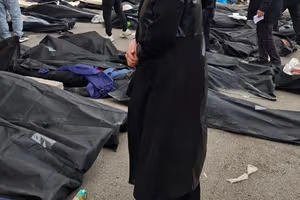
The killings of protesters in January did not end when the shooting stopped. For many Iranians living thousands of kilometers from the streets where the bullets fell, the event did not remain on their screens.

It entered their bodies – in sleepless nights, stomach illness, obsessive counting of the dead, and a persistent sense that something in their relationship to Iran had been permanently altered.

Now, two months later, as the United States and Israel wage war against the Islamic Republic and another far stricter internet blackout grips the country, that earlier rupture is returning with renewed force.

Images of death, the disappearance of communication, and the uncertainty surrounding Iran’s future have reopened a wound many in the diaspora say never fully closed.

A new qualitative study by researcher Nazanin Shahbazi, a PhD student at the University of Manchester, helps explain why.

Based on eight in-depth interviews with politically engaged members of the Iranian diaspora conducted shortly after the January killings and end of internet shutdown, the research explores how people far from the violence nevertheless experienced the uprising and massacre as a personal rupture – one that reshaped their bodies, their sense of time, and even what it meant to say “I am Iranian.”

“The protests, the killings, the internet blackout and the blocked funerals were not separate chapters,” Shahbazi told Iran International. “For the people I spoke with they formed one continuous shock that reorganized their lives.”

Human rights organizations have documented the repression in detail – the shootings, the arrests, the intimidation of families and the pressure placed on relatives of the dead. What those reports cannot capture is how such violence lives on in those who witness it from afar.

“They can tell us what was done to people and roughly how many were killed,” Shahbazi said. “But they can’t show what it feels like to live with that in your body, your sleep, your relationships and your sense of future.”

  • Iranians catalog tragedies blamed on the regime to counter antiwar narrative

    Iranians catalog tragedies blamed on the regime to counter antiwar narrative

  • Iran’s security agents gang rape two nurses detained for aiding protesters

    Iran’s security agents gang rape two nurses detained for aiding protesters

Body keeps the score

One of the most striking patterns in the interviews is how often the experience of the massacre appeared in the body.

Participants described vomiting after seeing images of burned bodies, sudden weight gain, eczema, IBS flare-ups, breathlessness, grinding teeth and persistent insomnia. Some lost their appetite entirely. Others said their ordinary routines collapsed into constant monitoring of news from Iran.

“When words ran out, people kept returning to their bodies,” Shahbazi said. “Sudden vomiting, weight gained in twenty days, neck spasms or grinding teeth were how they registered what they could not yet fully think or articulate.”

The body, in this sense, became both witness and container.

Political violence was not simply something they analyzed or debated. It was something that settled into digestion, sleep, muscles and skin.

Shahbazi believes those reactions reveal dimensions of suffering that familiar categories like trauma or PTSD sometimes fail to capture.

“Diagnostic labels can flatten experience into symptom lists,” she said. “What people described were very concrete bodily dramas tied to images and events in Iran.”

  • Dancing for the dead: How protest massacre is rewriting Iran’s mourning rituals

    Dancing for the dead: How protest massacre is rewriting Iran’s mourning rituals

  • Pay for bullets: How Iran pressures families after killing protesters

    Pay for bullets: How Iran pressures families after killing protesters

Safe but summoned

Another recurring theme was the strange moral position created by exile.

The interviewees were physically safe – living in UK, Europe, North America or elsewhere outside Iran – yet many said they did not experience themselves as distant observers.

“I would describe their condition as safe but summoned,” Shahbazi said. “They lived outside the field of bullets but inside a field of responsibility.”

Again and again participants returned to a painful question: why am I here while others were killed?

Exile did not reduce the emotional weight of the uprising. In many cases it intensified it.

“Safety, mobility and an intact body were experienced not simply as privileges,” Shahbazi said. “They were felt as a kind of unpaid debt to those who stayed and faced lethal risk.”

That sense of symbolic debt helps explain why many interviewees described weeks in which work, sleep and daily routines collapsed into constant monitoring of events in Iran.

Some called friends inside the country repeatedly. Others spent hours tracking death tolls or watching newly emerging videos.

They were not simply following the news. They were trying to answer a moral demand they felt placed upon them.

  • Over 36,500 killed in Iran's deadliest massacre, documents reveal

    Over 36,500 killed in Iran's deadliest massacre, documents reveal

  • 36,500 deaths in context: How Iran’s toll compares with wars and crackdowns

    36,500 deaths in context: How Iran’s toll compares with wars and crackdowns

Language at its limit

The scale of the violence also strained language itself. Participants repeatedly reached for extreme words – “catastrophe,” “slaughter,” or “something like a Holocaust” – because ordinary vocabulary seemed incapable of holding what they had seen.

“Everyday language felt too small,” Shahbazi said. “So people borrowed the biggest words they could find.”

Even those words felt insufficient.

Many interviewees hesitated as they spoke, qualifying their descriptions with phrases like “something like” or “nothing else really covers it.”

Numbers became another way of trying to grasp the event.

Several participants described compulsively tracking death tolls or attempting rough calculations of how many people might have been killed.

“Counting was a way of making the killings halfway thinkable,” Shahbazi said.

A different Iranian-ness

Despite the suffering described in the interviews, the research also uncovered something unexpected. Several participants said the uprising had changed how they understood their own identity.

For years, many had associated being Iranian internationally with embarrassment tied to the Islamic Republic’s image abroad. After the protests, that feeling began to shift.

Shahbazi said several participants described a “partial lifting of shame” when saying they were Iranian.

“In its place they spoke about pride in the courage and sacrifices of protesters,” she said.

Some described renewed attachment to Iranian culture, language and land. Others spoke about admiration for the mothers who stood at the forefront of demonstrations.

Shahbazi believes this shift may have political consequences as well.

“It recenters being Iranian around equality, justice and shared humanity,” she said, “rather than around the state’s ideology.”

That transformation remains fragile.

The war now unfolding and the renewed blackout mean that images of violence are again entering Iranian homes and diaspora communities alike.

But if the interviews reveal anything, it is that the event did not remain confined to the streets where it began.

As Shahbazi put it: “For many Iranians in the diaspora, the massacre did not stay on their screens; it cut into their bodies, their sense of time, and even the way they dare to say, ‘I am Iranian.’”