• العربية
  • فارسی
Brand
  • Iran Insight
  • Politics
  • Economy
  • Analysis
  • Special Report
  • Opinion
  • Podcast
  • Iran Insight
  • Politics
  • Economy
  • Analysis
  • Special Report
  • Opinion
  • Podcast
  • Theme
  • Language
    • العربية
    • فارسی
  • Iran Insight
  • Politics
  • Economy
  • Analysis
  • Special Report
  • Opinion
  • Podcast
All rights reserved for Volant Media UK Limited
volant media logo

French foreign minister urges de-escalation in call with Iranian counterpart

Mar 5, 2026, 07:44 GMT+0

French Foreign Minister Jean-Noel Barrot spoke with his Iranian counterpart and said France opposes the Iranian strikes, the foreign ministry said on Thursday.

Barrot also urged the release of French citizens currently held in Iran.

He reiterated France’s commitment to stability in the Middle East, called for de-escalation and the resumption of diplomatic dialogue, and stressed that international law must govern the use of force, the ministry said in a statement.

Most Viewed

Iran negotiators ordered to return after internal rift over Islamabad talks
1
EXCLUSIVE

Iran negotiators ordered to return after internal rift over Islamabad talks

2
INSIGHT

Iran's digital economy battered by prolonged blackout

3
ANALYSIS

US blockade enters murky phase as tankers spoof signals and buyers hesitate

4
ANALYSIS

Why the $100 billion Hormuz toll revenue is a myth

5

US tightens financial squeeze on Iran, warns banks over oil money flows

Banner
Banner

Spotlight

  • Hardliners push Hormuz ‘red line’ as US blockade tests Iran’s leverage
    INSIGHT

    Hardliners push Hormuz ‘red line’ as US blockade tests Iran’s leverage

  • Ideology may be fading in Iran, but not in Kashmir's ‘Mini Iran'
    INSIGHT

    Ideology may be fading in Iran, but not in Kashmir's ‘Mini Iran'

  • War damage amounts to $3,000 per Iranian, with blockade set to add to losses
    INSIGHT

    War damage amounts to $3,000 per Iranian, with blockade set to add to losses

  • Why the $100 billion Hormuz toll revenue is a myth
    ANALYSIS

    Why the $100 billion Hormuz toll revenue is a myth

  • US blockade targets Iran oil boom amid regional disruption
    ANALYSIS

    US blockade targets Iran oil boom amid regional disruption

  • Iran's digital economy battered by prolonged blackout
    INSIGHT

    Iran's digital economy battered by prolonged blackout

•
•
•

More Stories

Guards push fast Mojtaba Khamenei announcement amid dissent over hereditary rule

Mar 5, 2026, 06:52 GMT+0

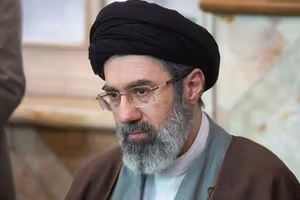
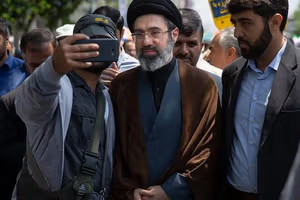
Iran’s Assembly of Experts is set to hold an emergency session on Thursday to formally announce Mojtaba Khamenei, a son of the late Supreme Leader, as the next leader, despite opposition from some members who warn against “hereditary leadership,” Iran International has learned.

The meeting comes two days after Iran International reported that the Assembly of Experts had chosen Mojtaba Khamenei as the next Supreme Leader under pressure from the Revolutionary Guards.

Two sources from the offices of Assembly of Experts representatives told Iran International that at least eight members will not attend the emergency session on Thursday in protest at what they described as “heavy pressure” from the Revolutionary Guards to impose Mojtaba Khamenei.

The first emergency meeting of the clerical body to choose a successor to Ali Khamenei was held on Tuesday, but ended prematurely after Israeli airstrikes targeted the Assembly building in the city of Qom.

According to sources, Thursday’s meeting will be held online and managed from a building near the shrine of Fatima Masumeh in Qom. Some representatives and members of the Assembly’s leadership board who live in Qom may attend in person.

  • A wartime succession in Iran: why the IRGC backed Mojtaba Khamenei

    A wartime succession in Iran: why the IRGC backed Mojtaba Khamenei

Arguments by opponents of Mojtaba

Sources told Iran International that a group of opponents contacted the Assembly’s chairman and members of its leadership board on Wednesday, warning that declaring Mojtaba Khamenei leader could raise public concerns about the leadership becoming hereditary and the Islamic Republic resembling a monarchy.

“Ayatollah Ali Khamenei was not pleased with the idea of his son’s leadership and never allowed this issue to be raised during his lifetime,” one Assembly member told the chairman and members of the body’s leadership in calls, according to the sources.

Another member argued that Mojtaba Khamenei “does not have an established, public clerical and jurisprudential standing,” and for that reason his selection as the state's Supreme Jurist (Vali-ye Faqih) would lack religious legitimacy, the sources added.

These representatives called for Mojtaba Khamenei to withdraw and for a new vote to be held at Thursday’s session.

Some opponents also signaled that if Mojtaba Khamenei does not withdraw, they may consider the selection process "invalid," a step that could deepen divisions within the ruling establishment and intensify the Islamic Republic’s legitimacy crisis.

Tensions during first Assembly session

After the historic National Assembly building in Tehran –where the clerical body traditionally meets – was bombed on Monday, the first session to select Ali Khamenei’s successor was held online on Tuesday without public announcement.

Information sent to Iran International indicates that from early Tuesday, Revolutionary Guard commanders across different cities pressured Assembly members to vote for Mojtaba Khamenei through in-person meetings and phone calls.

Sources said repeated contacts and psychological and political pressure on representatives continued until minutes before the online meeting began, creating what they described as an “unnatural” atmosphere inside the session. The Assembly leadership board insisted the vote be held quickly due to the country’s security situation.

Several members opposed to Mojtaba Khamenei were given limited time to present their arguments, but the leadership board moved forward with the vote, cutting short further discussion.

A source close to one Assembly representative told Iran International that the atmosphere was initially heavy because of Revolutionary Guard pressure, but more representatives might have spoken against the move if more time had been allowed.

Sources said that after the vote and shortly before the count was completed, the Assembly building in Qom – where the online session was being managed – was struck in Israeli airstrikes and communications were cut.

Hours later, members of the Assembly were informed in phone calls that Mojtaba Khamenei had been selected as Supreme Leader by a majority of votes.

  • From shadow to power: who is Mojtaba Khamenei?

    From shadow to power: who is Mojtaba Khamenei?

Legal questions and continued pressure

After the result was relayed to members, objections about how the legal process had been conducted surfaced in calls with the Assembly chairman and some members of the leadership board.

The leadership board then decided to delay the official announcement until a second session.

That second session is scheduled to take place online on Thursday and will be managed from a location near the shrine of Fatima Masumeh in Qom. Sources said the site was chosen because its religious significance could reduce the likelihood of an airstrike if its location became known.

Information received by Iran International also indicates that threatening pressure from the Revolutionary Guards to persuade opposing representatives has continued.

According to the sources, Guards commanders have been contacting and lobbying members directly to discourage them from boycotting the meeting or expressing public opposition.

Sources said the Guards argue that given the country’s “special conditions” and ongoing security situation, the new leader must be announced as quickly as possible and that any delay could worsen instability and deepen a decision-making vacuum at the top of the system.


China urges end to Middle East fighting, return to dialog

Mar 5, 2026, 05:06 GMT+0

China called for an end to military operations in the Middle East and a return to dialogue in a phone call between Foreign Minister Wang Yi and Saudi Foreign Minister Faisal bin Farhan on Thursday.

Chinese Foreign Ministry spokesperson Lin Jian said Beijing did not want to see the conflict in the Middle East spread and escalate, including impacts on Saudi Arabia and other countries in the region.

The spokesperson added that Beijing appreciated Saudi restraint and its commitment to resolving differences peacefully.

State Dept helps 7,300 Americans leave Middle East amid Iran conflict

Mar 5, 2026, 04:20 GMT+0

The US State Department’s Middle East Task Force has provided travel guidance and departure options to 7,300 American citizens as charter flights begin ferrying people out of the region, State Department said on Thursday.

"The department will not rest until every American who wants to leave the region is home," State Department spokesperson Tommy Pigott said, adding round-the-clock efforts to ensure safe returns amid escalating tensions following US-Israeli strikes on Iran.

Powerful explosions reported near IRGC naval base in Bandar Abbas

Mar 5, 2026, 04:16 GMT+0

A local resident sent videos to Iran International showing massive explosions on Thursday in Bandar Abbas, south of Iran.

According to reports, the blasts occurred near Bandar-e Bahonar in the First Naval Zone of the Islamic Revolutionary Guard Corps, the closest unit to the strategic Strait of Hormuz.

Everyone is watching oil in Iran war, but real risk is water

Mar 5, 2026, 03:48 GMT+0
•
Umud Shokri

As war spreads across the Middle East and attention focuses on oil, the region’s most dangerous soft targets may be desalination plants.

A serious strike, sabotage operation, cyberattack, or contamination event affecting these facilities would not just damage commerce. It could trigger a rapid human security crisis by threatening drinking water, electricity, sanitation, and public order at the same time.

GCC countries account for around 40 percent of the world’s desalinated water and operate more than 400 desalination plants across the region. About 90 percent of Kuwait’s drinking water comes from desalination. The figure is 86 percent in Oman and 70 percent in Saudi Arabia.

In a region defined by extreme heat, scarce rainfall, overdrawn aquifers, and growing urban populations, desalination is not a technical supplement to national life. It is the infrastructure that makes national life possible.

Persian Gulf governments can absorb temporary shocks to tourism, reroute some trade, and rely on global markets to cushion part of an oil disruption. Water is different. It cannot be improvised at scale, and it cannot be politically rationed for long in cities that depend on the state to supply the basics of daily life.

Qatar’s prime minister warned last year that any attack on Iran’s nuclear facilities could “entirely contaminate” the region’s waters and threaten life in Qatar, the UAE, and Kuwait.

He also said Qatar had once assessed that it could run out of potable water after just three days in such a scenario, prompting the construction of 15 massive water reservoirs to expand emergency reserves.

Those comments were made before the current war reached today’s level of direct regional spillover.

The Middle East Institute warned in 2025 that the Gulf’s heavy reliance on centralized desalination infrastructure presents a clear strategic vulnerability for Iran’s Arab neighbors.

Research on Qatar’s water security has specifically warned that oil spills and red tides could interrupt desalination operations or force shutdowns for a considerable period. In peacetime, these are serious risks. In wartime, they become strategic liabilities.

A leaked 2008 US diplomatic cable from Riyadh stated that the Jubail desalination plant supplied over 90 percent of Riyadh’s drinking water and warned that the capital “would have to evacuate within a week” if the plant, its pipelines, or associated power infrastructure were seriously damaged or destroyed.

The same cable added that “the current structure of the Saudi government could not exist without the Jubail Desalinization Plant.”

That is why desalination plants may matter more in this conflict than many of the targets receiving greater attention.

Research on conflict-related water disruption has also shown that contamination or shutdown of desalination capacity can worsen water insecurity and heighten risks to public health.

Iran’s recent attacks across the region appear intended in part to internationalize the battlefield and raise the cost for Arab states of aligning with Washington. But targeting, or even credibly threatening, desalination infrastructure would raise those costs in a different and more dangerous way.

It would push GCC governments to treat water security as national survival rather than collateral risk. That, in turn, could draw them more directly into the conflict or harden support for wider retaliation.

A war that begins around missiles, nuclear facilities, and energy flows could therefore widen around something more elemental: whether people in the region can drink, cool their homes, and keep hospitals functioning in extreme heat.

The Arab nations surrounding the Persian Gulf can withstand price shocks, flight cancellations, and even temporary energy disruption more easily than they can withstand a major breakdown in potable water supply.

That is why the next phase of this war may not be defined by what happens to oil. It may be defined by whether anyone is reckless enough to turn the region’s water system into a battlefield.