• العربية
  • فارسی
Brand
  • Iran Insight
  • Politics
  • Economy
  • Analysis
  • Special Report
  • Opinion
  • Podcast
  • Iran Insight
  • Politics
  • Economy
  • Analysis
  • Special Report
  • Opinion
  • Podcast
  • Theme
  • Language
    • العربية
    • فارسی
  • Iran Insight
  • Politics
  • Economy
  • Analysis
  • Special Report
  • Opinion
  • Podcast
All rights reserved for Volant Media UK Limited
volant media logo

Powerful explosions reported near IRGC naval base in Bandar Abbas

Mar 5, 2026, 04:16 GMT+0

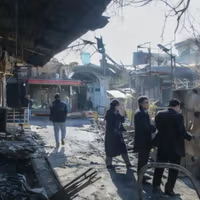
A local resident sent videos to Iran International showing massive explosions on Thursday in Bandar Abbas, south of Iran.

According to reports, the blasts occurred near Bandar-e Bahonar in the First Naval Zone of the Islamic Revolutionary Guard Corps, the closest unit to the strategic Strait of Hormuz.

Most Viewed

Iran negotiators ordered to return after internal rift over Islamabad talks
1
EXCLUSIVE

Iran negotiators ordered to return after internal rift over Islamabad talks

2
ANALYSIS

US blockade enters murky phase as tankers spoof signals and buyers hesitate

3
ANALYSIS

Why the $100 billion Hormuz toll revenue is a myth

4

US tightens financial squeeze on Iran, warns banks over oil money flows

5
ANALYSIS

US blockade targets Iran oil boom amid regional disruption

Banner
Banner

Spotlight

  • Hardliners push Hormuz ‘red line’ as US blockade tests Iran’s leverage
    INSIGHT

    Hardliners push Hormuz ‘red line’ as US blockade tests Iran’s leverage

  • Ideology may be fading in Iran, but not in Kashmir's ‘Mini Iran'
    INSIGHT

    Ideology may be fading in Iran, but not in Kashmir's ‘Mini Iran'

  • War damage amounts to $3,000 per Iranian, with blockade set to add to losses
    INSIGHT

    War damage amounts to $3,000 per Iranian, with blockade set to add to losses

  • Why the $100 billion Hormuz toll revenue is a myth
    ANALYSIS

    Why the $100 billion Hormuz toll revenue is a myth

  • US blockade targets Iran oil boom amid regional disruption
    ANALYSIS

    US blockade targets Iran oil boom amid regional disruption

  • Iran's digital economy battered by prolonged blackout
    INSIGHT

    Iran's digital economy battered by prolonged blackout

•
•
•

More Stories

Everyone is watching oil in Iran war, but real risk is water

Mar 5, 2026, 03:48 GMT+0
•
Umud Shokri

As war spreads across the Middle East and attention focuses on oil, the region’s most dangerous soft targets may be desalination plants.

A serious strike, sabotage operation, cyberattack, or contamination event affecting these facilities would not just damage commerce. It could trigger a rapid human security crisis by threatening drinking water, electricity, sanitation, and public order at the same time.

GCC countries account for around 40 percent of the world’s desalinated water and operate more than 400 desalination plants across the region. About 90 percent of Kuwait’s drinking water comes from desalination. The figure is 86 percent in Oman and 70 percent in Saudi Arabia.

In a region defined by extreme heat, scarce rainfall, overdrawn aquifers, and growing urban populations, desalination is not a technical supplement to national life. It is the infrastructure that makes national life possible.

Persian Gulf governments can absorb temporary shocks to tourism, reroute some trade, and rely on global markets to cushion part of an oil disruption. Water is different. It cannot be improvised at scale, and it cannot be politically rationed for long in cities that depend on the state to supply the basics of daily life.

Qatar’s prime minister warned last year that any attack on Iran’s nuclear facilities could “entirely contaminate” the region’s waters and threaten life in Qatar, the UAE, and Kuwait.

He also said Qatar had once assessed that it could run out of potable water after just three days in such a scenario, prompting the construction of 15 massive water reservoirs to expand emergency reserves.

Those comments were made before the current war reached today’s level of direct regional spillover.

The Middle East Institute warned in 2025 that the Gulf’s heavy reliance on centralized desalination infrastructure presents a clear strategic vulnerability for Iran’s Arab neighbors.

Research on Qatar’s water security has specifically warned that oil spills and red tides could interrupt desalination operations or force shutdowns for a considerable period. In peacetime, these are serious risks. In wartime, they become strategic liabilities.

A leaked 2008 US diplomatic cable from Riyadh stated that the Jubail desalination plant supplied over 90 percent of Riyadh’s drinking water and warned that the capital “would have to evacuate within a week” if the plant, its pipelines, or associated power infrastructure were seriously damaged or destroyed.

The same cable added that “the current structure of the Saudi government could not exist without the Jubail Desalinization Plant.”

That is why desalination plants may matter more in this conflict than many of the targets receiving greater attention.

Research on conflict-related water disruption has also shown that contamination or shutdown of desalination capacity can worsen water insecurity and heighten risks to public health.

Iran’s recent attacks across the region appear intended in part to internationalize the battlefield and raise the cost for Arab states of aligning with Washington. But targeting, or even credibly threatening, desalination infrastructure would raise those costs in a different and more dangerous way.

It would push GCC governments to treat water security as national survival rather than collateral risk. That, in turn, could draw them more directly into the conflict or harden support for wider retaliation.

A war that begins around missiles, nuclear facilities, and energy flows could therefore widen around something more elemental: whether people in the region can drink, cool their homes, and keep hospitals functioning in extreme heat.

The Arab nations surrounding the Persian Gulf can withstand price shocks, flight cancellations, and even temporary energy disruption more easily than they can withstand a major breakdown in potable water supply.

That is why the next phase of this war may not be defined by what happens to oil. It may be defined by whether anyone is reckless enough to turn the region’s water system into a battlefield.


No one coming to Iran’s aid except Democrats, Chairman Risch says

Mar 5, 2026, 03:15 GMT+0

Senate Foreign Relations Chairman Jim Risch said on Wednesday that major world powers such as China, Russia, North Korea, Cuba and Venezuela are not coming to Iran’s aid - and argued that “the only entity left that appears to be trying to help you, Iran, is the Democrats.”

“What’s happened over the last 47 years is the Arab countries have gotten tired of this. They’re sick and tired of this. And so where are we today? We are at the point today where you have only one bad apple left in the region, and that’s Iran,” the Republican senator said.

“Over these 47 years, what Iran has done while the Arab countries have moved away - while they have moved to wanting peace and security in the region - they have continued to murder thousands of Americans. They have killed thousands of Americans,” he added.

Israel says strikes cripple Iranian missile sites; all drones intercepted

Mar 5, 2026, 01:31 GMT+0

Israel’s ambassador to the US said on Wednesday that Israeli forces successfully struck Tehran’s missile production sites and launchers, shot down a Russian-made Iranian warplane with an F‑35, and intercepted all Iranian attack drones before they could enter Israeli airspace.

The Ambassador Yechiel (Michael) Leiter said the operations targeted missiles that have threatened neighboring countries, particularly the United Arab Emirates. He added that Israeli forces continue to track remaining missile launchers and Iranian leadership.

“Today, we had a tremendous success,” he posted a video on X. “We are destroying the production sites for missiles capable of deadly strikes… We see the numbers of missiles dwindling each day, and none of the drones sent toward Israel have entered our airspace.”

Conflict with Iran is ongoing and we are winning, Israeli envoy says

Mar 5, 2026, 00:26 GMT+0

Israel’s ambassador to the United Nations Danny Dannon said on Wednesday the country is in an ongoing conflict with the Iranian regime, which he accused of targeting Israelis for decades and of attempted assassinations of the US president

“When you have a regime that supports terror and attacks Israelis and Americans, it’s part of an ongoing conflict, and that’s why we are continuing this conflict,” Dannon said. “But this time, we are not playing defense. This time we are pushing back, and this time we are winning.”

Speaker Johnson defends Operation Epic Fury as ‘peace through strength’

Mar 4, 2026, 23:45 GMT+0

US House Speaker Mike Johnson rejected claims that Operation Epic Fury contradicts Republican calls for peace, saying the military action reflects the party’s long-held doctrine of “peace through strength” rather than appeasement.

“Peace is not secured through appeasement, and it’s certainly not secured by airdropping billions of dollars on terrorist regimes, which is what previous Democratic administrations have done,” Johnson said. “Peace is secured through strength.”

Johnson said the concept has defined the Republican Party throughout his lifetime and long before that, adding that the current administration is demonstrating that approach.

“That is why America is the last great superpower on the planet,” he said, adding that “all freedom-loving people around the world are grateful to God for that.”