• العربية
  • فارسی
Brand
  • Iran Insight
  • Politics
  • Economy
  • Analysis
  • Special Report
  • Opinion
  • Podcast
  • Iran Insight
  • Politics
  • Economy
  • Analysis
  • Special Report
  • Opinion
  • Podcast
  • Theme
  • Language
    • العربية
    • فارسی
  • Iran Insight
  • Politics
  • Economy
  • Analysis
  • Special Report
  • Opinion
  • Podcast
All rights reserved for Volant Media UK Limited
volant media logo

Suspicious blasts kill several in southern Iran; officials blame gas leak

Jan 31, 2026, 22:48 GMT+0
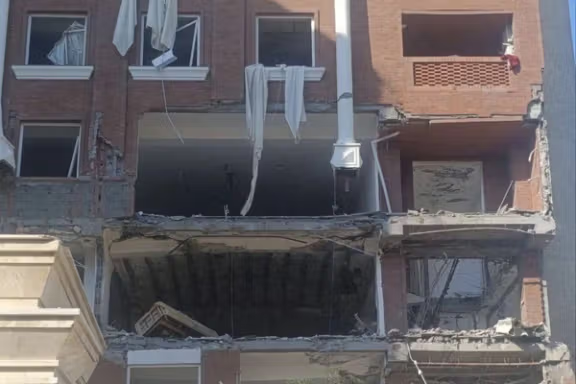
A building in Bandar Abbas damaged after an explosion on Saturday, January 31, 2026

Two explosions in southern Iran killed at least seven people and injured more than a dozen on Saturday, with officials blaming gas leaks, residents questioning the claim, and Israel denying any involvement.

In the southern port city of Bandar Abbas, an explosion in a residential building killed at least two people and injured 14 others, a local crisis management official told state media.

The local fire department chief said the blast was caused by a gas leak, a preliminary assessment echoed by state news outlets. However, one resident said in a video obtained by Iran International that the building was not yet connected to the gas grid.

Videos and images from the site showed significant structural damage to the building, with two floors destroyed and debris scattered nearby.

The Islamic Revolutionary Guard Corps (IRGC) denied rumors that the Bandar Abbas blast targeted its Navy commander, calling the reports false, according to the IRGC-affiliated Tasnim News Agency.

A video released by a local newspaper showed a man in uniform had been injured in the blast. However, local officials later said he was a Law Enforcement agent who was injured while trying to help the victims.

Separately, in Ahvaz in southwestern Iran, another explosion attributed to gas leak killed five people and injured three others, according to state media.

Reuters quoted two Israeli officials as saying the Jewish State was not involved in the explosions.

Iranian authorities said they were investigating both incidents and did not immediately provide further details on the causes.

Following a 12-day war between Iran and Israel last June, mysterious explosions and fires were reported at residential, commercial and infrastructure locations in several cities of Iran, including Tehran, Karaj, Qom, Mashhad and Tabriz.

In many cases, Iranian officials and state media described them as accidents, frequently citing gas leaks or technical causes, and said investigations were ongoing.

Most Viewed

IRGC-linked media hints at threat to Persian Gulf undersea internet cables
1

IRGC-linked media hints at threat to Persian Gulf undersea internet cables

2

Iran Guards say two ships seized in Hormuz after ceasefire extension

3
EXCLUSIVE

Strikes on petrochemical hubs leave Iran short of plastics

4
INSIGHT

War or economic collapse: can Iran withstand the pressure?

5

Iran executes former atomic agency employee over alleged spying for Israel

Banner
Banner

Spotlight

  • Power vacuum in Tehran emboldens hardliners
    INSIGHT

    Power vacuum in Tehran emboldens hardliners

  • Inflation spikes, basic goods slip out of reach for Iranians, citizens say
    VOICES FROM IRAN

    Inflation spikes, basic goods slip out of reach for Iranians, citizens say

  • Iran turns to citizenship and assets as tools of pressure beyond its borders

    Iran turns to citizenship and assets as tools of pressure beyond its borders

  • Who backs war now? Tehran flips the script
    INSIGHT

    Who backs war now? Tehran flips the script

  • As Tehran digs in, ordinary Iranians pay the price
    INSIGHT

    As Tehran digs in, ordinary Iranians pay the price

  • Internet Pro or Censor Pro? Iran rolls out a new service
    ANALYSIS

    Internet Pro or Censor Pro? Iran rolls out a new service

•
•
•

More Stories

US strikes on Iran a matter of 'when not if,' former IDF spokesman says

Jan 31, 2026, 01:57 GMT+0
•
Negar Mojtahedi

With US military assets building up across the Middle East and Washington warning Tehran that “time is running out,” a former Israeli military spokesperson says US strikes on Iran now appear increasingly likely.

“I think it’s only a matter of time before the US will conduct strikes against the Islamic Republic,” Lt Col Jonathan Conricus said in an interview with Iran International's English podcast Eye for Iran.

President Donald Trump said this week that the United States was prepared to act with “speed and violence, if necessary,” while Iranian officials have threatened immediate retaliation.

Trump also suggested Friday that Tehran may ultimately seek negotiations rather than face American military action.

“I can say this, they do want to make a deal,” confirming that he had given Iran a deadline to enter talks without specifying what it was. “We have a large armada, flotilla, call it whatever you want, heading toward Iran right now,” he added.

'Almost everything is in place'

Conricus, a senior fellow at the Foundation for Defense of Democracies (FDD), argued that the military tools required for meaningful action are already positioned.

“I think most of those capabilities and assets are in place and are ready to be deployed,” he said, adding: “Judging by the way things look now, almost everything is in place.”

He said the remaining question is timing—“the tactical operational opportunity” and political considerations around when to strike.

Secretary of State Marco Rubio also told lawmakers this week that the Islamic Republic is “probably weaker than it’s ever been."

Iran’s Foreign Minister Abbas Araghchi said Friday that Tehran was ready for talks only “on an equal footing,” but stressed that Iran’s missile and defence capabilities would “never be subject to negotiation.”

What would strikes target?

Conricus told Iran International any US strikes would likely prioritize crippling the regime’s internal control and ability to sustain repression.

He suggested an initial focus on “command and control” and the Islamic Republic's capacity “to exercise power domestically,” including “specifically targeting IRGC and Basij, but not limited to that.”

He also flagged cyber and communications disruption, saying he would “assume cyber and communications warfare against the networks and the communications infrastructure of the regime.”

In addition, he said missile infrastructure would be central—“related to Iran’s ballistic missiles,” including launch sites, silos and supply chains.

Nuclear-related facilities could also be targeted if the conflict escalates, particularly amid renewed American demands that Iran halt uranium enrichment and curb its missile program.

Israel watching, bracing and waiting

The Trump administration is also hosting senior Israeli and Saudi defense and intelligence officials in Washington this week amid discussions of possible strike scenarios and regional fallout.

From an Israeli perspective, Conricus described a mood focused less on whether action will happen, and more on when—and what retaliation might follow.

“People are waiting for when will it happen? What will the consequences be for Israel?” he said, adding that Israeli forces remain at “elevated readiness.”

He argued that a weakened Islamic Republic would also undercut Tehran’s regional proxy network, including Hamas, Hezbollah, and the Houthis.

“Getting rid of this horrible, terror-supporting, destabilizing regime would be very beneficial,” Conricus said.

You can watch the full episode on Eye for Iran on YouTube or listen on any podcast platform of your choosing.

Military strike on Iran now ‘virtually certain,’ Western source says

Jan 30, 2026, 22:00 GMT+0

Decision-making circles in the United States and Israel have moved past diplomacy with Iran, viewing military action as effectively decided, with only the timing still under debate, a Western source familiar with coordination talks told Iran International.

According to the source, the key question in current meetings is no longer whether an attack will take place, but when an appropriate operational and political window will emerge — a window that could open in the coming days or take shape over the course of several weeks.

The source emphasized that, at this stage, the logic being discussed — unlike in previous periods — is not based on “reaching a new agreement.”

US President Donald Trump said on Thursday he planned to speak with Iran, even as he sent another warship to the Middle East and the Pentagon chief said the military would be ready to carry out whatever the president decided.

Iran however says it will not engage in negotiations unless President Trump stops threatening it.

The source told Iran International that recent assessments identify the primary objective as delivering a decisive blow to maximally weaken and ultimately collapse Iran’s governing structure; a scenario that, in his words, is not comparable in scale or intensity to anything Iran has experienced so far.

The source said the operation under discussion would be “unprecedented,” stressing: “This time, we will be facing an attack the likes of which have not been seen before.”

According to the source, joint US-Israeli discussions have also concluded that current conditions for action differ from the past.

He said decision-makers believe the present situation has created a “once-in-a-lifetime opportunity,” and that, as a result, willingness to accept risk — compared with the 12-day war — has increased markedly.

The source said that during the 12-day war last June, both Washington and Tel Aviv avoided taking greater risks, but the prevailing view now is that the current moment must be seized.

In June, Israel launched a surprise military offensive against Iran, followed by US strikes on June 22 targeting key nuclear facilities in Isfahan, Natanz and Fordow.

The attacks were launched when Iran failed to reach an agreement with the United States within a 60-day deadline set by Trump.

The US president said on Friday that he had directly communicated a deadline to Iran for reaching a deal, but offered no further details.

'Israel on full alert'

The source also said Israel’s role could alter the scope of the scenario ahead. According to him, if Israel becomes directly involved — something he said has been planned for — the scale of the operation would expand, and in that case, the 12-day war would appear “very small” compared with the plans currently on the table.

The source said Israel is on full alert and that one scenario under discussion involves waiting for a “spark” to trigger the next phase, such as Iran attempting to fire a first missile toward Israel, which could then be used as justification for launching a far broader and more destructive campaign.

“The decision has been made. This will happen. The only question is when.”

Gunboat diplomacy: US seeks coercion without war on Iran

Jan 29, 2026, 17:29 GMT+0
•
Umud Shokri

President Donald Trump’s response to Iran’s recent unrest appears to reflect a strategy of gunboat diplomacy: the use of military pressure, rhetorical escalation, and economic coercion to extract concessions without committing to war or formal regime change.

Iran’s currency plunge in late December 2025 sparked nationwide protests that quickly escalated from economic grievances into calls for an end to the Islamic Republic. The crackdown that followed was unusually violent, killing thousands under a sweeping internet blackout.

Trump’s response was neither a formal call for regime change nor an immediate move toward military conflict. Instead, it combined public threats, diplomatic suspension, and economic pressure with visible military signaling designed to raise the cost of repression while preserving strategic flexibility.

“A massive Armada is heading to Iran,” Trump wrote on Truth Social last week, describing the fleet—led by the aircraft carrier Abraham Lincoln—as “ready, willing, and able to rapidly fulfill its mission, with speed and violence, if necessary.”

The signalling grew more explicit on Wednesday, when the US president urged Iran to “quickly ‘Come to the Table’” and negotiate a deal. He warned that “the next attack will be far worse” than last June’s strikes on Iran’s nuclear sites if an agreement was not reached.

The military centerpiece of Trump’s strategy is the redeployment of the USS Abraham Lincoln carrier strike group, restoring credible strike capacity at a moment when Iran’s leadership is consumed by internal unrest.

Escorted by multiple destroyers and carrying nearly 90 aircraft, including F-35s, the Lincoln gives Washington a flexible range of options—from limited strikes on Revolutionary Guard assets to broader operations.

Additional US combat aircraft, armored units, and air-defense systems have been repositioned across regional bases, underscoring the signaling intent. The objective appears to be readiness without commitment.

Trump’s apparent aim is to exploit Iran’s weakened position to coerce strategic concessions—not only on the nuclear and missile programs, but also on Tehran’s regional proxy activity. That pressure has been reinforced by a proposed 25 percent tariff on countries trading with Iran, announced on January 12.

Washington’s approach appears calibrated to push for negotiations while Tehran is at its most vulnerable, stopping short of an explicit commitment to military action or regime change.

The ambiguity looks deliberate—and strategic. It may work, but it is not risk-free. US credibility could erode if threats are not followed through. External pressure may also strengthen hardliners in Tehran by reinforcing narratives of foreign orchestration, potentially unifying a fractured elite.

Iran’s armed allies in the region retain some capacity to retaliate against US interests or Israel. Whether they choose to do so is unclear, but the risk of escalation into a broader conflict cannot be dismissed.

Tehran, for its part, has hardened its rhetoric, warning of an “unrestrained” and “unprecedented” response to any US military operation, while simultaneously expressing openness to what it calls “fair” negotiations.

Pressure on Iran is also building beyond Washington. On Thursday, the European Union took what its foreign policy chief, Kaja Kallas, described as a “decisive step” toward designating the Islamic Revolutionary Guard Corps as a terrorist organisation—its strongest signal yet that patience with the Islamic Republic is wearing thin.

At the same time, Kallas cautioned that the region “doesn’t need another war,” underscoring Europe’s own balancing act between pressure and restraint.

Iran’s streets are quiet after a bloody crackdown. But the economy is in free fall, and another round of widespread protests appears increasingly likely.

The key question now is whether Trump’s gunboat diplomacy can extract strategic gains without igniting the very conflict it seeks to avoid—or whether it merely postpones a more dangerous reckoning.

How a month of protests and threats brought Trump to Iran strike decision point

Jan 29, 2026, 13:17 GMT+0

A month of protests inside Iran, a widening crackdown and repeated warnings from President Donald Trump have brought Washington to a decision point on whether to use force, as senior Israeli and Saudi officials arrive in the US capital this week for talks on possible next steps.

Israeli military intelligence chief Maj. Gen. Shlomi Binder met senior officials at the Pentagon, the CIA and the White House on Tuesday and Wednesday, according to US officials and other sources familiar with the discussions, as Israel shared intelligence it says could inform potential targets inside Iran, Axios reported on Thursday.

Saudi Defense Minister Prince Khalid bin Salman was expected in Washington on Thursday and Friday for meetings at the Pentagon, the State Department and the White House, including with Secretary of State Marco Rubio and US special envoy Steve Witkoff, sources said.

Saudi officials have been urging de-escalation and have passed messages between Washington and Tehran in recent days, according to the same accounts.

The visits came as Reuters reported on Thursday that President Donald Trump is considering military options against Iran that range from targeted strikes on commanders and security forces blamed by Washington for a violent crackdown on protests, to broader attacks against Iran’s missile and nuclear infrastructure.

Trump has not made a final decision, Reuters reported, citing multiple sources, including US officials familiar with the deliberations.

Trump on Wednesday again warned Iran about possible strikes while also urging Tehran to “come to the table” on a nuclear deal, saying any future attack would be “far worse” than a June bombing campaign against Iranian nuclear sites.

He described US naval forces in the region as an “armada,” language he has used repeatedly in recent days.

Washington’s military posture has been shifting at the same time.

The arrival of the USS Abraham Lincoln aircraft carrier and supporting warships in the region this week broadened Trump’s options.

Open-source tracking and public statements over the past two weeks have pointed to a wider buildup of air, sea and air-defense assets, including deployments designed to support sustained air operations and defend US forces and regional partners against retaliation.

The question of whether a second major naval force could follow has added to the sense of escalation.

A separate carrier strike group, the USS George H.W. Bush, departed Norfolk on January 13, though its destination has not been publicly confirmed.

Analysts tracking force movements have said the Bush’s movements could determine whether the United States intends to maintain one carrier in the region as a deterrent, or assemble a larger package capable of prolonged operations.

Behind the high-level diplomacy and military deployments is a rapidly deteriorating crisis inside Iran that has reshaped Washington’s calculations over the past month.

Protests erupted on December 28 after strikes and demonstrations began in Tehran’s bazaars and spread nationwide, driven initially by economic pressures and rapidly escalating into wider political demands.

Iran’s authorities responded with mass killings and arrests as well as communications restrictions, while the Trump administration warned Tehran against lethal repression.

Trump publicly threatened military action if Iran carried out large-scale executions of protesters, and in mid-January said – without providing evidence – that killings had paused.

  • 36,500 deaths in context: How Iran’s toll compares with wars and crackdowns

    36,500 deaths in context: How Iran’s toll compares with wars and crackdowns

  • Over 36,500 killed in Iran's deadliest massacre, documents reveal

    Over 36,500 killed in Iran's deadliest massacre, documents reveal

The situation then worsened sharply. More than 36,500 Iranians were killed by security forces during the January 8-9 crackdown on nationwide protests, making it the deadliest two-day protest massacre in history, according to documents reviewed by Iran International

Iranian authorities have not released a comprehensive breakdown of protest-related deaths. They have, however, acknowledged several thousand fatalities.

In Tehran, Iranian officials have warned the United States and regional states against military action. Ali Shamkhani, a senior adviser to Iran’s top leadership, said on X that any US military action would be treated as an act of war and would prompt immediate retaliation, including against Israel and what he called those supporting an attack. Iranian officials have also said US bases in the region could be targeted in response.

At the same time, Iranian officials have signaled that indirect diplomacy remains possible even as they reject Washington’s terms.

Trump has not publicly laid out his terms. Past U.S. negotiating demands have included a ban on Iran enriching uranium, limits on long-range ballistic missiles and curbs on Tehran’s network of allied armed groups in the region. Iran has rejected preconditions and says it will negotiate only on equal footing.

A senior Iranian official told Reuters that Iran was preparing for a potential military confrontation while also using diplomatic channels, but said Washington was not showing openness to diplomacy.

Regional reactions

Regional governments are split between fear of Iranian retaliation and concern about Iran’s internal trajectory.

Persian Gulf states that host US forces have pressed Washington against strikes, wary that they would be the first targets in any escalation, according to Reuters.

Saudi Crown Prince Mohammed bin Salman told Iran’s President Masoud Pezeshkian that Riyadh would not allow its airspace to be used for an attack, according to state news agency SPA. Qatar, Oman and Egypt have also lobbied for restraint, Reuters reported.

Israeli officials, while sharing intelligence and planning closely with Washington, have also cautioned that air power alone is unlikely to produce political change in Iran, Reuters reported, and that any transition would depend on internal fractures and organized domestic forces.

“If you're going to topple the regime, you have to put boots on the ground,” a senior Israeli official told Reuters, adding that even if the United States killed Supreme Leader Ali Khamenei, Iran would "have a new leader that will replace him."

For now, US officials say the military buildup is nearing completion and Trump has not closed the door to diplomacy.

But the convergence of high-level visits, an expanded US force posture and the White House’s increasingly explicit linkage between military options and Iran’s internal crackdown has turned a once-remote contingency into an imminent choice for Washington.

Why 'locked and loaded’ US is still holding back on Iran

Jan 26, 2026, 20:06 GMT+0
•
Shahram Kholdi

US President Donald Trump’s dramatic naval buildup in the Middle East appears to have generated more strategic uncertainty than clarity both in Tehran and in Washington.

Over the weekend, as the USS Abraham Lincoln carrier strike group moved closer to the Persian Gulf, US Central Command Commander Admiral Brad Cooper travelled to Israel—a visit widely interpreted as evidence of intensified coordination ahead of a potential move against Iran.

Trump has framed the possibility of intervention in explicitly humanitarian terms, warning Tehran against the killing of protesters and asserting that US pressure has already halted hundreds of planned executions.

Yet despite naval deployments, repeated warnings, and unmistakable signaling, no kinetic action has followed.

This restraint has endured even as credible estimates from human rights organisations and the United Nations place civilian deaths from the crackdown at over 20,000. Iran International’s editorial statement of January 25 cites a figure of 36,000 killed, making this the bloodiest episode in the Islamic Republic’s history.

Jurists and international lawyers have argued that the scale and systematic nature of the violence may fall within the jurisdictional scope of the International Criminal Court under the Rome Statute.

Washington’s response has followed a different rhythm: maximalist language paired with deliberate restraint. Carrier deployments have provided leverage; sanctions and tariffs have expanded; diplomatic and military signaling has intensified. But strikes—despite the scale of civilian killing—have not materialized.

Restraint as policy

What, then, is actually holding President Trump back?

Humanitarian concern looms large in Trump’s public messaging. But this framing sits in visible tension with the administration’s broader strategic doctrine.

The National Security Strategy of November 2025 reiterates an America First approach, prioritizing US interests while explicitly seeking to avoid committing American forces to conflicts that risk metastasizing into “endless wars.”

The 2026 National Defense Strategy adopts a markedly harsher register toward Iran. It accuses Tehran of having “American blood on its hands,” framing it not only as an abusive authoritarian regime but as an enduring strategic adversary.

And yet, in a notable departure from Trump’s instinctive aversion to foreign entanglement, he has drawn explicit red lines around the execution of protesters and the use of lethal force against demonstrators. Any prospective action, he has suggested, would be framed not as conquest or regime change, but as rescue.

The evidence, however, suggests that humanitarian imperatives function more as legitimizing rhetoric than as decisive drivers of policy. Had halting mass killing been the primary determinant, intervention might plausibly have followed the peak of repression in early January.

Instead, Trump has oscillated between “locked and loaded” warnings and expressions of hope that force will not be required.

Strategic calculations

The deeper constraints lie elsewhere—in hard strategic and political realities that humanitarian language alone cannot dissolve.

First, escalation risk dominates the calculus.

Tehran has made clear that any US strike would trigger retaliation across multiple theatres: Israel, American bases in the region, and potentially global energy routes. The prospect of asymmetric escalation—through ballistic missiles, proxy warfare, cyber operations, or disruption of the Strait of Hormuz—carries profound economic and security consequences.

Regional partners, including Israel, are widely reported to have urged caution, acutely aware that even a limited strike could spiral into a broader conflagration.

In this context, the “armada” functions less as a prelude to war than as a tool of coercive signaling: capability without commitment. Trump’s repeated insistence that he “would rather not see anything happen” reflects not humanitarian restraint, but an aversion to cascading costs that could rapidly exceed any political or strategic gain.

Second, domestic political calculations weigh heavily.

American fatigue with Middle Eastern military entanglements remains deep-seated. Polling consistently shows majority opposition to new wars, even when framed around humanitarian catastrophe.

Trump’s political identity remains rooted in rejecting the interventionist excesses of the post–Cold War era. Forceful rhetoric projects resolve, carrier deployments demonstrate action, sanctions impose pain—all without exposing U.S. forces to open-ended conflict.

Third, strategic leverage without war remains attractive.

The current posture weakens Iran indirectly. Pressure on the nuclear program intensifies. Economic isolation deepens through secondary sanctions and tariffs on third-party trade. Internal regime fissures may widen as elites confront the costs of isolation without the rallying effect of a foreign attack.

Humanitarian language helps justify this approach publicly, but the underlying strategy prioritizes containment, deterrence, and attrition—not Responsibility-to-Protect-style intervention.

All tabs open

Taken together, Trump’s posture reflects a president operating within a narrow corridor between moral outrage, strategic constraint, and political risk. Restraint, however, should not be mistaken for permanence.

The current alignment keeps open a range of options that could be activated rapidly should circumstances shift.

A limited, precision strike aimed at degrading Tehran’s capacity for internal repression would suggest a convergence between humanitarian rhetoric and coercive deterrence. A broader campaign would signal that strategic imperatives had finally eclipsed restraint.

For Iranians facing repression, this uncertainty itself exerts pressure—on the regime no less than on Washington.

For policymakers, the lesson is neither complacency nor inevitability, but clarity: intervention, if it comes, will arrive not as a moral reflex, but at the moment when humanitarian catastrophe, strategic threat, and political risk briefly align.