• العربية
  • فارسی
Brand
  • Iran Insight
  • Politics
  • Economy
  • Analysis
  • Special Report
  • Opinion
  • Podcast
  • Iran Insight
  • Politics
  • Economy
  • Analysis
  • Special Report
  • Opinion
  • Podcast
  • Theme
  • Language
    • العربية
    • فارسی
  • Iran Insight
  • Politics
  • Economy
  • Analysis
  • Special Report
  • Opinion
  • Podcast
All rights reserved for Volant Media UK Limited
volant media logo

Iran shows no shift on US talks as Turkey engages Washington

Jan 30, 2026, 12:38 GMT+0
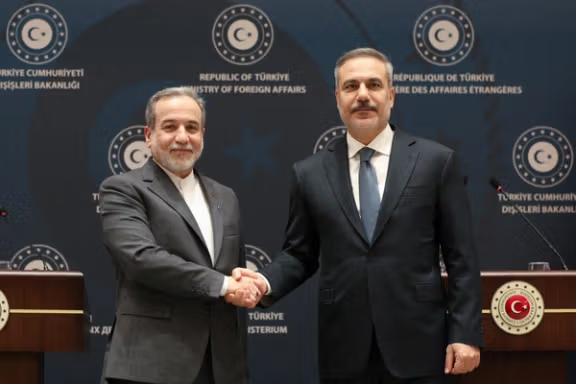
Turkish Foreign Minister Hakan Fidan and his Iranian counterpart Abbas Araghchi attend a press conference following their meeting in Istanbul, Turkey, January 30, 2026.

Iran showed no sign of shifting its stance toward the United States at a joint press conference with Turkey on Friday, with Foreign Minister Abbas Araghchi saying Tehran had no plan to meet US officials and would not negotiate under threats or preconditions.

“We do not have any plan or programme to meet or discuss with any US officials,” Araghchi told a joint news conference with Turkish Foreign Minister Hakan Fidan.

“Negotiation cannot be dictated,” he said. “If one party is threatening and setting preconditions, that is no longer a negotiation.”

“While they are threatening us, they say they want to negotiate,” Araghchi added.

Araghchi said Iran would only consider what he described as “just, fair and equitable” talks, but said the basic framework for such negotiations had not been established.

“We need to see the preconditions and the agenda first,” he said.

He warned that Iran was prepared for escalation if attacked. “We are ready for negotiations, but we are also ready for warfare,” Araghchi said. “We are even more ready than in June last year.”

He said any direct US intervention would change the situation fundamentally and could push the conflict beyond a bilateral confrontation, with wider regional consequences.

Araghchi described his talks with Fidan in Istanbul as “good and useful,” saying they covered bilateral, regional and international issues.

Fidan said Turkey was in contact with both Tehran and Washington as tensions rise, adding that he had held talks with US special envoy for the Middle East Steve Witkoff.

“Yesterday I had long talks with Steve Witkoff,” Fidan said, adding that Ankara would continue contacts with the United States and other regional actors.

Turkey opposes any new conflict in the region and views continued fighting as a driver of instability, terrorism and migration, Fidan said.

Most Viewed

Iran diplomacy wobbles as factions compete to avoid looking soft on US
1
INSIGHT

Iran diplomacy wobbles as factions compete to avoid looking soft on US

2

IRGC-linked media hints at threat to Persian Gulf undersea internet cables

3

Iran Guards say two ships seized in Hormuz after ceasefire extension

4
EXCLUSIVE

Strikes on petrochemical hubs leave Iran short of plastics

5

Scam messages seek crypto for ships’ safe passage through Hormuz, firm warns

Banner
Banner

Spotlight

  • As Tehran digs in, ordinary Iranians pay the price
    INSIGHT

    As Tehran digs in, ordinary Iranians pay the price

  • Internet Pro or Censor Pro? Iran rolls out a new service
    ANALYSIS

    Internet Pro or Censor Pro? Iran rolls out a new service

  • Strikes on petrochemical hubs leave Iran short of plastics
    EXCLUSIVE

    Strikes on petrochemical hubs leave Iran short of plastics

  • Diplomacy tolls at Hormuz as conflict returns to its doorstep
    OPINION

    Diplomacy tolls at Hormuz as conflict returns to its doorstep

  • Opposition to US talks grows in Tehran as ceasefire deadline nears
    INSIGHT

    Opposition to US talks grows in Tehran as ceasefire deadline nears

  • The future has been switched off here
    TEHRAN INSIDER

    The future has been switched off here

•
•
•

More Stories

Gunboat diplomacy: US seeks coercion without war on Iran

Jan 29, 2026, 17:29 GMT+0
•
Umud Shokri

President Donald Trump’s response to Iran’s recent unrest appears to reflect a strategy of gunboat diplomacy: the use of military pressure, rhetorical escalation, and economic coercion to extract concessions without committing to war or formal regime change.

Iran’s currency plunge in late December 2025 sparked nationwide protests that quickly escalated from economic grievances into calls for an end to the Islamic Republic. The crackdown that followed was unusually violent, killing thousands under a sweeping internet blackout.

Trump’s response was neither a formal call for regime change nor an immediate move toward military conflict. Instead, it combined public threats, diplomatic suspension, and economic pressure with visible military signaling designed to raise the cost of repression while preserving strategic flexibility.

“A massive Armada is heading to Iran,” Trump wrote on Truth Social last week, describing the fleet—led by the aircraft carrier Abraham Lincoln—as “ready, willing, and able to rapidly fulfill its mission, with speed and violence, if necessary.”

The signalling grew more explicit on Wednesday, when the US president urged Iran to “quickly ‘Come to the Table’” and negotiate a deal. He warned that “the next attack will be far worse” than last June’s strikes on Iran’s nuclear sites if an agreement was not reached.

The military centerpiece of Trump’s strategy is the redeployment of the USS Abraham Lincoln carrier strike group, restoring credible strike capacity at a moment when Iran’s leadership is consumed by internal unrest.

Escorted by multiple destroyers and carrying nearly 90 aircraft, including F-35s, the Lincoln gives Washington a flexible range of options—from limited strikes on Revolutionary Guard assets to broader operations.

Additional US combat aircraft, armored units, and air-defense systems have been repositioned across regional bases, underscoring the signaling intent. The objective appears to be readiness without commitment.

Trump’s apparent aim is to exploit Iran’s weakened position to coerce strategic concessions—not only on the nuclear and missile programs, but also on Tehran’s regional proxy activity. That pressure has been reinforced by a proposed 25 percent tariff on countries trading with Iran, announced on January 12.

Washington’s approach appears calibrated to push for negotiations while Tehran is at its most vulnerable, stopping short of an explicit commitment to military action or regime change.

The ambiguity looks deliberate—and strategic. It may work, but it is not risk-free. US credibility could erode if threats are not followed through. External pressure may also strengthen hardliners in Tehran by reinforcing narratives of foreign orchestration, potentially unifying a fractured elite.

Iran’s armed allies in the region retain some capacity to retaliate against US interests or Israel. Whether they choose to do so is unclear, but the risk of escalation into a broader conflict cannot be dismissed.

Tehran, for its part, has hardened its rhetoric, warning of an “unrestrained” and “unprecedented” response to any US military operation, while simultaneously expressing openness to what it calls “fair” negotiations.

Pressure on Iran is also building beyond Washington. On Thursday, the European Union took what its foreign policy chief, Kaja Kallas, described as a “decisive step” toward designating the Islamic Revolutionary Guard Corps as a terrorist organisation—its strongest signal yet that patience with the Islamic Republic is wearing thin.

At the same time, Kallas cautioned that the region “doesn’t need another war,” underscoring Europe’s own balancing act between pressure and restraint.

Iran’s streets are quiet after a bloody crackdown. But the economy is in free fall, and another round of widespread protests appears increasingly likely.

The key question now is whether Trump’s gunboat diplomacy can extract strategic gains without igniting the very conflict it seeks to avoid—or whether it merely postpones a more dangerous reckoning.
Iran bank branches face cash shortages as demand spikes

Jan 29, 2026, 09:39 GMT+0

Iranian bank branches are facing growing shortages of cash as demand for banknotes rises sharply, prompting informal daily withdrawal caps of 30 million to 50 million rials per customer (about $18 to $30), Iranian media reported.

Didban Iran website said branches in several banks were running out of banknotes on a daily basis, with customers arriving later in the working day sometimes unable to withdraw cash.

The report comes as inflation continues to erode purchasing power, and analysts have long said Iran’s chronic price rises have increased pressure for larger-denomination banknotes.

According to the Central Bank of Iran’s latest data, banknotes and coins held by the public rose by more than 23% in the first eight months of the current Iranian year, which began on March 21, 2025, compared with 0.8% growth over the same period a year earlier.

Iran’s largest widely circulating note is the 2,000,000-rial “Iran cheque” (about $1.22), which has steadily lost value in real terms.

The report added that the maximum daily cash withdrawal from ATMs has recently been set at 3,000,000 rials (about $1.83), a limit that has pushed more customers to visit branches in person to access larger sums.

The Central Bank has not publicly commented on the reported shortages or whether additional currency issuance is planned.

Gold, hoarding, fear: War fever deepens Iran’s economic anxiety

Jan 29, 2026, 07:44 GMT+0
•
Behrouz Turani

The possibility of US military action against Iran is eroding Iranians’ purchasing power and deepening their sense of insecurity, according to Iranian economic news outlets which provide a rare window into economic behavior amid an internet blackout.

Financial woes helped spark anti-government protests late last which which were crushed with deadly force, in a bloody crackdown in which security forces killed thousands.

The political uncertainty and a threat of attack by the United States has only deepened

Several economic publications, including Donya‑ye Eghtesad, the state‑run ISNA, and Tejarat News, published guidance on Tuesday advising citizens on how to protect their assets from devaluation, how to plan purchases to minimize the impact of price hikes and when to buy essential goods amid market volatility.

Reports indicate that many people are stockpiling non‑perishable items, viewing goods as safer than cash amid relentless inflation.

Those with savings, they noted, have increasingly turn to gold in any form, seeing it as a hedge against currency devaluation and a liquid asset that can be converted into cash at any time.

At the same time, households are keeping only small amounts of cash on hand, enough to cover basic needs in the event of internet outages that could disrupt ATMs and banking services.

The outlets warned that persistent inflation was fuelling panic buying of basic necessities that was distorting normal spending habits.

Economic malaise has festered as the Iranian rial currency again hit a new low this week and the internal crackdown suggests no near resolution to deep US and international sanctions along with persistent corruption and mismanagement.

US President Donald Trump on Tuesday suggested Iran would face a harsh attack if it did not accede to demands by Washington over its nuclear program and military posture.Iranian foreign minister Abbas Araghchi responded that Tehran was ready with “fingers on the trigger.”

The Shargh newspaper wrote that foreign policy news and not economic it is not economic fundamentals were driving market behavior and fears assets would devalue further.

The Economic dailies predicted that the impact on food and essential goods prices would be sharp and unavoidable.

As Donya‑ye Eghtesad observed, Iran’s economy is effectively in a state of suspended animation, with the key to stability lying in the hands of diplomats.

This prolonged uncertainty, the paper argued, is creating chronic anxiety among the public: a volatile mix of fear, despair, and anger that increasingly blames authorities deemed responsible for managing the crisis.

Khamenei's son built secret overseas property empire - Bloomberg

Jan 29, 2026, 01:47 GMT+0

Mojtaba Khamenei, the 56-year-old son of Iran’s Supreme Leader Ali Khamenei, directs a significant overseas real estate network through intermediaries, Bloomberg reported on Wednesday citing a year-long investigation.

No assets appear directly in Mojtaba's name, but he has been actively involved in deals dating to at least 2011, according to Western intelligence assessments, insider accounts, real estate records, and confidential documents reviewed by Bloomberg.

The portfolio includes luxury London properties exceeding $138 million (one bought for $46.5 million in 2014), a villa in an elite Dubai district, and upscale hotels in Frankfurt and Mallorca.

Funding, largely from Iranian oil sales, moved through British, Swiss, Liechtenstein, and UAE banks via shell companies such as Ziba Leisure Ltd., Birch Ventures Ltd., and Emirati entities, as tracked by the report.

Iranian banker Ali Ansari, sanctioned by the UK in October, features as owner or director in many transactions. Ansari denies any connection to Mojtaba and plans to challenge the sanctions, the report said.

The sanctions on Ansari were imposed for allegedly financing Iran’s Islamic Revolutionary Guards and building a European property portfolio worth about €400 million, according to a Financial Times investigation based on corporate filings.

The Financial Times reported that the assets include luxury properties across several European countries, ranging from a golf resort in Mallorca to a ski hotel in Austria.

Trump in Tehran? Former Iranian envoy floats Hail Mary talks to avoid war

Jan 28, 2026, 19:48 GMT+0
•
Behrouz Turani

As the threat of attack by the United States looms, Iranian commentators are sounding the alarm on the existential danger they see to Tehran, with one former envoy even saying US President Donald Trump should be hosted for talks.

Iran’s US- based former ambassador to Germany Hossein Mousavian said that the Iranian President Masoud Pezeshkian should invite Trump to Tehran as a step toward de-escalating tensions which could crescendo into an attack that threatens the Islamic Republic’s rule.

“Trump genuinely wants direct talks with Iran,” he told outlet Ensaf News in an interview.

“Pick up the phone and speak to him. Do not waste time as the situation is critically dangerous … I repeat: if you do not act immediately, Iran may face military confrontation with the United States, Israel, and NATO.”

In a more sober assessment, Iranian political commentator Reza Nasri warned “unlike his predecessors, Trump can wage a swift and clean war against Iran without imposing additional costs on US taxpayers or repeating past mistakes.”

Nasri warned against complacency about some Trump’s more conciliatory messaging, saying “any premature optimism about de-escalation can lead to dangerous miscalculations by lowering the state of alert and imposing heavy costs on Iran’s security.”

The US threat comes after Trump vowed to come to the defense of protestors before authorities unleashed one of the deadliest crackdowns on unrest in modern history, killing thousands.

Nasri, cleaving to the theocracy’s official discourse, described the demonstrations as “one of the most difficult and complex threats in Iran’s recent history and a project aimed at disintegrating the country and collapsing its political system.”

“This project has failed for now,” he added. “But a combination of domestic crisis, foreign threats and economic and psychological warfare still looms.”

Meanwhile, hardline Tehran commentator and social media personality Ali-Akbar Raefipour raised the alarm to an even louder pitch, saying without providing evidence that foreign preparations for a complex armed attack were already underway.

“Mutiny and targeted assassination cells may be activated if Iran is attacked. Their goals include killing prominent individuals and seizing sensitive centers,” he wrote on X.

“In recent days, we have seen equipment flowing into Iran for these groups.”