• العربية
  • فارسی
Brand
  • Iran Insight
  • Politics
  • Economy
  • Analysis
  • Special Report
  • Opinion
  • Podcast
  • Iran Insight
  • Politics
  • Economy
  • Analysis
  • Special Report
  • Opinion
  • Podcast
  • Theme
  • Language
    • العربية
    • فارسی
  • Iran Insight
  • Politics
  • Economy
  • Analysis
  • Special Report
  • Opinion
  • Podcast
All rights reserved for Volant Media UK Limited
volant media logo
ANALYSIS

Iran's energy trade defies year of US maximum pressure sanctions

Dalga Khatinoglu
Dalga Khatinoglu

Oil, gas and Iran economic analyst

Jan 23, 2026, 08:29 GMT+0
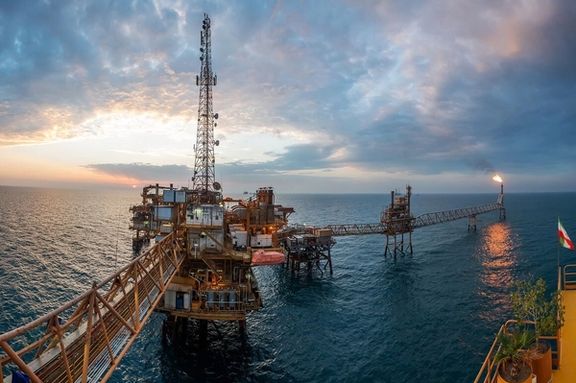
An offshore rig on Iran's Abouzar oil field in the Persian Gulf

One year after US President Donald Trump returned to the White House and revived the "maximum pressure" sanctions on Iran from his first term, available data show the country’s energy exports remain largely intact.

Data from the commodity intelligence firm Kpler, seen by Iran International, show that in 2025 Iran delivered an average of 1.38 million barrels per day (bpd) of crude oil and gas condensate to China—a decline of just 7 percent compared with 2024.

After Iranian oil exports to Syria halted in December 2024, China effectively remained Tehran’s sole buyer of crude oil over the past year.

Unlike crude oil, Iran’s petroleum product exports—fuel oil (mazut), naphtha and liquefied petroleum gas (LPG)—are relatively diversified, with shipments mainly destined for China, the United Arab Emirates, Malaysia and Singapore.

According to Kpler, Iran exported an average of 190,000 bpd of naphtha and 256,000 bpd of fuel oil last year, a combined decline of about 13 percent compared with 2024.

The drop, however, was driven not by tighter US sanctions but by Iran’s worsening domestic gas shortages, which forced power plants and industrial facilities to burn more fuel oil, reducing volumes available for export.

Data from tanker-tracking firms Kpler and Vortexa show that the modest decline in crude oil exports was offset by increased shipments of natural gas and LPG.

Iran has also continued exporting natural gas to Turkey and Iraq.

Tehran and Baghdad don’t publish official figures, but data from Turkey’s energy ministry indicate that natural gas imports from Iran increased about 9 percent during the first 11 months of last year compared with the same period in 2024.

One reason US sanctions have struggled to significantly curb Iran’s energy exports has been the continued operation of the so-called shadow fleet—a network of oil tankers that transport sanctioned crude through flag changes, disabled tracking systems, ship-to-ship transfers, and opaque ownership structures.

According to estimates by TankerTrackers, roughly 1,500 oil tankers worldwide were involved in shadow fleet activity last year, with nearly 40 percent linked to Iranian oil shipments.

Although the United States stepped up sanctions on such tankers in 2025, existing data suggests that hundreds of non-sanctioned vessels remain active in transporting Iranian oil through opaque trading routes and intermediary networks, undermining the enforcement capacity of US measures.

Further data from Kpler indicate that widespread domestic protests in Iran in recent weeks have had no noticeable impact on the country’s oil and petroleum product export volumes.

While China has remained the sole buyer of Iranian crude oil and condensate, the United Arab Emirates—one of Washington’s closest regional allies—has emerged as the largest importer of Iranian fuel oil, accounting for nearly 70 percent of those exports.

Estimates by Iran International put the total value of Iran’s exports of crude oil, petroleum products, and natural gas last year—excluding discounts and the costs of sanctions evasion—at roughly $60 billion.

The figure highlights the gap between early US projections that Iran’s oil exports would collapse by as much as 90 percent and the far more limited impact visible in the data so far.

Most Viewed

Ghalibaf defends Iran-US talks amid hardline backlash
1
INSIGHT

Ghalibaf defends Iran-US talks amid hardline backlash

2
INSIGHT

100 days after carnage: Iran economy reels from war, inflation, unemployment

3
INSIGHT

A nation in limbo: 100 days after the massacre, has the world moved on?

4
ANALYSIS

From instability to influence: Pakistan’s pivotal role in US-Iran diplomacy

5
ANALYSIS

100 days on: why Iran’s January protests spread across social classes

Banner
Banner

Spotlight

  • War-hit homeowners feel abandoned as Iran’s reconstruction aid fades

    War-hit homeowners feel abandoned as Iran’s reconstruction aid fades

  • 100 days on: the anatomy of Iran’s January crackdown
    INSIGHT

    100 days on: the anatomy of Iran’s January crackdown

  • Ghalibaf defends Iran-US talks amid hardline backlash
    INSIGHT

    Ghalibaf defends Iran-US talks amid hardline backlash

  • 100 days on: why Iran’s January protests spread across social classes
    ANALYSIS

    100 days on: why Iran’s January protests spread across social classes

  • From instability to influence: Pakistan’s pivotal role in US-Iran diplomacy
    ANALYSIS

    From instability to influence: Pakistan’s pivotal role in US-Iran diplomacy

  • A nation in limbo: 100 days after the massacre, has the world moved on?
    INSIGHT

    A nation in limbo: 100 days after the massacre, has the world moved on?

•
•
•

More Stories

Tehran quelled street protests but economic troubles persist

Jan 23, 2026, 02:45 GMT+0
•
Maryam Sinaiee

Tehran may have crushed street unrest with brute force, but it has no comparable solution for an economy gripped by surging inflation and collapsing incomes.

The protests initially erupted over a sharp spike in exchange rates but soon escalated into open calls for the overthrow of the Islamic Republic.

Many Iranians now say they personally know at least one or two people killed on January 8 or 9. Arrests and enforced disappearances—whose exact scale remains unknown—have also drawn countless families into the crisis, deepening fear and uncertainty.

According to people who have recently left Iran or managed to communicate via Starlink, businesses across the country are either closed or operating at minimal capacity, battered by currency turmoil and the prolonged internet shutdown.

On one side, customers have disappeared; on the other, sellers are reluctant to part with their goods.

Merchants say they cannot be sure they will be able to replace inventory amid exchange-rate volatility, turning even routine transactions into a gamble. Many now prefer not to sell at all.

Even before the unrest, businesses were under intense pressure.

Data published by the economic website Eco Iran show that bank lending from April to December rose 47 percent year-on-year. But 82 percent of loans to the productive sector went toward “working capital”—a sign that firms were borrowing not to expand, but simply to survive.

Shrinking purchasing power

Soon after the protests began, the government announced a plan to offset declining purchasing power following the removal of subsidized exchange rates for essential imports.

Under the plan, low- and middle-income individuals are to receive 10 million rials per month—about $7.50, roughly equivalent to one day’s wage for a construction worker.

Four months of payments were deposited at once, with recipients told they could spend one-quarter of the sum each month on 11 basic items, including rice, cooking oil, protein products, and dairy, at state-set prices in designated stores.

Prices for most of those goods in the open market have continued to surge, and some items have become scarce. Most readers responding to a poll by the news website Khabar Online said the subsidy was insufficient or ineffective.

One reader commented on the website that the handout offsets at most half the price increase for the 11 subsidized items, noting that rising food costs would also push up prices for everything from biscuits to restaurant meals, for which no compensation exists.

Many also fear the government will finance the program by printing money, further accelerating inflation, which official figures show had already surpassed 50 percent by December.

Cost of blackout

The nationwide internet shutdown, imposed on January 8 and still in place, has crippled hundreds of thousands of small and home-based businesses.

From home food producers to online language and music teachers, entire livelihoods have vanished overnight, with authorities offering no clear timeline for restoring connectivity.

These businesses relied almost entirely on online platforms for advertising and sales. Many were small producers in cities and even remote villages, selling handicrafts, agricultural goods, or homemade food directly to customers through Instagram.

Even before the shutdown, widespread filtering had forced them to pay for VPNs, further straining already fragile operations.

Kourosh, the manager of an advertising company who left Iran for Turkey after the January 8–9 killings, said all advertising activity had come to a halt.

“My clients have lost any hope of selling their products before the Iranian New Year, which is just two months away,” he told Iran International.

“People have no money, and even if they do, they won’t spend it on clothes, shoes, or home goods. Everyone was counting on sales in these final weeks of the year.”

Come what may in Iran, Russia will adapt to preserve influence

Jan 22, 2026, 15:57 GMT+0
•
Mark N. Katz

Russia likely views Iran’s mass anti-regime protests with deep unease, but may ultimately adapt just as it did in Syria to preserve influence whether the Islamic Republic survives or a new political order emerges.

After the loss of longtime Russian allies Bashar al-Assad in Syria and Nicolas Maduro in Venezuela, the Kremlin can hardly wish to suffer further loss of an ally in Tehran.

Supreme Leader Ali Khamenei may yet remain in power—thanks partly to ongoing Russian-Iranian cooperation. But even if he does not, Vladimir Putin may still be able to salvage the situation.

Moscow, according to an analysis by the Carnegie Endowment, does not seem likely to intervene militarily in Iran to defend the Islamic Republic against its opponents. Russian forces, after all, are preoccupied with the war in Ukraine.

Yet, as detailed in an article in Foreign Policy, Moscow has long provided Tehran with electronic and other tools of repression. Since the Iranian demonstrators are not an armed opposition, Russian military intervention may not be needed to contain or suppress the unrest.

The situation might change, of course, if US president Donald Trump follows through on his threats to intervene in Iran. Both Tehran and Moscow want to avoid this. But how?

While Putin himself has been remarkably quiet about events in Iran, the one initiative Russia has engaged in so far is mediation between Iran and Israel. Both governments have reportedly conveyed to Moscow that neither will preemptively attack the other.

This Russian mediation effort may be highly important for protecting the Islamic Republic. Unlike just before and during the June 2025 twelve-day war—when Israeli Prime Minister Benjamin Netanyahu was urging the United States to join attacks on Iran—Netanyahu is now reportedly counseling restraint in Washington regarding military intervention.

While Israel has long opposed Iran’s acquisition of nuclear weapons, Netanyahu may prefer that a weakened Islamic Republic remain in power rather than be overthrown and replaced by either a more hostile regime, or one more closely aligned with the West in ways Israel cannot shape.

Netanyahu has already found himself at cross-purposes with Trump over Syria, where the United States has sought to cooperate with the new leadership under Ahmed al-Sharaa, while Israel views the government in Damascus as a threat.

Moscow’s coordination with Israel may therefore increase Putin’s ability to dissuade Trump from intervening in Iran.

For Moscow, the best outcome in the current crisis is that the Islamic Republic defeats its internal opponents and survives. But Russia may still retain significant influence and cooperation with Iran after a change in leadership—or even regime.

In Syria, Moscow has kept its naval and air bases despite the fall of Assad. In Venezuela, Russia has moved quickly to re-engage with the post-Maduro authorities, seeking to preserve economic and strategic ties despite a major political rupture.

If Khamenei falls but the Islamic Republic remains intact, Tehran is likely to continue cooperating with Russia despite any newfound willingness to work with the United States.

Even if the Islamic Republic collapses, its replacement will almost certainly continue to envision Iran as a regional great power.

A new Iranian government may pursue more cooperative relations with Washington while still seeking ties with Russia, China, and others—much as new leaderships elsewhere have attempted to diversify their external partnerships.

Moscow, for its part, will actively seek cooperation with any new authorities in Tehran to prevent Iran from becoming overly dependent on the West.

With regard to Ukraine, Putin has shown little flexibility, pressing ahead despite extraordinary human and financial costs. But when it comes to supporting anti-Western allies in the Global South, Moscow has been more pragmatic.

The demands of the war in Ukraine limit Russia’s ability to defend embattled partners elsewhere, while Putin’s long-standing efforts to cultivate relations with traditionally pro-Western governments have reduced the strategic necessity of rigid ideological allies.

It is undoubtedly embarrassing for Moscow to see longtime partners fall from power, but this is hardly unique to Russia—as the collapse of the Western-backed government in Afghanistan demonstrated.

Putin appears to understand that the downfall of any government in the Global South is typically followed by competition among outside powers for influence. This is not a moment to lament losses, but to adapt—to engage new leaders eager to keep their options open rather than rely on a single great-power patron.

Moscow’s preferred outcome in Iran remains the survival of the Islamic Republic and the continuation of close cooperation. But if leadership—or even regime—change occurs, Russia will move quickly to adjust.

If Putin’s success in retaining Russian bases in Syria despite backing the losing side is any guide, he may well succeed in doing so in Iran as well.

Iran's rulers are betting on the iron fist

Jan 21, 2026, 18:50 GMT+0
•
Ata Mohamed Tabriz

The unprecedented brutal crackdown on recent protests in Iran suggests Tehran's rulers are no longer attempting to govern a discontented society but are in open conflict with it.

The large-scale killing of protesters may look like a panicked security response, but it is better understood as a calculated effort to destroy protest both on the streets and in people’s minds.

By deploying overwhelming force, the state is seeking to reframe protest as an act that guarantees death—so dangerous that it becomes irrational to attempt.

This logic has been reinforced by the nationwide internet shutdown. Cutting communication is not simply about hiding abuses from the outside world; it is about isolating protesters from one another, breaking networks of trust, and leaving individuals to face fear alone.

When information collapses, collective will fractures. The aim is to ensure that even before a demonstration forms, the decision to join it feels like a solitary, suicidal gamble.

The state has effectively pushed society into an impossible position, where enduring daily life is as unpleasant—and as unimaginable—as any attempt to change it. This paralysis is not accidental. It is Tehran’s endgame, and increasingly its only means of survival.

'Us against them'

The violence of January 9 and 10 served another purpose as well: consolidating power from within.

By tying the survival of the political system to the actions of those carrying out repression, the state has produced what might be called forced loyalty. Security forces and affiliated actors are drawn into violence so severe that there is no path back.

Once hands are stained with blood, survival becomes inseparable from the survival of the system itself. This creates a hardened core of enforcers whose only perceived option is to push forward, no matter the cost.

This dynamic encourages a “scorched earth” approach. The conflict is no longer managed or contained; it is framed as a total struggle between “us” and “them,” with protesters cast as enemies rather than citizens.

In such a framework, compromise is not weakness—it is betrayal. Mediation disappears. Violence becomes the only remaining language.

Murky repression

By ignoring collective demands and stripping the public of political relevance, the Islamic Republic has effectively dismantled politics itself. What remains is not governance, but a permanent security posture.

The use of plainclothes forces and paramilitary units fits squarely within this logic. By blurring the boundary between state and society, the authorities have sought to reframe repression as “people against people.”

Protesters are portrayed as violent elements within society, already dehumanized through labels such as “rioters” or “terrorists.” This allows the state to deflect responsibility while deepening social fragmentation.

Slain senior Revolutionary Guard commander Hossein Hamedani once boasted about mobilizing convicts and thugs to suppress protests. “They are not afraid of blood,” he said.

Their role is not only physical repression but also narrative production: muddying responsibility, normalizing brutality, and casting doubt on the moral legitimacy of protest itself. Their unofficial status also provides the state with plausible deniability.

Burned bridges

At the same time, the machinery of repression has become increasingly bureaucratic. Killings are absorbed into routine procedure; violence is carried out as a duty—lawful, necessary, even sacred.

Statements from military and security institutions during this period make clear that the deaths of protesters are not seen as a national loss, but as a means of preserving the political order.

This moment also exposes a deeper vulnerability. A system that securitizes everything produces nothing but control and coercion. Maintaining such a structure requires constant expenditure—of resources, manpower, and legitimacy—both at home and abroad.

A crisis in the domestic security sphere cannot remain contained indefinitely; it will eventually spill outward, generating external pressure and international consequences.

What is unfolding in Iran is therefore not a temporary crackdown. It is the outcome of a long shift from governing society to confronting it as an enemy.

It is almost impossible to predict where Iran is headed, but its rulers appear to have bet on the iron fist—suspending politics for a permanent emergency and burning all bridges back to mediation and consent.

If Iran changes, the region's economy would change with it

Jan 19, 2026, 14:55 GMT+0
•
Mohamad Machine-Chian

The future of the Islamic Republic is unresolved, but if and when change comes, Iran’s return to global trade would carry far-reaching consequences for the region’s economy.

A deadly crackdown may have quieted Iran’s streets for now, but the state appears increasingly brittle, with no clear answer to a deepening economic crisis that is eroding living standards and confidence.

External pressures are also likely to intensify after Tehran’s crackdown on protesters, narrowing revenue channels and shrinking the government’s economic room to maneuver.

Left unresolved, those pressures are likely to generate further unrest and, in time, a political transition that seeks normalization with the world.

A normalized Iran—able to trade, borrow, insure cargoes and receive investment like other upper-middle-income economies—would likely enjoy a large upside, given how much of its economy has been operating below potential.

Its advantages are straightforward: scale, in the form of a large domestic consumer market; a relatively diversified industrial base by regional standards; deep energy and petrochemical capacity; and a geographic position that could turn the country into a natural junction linking the Persian Gulf, the Caucasus, Central Asia and Turkey.

The most immediate gains would come from energy exports unleashed from sanctions and sharply lower transaction costs. Over time, however, the larger prize would be productivity. Access to global supply chains and affordable capital, combined with Iran’s labor force, could lift output across all sectors.

None of this would be automatic. The payoff would depend on restoring basic economic credibility: stable money, predictable regulation and a solid banking system.

Turkey stands out as the clearest short-term beneficiary of such a shift in Iran. Proximity, road links and established distribution networks would allow Turkish firms to move quickly, while airlines and tourism operators would likely benefit from a surge in outbound Iranian travel.

Iraq would gain from formal payment channels and more predictable energy trade, easing pressure on the dinar and reducing transaction costs.

Pakistan’s upside would lie in infrastructure: if sanctions risk were removed, long-stalled energy links could become commercially viable, easing power constraints and lowering industrial costs.

The United Arab Emirates would likely lose some of the high margins associated with sanctions-bypass trade but gain as a platform where Iran-bound capital is raised, structured and eventually deployed.

Azerbaijan could benefit if Iran became a reliable bridge to Russia and Eurasia through freight, swaps and grid connections.

Israel could also emerge as a beneficiary. A normalized Iran would lower the region’s risk premium and potentially reduce energy costs, while Israeli firms—particularly in technology and water and agricultural solutions—could potentially compete for contracts in a large, untapped market.

The clearest losers would be producers and hubs that have quietly benefited from Iran’s isolation.

In energy markets, a sanctions-free Iran re-entering at scale would intensify competition between price and market share, leaving oil-dependent exporters such as Saudi Arabia and Kuwait more exposed to revenue volatility and fiscal trade-offs.

In gas, Qatar’s dominance in Asian LNG contracting could face pressure as investment and technology return to Iran’s side of South Pars, potentially narrowing bargaining power and affecting pricing over time.

Iran’s reintegration would also challenge business models built on being indispensable detours. Kuwait, for example, could find that costly hub ambitions become less compelling if Iraq–Iran rail and port combinations offered cheaper trade routes.

More subtly, some early beneficiaries could face second-round competition once Iran begins producing and exporting at scale.

Turkey may initially sell heavily into the Iranian market, but over time a revitalized Iranian manufacturing sector could begin displacing Turkish goods in nearby markets.

For Pakistan, cheaper Iranian energy would be an opportunity, but a fully functional Chabahar and Iran-centered transit corridors could divert trade away from Gwadar unless Pakistan integrates its infrastructure into those routes.

If Iran were to return as a normal economic actor, regional debates would shift from ideology to competition. The central question may no longer be who can contain Tehran, but who can compete with it.

In that environment, the advantage would likely accrue to states that adapt fastest, moving away from protected niches and easy rents toward productivity, technology and integration.

A reopened Iran would not simply add another participant to the regional economy; it would change the structure of the marketplace itself.

Turkey treads carefully as Iran faces unrest

Jan 16, 2026, 07:38 GMT+0
•
Umud Shokri

Turkey has adopted a calculated caution during the recent waves of protests in neighboring Iran, avoiding endorsement of those who took to the streets while stopping short of backing Tehran’s violent crackdown.

Turkish officials have acknowledged that the unrest is rooted in genuine domestic grievances, but warned against what they describe as external efforts to exploit the turmoil.

This balancing act reflects Turkey’s dual position.

A NATO member with institutional ties to the West, Ankara is also a pragmatic regional power deeply embedded in Middle Eastern geopolitics. Its approach to Iran’s crisis has been shaped less by ideological alignment than by concern over how prolonged instability could affect Turkey’s borders, economy and regional posture.

Senior officials, including Foreign Minister Hakan Fidan and spokesperson for the ruling AKP party Ömer Çelik, have framed the protests as domestically driven but vulnerable to manipulation by outside actors, particularly Israel.

"We are against a military intervention against Iran," Fidan said on Wednesday. Iran needs to solve its authentic internal problems on its own."

At the same time, Turkey has avoided explicitly endorsing Tehran’s security response, signaling unease with the scale of repression.

Shared interests

Behind the public rhetoric, Turkish diplomacy has intensified.

Reports in Turkish media this week suggest that Ankara has remained in close contact with Tehran, Western partners and Arab countries surrounding the Persian Gulf—urging de-escalation and arguing against US intervention.

This is despite Turkey and Iran standing on opposing sides of regional conflicts in recent years, notably in Syria and Iraq.

The Kurdish question adds another layer of sensitivity. Both states oppose Kurdish separatism, but Turkish officials have long accused Iran of tolerating or exploiting groups linked to the PKK, which Ankara considers an existential threat.

But such rivalries have often given way to pragmatism.

Bilateral trade reached roughly $10 billion in 2024, and Iran supplies about 15 percent of Turkey’s natural gas under a pipeline agreement set to expire in mid-2026. Tourism, transportation links and security coordination have continued even during periods of political tension.

Turkey has also consistently opposed US sanctions on Iran, arguing they harm regional trade and ordinary Iranians more than decision-makers in Tehran.

Impartial intermediary

Public messaging during the current crisis has been carefully calibrated.

On January 12, Ömer Çelik warned that foreign intervention would “lead to greater crises,” urging negotiations while acknowledging Iran’s internal problems. Fidan echoed that line and sought to downplay the scale of unrest—perhaps to discourage escalation.

President Recep Tayyip Erdoğan has also largely avoided inflammatory rhetoric. Rather than issuing public condemnations or threats, he convened security meetings to assess potential spillover risks.

Turkish authorities restricted demonstrations near Iran’s consulate in Istanbul, aiming to reassure Tehran of shared security interests.

Overall, Ankara has sought to position itself as a potential intermediary rather than a partisan actor.

Retaining regional influence

Prolonged unrest in Iran raises the prospect of refugee flows that Turkey, already hosting millions of displaced people from Syria and elsewhere, is politically and economically ill-equipped to absorb.

Large-scale displacement from Iran would strain public services, intensify domestic backlash against migrants and complicate relations with the European Union.

Economic exposure reinforces that caution. Iran remains a key energy supplier, and any disruption, particularly during winter, would push up prices and inflation in Turkey’s already fragile economy. With the gas contract nearing renewal, Ankara has strong incentives to avoid a rupture with Tehran.

A wider military confrontation involving Iran would also threaten Turkey’s commercial routes and military positions in Iraq and Syria.

Ultimately, Turkey’s response reflects strategic self-preservation. By combining public restraint with private engagement, Ankara aims to shield itself from instability, protect critical economic links and preserve leverage regardless of how events in Iran unfold.

Whether the Islamic Republic emerges intact or weakened, Turkey appears determined to remain positioned as a consequential regional actor—even as unrest across its border underscores how rarely domestic crises in the Middle East remain contained.






