• العربية
  • فارسی
Brand
  • Iran Insight
  • Politics
  • Economy
  • Analysis
  • Special Report
  • Opinion
  • Podcast
  • Iran Insight
  • Politics
  • Economy
  • Analysis
  • Special Report
  • Opinion
  • Podcast
  • Theme
  • Language
    • العربية
    • فارسی
  • Iran Insight
  • Politics
  • Economy
  • Analysis
  • Special Report
  • Opinion
  • Podcast
All rights reserved for Volant Media UK Limited
volant media logo
ANALYSIS

If Iran changes, the region's economy would change with it

Mohamad Machine-Chian

Iran International

Jan 19, 2026, 14:55 GMT+0
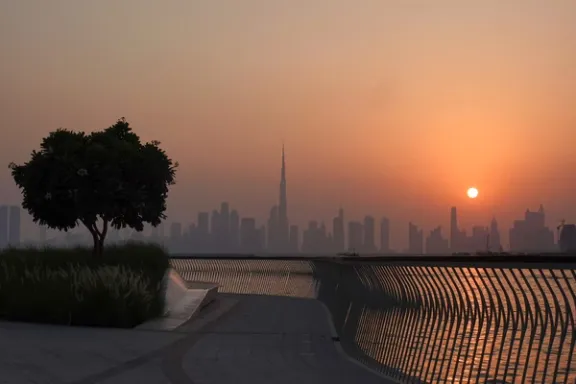
The Burj Khalifa building peaks through the skyline as the sun sets over Dubai, United Arab Emirates, September 9, 2023.

The future of the Islamic Republic is unresolved, but if and when change comes, Iran’s return to global trade would carry far-reaching consequences for the region’s economy.

A deadly crackdown may have quieted Iran’s streets for now, but the state appears increasingly brittle, with no clear answer to a deepening economic crisis that is eroding living standards and confidence.

External pressures are also likely to intensify after Tehran’s crackdown on protesters, narrowing revenue channels and shrinking the government’s economic room to maneuver.

Left unresolved, those pressures are likely to generate further unrest and, in time, a political transition that seeks normalization with the world.

A normalized Iran—able to trade, borrow, insure cargoes and receive investment like other upper-middle-income economies—would likely enjoy a large upside, given how much of its economy has been operating below potential.

Its advantages are straightforward: scale, in the form of a large domestic consumer market; a relatively diversified industrial base by regional standards; deep energy and petrochemical capacity; and a geographic position that could turn the country into a natural junction linking the Persian Gulf, the Caucasus, Central Asia and Turkey.

The most immediate gains would come from energy exports unleashed from sanctions and sharply lower transaction costs. Over time, however, the larger prize would be productivity. Access to global supply chains and affordable capital, combined with Iran’s labor force, could lift output across all sectors.

None of this would be automatic. The payoff would depend on restoring basic economic credibility: stable money, predictable regulation and a solid banking system.

Turkey stands out as the clearest short-term beneficiary of such a shift in Iran. Proximity, road links and established distribution networks would allow Turkish firms to move quickly, while airlines and tourism operators would likely benefit from a surge in outbound Iranian travel.

Iraq would gain from formal payment channels and more predictable energy trade, easing pressure on the dinar and reducing transaction costs.

Pakistan’s upside would lie in infrastructure: if sanctions risk were removed, long-stalled energy links could become commercially viable, easing power constraints and lowering industrial costs.

The United Arab Emirates would likely lose some of the high margins associated with sanctions-bypass trade but gain as a platform where Iran-bound capital is raised, structured and eventually deployed.

Azerbaijan could benefit if Iran became a reliable bridge to Russia and Eurasia through freight, swaps and grid connections.

Israel could also emerge as a beneficiary. A normalized Iran would lower the region’s risk premium and potentially reduce energy costs, while Israeli firms—particularly in technology and water and agricultural solutions—could potentially compete for contracts in a large, untapped market.

The clearest losers would be producers and hubs that have quietly benefited from Iran’s isolation.

In energy markets, a sanctions-free Iran re-entering at scale would intensify competition between price and market share, leaving oil-dependent exporters such as Saudi Arabia and Kuwait more exposed to revenue volatility and fiscal trade-offs.

In gas, Qatar’s dominance in Asian LNG contracting could face pressure as investment and technology return to Iran’s side of South Pars, potentially narrowing bargaining power and affecting pricing over time.

Iran’s reintegration would also challenge business models built on being indispensable detours. Kuwait, for example, could find that costly hub ambitions become less compelling if Iraq–Iran rail and port combinations offered cheaper trade routes.

More subtly, some early beneficiaries could face second-round competition once Iran begins producing and exporting at scale.

Turkey may initially sell heavily into the Iranian market, but over time a revitalized Iranian manufacturing sector could begin displacing Turkish goods in nearby markets.

For Pakistan, cheaper Iranian energy would be an opportunity, but a fully functional Chabahar and Iran-centered transit corridors could divert trade away from Gwadar unless Pakistan integrates its infrastructure into those routes.

If Iran were to return as a normal economic actor, regional debates would shift from ideology to competition. The central question may no longer be who can contain Tehran, but who can compete with it.

In that environment, the advantage would likely accrue to states that adapt fastest, moving away from protected niches and easy rents toward productivity, technology and integration.

A reopened Iran would not simply add another participant to the regional economy; it would change the structure of the marketplace itself.

Most Viewed

Ghalibaf defends Iran-US talks amid hardline backlash
1
INSIGHT

Ghalibaf defends Iran-US talks amid hardline backlash

2
ANALYSIS

From instability to influence: Pakistan’s pivotal role in US-Iran diplomacy

3
ANALYSIS

100 days on: why Iran’s January protests spread across social classes

4

War-hit homeowners feel abandoned as Iran’s reconstruction aid fades

5

Iran says no decision yet on talks as Pakistan prepares to host US team

Banner
Banner

Spotlight

  • Iran diplomacy wobbles as factions compete to avoid looking soft on US
    INSIGHT

    Iran diplomacy wobbles as factions compete to avoid looking soft on US

  • The politics of pink: how Iran uses cuteness to rebrand violence
    ANALYSIS

    The politics of pink: how Iran uses cuteness to rebrand violence

  • Bread shortages, soaring prices strain households in Iran, residents say
    VOICES FROM IRAN

    Bread shortages, soaring prices strain households in Iran, residents say

  • 100 days on: the anatomy of Iran’s January crackdown
    INSIGHT

    100 days on: the anatomy of Iran’s January crackdown

  • Ghalibaf defends Iran-US talks amid hardline backlash
    INSIGHT

    Ghalibaf defends Iran-US talks amid hardline backlash

  • From instability to influence: Pakistan’s pivotal role in US-Iran diplomacy
    ANALYSIS

    From instability to influence: Pakistan’s pivotal role in US-Iran diplomacy

•
•
•

More Stories

Turkey treads carefully as Iran faces unrest

Jan 16, 2026, 07:38 GMT+0
•
Umud Shokri

Turkey has adopted a calculated caution during the recent waves of protests in neighboring Iran, avoiding endorsement of those who took to the streets while stopping short of backing Tehran’s violent crackdown.

Turkish officials have acknowledged that the unrest is rooted in genuine domestic grievances, but warned against what they describe as external efforts to exploit the turmoil.

This balancing act reflects Turkey’s dual position.

A NATO member with institutional ties to the West, Ankara is also a pragmatic regional power deeply embedded in Middle Eastern geopolitics. Its approach to Iran’s crisis has been shaped less by ideological alignment than by concern over how prolonged instability could affect Turkey’s borders, economy and regional posture.

Senior officials, including Foreign Minister Hakan Fidan and spokesperson for the ruling AKP party Ömer Çelik, have framed the protests as domestically driven but vulnerable to manipulation by outside actors, particularly Israel.

"We are against a military intervention against Iran," Fidan said on Wednesday. Iran needs to solve its authentic internal problems on its own."

At the same time, Turkey has avoided explicitly endorsing Tehran’s security response, signaling unease with the scale of repression.

Shared interests

Behind the public rhetoric, Turkish diplomacy has intensified.

Reports in Turkish media this week suggest that Ankara has remained in close contact with Tehran, Western partners and Arab countries surrounding the Persian Gulf—urging de-escalation and arguing against US intervention.

This is despite Turkey and Iran standing on opposing sides of regional conflicts in recent years, notably in Syria and Iraq.

The Kurdish question adds another layer of sensitivity. Both states oppose Kurdish separatism, but Turkish officials have long accused Iran of tolerating or exploiting groups linked to the PKK, which Ankara considers an existential threat.

But such rivalries have often given way to pragmatism.

Bilateral trade reached roughly $10 billion in 2024, and Iran supplies about 15 percent of Turkey’s natural gas under a pipeline agreement set to expire in mid-2026. Tourism, transportation links and security coordination have continued even during periods of political tension.

Turkey has also consistently opposed US sanctions on Iran, arguing they harm regional trade and ordinary Iranians more than decision-makers in Tehran.

Impartial intermediary

Public messaging during the current crisis has been carefully calibrated.

On January 12, Ömer Çelik warned that foreign intervention would “lead to greater crises,” urging negotiations while acknowledging Iran’s internal problems. Fidan echoed that line and sought to downplay the scale of unrest—perhaps to discourage escalation.

President Recep Tayyip Erdoğan has also largely avoided inflammatory rhetoric. Rather than issuing public condemnations or threats, he convened security meetings to assess potential spillover risks.

Turkish authorities restricted demonstrations near Iran’s consulate in Istanbul, aiming to reassure Tehran of shared security interests.

Overall, Ankara has sought to position itself as a potential intermediary rather than a partisan actor.

Retaining regional influence

Prolonged unrest in Iran raises the prospect of refugee flows that Turkey, already hosting millions of displaced people from Syria and elsewhere, is politically and economically ill-equipped to absorb.

Large-scale displacement from Iran would strain public services, intensify domestic backlash against migrants and complicate relations with the European Union.

Economic exposure reinforces that caution. Iran remains a key energy supplier, and any disruption, particularly during winter, would push up prices and inflation in Turkey’s already fragile economy. With the gas contract nearing renewal, Ankara has strong incentives to avoid a rupture with Tehran.

A wider military confrontation involving Iran would also threaten Turkey’s commercial routes and military positions in Iraq and Syria.

Ultimately, Turkey’s response reflects strategic self-preservation. By combining public restraint with private engagement, Ankara aims to shield itself from instability, protect critical economic links and preserve leverage regardless of how events in Iran unfold.

Whether the Islamic Republic emerges intact or weakened, Turkey appears determined to remain positioned as a consequential regional actor—even as unrest across its border underscores how rarely domestic crises in the Middle East remain contained.

From 'grievances' to 'terrorism’: how Tehran reframed dissent

Jan 15, 2026, 20:18 GMT+0
•
Behrouz Turani

A review of public statements by Iran’s senior officials since late December suggests a marked hardening of tone as protests escalated, a shift that coincided with a sharp intensification of the state’s security response.

The protests began on December 28 amid soaring inflation. It initially drew a more measured response from the government.

But following a surge in demonstrations on January 8, and especially after a Supreme Leader speech the following day, officials reverted to a familiar framing: unrest portrayed as a foreign-backed security threat demanding a forceful response.

In an interview with Al Jazeera broadcast between January 9 and 12, Foreign Minister Abbas Araghchi said protests had been peaceful from December 28 through January 7, but claimed that “armed terrorist elements linked to Israel and the United States” had subsequently turned them violent.

The judiciary soon echoed that framing.

Speaking to bazaar merchants on January 10, Chief Justice Gholamhossein Mohseni Ejei said protesters had initially “demanded the country’s progress,” avoiding direct reference to the violent response.

Three days later, he called for the immediate trial of detainees, and in a January 14 post on X announced plans to televise the trials of what he called the “main culprits” in order to expose their alleged foreign ties.

Around the same time, footage of Ejei interrogating a detainee on state television circulated on social media.

‘No peace, only war’

The rhetorical shift became unmistakable on January 9, when Khamenei delivered a speech that many observers viewed as pivotal. He described protesters as “rioters under foreign influence” and urged security forces to confront them sternly.

President Masoud Pezeshkian, who until then had acknowledged protesters’ grievances and expressed openness to dialogue, followed suit.

“(They are) violent terrorists and rioters brought from abroad to attack mosques and civilians,” he said, urging the public “to stop the terrorists.”

Other senior figures reinforced the message. Security Chief Ali Larijani said on January 11 that forces were “controlling the protests with minimal damage,” despite emerging videos of a bloody crackdown.

“There will be no peace and no ceasefire, only war,” he warned protesters.

‘Conspiracy’

Some civilian officials sought to strike a more conciliatory tone, though without challenging the core narrative. Government spokesperson Fatemeh Mohajerani condemned violence in general terms and said the internet blackout—entering its eighth day on Thursday—was a “temporary measure.”

Parliament Speaker Mohammad Bagher Ghalibaf said on January 13 that “protesting is the people’s legitimate right” and promised to address economic grievances, while also accusing protesters of “seeking violence.”

Military commanders, meanwhile, were more explicit. From January 8 through 14, senior officers repeatedly characterized the unrest as a “conspiracy” orchestrated by Israel and unnamed terrorist groups.

Army Commander Abdolrahim Mousavi praised the Basij domestic enforcement militia and police for “controlling the riots,” warned of possible direct military involvement, and described the protests as “a malicious conspiracy.”

Police Commander Ahmadreza Radan said “the level of confrontation has been raised,” warned that attacks on police stations “will not be tolerated,” and described police conduct as “mild” despite reports of mounting casualties.

Taken together, the statements reflect a rapid convergence among Iran’s political, judicial and security elites around a securitized narrative after January 8—one that recast the protests as an externally driven threat that can only be thwarted with bullets.

Restraint as strategy: Israel watches Iran’s unrest from afar

Jan 15, 2026, 00:04 GMT+0
•
Danny Citrinowicz

Israel’s apparent inaction amid Iran’s widespread unrest may look counterintuitive, but it reflects a long-standing strategic calculation rather than hesitation.

The wave of protests arrived at a sensitive moment for Israeli Prime Minister Benjamin Netanyahu: as he was pressing US President Donald Trump to nod ahead another round of Israeli strikes against Iran, especially its missile program.

For years, Netanyahu has argued in Washington that Tehran’s challenge cannot be resolved through containment or diplomacy alone, but only through the collapse of the Islamic Republic.

Against that backdrop, one might have expected Israel to seize on Iran’s internal instability and move decisively against its strategic assets. Instead, restraint has become policy.

Netanyahu is aware that any visible Israeli role could serve the interests of Iran’s rulers—by discrediting protesters as foreign-backed agents or by giving Tehran justification to escalate militarily against Israel.

Cautious calculation

Several considerations reinforce Netanyahu’s caution.

Israel is still emerging from a recent military campaign and has little appetite for being drawn into another direct confrontation with Iran. At the same time, Netanyahu continues to prefer US leadership on the Iran file, a long-standing strategic priority.

From his perspective, the most effective—and legitimate—pressure on Iran, including any potential military action, must come from the United States rather than Israel.

There is also a deeper calculation at play. Netanyahu may believe the Islamic Republic is closer than at any point in decades to a breaking point, and that overt Israeli involvement could delay or derail that process.

From this view, Israel’s most effective contribution to regime destabilization is to avoid becoming the focal point of Iranian nationalism or regime propaganda.

Restraint: pros and cons

Yet restraint carries risks of its own.

Iran’s theocratic rule may survive the current unrest and seek to exploit its vulnerability by pursuing a renewed nuclear agreement with the West. For Israel, this is a deeply troubling scenario as it could ease economic pressure on Tehran and extend the life of the Islamic Republic without addressing Israel’s core security concerns.

Nor would every political transformation in Iran necessarily serve Israeli or American interests.

A pro-Western restoration, such as the return of the Shah’s son, is far from certain. Other outcomes could include further radicalization of the regime or a decision to accelerate its nuclear program, moving more decisively toward a nuclear weapon.

In short, Israel is not rushing to exploit Iran’s internal crisis. Despite longstanding fears over Iran’s military buildup and a fundamental desire for regime change, Netanyahu is pursuing a policy of restraint shaped by caution, timing, and deference to US leadership.

Even so, restraint does not guarantee insulation. Israel could still be drawn into a broader conflict—particularly if the United States launches a military strike and Iran chooses to retaliate against Israeli targets.

For now, Israel’s posture reflects a familiar strategic logic: hoping for the best, while preparing for the worst.

How Trump’s secondary tariffs could hurt Tehran

Jan 14, 2026, 17:49 GMT+0
•
Dalga Khatinoglu

A 25 percent tariff on US imports from any country that trades with Iran appears aimed at punishing third countries, but it is likely to hit Tehran far harder.

The proposed secondary tariffs were announced by President Donald Trump earlier this week in response to a violent crackdown on protesters in Iran.

Some commentators have questioned whether such measures could be enforced, pointing to Iran’s trade links with more than 140 countries. Others have focused on China’s open opposition, noting that Beijing is Iran’s largest trading partner.

Yet recent experience suggests that secondary tariffs can be far more damaging to the sanctioned country than to those doing business with it.

What past examples say?

A telling precedent is the United States’ action against India over its imports of Russian oil in late August last year. Although the mechanics differed, the effect became clear within months.

By late 2025, Russian crude was selling at discounts of up to $20 to $30 per barrel compared to discounts of around $3 per barrel in summer and $10 in autumn. Even at a discounted price, Russia’s oil exports to India fell by 29 percent in December compared with the previous month.

The pain, in short, was absorbed primarily by Russia, not India.

US Census Bureau data show that despite the imposition of 25 percent tariffs on Indian goods, India’s exports to the United States did not decline significantly. Cheap Russian oil helped Indian refiners remain competitive.

China’s experience tells a similar story. While Chinese exports to the United States fell by about 20 percent in 2025 under US tariffs, China’s total global exports grew by 5.5 percent. Supported by discounted Russian oil and gas, Beijing posted a record $1.2 trillion trade surplus.

Taken together, these cases suggest that secondary tariffs tend to extract concessions from the sanctioned exporter rather than meaningfully penalizing its trading partners.

How secondary tariffs on Iran would work?

Washington has yet to publish detailed guidance on how the proposed 25 percent tariff would be applied. Still, Trump’s public statements indicate that the measure would not be limited to countries purchasing Iranian crude oil.

As with its oil exports to China, Tehran would likely be forced to lower prices across a wide range of goods so that buyers can offset the cost of tariffs imposed on their exports to the United States.

Even if secondary tariffs were applied only to buyers of Iranian energy and petrochemical products, the impact would be severe.

According to data from the commodity intelligence firm Kpler, seen by Iran International, Iran currently exports around 1.3 million barrels per day of crude oil—almost all to China.

It also exports more than half that volume in refined petroleum products, primarily to the United Arab Emirates, Turkey, Iraq, India, and Pakistan.

Annual revenues from liquefied petroleum gas exceed $10 billion, fuel oil generates roughly $7 billion, and gas exports about $5 billion. When petrochemical shipments are included, income from these products roughly matches Iran’s crude oil earnings.

Here, too, vulnerabilities are mounting.

Iran’s 25-year gas supply contract with Turkey is set to expire in five months, with no indication that Ankara intends to renew it. Gas deliveries to Iraq have also been halted because of domestic shortages, prompting Baghdad to seek alternative suppliers.

Tehran shouldering the costs

The United Arab Emirates—the largest buyer of Iranian fuel oil and a major importer of Iranian LPG—maintains extensive economic ties with the United States, making it unlikely to risk exposure to secondary tariffs.

Other Asian buyers, including India, Singapore, Malaysia, and Pakistan, import Iranian products in volumes too small to justify jeopardizing access to the US market.

The most likely outcome is that Iran will once again be pushed to rely overwhelmingly on China, offering steep discounts to preserve market share.

If implemented, secondary tariffs would not isolate Iran’s trading partners so much as narrow Iran’s options, deepen its dependence on a single buyer, and erode its earnings at a moment of acute domestic and fiscal strain.

In that sense, the policy may prove more damaging than conventional sanctions—by forcing Iran itself to absorb the cost of maintaining its already limited presence in the global economy.

Iran’s crisis and the limits of sovereignty

Jan 14, 2026, 09:11 GMT+0
•
Shahram Kholdi

The events of the past two weeks in Iran point toward an openly regime-change movement, with protesters calling for the end of the Islamic Republic itself.

Revolutions differ from episodic unrest not by the scale of any single demonstration, but by their structure and direction. They are sustained rather than spontaneous; cumulative rather than cathartic. Their power lies in endurance, in the gradual erosion of legitimacy, authority, and administrative control, until the system itself becomes untenable.

Compared with past protest waves, the current unrest appears more nationally synchronised, socially broad, and symbolically convergent. Equally significant is the re-emergence of a shared national language of opposition that Tehran has long sought to crush through ideology, patronage, and repression.

This matters because revolutions do not target the security apparatus alone. They strike at the regime’s ability to govern routinely. A state under revolutionary pressure must deploy coercion continuously rather than episodically. That is costly, exhausting, and politically corrosive.

Iranian police have circulated text messages warning families to keep young people and teenagers at home, citing the alleged presence of “terrorist groups” and armed individuals at demonstrations and threatening decisive action. The author has independently verified these messages.

Such warnings are not merely informational; they are designed to shift responsibility for state violence onto families themselves.

Yet repression alone does not explain the regime’s present fragility. For much of its rule, governance in the Islamic Republic has been hollowed out by a deeply entrenched kleptocratic system, in which political authority, security power, and economic privilege are fused.

Years of sanctions, chronic inflation, currency collapse, and fiscal mismanagement have hollowed out state capacity. Recent military setbacks have compounded internal strain. The result is a regime increasingly reliant on force at a moment when its economic and institutional resilience is at its weakest.

Mass killing

Iran International reported on Tuesday that at least 12,000 people had been killed in the recent protests, describing the crackdown as “the largest killing in Iran’s contemporary history.”

The emerging scale of violence therefore places Iran’s crisis under increasing strain within the framework of the Responsibility to Protect doctrine (R2P). When a state is credibly accused of mass killing, collective punishment, and systematic efforts to conceal casualties, its claim to sovereign non-intervention comes under acute pressure.

R2P does not mandate automatic military action, but it does impose an obligation on the international community to consider diplomatic, economic, legal, and—if atrocities escalate further—coercive measures.

In this sense, the internationalisation of Iran’s crisis would be the consequence of Tehran's own conduct, not foreign imposition.

In 2011, the UN Security Council invoked the Responsibility to Protect in Libya when the Gaddafi regime threatened mass atrocities during the Arab Spring. Western alliances have acted to prevent large-scale civilian harm even in the absence of an explicit UN mandate.

From Bosnia and Kosovo during the wars of the former Yugoslavia to Sierra Leone and parts of the Sahel, the underlying logic has been consistent: when states engage in or enable mass violence against civilians, sovereignty ceases to function as an absolute shield.

Trump’s intervention

It is in this context that US President Donald Trump’s increasingly explicit warnings to the Islamic Republic should be understood.

Earlier today, Trump issued a direct message to Iranian protesters on Truth Social, urging them to “KEEP PROTESTING–TAKE OVER YOUR INSTITUTIONS,” announcing that he has cancelled all meetings with Iranian officials, and declaring that “HELP IS ON ITS WAY” if the killing of protesters does not stop.

This marks a notable escalation in both tone and signalling.

Trump has now repeatedly framed continued repression as a red line, stating that the United States will not tolerate mass killings of civilians.

It is unlikely that US planners would ignore the lessons of Israel’s recent 12-day campaign against Iran, a campaign in which American forces ultimately participated and which demonstrated both the reach and the limits of strikes narrowly focused on infrastructure.

Any strategy under consideration would likely be shaped less by symbolic targets than by the regime’s security architecture itself: the institutions, decision-making structures, and coercive networks that sustain repression.

Whether such pressure remains declaratory or translates into action, the signal is unmistakable: the regime’s own conduct has pushed the crisis beyond routine diplomacy and into active contingency planning.

Change in strategic terrain

The comparison most often drawn is with 2009. But the analogy is misleading.

The Green Movement was largely urban, middle-class, and procedural in its demands. It challenged an election outcome, not the foundational legitimacy of the system itself. The current movement contests the regime’s right to rule altogether.

Nor does this moment resemble many leaderless uprisings of the past century, which fractured under pressure or collapsed into ideological ambiguity. What distinguishes the present phase is the growing convergence around a figure and a direction.

Reza Pahlavi, the son of Iran’s last shah—whose reign ended in February 1979 following the revolution led by Ruhollah Khomeini—appears to be functioning, through popular recognition rather than formal appointment, as a focal point for disparate strands of opposition.

Whatever one’s view of monarchy, the presence of an identifiable political centre of gravity marks an important departure from previous cycles of unrest.

For now, the Islamic Republic retains formidable coercive capacity. Revolution does not guarantee swift collapse. What it does guarantee is a change in the strategic terrain.

The question is no longer whether the regime can suppress protests tonight, but whether it can sustain governance tomorrow, next month, or next year under unrelenting strain.