• العربية
  • فارسی
Brand
  • Iran Insight
  • Politics
  • Economy
  • Analysis
  • Special Report
  • Opinion
  • Podcast
  • Iran Insight
  • Politics
  • Economy
  • Analysis
  • Special Report
  • Opinion
  • Podcast
  • Theme
  • Language
    • العربية
    • فارسی
  • Iran Insight
  • Politics
  • Economy
  • Analysis
  • Special Report
  • Opinion
  • Podcast
All rights reserved for Volant Media UK Limited
volant media logo
INSIGHT

Tehran quelled street protests but economic troubles persist

Maryam Sinaiee
Maryam Sinaiee

Iran International

Jan 23, 2026, 02:45 GMT+0
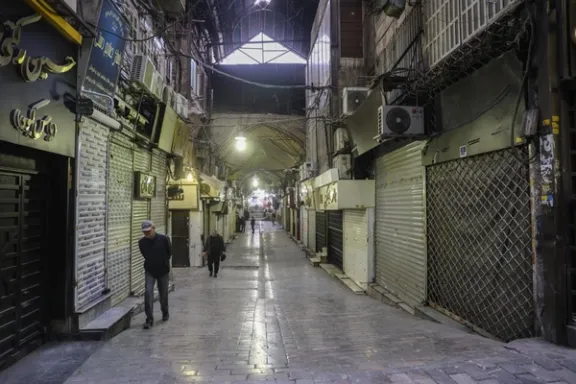
People walk past closed shops in Tehran's Grand Bazaar, January 15, 2026.

Tehran may have crushed street unrest with brute force, but it has no comparable solution for an economy gripped by surging inflation and collapsing incomes.

The protests initially erupted over a sharp spike in exchange rates but soon escalated into open calls for the overthrow of the Islamic Republic.

Many Iranians now say they personally know at least one or two people killed on January 8 or 9. Arrests and enforced disappearances—whose exact scale remains unknown—have also drawn countless families into the crisis, deepening fear and uncertainty.

According to people who have recently left Iran or managed to communicate via Starlink, businesses across the country are either closed or operating at minimal capacity, battered by currency turmoil and the prolonged internet shutdown.

On one side, customers have disappeared; on the other, sellers are reluctant to part with their goods.

Merchants say they cannot be sure they will be able to replace inventory amid exchange-rate volatility, turning even routine transactions into a gamble. Many now prefer not to sell at all.

Even before the unrest, businesses were under intense pressure.

Data published by the economic website Eco Iran show that bank lending from April to December rose 47 percent year-on-year. But 82 percent of loans to the productive sector went toward “working capital”—a sign that firms were borrowing not to expand, but simply to survive.

Shrinking purchasing power

Soon after the protests began, the government announced a plan to offset declining purchasing power following the removal of subsidized exchange rates for essential imports.

Under the plan, low- and middle-income individuals are to receive 10 million rials per month—about $7.50, roughly equivalent to one day’s wage for a construction worker.

Four months of payments were deposited at once, with recipients told they could spend one-quarter of the sum each month on 11 basic items, including rice, cooking oil, protein products, and dairy, at state-set prices in designated stores.

Prices for most of those goods in the open market have continued to surge, and some items have become scarce. Most readers responding to a poll by the news website Khabar Online said the subsidy was insufficient or ineffective.

One reader commented on the website that the handout offsets at most half the price increase for the 11 subsidized items, noting that rising food costs would also push up prices for everything from biscuits to restaurant meals, for which no compensation exists.

Many also fear the government will finance the program by printing money, further accelerating inflation, which official figures show had already surpassed 50 percent by December.

Cost of blackout

The nationwide internet shutdown, imposed on January 8 and still in place, has crippled hundreds of thousands of small and home-based businesses.

From home food producers to online language and music teachers, entire livelihoods have vanished overnight, with authorities offering no clear timeline for restoring connectivity.

These businesses relied almost entirely on online platforms for advertising and sales. Many were small producers in cities and even remote villages, selling handicrafts, agricultural goods, or homemade food directly to customers through Instagram.

Even before the shutdown, widespread filtering had forced them to pay for VPNs, further straining already fragile operations.

Kourosh, the manager of an advertising company who left Iran for Turkey after the January 8–9 killings, said all advertising activity had come to a halt.

“My clients have lost any hope of selling their products before the Iranian New Year, which is just two months away,” he told Iran International.

“People have no money, and even if they do, they won’t spend it on clothes, shoes, or home goods. Everyone was counting on sales in these final weeks of the year.”

Most Viewed

Ghalibaf defends Iran-US talks amid hardline backlash
1
INSIGHT

Ghalibaf defends Iran-US talks amid hardline backlash

2
INSIGHT

100 days after carnage: Iran economy reels from war, inflation, unemployment

3
INSIGHT

A nation in limbo: 100 days after the massacre, has the world moved on?

4
ANALYSIS

From instability to influence: Pakistan’s pivotal role in US-Iran diplomacy

5
ANALYSIS

100 days on: why Iran’s January protests spread across social classes

Banner
Banner

Spotlight

  • War-hit homeowners feel abandoned as Iran’s reconstruction aid fades

    War-hit homeowners feel abandoned as Iran’s reconstruction aid fades

  • 100 days on: the anatomy of Iran’s January crackdown
    INSIGHT

    100 days on: the anatomy of Iran’s January crackdown

  • Ghalibaf defends Iran-US talks amid hardline backlash
    INSIGHT

    Ghalibaf defends Iran-US talks amid hardline backlash

  • 100 days on: why Iran’s January protests spread across social classes
    ANALYSIS

    100 days on: why Iran’s January protests spread across social classes

  • From instability to influence: Pakistan’s pivotal role in US-Iran diplomacy
    ANALYSIS

    From instability to influence: Pakistan’s pivotal role in US-Iran diplomacy

  • A nation in limbo: 100 days after the massacre, has the world moved on?
    INSIGHT

    A nation in limbo: 100 days after the massacre, has the world moved on?

•
•
•

More Stories

Iran seizes assets to punish dissent

Jan 22, 2026, 18:58 GMT+0
•
Hooman Abedi

Tehran has broadened its attack on dissent after the deadliest crackdown on protests in the Islamic Republic's history by seizing assets of those accused of supporting the unrest, in a tactic first deployed amid the state's chaotic birth.

Judicial authorities in Qom province last week announced the confiscation of all assets and bank accounts belonging to Mohammad Saeedinia, the founder of a popular cafe chain operating in several Iranian cities.

Saeedinia had been arrested a day earlier and officials linked the move to his alleged support for strikes and protests after he temporarily closed his cafés following calls for strikes and work stoppages.

State-affiliated Fars News reported that assets linked to Saeedinia—including cafe chains, a roadside complex and food-industry businesses—were valued at between 25 and 27 trillion rials ($17.5–19 million).

Prosecutors said similar cases had been opened against dozens of other cafes, as well as actors, athletes and signatories of protest statements, adding that some assets had already been seized to compensate for damage to public property.

No violent crime, financial fraud or national-security offense has been publicly substantiated in Saeedinia’s case. Instead, it illustrates how economic pressure has emerged as an element of state repression in a practice with a long pedigree.

The owner of the Saedinia café chain Mohammad Saeedinia attending a public event (Undated)
100%
The owner of the Saedinia café chain Mohammad Saeedinia attending a public event

Confiscation codified

From the earliest months after the 1979 revolution, confiscation was used not only to dismantle the ancien régime’s economic base, but to restructure ownership and concentrate power within institutions aligned with the new state.

In the chaotic post-revolutionary period, seizures were carried out in what amounted to a legal vacuum. Revolutionary courts and ad hoc committees confiscated property under broad ideological justifications, often before a coherent judicial framework existed.

Decrees issued by Ruhollah Khomeini concerning “ownerless” or “illegitimate” property created elastic categories through which private assets could be absorbed by revolutionary bodies.

Although framed as redistribution, these measures laid the economic foundations of new power centers.

Over time, confiscation was institutionalized through bodies such as the Foundation of the Oppressed and the Execution of Imam Khomeini’s Order, as well as through legal provisions including Article 49 of the constitution, which targets “illegitimate wealth” without defining the term.

100%

Among the early and most consequential targets was Ahmad Khayami, a pioneer of Iran’s modern auto industry and co-founder of Iran National, later Iran Khodro. The seizure of his assets and removal of private control over the company marked a decisive break with Iran’s pre-revolutionary model of industrial entrepreneurship.

Another prominent case was Habib Sabet, an entrepreneur active in media, construction and commerce, and the founder of Iran’s first private television network. His assets were confiscated in the revolution’s aftermath, reflecting how independent capital—even without overt political involvement—was treated as incompatible with the new order.

Private sector hobbled

The execution of Habib Elghanian, a leading industrialist and head of Tehran’s Jewish community, sent a particularly chilling signal. After a summary revolutionary trial in 1979, his assets were seized and he was put to death, accelerating capital flight and underscoring the risks facing private enterprise in the new Islamic Republic.

The impact on Iran’s modern private sector was significant.

Entrepreneurs who had built manufacturing, retail and financial enterprises over decades were removed, their assets transferred to state or quasi-state structures. Many left the country.

Others were sidelined through prosecution or regulatory exclusion.

Habib Elghanian, a prominent leader of Iran's Jewish community, seen during his trial in Iran that led to his 1979 execution.
100%
Habib Elghanian, a prominent leader of Iran's Jewish community, seen during his trial in Iran that led to his 1979 execution.

As revolutionary fervor faded, the practice evolved rather than disappeared. Highly publicized trials and executions gave way to asset freezes, license revocations and selective enforcement. Confiscation became less spectacular but more routine, embedded in administrative and judicial processes.

Recent protest cycles have again brought these mechanisms to the fore. Business closures, account seizures and professional bans have accompanied crackdowns, reinforcing the message that economic activity remains conditional on political compliance.

The seizure of Saeedinia’s assets fits squarely within this longer trajectory. It is not an isolated response to unrest, but part of a system in which control over property has, from the outset, served as a means of political management.

Tehran ignored warnings of unrest, chose force over reform

Jan 21, 2026, 21:43 GMT+0
•
Behrouz Turani

The protests that erupted across Iran in January 2026 may have appeared sudden to outside observers but inside the country, they were anything but.

For more than a year, Iranian political analysts, sociologists and even establishment insiders had warned that mounting economic pressure and social exhaustion were pushing the country toward a nationwide rupture.

The state, unable or unwilling to pursue reform, appeared to place its faith instead in a familiar instrument: brute force.

When unrest finally broke out, it was met with an exceptionally violent crackdown that claimed thousands of lives. The predictions came true in the worst possible way.

‘Boiling point’

In October 2025, former labor minister and government spokesman Ali Rabiei wrote in the reformist daily Sharq that Iranians were “fed up with the government’s promises.” Without meaningful economic relief, he warned, the country risked sliding into civil unrest.

A month later, sociologist Taghi Azad Armaki described the situation as “critical,” calling for national dialogue rather than denial. Accumulated social dissatisfaction, he told the moderate daily Etemad, had pushed society to its “boiling point.”

Moderate commentator Abbas Abdi went further weeks later, writing in Etemad that Iranian society had reached “the point of no return.”

State-affiliated news agencies — including Revolutionary Guards-linked Fars — did highlight economic grievances, but largely downplayed the likelihood of widespread protest, framing any potential unrest as the work of foreign actors.

A crisis mapped in advance

The clearest articulation of what lay ahead came in late December 2025, just as protests were beginning to spread and foreign-exchange and gold prices were surging.

Writing for the reformist website Rouydad24, analyst Amir Dabiri Mehr argued that Iran’s fate now hinged almost entirely on how the government chose to respond. He outlined four possible scenarios, ranging from de-escalation to catastrophe.

In the first two — economic reform or restraint by security forces — the government would seek to calm public anger without violence. Dabiri Mehr treated both as increasingly unlikely. Events soon confirmed that assessment.

The third scenario, a violent crackdown, did unfold. Security forces suppressed protests across cities including Tehran, Mashhad, Isfahan and Rasht, temporarily silencing dissent through force.

Ignoring it all

Dabiri Mehr’s fourth scenario envisioned escalation: a severe crackdown combined with the portrayal of protesters as “enemies” or “foreign agents,” pushing unrest toward militarization and raising the risk of foreign intervention or broader confrontation.

He cautioned that a social media blackout would not contain anger but displace it — forcing dissent from online spaces into the streets and transforming economic frustration into a wider social movement. Repression alone, he warned at the time, would not resolve the crisis.

The tragedy now unfolding was foreseen not only by contemporary analysts but, metaphorically, by Iran’s own literary tradition.

In Ferdowsi’s Shahnameh, written a millennium ago, a line captures the logic of the present moment: When a man’s fortune darkens, he does everything he should not do.

The warnings were clear. The alternatives were understood. What followed was not inevitability, but choice—and its consequences are now unfolding.

How '800 executions canceled' fits Tehran’s playbook

Jan 21, 2026, 14:50 GMT+0
•
Roozbeh Mirebrahimi

The thank-you note from US President Donald Trump to Iran’s leadership for halting what he described as planned mass executions reveals much about his politics, but more about the rulers in Tehran who have canonised deception as a political instrument.

Trump said last week that he had it “on good authority” that Iran intended to execute 800 prisoners, a claim for which no corresponding evidence has appeared in Iranian official announcements or domestic reporting.

American media reports suggested Iran's foreign minister Abbas Araghchi had been communicating with Trump's Mideast envoy Steve Witkoff and his statements had influenced the president's thinking to relent on a mooted attack.

Trump’s apparent willingness to take the claim at face value may also reflect his own preference, at least momentarily, for de-escalation—or for deferring action he may have judged premature at that stage.

Whether the specific information circulated in this episode was exaggerated, fabricated, or misunderstood remains unclear. But if misleading claims were fed to American officials or intermediaries, such behavior would be entirely consistent with Tehran’s long-standing political logic.

Concealment as expediency

This logic does not arise from classical Islamic jurisprudence as such. In traditional Islamic legal thought, deception is generally condemned in ordinary political and social life and tightly constrained even in wartime.

The Islamic Republic, however, reconfigured this ethical boundary when its first supreme leader, Ruhollah Khomeini, argued that actions normally considered impermissible could be justified under the higher imperative of preserving Islam—and later, preserving the system itself.

Concepts such as maslahat (expediency) and political taqiyya (concealment) were thus transformed from narrowly defined exceptions into governing principles. Deception ceased to be situational and became structural.

This transformation was evident even before the Islamic Republic consolidated power. Khomeini publicly promised political pluralism, civil liberties, and limits on clerical authority. After 1979, these commitments were quietly discarded or retrospectively framed as tactical necessities of the revolutionary struggle.

What occurred was less a political reversal than the institutionalization of a widening gap between public narrative and actual intent. Decisions of lasting consequence were made offstage, while legality and transparency were preserved largely in appearance.

‘Managing’ foes

In later decades, deception became a stable feature of Iran’s foreign policy as well. Negotiations were often used not to resolve disputes but to reduce pressure, fragment opposition, and buy time.

Iran’s best-known diplomat, Mohammad Javad Zarif, boasted several years ago that his team had deliberately “managed” international perceptions. Misrepresentation was not incidental; it was strategic.

Within such a system, misleading a foreign government or manipulating a prominent political figure would be a default option, not merely a necessary evil.

Whether or not the recent execution claims were accurate, their circulation fits a familiar operational pattern: deflect scrutiny, reshape headlines, ease pressure, and gain time.

Is the Trump-Khamenei feud nearing endgame?

Jan 21, 2026, 08:17 GMT+0
•
Behrouz Turani

The public rancor between US President Donald Trump and Iranian Supreme Leader Ali Khamenei has gotten increasingly personal, suggesting that a standoff once mediated through proxies and carefully coded threats may be approaching a finale.

That escalation was on display last week when Trump openly questioned Khamenei’s right to rule and called him a “sick man” who kills his own people.

“It’s time to look for new leadership in Iran,” the president was quoted as saying by Politico. His blistering rhetorical intervention came after one of Khamenei's most strident speeches yet in which he, uncharacteristically, acknowledged thousands had been killed in the state's crackdown on protests this month.

"We consider the US president criminal for the casualties, damages and slander he inflicted on the Iranian nation," Khamenei said.

Iranian officials denounced Trump’s language as “offensive” and “unacceptable,” with president Masoud Pezeshkian warning that any move against Khamenei would trigger an all-out war.

The latest public spat followed widespread protests inside Iran, which were quelled through the unprecedented use of force. Speaking about the unrest last week, Khamenei once again blamed Israel and the United States for incitement, accusing Washington of fomenting terrorism and sabotage.

'The most wretched of humankind'

While the language has grown sharper, the confrontation itself is not new.

The personal animosity between Trump and Khamenei reached a decisive turning point in January 2020, when a US drone strike in Baghdad ordered by Trump killed Qassem Soleimani, the commander of Iran’s Quds Force and one of the most powerful figures in the Islamic Republic.

Khamenei described those responsible as “the most wretched of humankind” and vowed revenge. The killing transformed what had been a strategic rivalry into a deeply personal feud—one infused with symbolism, grievance, and a sense of irreversibility.

In the years that followed, Khamenei increasingly personalized his attacks on Trump. He portrayed the US president as the embodiment of American arrogance and decay, at one point calling him a “clown.”

Still, the veteran theocrat most abstained from uttering the name of his nemesis, out of contempt. Trump has done largely likewise.

'Ultimately responsible'

Even before Soleimani’s death, the two leaders had traded insults during Trump’s first term.

In June 2019, Trump imposed sanctions on Khamenei, calling him “ultimately responsible” for Tehran’s conduct. Iran’s then president, Hassan Rouhani, responded by calling the White House “mentally disabled,” a remark later endorsed by Khamenei’s office.

Trump dismissed the response as “ignorant and insulting,” saying Iran’s leaders “do not understand reality.”

A year later, when Japan’s then prime minister Shinzo Abe attempted to deliver a message from Trump to Khamenei, the Iranian leader publicly refused to accept it, telling Abe that he did not believe Trump was “worthy” of receiving a message.

Footage later showed Abe awkwardly folding the envelope away—an episode widely read as a calculated public snub.

One last dance?

Since Trump’s return to office, the exchanges have become more frequent and more explicit, often coinciding with moments of heightened tension, not least the June war between Iran and Israel.

On June 17, Trump took to social media for a rare direct attack.

“We know exactly where the so-called ‘Supreme Leader’ is hiding,” he wrote. “He is an easy target, but is safe there—we are not going to take him out, at least not for now.”

In October 2025, Khamenei described the United States under Trump as “a true manifestation of terrorism.” He compared Trump to figures such as Pharaoh and Nimrod, warning that “tyrants fall at the height of their arrogance.”

What distinguishes the current phase of their feud is not merely its volume, but its direction.

Earlier exchanges left room for ambiguity, intermediaries, or eventual de-escalation. The present rhetoric increasingly dispenses with those buffers, with Trump now speaking openly of replacement.

Whether this marks the final chapter of the confrontation remains uncertain. What is clear is that the US-Iran conflict now includes a personal clash between two leaders loath to compromise, despite the asymmetry of power between them.

Iran after the crackdown: serenity on screens, grief on the streets

Jan 21, 2026, 01:58 GMT+0
•
Maryam Sinaiee

After the January 8-9 mass killing of protestors in Iran, state media broadcasts fresh snow falls and other serene scenes bearing little resemblance to the agony of many Iranians reeling from the historic violence.

Official outlets show bundled up children frolicking and families shopping, suggesting normal life restored. Eyewitness accounts from inside Iran and testimony from those who have recently left describe instead a country gripped by grief, fear and economic paralysis.

Prominent journalist Elaheh Mohammadi—whose report about Mahsa Amini, a young woman who died in morality police custody, helped trigger the widespread protests of 2022—described the mood.

“For the past day or two, our VPNs have been working only sporadically—maybe for half an hour to an hour each day—allowing us brief access to the internet. We use that time to let people know we’re still alive,” she said on X.

“The city smells of death. In all my life, I have never seen snow fall in Tehran without anyone even smiling,” she added. “Everyone is in shock; the entire country is in mourning.”

For nearly two weeks, Iran’s internet has been almost entirely shut down, with little sign it will be soon restored. Aside from a handful of government-affiliated outlets and state television, access to news has been virtually nonexistent.

Fleeing the tragedy

Those who have managed to leave Iran by land or air have become key sources of information. Yet many say that once across the border, they too fall into an information vacuum, cut off from reliable updates from home.

Mortaza, who left Iran for a neighboring country several days after the killings, says satellite television has become the primary source of news for many inside the country. Even those broadcasts, he adds, are intermittently disrupted by jamming.

Without exception, those interviewed say the scale of the killings far exceeded what many had anticipated. Violence was so widespread, they say, that almost everyone knows at least one of the dead personally.

Across neighborhoods, families and friends have erected traditional mourning displays—hejleh—decorated with flowers, candles, mirrors, lights and framed photographs of young victims.

The structures resemble wedding canopies, symbolizing lives cut short before marriage.

Banners announcing the victims’ “passing,” often accompanied by poetry or phrases such as “martyr of the homeland,” are visible throughout cities.

What tragedy?

News programs on the state broadcaster repeatedly air footage of vehicles and buildings allegedly set ablaze by protesters—now described not merely as “rioters,” but as “US- and Israel-backed terrorists.”

These segments are interspersed with televised interrogations and forced confessions of individuals who have not appeared in court, alongside images of daily life and repeated claims that foreign-backed "terrorist" plots have been thwarted.

In recent days, the judiciary has issued repeated warnings promising harsh punishment and “no leniency” for those accused of participating in the unrest.

Continued repression

The crackdown has extended well beyond those who took part in protests.

Mohammad Saedi-Nia, a prominent investor and owner of the Saeedi-Nia café chain, was arrested after closing his cafés during calls to protest by exiled Prince Reza Pahlavi. His businesses—along with those of former national footballer Voria Ghafouri—were shut down for supporting protesters.

Saeedi-Nia’s assets, estimated at around $20 million, have reportedly been confiscated.

Dozens of athletes, artists and intellectuals who expressed support for the demonstrations have also had cases opened against them; some have been detained.

The judiciary says assets have been seized to ensure that, if convictions follow, alleged damage to public or private property can be recovered.

Mostafa, who communicated with Iran International via Starlink from his workplace, says traffic in Tehran is unusually light. Only a small number of street-facing shops have opened, he said, and the gold market remains shut.

Economic standstill

Most universities are closed, with final exams moved online. Many businesses are effectively dormant: transactions have stalled because prices depend on the dollar, and the currency market has frozen without a clear exchange rate.

Eyewitnesses also report growing shortages of basic goods. Cooking oil is scarce and selling at several times its previous price when available.

Prices of staples such as rice, eggs, chicken and meat have surged, while consumers limit purchases to essentials and shopkeepers hesitate to sell non-perishable goods.

State media deny that conditions resemble martial law, but eyewitnesses insist otherwise.

Many people have deleted photos and videos of protests from their phones, fearing random stops and searches by security forces.

Some witnesses say young people have been forced to expose their bodies in public to show they bear no marks from pellet guns or rubber bullets—signs authorities use to identify those who took part in demonstrations.