• العربية
  • فارسی
Brand
  • Iran Insight
  • Politics
  • Economy
  • Analysis
  • Special Report
  • Opinion
  • Podcast
  • Iran Insight
  • Politics
  • Economy
  • Analysis
  • Special Report
  • Opinion
  • Podcast
  • Theme
  • Language
    • العربية
    • فارسی
  • Iran Insight
  • Politics
  • Economy
  • Analysis
  • Special Report
  • Opinion
  • Podcast
All rights reserved for Volant Media UK Limited
volant media logo

New Canadian rule mandates reporting of all Iran transactions

Negar Mojtahedi
Negar Mojtahedi

Iran International

Dec 2, 2025, 22:27 GMT+0Updated: 23:47 GMT+0
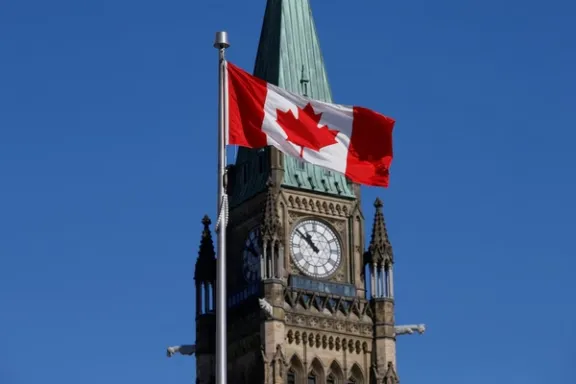
A Canadian flag flies in front of the Peace Tower on Parliament Hill in Ottawa, Ontario, Canada, March 22, 2017.

Every transaction linked to Iran — no matter how small — must now be treated as high-risk under newly tightened regulations introduced by Canada last week, a move experts warn could fall hardest on ordinary Iranians.

The previous $10,000 reporting threshold has been eliminated in favor of a zero-dollar threshold for any financial transaction to or from Iran.

Ottawa tightened the rules after the international anti-money laundering body the Financial Action Task Force (FATF) again warned that Iran remains a high-risk jurisdiction for terrorism financing and sanctions evasion.

Canada says the new rules target funds that originate in Iran and may involve individuals, organizations or networks linked to the Islamic Republic using small transfers to evade sanctions or obscure the true source of money.

But because these transactions often resemble ordinary remittances, the government has argued, the measures now apply to anyone receiving money from Iran, even for legitimate reasons.

“There is a risk that the Islamic Republic of Iran may be facilitating sanctions evasion, which the Minister is of the opinion could have an adverse impact on the integrity of the Canadian financial system or the reputational risk to that system," Canada’s Finance Minister wrote in a statement.

Canada is home to one of the largest Iranian diaspora communities in the world — nearly 300,000 people — and many depend on incoming transfers from Iran, ranging from the sale of land or property and inheritance payments to financial support that parents send to their children studying at Canadian universities.

Remittances from professionals in Canada to loved ones in Iran are also widespread.

FINTRAC, or Financial Transactions and Reports Analysis Centre of Canada, is the independent federal agency reporting to the Ministry of Finance which is overseeing the rule change.

“With the changes, all businesses subject to the Act are required to report every financial transaction to or from Iran regardless of its amount,” a spokesperson for FINTRAC wrote to Iran International.

“Prior to this update," she added, "the Ministerial Directive only required banks, credit unions, foreign banks and money services businesses to report every financial transaction to or from Iran.”

'Uniquely challenging'

But experts warn that while the directive may make it harder for Islamic Republic-linked actors to move money, it may also create unintended consequences.

Investigative journalist Sam Cooper, one of Canada’s leading reporters on transnational crime, said Iran-linked transactions were particularly hard to detect.

“The regime and its proxies already operate through deep, global underground banking networks," said Cooper, author of Willful Blindness, a book on money laundering networks operating through Canada. "They work with transnational crime groups — from Hezbollah to Latin American cartels and their partners in places like Venezuela.”

Cooper added that tougher reporting rules often fall hardest on ordinary Iranians trying to send money through legitimate channels.

“They often hit ordinary Iranians who refuse to use those underground networks and end up locked out of legitimate banking instead. That can unintentionally strengthen Iranian, Chinese and Mexican criminal networks, which step in to provide ‘services’ that formal banks can no longer offer,” he said.

Canada shuttered its embassy and cut diplomatic ties with Iran in 2012 over what it called security concerns for its diplomats and Iran’s alleged support for terrorism and human-rights abuses.

The move is also being closely watched by those involved in shaping Canada’s sanctions policy. Brandon Silver, an international human rights lawyer has provided expert testimony before Parliament, welcomed the strengthened guidance which many in the sanctions community have long pushed for.

“This FINTRAC guidance on Iran is a reflection of the Islamic Republic’s culture of corruption and criminality,” Silver told Iran International.

“These funds are used to finance mass domestic repression and external aggression — whether it is the murder and maiming of Iranian women’s rights leaders, or the transnational repression targeting Canadians," he said, adding that he hoped other countries in the G7 grouping of wealthy democracies would impose their own curbs.

Most Viewed

State media slam Araghchi's Hormuz tweet, say it let Trump claim victory
1

State media slam Araghchi's Hormuz tweet, say it let Trump claim victory

2

Iran International says it won’t be silenced after London arson attack

3
INSIGHT

How Tehran bends its own red lines to boost state rallies

4
OPINION

The Hormuz get out of jail card turned to a grave

5

Iran halts petrochemical exports to supply domestic market

Banner
Banner

Spotlight

  • Too early to tell who is winning Iran war, experts say
    PODCAST

    Too early to tell who is winning Iran war, experts say

  • How Tehran bends its own red lines to boost state rallies
    INSIGHT

    How Tehran bends its own red lines to boost state rallies

  • Iran blackout cripples freelancer, small business incomes
    VOICES FROM IRAN

    Iran blackout cripples freelancer, small business incomes

  • Ideology may be fading in Iran, but not in Kashmir's ‘Mini Iran'
    INSIGHT

    Ideology may be fading in Iran, but not in Kashmir's ‘Mini Iran'

  • US blockade enters murky phase as tankers spoof signals and buyers hesitate
    ANALYSIS

    US blockade enters murky phase as tankers spoof signals and buyers hesitate

  • Why the $100 billion Hormuz toll revenue is a myth
    ANALYSIS

    Why the $100 billion Hormuz toll revenue is a myth

•
•
•

More Stories

Trump admin's green card review sparks fears of collective punishment

Dec 2, 2025, 20:50 GMT+0
•
Negar Mojtahedi

A plan to reassess green cards for nationals from 19 countries including Iran after a DC shooting risks collective punishment, legal experts and members of the affected communities warn, as the move plunges thousands of vetted immigrants into limbo.

The announcement came after an Afghan national opened fire on West Virginia National Guard on the day before Thanksgiving last week, killing Sarah Beckstrom, 20, and severely injuring Andrew Wolfe, 24.

“This feels like a form of collective punishment because there was one sole shooter who is not reflective of a broader community of Afghans,” international human rights lawyer Gissou Nia told Iran International.

“It also feels like a move to ban legal immigration completely from certain countries that the Trump administration does not want to see any immigrants from.”

The suspect, Rahmanullah Lakanwal, arrived in the United States in 2021 under a program that granted protections to Afghan partner forces following the US withdrawal from Afghanistan.

Lakanwal sought asylum in 2024 and was granted it in April under the Trump administration according to sources familiar with the matter cited by ABC News.

The administration has so far provided few details about how the re-evaluation would work beyond public statements from US President Donald Trump and senior immigration officials.

Trump, whose political comeback last year depended heavily on his pledge to halt illegal immigration and carry out mass deportations, said he would “permanently pause migration from all third world countries”.

But a lack of clarity has created deep uncertainty for thousands of legal permanent residents — including Iranians, dual nationals and residents of third countries — who wonder whether they will be affected.

The Department of Homeland Security did not immediately respond to an Iran International request for comment.

Kristi Noem, Secretary of the Department of Homeland Security wrote on X after meeting with Trump on Monday: “I am recommending a full travel ban on every damn country that’s been flooding our nation with killers, leeches, and entitlement junkies ... We don’t want them. Not one.”

Supporters of the administration’s move are also speaking out publicly.

Stephen Miller, former White House deputy chief of staff for policy and homeland security advisor, pushed back against Democratic criticism of the Trump administration’s immigration measures, arguing that critics oppose any limits on immigration.

“The Democrat Party is organized around one essential command: No limit of any kind can be placed on the entry of third-world migrants. The failed states of the world must be allowed to empty themselves out into America. And you must pay for their every need, forever,” Miller wrote.

'Political tokens'

Iranian-American organizations say the decision jeopardizes legal commitments made to people who have already undergone years of vetting.

Ali Rahnama of the Iranian American Lawyers Defense Fund (IALDF) said the move threatens fundamental principles of fairness and rule of law.

“Green cards are not political tokens. They are the foundation of family reunions, economic growth and America’s future. They are earned after an elaborate and detailed process,” he told Iran International.

National security analysts caution that the government’s response seeing complex geopolitical dynamics through the prism of a single tragedy.

Dr. Eric Mandel, director of the Middle East Political Information Network (MEPIN) said the administration’s decision must be understood in the broader context of America’s ongoing effort to secure its borders.

He said the United States still needs strict screening to keep out real threats but warned "those escaping the (Iranian) regime’s Shiite jihadists are often the very Iranians most inclined to stand with the United States. Instead of punishing them, US policy should champion the Iranian people and signal unequivocally that America supports their pursuit of democratic change.”

Iran specialist Behnam Ben Taleblu of the Foundation for Defense of Democracies (FDD) said the review could unfairly ensnare Iranians who underwent years of rigorous screening.

“There’s an old Persian saying that goes, ‘a fool throws a stone into a well, and a thousand wise men can’t get it out.’ This best describes the situation facing Iranian green card holders following the shooting,” he said.

“It was already hard enough for Iranians to come to America, especially after the travel ban. Iran has one of the highest brain drain rates in the region."

Sense of blame

Among Afghans, the shooting has triggered not only grief but fear of collective blame. A community member who attended a candlelight vigil outside the White House on Sunday for the two National Guard victims said she is overcome with grief.

"They (the Afghan community) expressed deep sympathy for the victims and called for the strongest punishment for the perpetrator," she said.

The community member who also lived in Iran, who asked to remain anonymous for her safety, said fellow Afghans worry they would now be blamed.

“Afghans have been US partners for two decades," she said," and one person’s crime should not define millions.”

Trump says Iraq more friendly after US attacks on Iran

Dec 2, 2025, 19:34 GMT+0

President Donald Trump on Tuesday said US strikes on Iran's nuclear facilities in June curbed Tehran's regional dominance and rendered Iraq more friendly to the United States.

“Iraq has been a much different place since we hit them with those B-2 bombers and knocked out and obliterated Iran’s nuclear capability," Trump told reporters at a cabinet meeting in the White House.

“Iran has gone down many, many steps … they’re really not the bully of the Middle East anymore,” Trump said. "I will tell you, Iraq has been a much friendlier place. They talk to us."

He was responding to a question from an Iraqi Kurdish journalist about a rocket attack on Thursday at Khor Mor gas field in the region which halted production for four days. No casualties were reported in the attack, which local officials blamed on Iran-backed militias.

The United States launched surprise strikes on three key Iranian nuclear sites on June 22, in attacks Trump has repeatedly said "obliterated" Tehran's capabilities.

"I saved a lot of lives," Trump continued, "Iraq nominated us for the Nobel Prize, and that was great honor. We didn't expect that from Iraq. Iraq has been a much different place since the taking out of Iran, the nuclear capability.”

Emerging from years of civil war which followed a US invasion in 2003, Baghdad is caught between the competing influence of Tehran and Washington.

US envoy to Iraq Mark Savaya condemned the gas field attack as the work of “armed groups operating illegally and driven by hostile foreign agendas.”

Kurdish authorities have frequently accused armed groups aligned with Tehran of targeting energy infrastructure to pressure the Kurdistan Regional Government (KRG) and undermine US-linked projects.

Iraqi Prime Minister Mohammed Shia al-Sudani condemned the attack as “an assault on all of Iraq” and said a joint investigation with Kurdish authorities would be launched.

Iran army says borders now monitored by advanced sensors, cameras

Dec 2, 2025, 13:48 GMT+0

Iran’s army has expanded electronic surveillance along its borders using advanced cameras and sensors, the commander of the army’s ground forces said on Tuesday.

Brigadier General Ali Jahanshahi told reporters that the upgrades are part of a broader effort to strengthen defenses and prevent illegal crossings. “In addition to new bases and watchtowers, border monitoring is being carried out electronically with advanced cameras and sensors,” he said.

He said construction of a border wall in eastern Iran is under way using domestic contractors and materials, combined with wire fencing and electronic detection systems. The aim, he said, is to curb smuggling and unauthorized movement across the frontier.

Jahanshahi added that the army’s ground forces, operating ten combat brigades, defend Iran’s western, southern and eastern borders alongside police and border guards. The joint operations, he said, have been effective in reducing drug trafficking and cross-border crime.

He also announced plans for a new “Eghtedar” (Power) military exercise in central Iran, saying recent drills have focused on upgrading weapons, tactics and coordination with other branches of the armed forces.

Cook Islands linked to tankers moving Iranian and Russian oil - AFP

Dec 2, 2025, 12:06 GMT+0

Dozens of foreign tankers suspected of transporting sanctioned crude for Iran and Russia sailed under the Cook Islands flag in 2024-2025, according to an AFP analysis of US and UK sanctions data.

AFP reported that at least 34 ships linked to suspected sanctions evasion were Cook Islands–flagged over the period, including 20 cited on US sanctions lists and a further 14 on a British blacklist.

The flag is administered by Maritime Cook Islands, a private operator that runs the registry for the self-governing Pacific territory.

The analysis said shipowners could obtain Cook Islands papers without visiting the country, using a small beachside office – located next to a pizza shop – as their point of contact. The office serves as the headquarters for what AFP described as one of the world’s fastest-growing shipping registries.

New Zealand, which has a free-association relationship with the Cook Islands and retains responsibilities that include foreign affairs, said the findings show a policy divergence with the microstate and that Wellington has repeatedly raised concerns with its government.

  • Iran crude piles up at sea as Chinese demand slows, Kpler data show

    Iran crude piles up at sea as Chinese demand slows, Kpler data show

  • Iran oil sales hit seven-year high despite US sanctions, trackers say

    Iran oil sales hit seven-year high despite US sanctions, trackers say

“New Zealand continues to hold serious concerns about how the Cook Islands has been managing its shipping registry, which it has repeatedly expressed to the Cook Islands government over many years... This is a completely unacceptable and untenable foreign policy divergence,” said a spokesman for Foreign Minister Winston Peters.

Maritime Cook Islands said it does not harbor sanctioned vessels and that any ships accused of sanctions-busting are promptly deleted from the registry, adding that it conducts due diligence checks before registration.

Western sanctions aim to limit oil revenue for Tehran and Moscow.

Analysts say a “shadow fleet” uses reflagging, opaque ownership and ship-to-ship transfers to move cargoes outside mainstream maritime services – a practice that places added scrutiny on flag registries as enforcement widens to entities connected to suspect voyages.

Lawmakers accuse Iran’s judiciary of inaction on hijab enforcement

Dec 2, 2025, 10:39 GMT+0

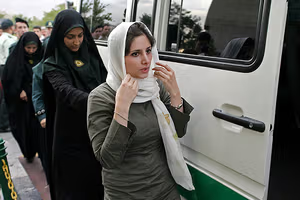
More than 150 Iranian lawmakers have accused the judiciary of failing to act against growing public defiance of the hijab, saying inaction has fueled what they called lawlessness in society, state media reported on Tuesday.

In a letter addressed to Judiciary Chief Gholamhossein Mohseni Ejei, 155 members of parliament said the judiciary had become passive in applying regulations on Islamic dress and public behavior.

They urged the courts to “restore governance” by ensuring that all state bodies enforce existing rules while the government’s postponed hijab law remains under review.

“The judiciary cannot remain passive toward failures by executive bodies,” the lawmakers wrote, accusing some judges and officials of “negligence” that had allowed “moral decline” and “social abnormalities” to spread.

The lawmakers urged action on the Chastity and Hijab law—formally called the Law on Protection of the Family Through Promotion of Chastity and Hijab—which was approved by parliament but has yet to be sent to the government for implementation.

Parliament Speaker Mohammad Bagher Ghalibaf has faced mounting criticism from hardline lawmakers who accuse him of withholding the legislation.

Tehran MP Kamran Ghazanfari on Tuesday said Ghalibaf had refused to finalize the law since September last year, calling the delay a violation of his legal duty.

“This means obstructing the implementation of a Quranic and divine command,” he told parliament, accusing the speaker of “ignoring repeated calls” from clerics and legislators and allowing “immodesty and corruption” to spread.

Government signals caution

Also on Tuesday, government spokeswoman Fatemeh Mohajerani said ministries have submitted periodic reports on the status of hijab enforcement to President Masoud Pezeshkian and Supreme Leader Ali Khamenei.

“The hijab report has been delivered on time to the president and the Supreme Leader, and action will be taken to curb organized movements,” she said, adding that each ministry provides updates according to its responsibilities within specific time frames.

  • Is Iran quietly sweeping controversial hijab law under the rug?

    Is Iran quietly sweeping controversial hijab law under the rug?

  • Conservatives clash over hijab law as Tehran streets move on

    Conservatives clash over hijab law as Tehran streets move on

  • Leaked hijab directive from Supreme Leader reignites Tehran tensions

    Leaked hijab directive from Supreme Leader reignites Tehran tensions

Supreme leader’s directive

Tensions rose further last week when a leaked audio file suggested Supreme Leader Ali Khamenei had issued a written order to step up enforcement of Islamic dress codes after reviewing an intelligence ministry report warning of “erosion of discipline.”

Officials later confirmed the directive but denied any dispute within the cabinet. Conservative outlets described it as an “explicit call for decisive action” against violations of the hijab law.

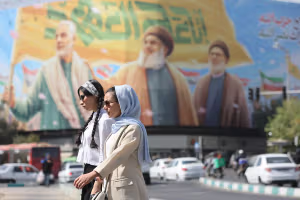
Despite growing pressure, many women and girls continue to appear unveiled in public. The Associated Press reported last week that uncovered women were seen walking freely in Tehran’s markets, metro stations and schools, often without interference from police.

Analysts say authorities are wary of large-scale crackdowns that could reignite unrest. “The scale of disobedience is unprecedented,” said Iran analyst Holly Dagres. “Another coercive campaign could spark protests they cannot contain.”