• العربية
  • فارسی
Brand
  • Iran Insight
  • Politics
  • Economy
  • Analysis
  • Special Report
  • Opinion
  • Podcast
  • Iran Insight
  • Politics
  • Economy
  • Analysis
  • Special Report
  • Opinion
  • Podcast
  • Theme
  • Language
    • العربية
    • فارسی
  • Iran Insight
  • Politics
  • Economy
  • Analysis
  • Special Report
  • Opinion
  • Podcast
All rights reserved for Volant Media UK Limited
volant media logo

Iran army says borders now monitored by advanced sensors, cameras
Dec 2, 2025, 13:48 GMT+0

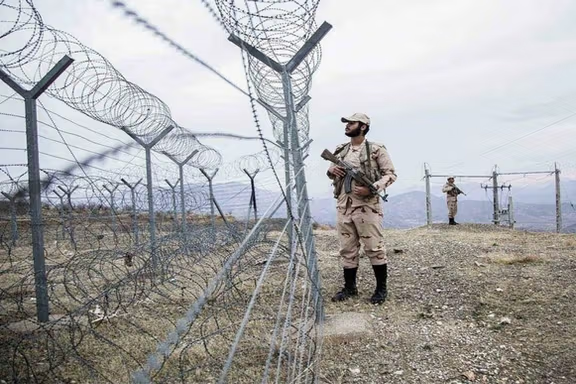
Iran’s army has expanded electronic surveillance along its borders using advanced cameras and sensors, the commander of the army’s ground forces said on Tuesday.

Brigadier General Ali Jahanshahi told reporters that the upgrades are part of a broader effort to strengthen defenses and prevent illegal crossings. “In addition to new bases and watchtowers, border monitoring is being carried out electronically with advanced cameras and sensors,” he said.

He said construction of a border wall in eastern Iran is under way using domestic contractors and materials, combined with wire fencing and electronic detection systems. The aim, he said, is to curb smuggling and unauthorized movement across the frontier.

Jahanshahi added that the army’s ground forces, operating ten combat brigades, defend Iran’s western, southern and eastern borders alongside police and border guards. The joint operations, he said, have been effective in reducing drug trafficking and cross-border crime.

He also announced plans for a new “Eghtedar” (Power) military exercise in central Iran, saying recent drills have focused on upgrading weapons, tactics and coordination with other branches of the armed forces.


Most Viewed

State media slam Araghchi's Hormuz tweet, say it let Trump claim victory
1

State media slam Araghchi's Hormuz tweet, say it let Trump claim victory

2
OPINION

The Hormuz get out of jail card turned to a grave

3
INSIGHT

How Tehran bends its own red lines to boost state rallies

4

Iran International says it won’t be silenced after London arson attack

5
VOICES FROM IRAN

Iran blackout cripples freelancer, small business incomes

Banner
Banner

Spotlight

  • Too early to tell who is winning Iran war, experts say
    PODCAST

    Too early to tell who is winning Iran war, experts say

  • How Tehran bends its own red lines to boost state rallies
    INSIGHT

    How Tehran bends its own red lines to boost state rallies

  • Iran blackout cripples freelancer, small business incomes
    VOICES FROM IRAN

    Iran blackout cripples freelancer, small business incomes

  • Ideology may be fading in Iran, but not in Kashmir's ‘Mini Iran'
    INSIGHT

    Ideology may be fading in Iran, but not in Kashmir's ‘Mini Iran'

  • US blockade enters murky phase as tankers spoof signals and buyers hesitate
    ANALYSIS

    US blockade enters murky phase as tankers spoof signals and buyers hesitate

  • Why the $100 billion Hormuz toll revenue is a myth
    ANALYSIS

    Why the $100 billion Hormuz toll revenue is a myth

•
•
•

More Stories

Germany says Iran withholds visas for diplomats, crippling embassy operations

Dec 2, 2025, 12:57 GMT+0

Germany’s embassy in Tehran is operating with sharply reduced visa capacity and expects constraints to persist, the Foreign Office said, citing Iran’s restrictive accreditation of diplomatic staff and significant technical hurdles at post.

The ministry told Iran International that since the June 2025 Iran-Israel hostilities, the embassy has worked in a limited capacity, and both the embassy and its visa section “will, for the foreseeable future, have only a fraction of the personnel” they had before the temporary shutdown.

The reduction of operations “is due in particular to Iran’s restrictive policy on accrediting diplomatic personnel,” read the statement.

Despite the squeeze, Berlin said processing has been gradually expanded in recent weeks by outsourcing application intake to an external service provider and moving case handling to the Federal Office for Foreign Affairs.
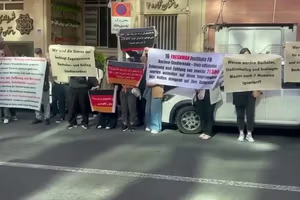
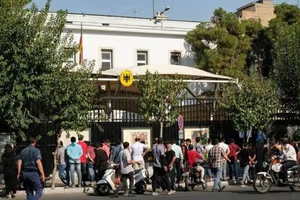
  • German visa delays leave Iranians stranded, separated from families

    German visa delays leave Iranians stranded, separated from families

  • Iranians protest outside German consulate over frozen visas since June war

    Iranians protest outside German consulate over frozen visas since June war

  • Germany scales back Tehran embassy services as ambassador departs

    Germany scales back Tehran embassy services as ambassador departs

“These steps have created additional processing capacity,” the ministry said, adding that the changes especially benefit student-visa applicants and Iranian physicians applying for visas to complete professional recognition procedures in Germany.

Appointment rules have also been adjusted “to ensure the largest possible number of applications can be accepted via the external provider,” the Foreign Office said.

It cautioned, however, that “despite these tangible improvements,” limitations at the Tehran post will remain for the time being.

Germany’s visa services in Tehran have operated at reduced capacity since the June 2025 Iran–Israel conflict, when the embassy temporarily closed, canceled appointments, and said new dates would be issued automatically as capacity allows.

Applicants report prolonged delays and uncertainty, staging weekly protests outside the embassy and TLScontact.

Iranian paper Shargh estimated more than 6,000 delayed cases, including about 4,000 family-reunification files, while IRNA previously put 3,000–4,000 Iranian passports as stuck in foreign missions after wartime closures.

Lawmakers accuse Iran’s judiciary of inaction on hijab enforcement

Dec 2, 2025, 10:39 GMT+0

More than 150 Iranian lawmakers have accused the judiciary of failing to act against growing public defiance of the hijab, saying inaction has fueled what they called lawlessness in society, state media reported on Tuesday.

In a letter addressed to Judiciary Chief Gholamhossein Mohseni Ejei, 155 members of parliament said the judiciary had become passive in applying regulations on Islamic dress and public behavior.

They urged the courts to “restore governance” by ensuring that all state bodies enforce existing rules while the government’s postponed hijab law remains under review.

“The judiciary cannot remain passive toward failures by executive bodies,” the lawmakers wrote, accusing some judges and officials of “negligence” that had allowed “moral decline” and “social abnormalities” to spread.

The lawmakers urged action on the Chastity and Hijab law—formally called the Law on Protection of the Family Through Promotion of Chastity and Hijab—which was approved by parliament but has yet to be sent to the government for implementation.

Parliament Speaker Mohammad Bagher Ghalibaf has faced mounting criticism from hardline lawmakers who accuse him of withholding the legislation.

Tehran MP Kamran Ghazanfari on Tuesday said Ghalibaf had refused to finalize the law since September last year, calling the delay a violation of his legal duty.

“This means obstructing the implementation of a Quranic and divine command,” he told parliament, accusing the speaker of “ignoring repeated calls” from clerics and legislators and allowing “immodesty and corruption” to spread.

Government signals caution

Also on Tuesday, government spokeswoman Fatemeh Mohajerani said ministries have submitted periodic reports on the status of hijab enforcement to President Masoud Pezeshkian and Supreme Leader Ali Khamenei.

“The hijab report has been delivered on time to the president and the Supreme Leader, and action will be taken to curb organized movements,” she said, adding that each ministry provides updates according to its responsibilities within specific time frames.
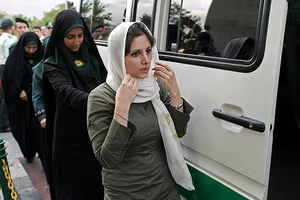
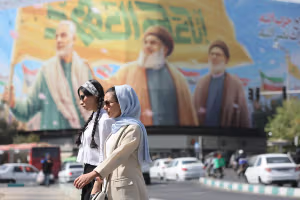
  • Is Iran quietly sweeping controversial hijab law under the rug?

    Is Iran quietly sweeping controversial hijab law under the rug?

  • Conservatives clash over hijab law as Tehran streets move on

    Conservatives clash over hijab law as Tehran streets move on

  • Leaked hijab directive from Supreme Leader reignites Tehran tensions

    Leaked hijab directive from Supreme Leader reignites Tehran tensions

Supreme leader’s directive

Tensions rose further last week when a leaked audio file suggested Supreme Leader Ali Khamenei had issued a written order to step up enforcement of Islamic dress codes after reviewing an intelligence ministry report warning of “erosion of discipline.”

Officials later confirmed the directive but denied any dispute within the cabinet. Conservative outlets described it as an “explicit call for decisive action” against violations of the hijab law.

Despite growing pressure, many women and girls continue to appear unveiled in public. The Associated Press reported last week that uncovered women were seen walking freely in Tehran’s markets, metro stations and schools, often without interference from police.

Analysts say authorities are wary of large-scale crackdowns that could reignite unrest. “The scale of disobedience is unprecedented,” said Iran analyst Holly Dagres. “Another coercive campaign could spark protests they cannot contain.”

Iran court fines US $22 billion over Woman, Life, Freedom protests

Dec 2, 2025, 08:53 GMT+0

An Iranian court said it has ordered the United States government to pay more than $22 billion in damages for what it described as support for protesters during the 2022 Woman, Life, Freedom movement, state media reported on Tuesday.

The verdict, announced by Tehran’s civil court, was described by state media as stemming from a lawsuit filed by 607 people said to be families of those killed or injured during the unrest that followed the death of Mahsa Amini in police custody.

The court accused Washington of providing “financial and moral backing” to what Iranian officials call “rioters.”

Iran’s judiciary said the US actions violated the country’s sovereignty and international law. The ruling cited several Iranian laws addressing what Tehran terms “terrorist or subversive acts” by the United States.

According to the court, the damages include $5.8 billion in material losses, $11.6 billion for moral damages, and billions more in punitive payments, totaling more than $22 billion.

The judgment is largely symbolic since Iranian court rulings against the United States are not enforceable abroad. Similar verdicts in past years have served as political statements amid strained relations between Tehran and Washington.

'Woman, Life, Freedom'

The Woman, Life, Freedom movement began after 22-year-old Mahsa Amini died in the custody of Iran’s morality police in September 2022. Her death sparked months of nationwide protests demanding greater freedoms and an end to compulsory hijab laws.

Rights groups say hundreds were killed and thousands detained in the crackdown that followed. Iranian authorities have blamed the United States and Israel for inciting the unrest—allegations Washington denies.

A UN fact-finding mission later concluded that Iran’s security forces committed crimes against humanity during the protests.

The mission said it found evidence that state agents were responsible for the “physical violence” that led to Amini’s death and the killing of at least 551 protesters, including 49 women and 68 children. It also documented cases of rape and other sexual violence against women and girls in custody.

Senior clerics have since framed women who refuse to wear the headscarf as acting under foreign influence. In a recent sermon, Tehran’s Friday prayer leader Ahmad Khatami said defiance of the hijab amounted to collaboration with Israel and the United States.

Despite such rhetoric, many women continue to appear unveiled in public spaces, and enforcement of dress codes has weakened.

US condemns Iran over arrests at private party, Panahi sentence

Dec 2, 2025, 08:32 GMT+0

The US State Department’s Persian-language account on X criticized Iranian authorities over the detention of guests at a private birthday gathering in Tehran and the in-absentia sentencing of award-winning filmmaker Jafar Panahi.

Iranian media last week reported police raided a film star’s home in Tehran, detaining more than 20 people and seizing homemade alcohol – contraband under Iranian law – with several attendees later freed on undertakings or bail.

“In today’s Iran, no one outside the ruling inner circle is safe from state intrusion—even as officials enjoy lavish parties of their own, laying bare the hypocrisy behind what they call upholding values... While officials claim to defend Islamic values, their real objective is absolute control over society,” read the post.
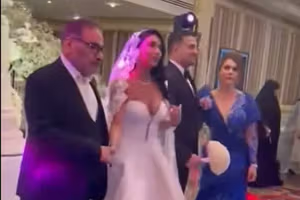
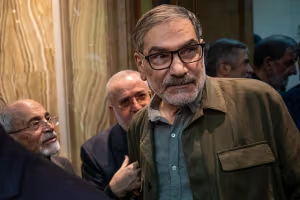
  • Double standard: privacy defense over Shamkhani leak angers Iranians

    Double standard: privacy defense over Shamkhani leak angers Iranians

  • Israel, inside job? Tehran blame game flares over Shamkhani wedding leak

    Israel, inside job? Tehran blame game flares over Shamkhani wedding leak

Authorities frequently announce closures and arrests tied to alcohol, mixed-gender events or dress-code enforcement as part of broader morality crackdowns, according to state-aligned and independent outlets.

Panahi – one of Iran’s most acclaimed directors and a recent Palme d’Or winner at Cannes – has faced recurring curbs on his work and movement over the past decade.

  • Iran sentences acclaimed filmmaker to prison term on propaganda charge

    Iran sentences acclaimed filmmaker to prison term on propaganda charge

  • Tehran police detain several prominent actors at birthday party

    Tehran police detain several prominent actors at birthday party

Alcohol has been banned in Iran since 1979, with violations punishable by fines, lashings or prison, and tougher penalties for production and distribution.

Publicized raids on cafés and private venues have increased in recent years, while rights groups and local officials periodically report poisonings from unregulated liquor in the underground market.

Iranian officials say strict enforcement upholds Islamic norms and deters smuggling; critics argue decades of prohibition have pushed consumption into riskier, unregulated channels.

Iran closed security gaps after war with Israel, Araghchi says

Dec 2, 2025, 03:11 GMT+0

Iranian Foreign Minister Abbas Araghchi said a 12-day war with Israel in June allowed Tehran to close many security gaps, calling it a miscalculation by the Jewish state that would end with the same result if repeated.

“The recent war enabled us to close many of our security gaps. The war gave us valuable experience because it revealed our weaknesses and we eliminated them,” Araghchi cited in an interview with Omani broadcaster Moosa Al-Farei, published on Monday.

Araghchi said the surprise military campaign by Israel in June, did not achieve the objectives and was a miscalculation.

“They (Israel) imagined that if this war began, the Iranian nation would take to the streets and protest against the government and the system. But what happened was exactly the opposite: the nation came out into the streets to support the government and the country,” Araghchi said.

Israel attacks killed over 20 senior commanders, including Mohammad Bagheri, Chief of Staff of Iran's Armed Forces; Hossein Salami, Islamic Revolutionary Guards Corps (IRGC) Commander-in-chief; and Gholamali Rashid, Head of Khatam al-Anbiya Central Headquarters.

The attacks on June 21 also struck the IRGC’s external arm, killing Mohammad Saeed Izadi, who oversaw Palestinian operations, and Mohammadreza Nasirbaghban, the Quds Force’s deputy for intelligence.

“They thought that if our military commanders were assassinated in the first hours of the war, our armed forces would collapse. On the contrary, replacement commanders were immediately appointed, and the armed forces fought with even higher morale,” Araghchi said.

“This war that the Zionist regime started was based on miscalculation and misunderstanding. As I said, repeating this mistake will bring nothing but a similar defeat,” he added.

The United States held five rounds of negotiations with Tehran over its disputed nuclear program earlier this year, for which President Donald Trump set a 60-day ultimatum.

When no agreement was reached by the 61st day Israel launched a surprise military offensive on June 13, followed by US strikes on June 22 targeting key nuclear facilities in Isfahan, Natanz and Fordow.