• العربية
  • فارسی
Brand
  • Iran Insight
  • Politics
  • Economy
  • Analysis
  • Special Report
  • Opinion
  • Podcast
  • Iran Insight
  • Politics
  • Economy
  • Analysis
  • Special Report
  • Opinion
  • Podcast
  • Theme
  • Language
    • العربية
    • فارسی
  • Iran Insight
  • Politics
  • Economy
  • Analysis
  • Special Report
  • Opinion
  • Podcast
All rights reserved for Volant Media UK Limited
volant media logo

Kite Runner star Homayoun Ershadi dies at 78

Nov 11, 2025, 18:04 GMT+0Updated: 23:57 GMT+0

Homayoun Ershadi, one of Iran’s most internationally recognized actors who rose from a career in architecture to global movie fame through Abbas Kiarostami’s Taste of Cherry and later The Kite Runner, has died at the age of 78.

Ershadi passed away on November 11 at the age of 78 after battling cancer, according to Iranian state media.

Born in Isfahan in 1947, Ershadi began his professional life as an architect, never imagining he would one day become the face of one of Iranian cinema’s most celebrated films.

His unlikely entry into the film industry became almost cinematic itself. As Ershadi recalled in interviews, world renowned director Abbas Kiarostami noticed him while both were stuck in Tehran traffic and asked if he would consider acting.

That spontaneous encounter led to Taste of Cherry (1997), which went on to win the Palme d’Or at the Cannes Film Festival.

Speaking years later about the experience, Ershadi told Media Max: “We were sitting in my car with Kiarostami, eating ice cream when I asked him about my character. He said, ‘Your character is an architect from Italy.’ I was also an architect working in Italy. I wore my own clothes in the film, and that was my car I drove. During the dialogues there was Kiarostami standing in front of me, instead of the actor. I was not playing a role; I was just being myself.”

Ershadi also once remarked with pride, “Kiarostami did not work with professional actors. The non-professional actors of his films did not continue their careers later. I can say I am the only one who kept acting after his film.”

Following his breakout performance, Ershadi devoted himself fully to cinema, appearing in dozens of productions in Iran and abroad. His most acclaimed international role came a decade later as Baba in Marc Forster’s The Kite Runner (2007), which brought him to the attention of Western audiences and received multiple nominations, including at the Academy Awards and the Golden Globes.

He went on to appear in Kathryn Bigelow’s Zero Dark Thirty (2012), Anton Corbijn’s A Most Wanted Man (2014), and Asif Kapadia’s Ali and Nino (2016).

In his later years, Ershadi often reflected on the bridge between architecture and acting, saying both required “a sense of structure, patience, and creativity.”

His quiet, dignified presence on and off screen left a lasting mark on Iranian and world cinema alike.

Most Viewed

Iran diplomacy wobbles as factions compete to avoid looking soft on US
1
INSIGHT

Iran diplomacy wobbles as factions compete to avoid looking soft on US

2

IRGC-linked media hints at threat to Persian Gulf undersea internet cables

3

Iran Guards say two ships seized in Hormuz after ceasefire extension

4
EXCLUSIVE

Strikes on petrochemical hubs leave Iran short of plastics

5

Scam messages seek crypto for ships’ safe passage through Hormuz, firm warns

Banner
Banner

Spotlight

  • As Tehran digs in, ordinary Iranians pay the price
    INSIGHT

    As Tehran digs in, ordinary Iranians pay the price

  • Internet Pro or Censor Pro? Iran rolls out a new service
    ANALYSIS

    Internet Pro or Censor Pro? Iran rolls out a new service

  • Strikes on petrochemical hubs leave Iran short of plastics
    EXCLUSIVE

    Strikes on petrochemical hubs leave Iran short of plastics

  • Diplomacy tolls at Hormuz as conflict returns to its doorstep
    OPINION

    Diplomacy tolls at Hormuz as conflict returns to its doorstep

  • Opposition to US talks grows in Tehran as ceasefire deadline nears
    INSIGHT

    Opposition to US talks grows in Tehran as ceasefire deadline nears

  • The future has been switched off here
    TEHRAN INSIDER

    The future has been switched off here

•
•
•

More Stories

Tuning out the state's monologue, Iranians start listening to each other

Nov 11, 2025, 07:42 GMT+0
•
Kambiz Hosseini

It’s eleven o’clock at night in Tehran when I open the phone lines for my live call-in show, The Program. Friday night is when I ask Iranians to do something that has become almost subversive: not just to talk, but to listen.

For more than forty some years, the Islamic Republic has tried not only to control power but to monopolize conversation itself, deciding who speaks, what is heard, and which "alternative truths" are permitted to exist.

Dialogue frightens it. So does ordinary patriotism, the kind that arises when people speak in their own words about their country.

On the line, a teacher from Kermanshah tells me that students are never taught the courage to ask critical questions. A Toronto caller describes a generation that has learned to survive by lying. A woman in Tehran confesses that she’s waiting for a miracle because she can no longer imagine change.

These voices are not fragments; they are coordinates on the map of a national psyche. Talking in Iran can be dangerous. Silence, in another way, is deadly too. When a society stops speaking to itself, it begins to turn against itself. Authoritarians thrive on that silence.

The live show I host is an attempt—improvised, fragile, sometimes chaotic, to reverse that damage. We bring Iranians together in real time, from Tehran to Los Angeles. We follow three simple rules: everyone gets heard, no judgment, and keep it suitable for all ages.

Our callers often contradict themselves. That’s what makes it real. Dialogue isn’t the theater of agreement; it’s the discipline of listening.

Across the static and emotion, three truths keep repeating.

First: the Islamic Republic never stops talking, but it doesn’t listen. It sermonizes, threatens, censors and congratulates itself. This isn’t strength, it’s fear.

Second: society has begun to mirror that refusal. Iranians interrupt before they understand, argue before they think and treat disagreement as contamination. The Islamic Republic feeds that instinct.

Third: the way out of this loop isn’t heroic, it’s procedural. Ask a real question. Wait for real answers. Let facts, not pride, decide who’s right. simple but challenging.

'Look in the mirror'

Iran today is divided by many wars: between people and government, truth and propaganda, hope and exhaustion. Yet, amid that division, I still hear the quiet persistence of life.

A caller from Tehran wants to talk about water: the taps shut off at midnight, and families fill bottles before the cutoff. That, too, is politics, the right to live without fear of thirst.

Another caller, from Shiraz, demands leadership. “Death with honor is better than life with humiliation,” he says. Moments later, a woman from Tehran replies, “Stop looking for a savior. Look in the mirror.”

These exchanges are the substance of what I call "national dialogue". Not a slogan or a policy, just the collective decision to speak before it’s too late.

Tunisia did it and saved itself from civil war. Nelson Mandela in South Africa did it and dismantled apartheid. Yemen pretended to do it and collapsed. For Iran, dialogue is not an ideal; it’s a means of survival.

I am not neutral about the Islamic Republic forcing people to whisper. But I am devout about the method that can outlast it. Patriotism, to me, is standing by the truth even when it’s spoken by someone you dislike.

Dialogue is resistance; listening is courage.

Some nights, when the last call ends, I sit in the quiet studio and hear only the click of the line going dead. But I know the sound that came before it—a mother’s whisper, a teacher’s question, a citizen’s confession—is proof of something still breathing inside the country.

After years of state monologue, the most subversive sound in Iran is a nation talking to itself. Something is stirring beneath the surface, and I can hear it. I hear it every night on the program. Live, raw, and authentic.

I am hopeful.

Iran drug and medical costs surge 70% after subsidy removal

Nov 10, 2025, 10:47 GMT+0

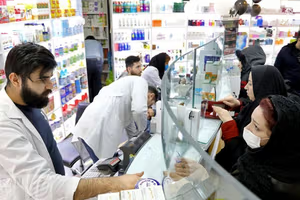
Prices of medicines, medical equipment and healthcare services in Iran have surged by around 70% following the government’s removal of the subsidized exchange rate for drug imports, domestic media reported on Monday.

The Daroyar reform plan, launched to offset price hikes through insurance coverage, has failed to meet its target, leaving patients to shoulder the cost, news outlet Rouydad24 said.

Rising foreign exchange rates, reduced liquidity among importers, and broader inflation have deepened shortages in hospitals and pharmacies. 

Analysts say the crisis is worsened by budget shortfalls in social insurance funds and the influence of monopolistic drug networks, which are accused of hoarding and speculative pricing.

Lawmakers have warned that continued price spikes could spark public anger and further strain Iran’s already fragile healthcare system.

  • Iranians feel the pain as medicine market reels from economic pressure

    Iranians feel the pain as medicine market reels from economic pressure

  • Iran faces looming medicine shortages as UN sanctions strain drug supply chains

    Iran faces looming medicine shortages as UN sanctions strain drug supply chains

  • Rising prices, medicine shortages hit Iran after sanctions return

    Rising prices, medicine shortages hit Iran after sanctions return

Foreign currency squeeze

Last month, a leading pharmaceutical industry figure, Mojtaba Sarkandi, told the reformist daily Etemad that Iran faces inevitable production disruptions and severe drug shortages by March, as renewed UN sanctions under the snapback mechanism tighten access to foreign currency and strain supply chains.

“The industry operates on two realities,” Sarkandi said. “While up to 99% of medicines are locally produced, most key ingredients still come from abroad, mainly China and India.”

According to Etemad, Tehran allocated about $3.4 billion in foreign currency for medicine and medical equipment this year, but a 10–20% shortfall has already emerged. Shipping and insurance costs have climbed by as much as 50% since September, and import timelines have doubled to six months.

While sanctions have limited Tehran’s ability to finance imports, industry executives also blame policy missteps, from delayed currency allocation to state-imposed price caps, for deepening the turmoil.

“Sanctions may explain 40% of the crisis,” one executive told Etemad. “The rest stems from domestic policy failures, arbitrary pricing and poor transparency.”

Water crisis threatens Iran’s stability and global standing, UN expert warns

Nov 10, 2025, 10:10 GMT+0

Iran’s worsening water crisis, described by a top United Nations environmental expert as a state of “water bankruptcy,” risks crippling the country’s infrastructure, undermining its stability, and weakening its influence internationally.

Kaveh Madani, Director of the United Nations University Institute for Water, Environment and Health, told Fox News Digital that the crisis was the culmination of decades of environmental mismanagement and overexploitation of resources.

“The water bankruptcy situation was not created overnight,” he said. “The house was already on fire, and people like myself had warned the government for years that this situation would emerge.”

Iran is now facing one of its most severe shortages in decades, with major reservoirs and dams nearing depletion. 

Of the five dams supplying Tehran, one has run dry and another is operating at below 8% capacity, according to recent reports. The energy ministry has already announced evening water cuts to refill reservoirs and urged households to reduce consumption by 20% to avoid mandatory rationing.

“The symptoms were already present, and now the flames are undeniable,” Madani said. “We are discussing Day Zero, when the taps would run dry in Tehran and other cities once immune to shortages.”

He described the situation as the product of “decades of mismanagement, worsened by prolonged drought and climate change,” warning that the ecological collapse was now threatening national security.

“When people are out of water and electricity, you face domestic and national security problems that even Iran’s enemies, not even President Trump or Prime Minister Netanyahu, could have wished for this to happen,” he said.

  • Water reserves in Iran’s second-largest city drop below 3%

    Water reserves in Iran’s second-largest city drop below 3%

  • Tehran denies water ‘rationing,’ calls it nightly pressure cuts

    Tehran denies water ‘rationing,’ calls it nightly pressure cuts

Ripple effect 

Madani warned that the crisis could have a ripple effect on Iran’s energy and nuclear infrastructure, which depends on stable power and water supplies. 

“If water and electricity shortages persist, any nuclear program would also be impacted,” he said. “Lack of rain means less hydropower generation, leading to both water and power outages.”

He added that the government’s continued defiance of Western powers and its resistance to reform had compounded the environmental strain. 

“If they want to stick to their ideology and fight with the West, they must use their natural resources and burn them,” Madani said. “So if there is no water, there is less resilience and less capacity to resist.”

The crisis, he said, is being aggravated by renewed international sanctions and economic isolation. 

“There were already sanctions in place, imposed by the United States, and there were also Security Council sanctions that, as you know, have been reintroduced,” he said. 

“Iran is in resistance mode, and remaining in this mode means increased pressure on Iran's ecosystem, natural resources, and water, but it also means heightened concerns about food insecurity issues and dependence on food imports.”

Madani concluded that Iran’s water crisis has become a national emergency with global implications. 

“This water bankruptcy weakens Iran on the world stage,” he said. “If there is no water, there is less resilience and less capacity to resist.”

Iranian athlete detained in Tehran over street performance without hijab

Nov 10, 2025, 09:24 GMT+0

A women’s sports coach has been detained in Tehran after performing acrobatic moves in public without wearing a headscarf, a human rights group said on Monday, as Iranian authorities continue to enforce the country’s mandatory hijab law.

The Norway-based Hengaw Organization for Human Rights said security forces arrested Hanieh Shariati Roudposhti, a taekwondo athlete and gymnastics instructor, on Sunday night and took her to an undisclosed location.

The group cited an informed source as saying the arrest was linked to a street performance deemed in violation of public dress regulations. It added that Shariati was allowed a brief phone call with her family after her detention but that her current whereabouts remain unknown.

Hengaw also said that since her arrest, Shariati’s social media accounts – including an Instagram page with about 160,000 followers – had been taken over by security officials and later disabled, displaying a message linked to Iran’s cyber police. 

In recent weeks, senior Iranian officials have repeated calls for stricter enforcement of hijab laws. Iran’s Prosecutor-General Mohammad Movahedi-Azad said on Monday that observing Islamic dress codes was a religious duty and that prosecutors were obliged to act firmly against noncompliance.

Earlier this month, Esfahan’s provincial judiciary chief also urged legal action against what he described as “immodest public behavior.”

Iranian clerics and some government figures have defended the hijab law as a social and religious necessity, while critics say it has become a symbol of broader state control over personal freedoms.

One in seven Iranian adults has diabetes, health official warns

Nov 10, 2025, 08:08 GMT+0

About 14% of Iran’s adult population, roughly 7.5 million people, live with diabetes, and nearly one in three are unaware of their condition, the head of Iran’s Endocrine and Metabolism Research Institute, Bagher Larijani, said on Monday.

Larijani told reporters that 500,000 new cases are added each year, warning that poor diet, obesity, and low physical activity are driving a “growing national health burden.” 

He said diabetes and its complications consume up to 15% of Iran’s healthcare spending and shorten healthy life expectancy by about 300,000 years annually.

He added that 9 million Iranians have pre-diabetes and that only a quarter of treated patients maintain proper glucose control. 

The health ministry, he said, plans to boost public awareness and expand early screening under a new “80-80-80” plan – ensuring 80% of citizens know their status, 80% receive treatment, and 80% achieve stable blood-sugar control.