Protesters wave Iran's flag and burn that of the United States, in a rally to support the people of Gaza, Tehran, October 10, 2025
Hardliners in Tehran have grown more vocal in their opposition to renewed diplomacy with Washington following Supreme Leader Ali Khamenei’s defiant speech this week.
“The United States is in no position to determine what countries should or should not possess nuclear capabilities,” Khamenei said, adding that Iran’s missiles “remain ready to be used again if necessary.”
That tone has quickly been amplified across Iran’s hardline media.
Key hardline outlets—including state television (IRIB), Kayhan closely aligned with Khamenei’s office, Javan linked to the Revolutionary Guards and the ultraconservative Vatan-e Emrooz—have echoed the message that rapprochement with Washington is no longer on the table.
IRIB continues to attack any suggestion that dialogue with the United States could help resolve Iran’s foreign policy or economic challenges.
Its flagship Channel 2 news bulletin, known for ties to the intelligence community, has intensified messaging around “the weakening of US global hegemony” and the rise of powers such as China, Russia, India, and Iran.
'America is gone!'
Javan on Thursday sharply rebuked foreign minister Abbas Araghchi for what it called “ambivalent attitudes” toward the US, accusing him of creating false expectations about a possible thaw in relations.
“Iranian markets react to even the slightest hint of rapprochement,” the daily wrote in an editorial, torching Tehran’s top diplomat for showing readiness to engage if Washington abandoned its “excessive demands” and hinting at indirect contact through US negotiator Steve Witkoff.
“This keeps Iran suspended, waiting for America to reach out,” Javan wrote. “We must forget about friendship with the United States… America is gone!”
Kayhan echoed the sentiment in an editorial titled “Indulge in Your Imagination,” quoting Khamenei’s retort to former US President Donald Trump’s claims about ending Iran’s nuclear program.
“Bombing a center or assassinating a scientist is like cutting one branch of a tree whose roots run throughout Iran,” the paper wrote, asserting that Iran’s nuclear capabilities are scattered wide and deep—across more than 20 universities, 70 research centers, and 1,500 senior experts.
Gearing up?
Vatan-e Emrooz ran a similar headline in English, as if addressing Trump.
“OK. In Your Dreams!” the daily declared, adding that Tehran’s nemesis “has reached the end of its strategy to contain Iran.”
Both papers emphasized that Khamenei’s remarks were not rhetorical flourishes but strategic declarations.
The consistency across IRIB, Javan, Kayhan, and Vatan-e Emrooz suggests a coordinated media campaign to amplify Khamenei’s message: that the Islamic Republic is not entertaining the idea of renewed diplomacy and is readying for more confrontation.
Police destroying a satellite dish in Tehran in 2011
A blunt acknowledgment by Iran’s former state broadcasting chief that the country’s satellites ban and the so-called morality police had become “obsolete” has underscored how the state's strict social codes are eroding in practice.
“The law banning satellite receivers has become obsolete and is no longer enforced,” Ezzatollah Zarghami wrote in the government’s official daily Iran. “Similarly, the morality patrol is now obsolete.”
“All those who care for the revolution admit the wrongfulness and ineffectiveness (of the satellite ban),” added Zarghami, who served as culture minister under conservative President Ebrahim Raisi.
Other establishment figures have voiced similar views.
Mohammadreza Bahonar, a senior Expediency Council member, said during a televised debate that “the era of governing the country through mandatory hijab laws is over,” though he later softened his tone, calling the hijab a “social necessity.”
Such comments from prominent conservatives suggest the theocracy’s flagship ban may be on its way to a long list of restrictions that have quietly fallen into disuse.
Satellite dishes: banned but ever-present
The possession and use of satellite equipment has been banned under a 1994 law but millions of Iranians continue to use dishes, and with the ban only remaining on paper, enforcement largely lapsed.
During the 2000s and 2010s, police and Basij forces famously rappelled down buildings to seize dishes in a crackdown against “Western cultural invasion.” The raids targeted households secretly using satellite dishes.
Morality patrols in retreat
Feared morality patrols that enforced Islamic veiling largely vanished from the streets of Tehran and other cities after the nationwide protests following the death of a young woman, Mahsa Amini, in their custody in September 2022. Many women now go out without even carrying a headscarf.
Iran's Supreme National Security Council this year shelved a very strict new hijab law drawn by the Parliament’s ultra-hardliners, likely in a bid to avert a public backlash.
The new law aimed to dramatically increase fines and prison terms for women appearing unveiled in public and extended penalties to businesses and online platforms that fail to enforce or promote the dress code.
President Masoud Pezeshkian’s government says no resources will be allocated for enforcement, but hardliners continue to push back.
Judiciary spokesman Asghar Jahangir affirmed earlier hijab laws remain enforceable, with police warning businesses to comply and Tehran’s morality enforcers say they are planning to mobilize 80,000 “promoters of virtue” to monitor women’s dress across the capital and a “Chastity and Hijab Situation Room” involving cultural and executive bodies.
Bans fail or fall away
From satellite dishes to hijab, chess and billiards, Iran’s history shows that laws may be decreed, but culture often wins in the end.
Chess was banned for several years following the 1979 Islamic Revolution, as some clerics considered it a form of gambling and a distraction from religious duties.
Ayatollah Khomeini, who initially opposed the game, issued a 1988 fatwa allowing chess if no gambling was involved and religious obligations were not neglected.
Its reinstatement led to a resurgence of interest. Today, chess tables and players are a common sight in urban parks.
In the early 1980s, billiard halls were shut down as symbols of Western decadence and immoral leisure, with authoritities associating them with gambling, smoking and social corruption. Even selling billiard tables was prohibited.
By the mid-1990s billiards was officially reclassified as a “sport” rather than a “vice,” allowing clubs to operate legally. Today, Iranian players compete internationally.
Iranian intelligence minister said on Wednesday that the US President Donald Trump's so-called peace through strength policy seeks to pressure Iran into submission, marking another defiant comment leveled at Tehran's perceived nemesis in recent days.
“Enemies have replaced ‘peace through strength’ with ‘surrender through crime,’ creating conditions through spectacle and propaganda to manipulate public opinion against us,” Esmaeil Khatib told officials at a gathering in the town of Shahrekord.
Trump’s peace through strength is a foreign policy doctrine emphasizing military buildup, deterrence and sanctions to avoid wars in a revival of an approach the Reagan administration deployed with the Soviet Union in its latter days.
“The phrase ‘peace through strength’ reflects the very crimes they committed in Gaza, in Syria and Lebanon, and in our own country, where they martyred more than a thousand people,” Khatib said, according to state media.
On June 22, the United States carried out airstrikes on Iran’s key nuclear sites at Fordow, Natanz and Isfahan. The attacks capped a surprise 12-day Israeli military campaign on Iran which badly weakened its Mideast foe.
After the attacks, Iran suspended cooperation with the International Atomic Energy Agency (IAEA), prompting three European countries - Germany, France and the UK - to trigger the resumption of UN sanctions on Tehran last month.
The new measures will pile pressure on Iran's already teetering economy, but officials insist Iran will not alter their stance opposed to the Israel and the United States.
Trump said on Monday that Iran could not withstand the sanctions but would likely return to negotiations, in his latest conciliatory remarks amid signs of diplomatic progress on Gaza.
Iran's Supreme Leader Ali Khamenei appeared to reject Trump's peace overture and said US offers of diplomacy demanded Iran relinquish defense capabilities in an approach the 86-year-old theocrat decried as "bullying."
Iran’s Foreign Ministry on Tuesday criticized US President Donald Trump’s call for dialogue with Tehran, saying his remarks about peace were inconsistent with Washington’s record of sanctions, military strikes and support for Israel.
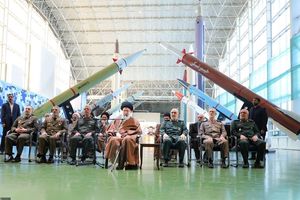
Iran's Supreme Leader Ali Khamenei during his visit to the IRGC Aerospace Force achievements exhibition in Tehran, November 19, 2023
Iran must rely on both its missile capabilities and diplomacy to safeguard national interests, the country’s foreign ministry spokesman said on Wednesday, emphasizing that resistance and engagement are complementary pillars of its foreign policy.
Iran faces stark economic and geopolitical challenges as a lingering impasse over its nuclear program led to the resumption of European-triggered international sanctions last month.
Western countries have called for Tehran to engage in renewed diplomacy with Washington and restored access to international nuclear inspectors.
Speaking at a seminar on “resistance diplomacy” at Ferdowsi University in Mashhad, Esmail Baghaei said: “We must use all tools to protect the country’s rights -- whether through missiles or diplomacy and negotiation.”
“The concept of resistance has now evolved and taken the form of resilience,” he said, adding that that Iran’s approach combines self-reliance with international engagement.
His comments appeared to strike a relatively moderate tone, two days after Iran's ultimate decision-maker Supreme Leader Ali Khamenei appeared to reject a peace overture by President Trump and deployed sharp language at his nemesis.
The 86-year-old veteran ruler called Trump's repeated assertions that US attacks on June 22 had obliterated Iran's nuclear program "nonsense" and in a rare direct address to a US President told him to "keep dreaming."
Khamenei appeared to rule out renewed talks, calling reported US demands for curbs to Iranian missile ranges and Tehran's support for regional armed groups bullying and a
Baghaei said Iran faces powerful adversaries but remains capable of shaping developments within the international system.
“Our opponents invoke international law to justify their actions, so we must also rely on the same law to prove our rights,” he said. “Resistance diplomacy must be seen as an active instrument to secure national interests.”
He defended Tehran’s stance in the wake of the UN sanctions snapback mechanism, saying that Western powers had expected immediate compliance but were surprised by global resistance to reimposing restrictions.
Addressing Iran’s backing of allied groups in the region, Baghaei rejected the notion that Tehran created “proxy” groups.
“We did not create them,” he said. “The issues of Palestine and Lebanon did not begin in 1979 (when the Islamic Republic was established). These movements existed long before, and we have supported them based on our constitutional and strategic principles.”
Baghaei added that Iran’s support is “based on a defined framework” and that “to prevent harm, we must build allies within the international system.”
He said the resilience of such movements is enduring despite repeated attempts to weaken them.
“After two years, those who claimed resistance was finished end up sitting at the same table with them,” he said. “The foundations of resistance are deeply rooted and cannot be easily destroyed.”
Baghaei also defended Iran’s record on diplomacy, citing past cooperation with global institutions and negotiations with Washington.
He recalled that after the US withdrawal from the 2015 nuclear deal, Iran “remained committed for months” before gradually reducing compliance.
He also noted that indirect talks with the United States had taken place under both Trump and Biden but collapsed due to continued sanctions and regional tensions.
“When one side plans an attack and then invites you to a meeting, how can you attend such a session?” he said, referring to recent incidents.
Iran's foreign minister said on Wednesday it will not return to negotiations with the United States unless Washington abandons what it described as unreasonable and excessive demands.
Abbas Araghchi told reporters in the northeastern city of Mashhad that Iran remained committed to diplomacy but would not compromise on its national rights.
He said five rounds of indirect talks with Washington had taken place before the 12-day conflict in June that saw US and Israeli strikes on Iranian nuclear facilities and that subsequent discussions on the sidelines of the UN General Assembly also failed due to US demands.
“This year, after five rounds of negotiations, the United States joined Israel’s military attack against Iran. Later, in New York, there was also an opportunity for a reasonable, mutually beneficial agreement -- but once again, the talks failed because of America’s excessive demands,” he said.
He added, “As long as the Americans persist in their policy of overreach and continue to make unreasonable demands, we will not return to the negotiating table.”
“Iran has always shown that it believes in peace and diplomacy,” Araghchi emphasized. “Wherever the country’s interests can be secured through dialogue, we will not hesitate to act. But the other side has repeatedly proven it does not adhere to diplomacy.”
The comments came as Araghchi arrived in Mashhad to attend a two-day regional diplomacy conference alongside senior Iranian officials, business leaders, and ambassadors to neighboring and Asian countries.
Earlier in the day, the foreign ministry spokesperson said Iran must rely on both its missile capabilities and diplomacy to safeguard national interests.
Speaking earlier in the day in the same city, Esmail Baghaei said: “We must use all tools to protect the country’s rights -- whether through missiles or diplomacy and negotiation.”
The collapse of the talks followed months of rising tension over Iran’s nuclear and missile programs, compounded by the reimposition of UN sanctions under the 2015 nuclear deal’s snapback mechanism.
Members of Hezbollah march with party's flags during a rally in Beirut.
Hezbollah is relying more on its overseas financial networks as Iran faces economic strain, US experts told a Senate hearing on Tuesday, warning that the group could deepen its activities in Venezuela and across Latin America.
“Hezbollah has a long history of turning to its diaspora networks when it’s facing financial stress,” analyst Matthew Levitt said.
He told senators that while Iran continues to support the group, “it is having a much harder time getting that money to Hezbollah in a timely manner.”
Lawmakers described Venezuela as a growing hub for Hezbollah’s drug and finance operations.
Senator Sheldon Whitehouse, the top Democrat on the Senate International Narcotics Control Caucus, said the group “is one of Iran’s tools to destabilize and terrorize,” adding that “if we target Hezbollah’s financing, we can deny them the opportunity to rebuild.”
Levitt said Hezbollah has operated in Latin America for nearly five decades, cultivating ties with traffickers and using illicit trade networks to move money.
“If you need big money real fast, you turn to illicit activities and especially to narcotics trafficking,” he said.
Several senators urged a tougher US response to Venezuela’s cooperation with Iran.
Senator Bernie Moreno said the Maduro government’s actions “meet the legal standard” to be labeled a state sponsor of terrorism and warned that “Maduro should know his days are numbered.”
Witnesses also called on Latin American governments to follow the lead of Argentina, Colombia, and Paraguay in designating Hezbollah as a terrorist organization, saying it would help disrupt its financial activity and weaken Tehran’s influence in the region.