Iran warns of regional security shift if Europe triggers snapback sanctions
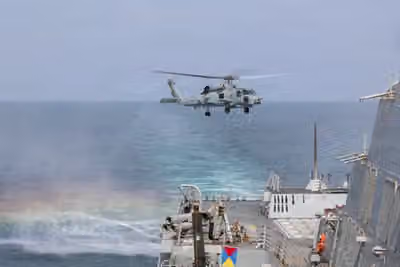
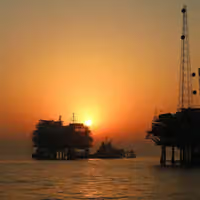
An aerial view of the Strait of Hormuz, a critical global oil chokepoint
A senior Iranian lawmaker warned on Monday that Tehran could halt its regional maritime security cooperation, including in the Strait of Hormuz, if European powers move to reimpose United Nations sanctions via the so-called snapback mechanism.
Abbas Moghtadaei, deputy chair of Iran’s parliamentary committee on national security and foreign policy, said the potential activation of the mechanism by the UK, France, and Germany would be viewed as a hostile act akin to military aggression.
“If pressure continues, our self-restraint may come to an end,” Moghtadaei told Borna news, adding that Iran has so far prevented harm to Western interests in the region but reserves the right to respond with measures across the security, economic, political, and cultural spheres.
Abbas Moghtadaei, deputy chair of Iran’s parliamentary committee on national security and foreign policy
"We have many tools in our disposition. We can withhold our commitment to security in the region, Persian Gulf and Hormuz Strait as well as other maritime areas," Moghtadaei said in reference to Tehran's potential counter-measures.
The remarks follow growing tensions between Iran and European parties to the 2015 nuclear deal, who accuse Tehran of breaching its commitments.
The three European states, known as E3, have said they would restore international sanctions on Iran by the end of August if the country did not enter productive talks on its nuclear program with Western powers.
Moghtadaei urged European governments to reconsider their approach and instruct their ambassadors to provide more accurate assessments of Iran’s domestic conditions.
“Europe is dependent on Iran’s cooperation in the region,” he said. “They should calculate the consequences of continued hostility.”
"Europe is not in a position to endanger itself in the... Hormuz Strait when it is itself in political, economic and cultural conflicts with Russia, China and even the United States."
In recent months, E3 countries and Iran have held inconclusive talks on Tehran's nuclear program, in parallel to indirect nuclear negotiations between Tehran and Washington. Israel's attack on Iran in June led to the suspension of such talks.
Iran and the European troika will hold nuclear talks on Friday in Istanbul, Turkey, Iran's state TV announced on Sunday, citing the foreign ministry spokesman.