Families of slain protesters challenge Pezeshkian over UN remarks
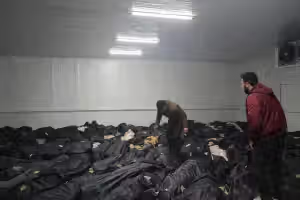
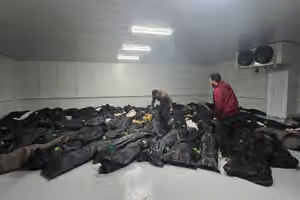
The bodies of slain protesters at an unnamed morgue in Iran (January 2026)
Relatives of protesters killed during Iran’s January crackdown challenged President Masoud Pezeshkian’s portrayal of the unrest as foreign-driven, saying their family members were unarmed and had no links to foreign governments, after his UN General Assembly address on Wednesday.
Pezeshkian accused protesters of being incited by the United States and Israel and receiving weapons to disrupt Iran’s security. He also defended system supporters who took to the streets during the unrest.
The sisters of Sina Kazemi, Emad Mavedatipour and Babak Sadeghi Mohseni responded on X, saying their brothers were unarmed when they were killed on January 8 or 9 and were not acting on behalf of any foreign government.
“I testify that my brother was unarmed when he was killed by the Islamic Republic of Iran’s forces on January 8, 2026,” Kazemi’s sister wrote. “He was not acting on behalf of any foreign government. I seek truth, justice, and accountability.”
Mavedatipour’s sister posted the same account of her brother, saying he was unarmed when he was killed on January 9 and denying that he acted for a foreign government.
Sadeghi Mohseni’s sister said her brother was unarmed when he was killed on January 8 and also called for “truth, justice, and accountability.”
The sister of Ahmad Khosravani, a 21-year-old professional basketball player, said her brother was completely unarmed when Iranian forces killed him on January 9.
“He was not acting on behalf of any foreign government,” she wrote. “They shot him directly in the heart.”
Fathers challenge Pezeshkian
Two other bereaved fathers challenged the government's account in separate video messages sent to Iran International.
The father of Erfan Abdipour, an architecture student who also worked at his brother’s restaurant, called on Pezeshkian to publish evidence if authorities had any showing that his son had received military training or carried a weapon.
“My request is that if you have evidence showing that he received military training, was instructed or had a weapon, or anything else that night, publish it,” Abdipour’s father said.
Abdipour had gone to protest on the night he was killed, his father said, questioning what his son could have been trying to seize in an area he described as having no military barracks or security facility.
The father of Pouria Bagheri separately rejected the government's explanation for the scale of the killings.
“I categorically reject the overall argument that such widespread killing was foreign actors work.”
Bagheri’s father questioned why authorities shut down the internet and electricity and said that security agents removed surveillance cameras from shops. He also asked why officials brought government supporters onto the streets two days later if foreign-backed armed groups posed the extensive threat described by authorities.
“Why did you bring your own supporters into the streets two days later? With what guarantee?” he said. “Was it not because you were in control?”
January crackdown
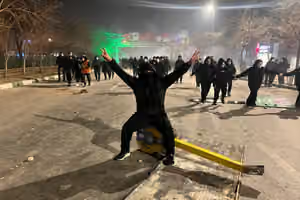
The protests began on December 28, 2025, following a sharp fall in the rial and rising prices before spreading across all 31 provinces and developing into a broader challenge to the Islamic Republic.
The deadliest violence came on January 8 and 9. Amnesty International said verified videos and eyewitness testimony showed security forces using rifles and shotguns against protesters, frequently firing at heads and torsos.
Iran International’s Editorial Board concluded in January that more than 36,500 people were killed by security forces on January 8 and 9 after reviewing classified government documents, field reports and accounts from medical workers, witnesses and victims’ families.
The UN Fact-Finding Mission on Iran later said security forces used lethal force against protesters and bystanders, including children, who posed no imminent threat of death or serious injury.
Iranian authorities initially put the death toll at 3,117. The government subsequently published 3,038 names, according to the UN mission, which said it believes the actual number may be significantly higher.
US President Donald Trump cited increasingly higher death tolls from Iran’s January protest crackdown in successive remarks, putting the number at 32,000 on February 20, 42,000 in later comments and subsequently 45,000.
Iran's Supreme Court has upheld the death sentence of Mozhdeh Hashemi Bazargani, a 27-year-old Red Crescent worker who said in a recording from Qazvin prison that interrogators beat her until her teeth broke and made her sign a confession, a source told Iran International.
Hashemi Bazargani was denied a lawyer of her own choosing throughout the proceedings, the source said. She is held in Qazvin Central Prison, in the city 150 kilometers west of Tehran, and is accused of sending the location of a military site to "the enemy," a charge she has denied.
In an audio message from prison earlier this year, she said security agents raided her home at 2:30 in the morning on April 4, cutting through the door with a metal grinder. She had been living with her elderly, ailing mother.
After her arrest, she said, she was beaten with a pipe and a baton on the head, neck and shoulders during long interrogations, breaking two teeth and leaving her with dizziness, shortness of breath and heart problems. No doctor came to examine her despite visible bruising and injuries, and her requests to be taken to the coroner's office to document the beating went unanswered.
Interrogators pressed her to confess, she said. "They pin a thousand charges on me. They force me: whatever we tell you, you have to write it down and sign it."
She said they beat her while she was blindfolded and cut her interrogation answers into a video presenting her as a terrorist. The charges put to her included espionage and receiving money from abroad. The confession footage was broadcast on Qazvin's provincial state television channel.
She also rejected the accusation of taking any money.
Her physical and mental condition is poor, the source told Iran International. Under the pressure of detention she has suffered seizures and lost consciousness several times, and was hospitalized before being returned to prison after a partial recovery.
In her message she also spoke of her mother in the town of Alvand, near Qazvin, who she said had been left with no one to care for her.
Iran's judiciary has issued sentences ranging from long prison terms to death against dozens of people this year on charges of espionage, sending information abroad or contact with hostile states, many of them arrested after the January protests.
Confessions broadcast on state television have repeatedly been described by defendants and their families as obtained under torture, and Revolutionary Court trials in such cases are closed to public scrutiny of the evidence.
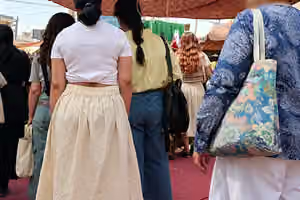
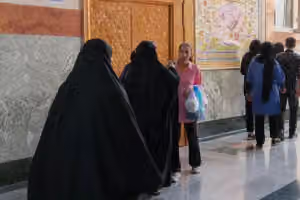
Iranian mothers accompany their daughters on the first day of school in Tehran in September. The image was reframed using AI to extend the background horizontally.
Mothers without headscarves walked daughters in regulation hoods to school in Iran this week. Women who remember 1980 describe the same scene from the year the state began imposing hijab. The picture is identical. What has changed is the society around it.
Among the images of the first day of the school year on September 23 were mothers who had dropped their daughters at the gate with their own hair uncovered, beside girls wearing the maghnaeh, the fitted hood that covers the hair, neck and shoulders and has been part of the girls' uniform in Iranian schools for four decades.
The scene is not new to the Islamic Republic. In the oral histories of women who remember the first years after the 1979 revolution, the same picture appears: mothers who still left the house without a headscarf, walking daughters who had to cover for school, because school was where the new state was making the rule stick first.
In the Islamic Republic's early years, compulsory hijab was established first in the spaces the state controlled most directly, government offices and schools, and only afterward extended to the street and the whole of public life.
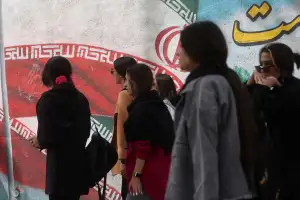
Today the rules in schools and offices remain, and the law on compulsory hijab has not been repealed or even amended. But outside those spaces, part of the female population has been living differently for some time. This time, society has moved ahead of the rules.
Before the hood became the uniform
This summer an image of two designs for girls' school uniforms from 1979, first published by the popular weekly Javanan-e Emrooz, circulated again. Neither design includes the maghnaeh that later became a fixed part of the girls' uniform.
That interval did not last. In 1980, as the new state Islamized government offices and institutions, the dress code for schoolgirls changed too. For the 1980-81 school year, the requirement became a long-sleeved smock, loose trousers and a headscarf. In 1983, appearing in public without what the state called "sharia hijab" was made a crime.
The note to Article 638 of the Islamic Penal Code later became the legal basis for action against women who appear in public without the hijab the state requires.
So the history of compulsory hijab cannot be read from the street alone. School and office were among the first places it was enforced, and only later did the requirement settle across public space.
The regulation and the mandatory hood
In schools, much of that structure still stands. Article 85 of the schools' executive regulation, adopted in 2021, says students' clothing should be "simple, beautiful, varied, neat and cheerful," appropriate to Islamic-Iranian culture and identity, social custom, the student's age and the climate. The choice of style and color is left to each school's council, with the participation of the student council.
But the note to the same article fixes the range for girls. A female student's dress is either "chador, manteau, trousers and maghnaeh" or "manteau, trousers and maghnaeh," the chador being the full-length cloak and the manteau the long coat worn over trousers.
The chador is not compulsory. The maghnaeh is. The regulation provides no option for a girl to attend school with her hair uncovered.
The requirement begins in primary school. A girl of six or seven may walk to the gate hand in hand with a mother whose hair is uncovered, and must then cover her own to go in.
The distance between society and the rules can hardly be seen more clearly than in those few meters.
The fight reaches the uniform itself
This year the argument over girls' dress did not stop at the hood. The uniform itself made news.
On the eve of the new term, a message circulated about a girls' primary school in Saadat Abad, an affluent district in northwest Tehran, saying pupils would wear a shirt or blouse with trousers in place of the usual smock or manteau. Because the school is state-run, the message spread widely and reached state television.
The education office for Tehran's District 2 denied it, saying the images being shared had nothing to do with that school's uniform.
So the case cannot be treated as a confirmed change to a state school's uniform. But that such a report could circulate about a state school, and that the ministry felt obliged to answer it, shows the argument over girls' dress has reached the definition of the uniform itself.
Official policy has not moved. This year's directives asked schools to avoid unnecessary changes to the design and color of uniforms.
The result is a split. Outside school, the way women dress has changed quickly in recent years. Inside it, the manteau, trousers and maghnaeh of the official regulation remain exactly where they were.
Today's girls are not the girls of 1980
The most important difference between the two identical pictures may be the girls themselves.
The dress rules of 1980 were imposed on a society in which the Islamic Republic was still building its political, educational and cultural institutions. Today the same rules have to be enforced on a generation whose experience of how women around them dress is entirely different.
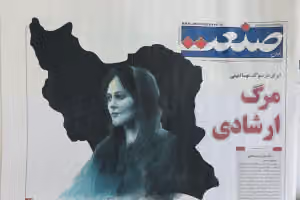
The protests of 2022 carried that difference into the schools. Among the most repeated images of the Woman, Life, Freedom uprising were teenage girls in school uniform who had taken off their hoods, in the schoolyard, the classroom and the street.
Reports of action against students over hijab followed. Amnesty International recorded the account of a 17-year-old who, after being seen with her hair uncovered on the school's cameras, was suspended and threatened with being reported to the security agencies.
That is a different experience from 1980. A student today may see bareheaded women on her way to school in the morning, be dropped off by a bareheaded mother, put on the hood to enter, and take it off again when school lets out.
For part of this generation, the maghnaeh is no longer a continuation of how they dress outside. It is a rule that applies on entering a controlled space, and stops applying on leaving it.
The law has not moved
None of this social change has become legal change.
The note to Article 638 still makes it a crime for a woman to appear in public without sharia hijab. Article 85 still lists the maghnaeh as part of a girl's dress.
The law known as Protection of the Family through the Promotion of the Culture of Chastity and Hijab, passed in December 2024, which would have widened the punishments and the means of enforcing compulsory hijab considerably, is not being implemented for now. Its suspension did not repeal the laws that came before it.
So what has happened in Iran's streets is not, in law, hijab becoming optional. The law has not recognized a right to choose. Part of society has made a different choice in practice.
A woman without a headscarf in Iran today is not uncovered because the law gave her that right. The law can still treat what she is doing as a crime, even if it is not enforced at every time and in every place.
The administrative structure behind hijab policy has not gone either. The budget for the Iranian year that began in March 2025 set aside 2.592 trillion rials, about $1.1 million at market rates, for the Headquarters for Enjoining Good and Forbidding Evil, the state body charged with policing public morality, for which hijab has been a principal concern. That is roughly the annual minimum wage of 1,300 workers.
In the budget for the year that began this March, the line was written differently: 6.284 trillion rials, about $2.7 million, in a single shared allocation for three bodies, the headquarters, Soureh University, which is run by the state's Islamic propaganda organization, and the Islamic Propagation Coordination Council, which organizes official rallies. Because the shares are not separated, the full figure cannot be described as the headquarters' budget, still less as a hijab budget.
The education ministry and other state bodies also retain duties under the existing law on dress. The retreat of enforcement in parts of public space has not removed the law, the institutions or the money behind it.
In 1980, the bareheaded mother was walking her daughter toward a rule that would soon reach her too. In 2026 she walks her daughter toward the last place the rule still holds. The picture has not changed. Its direction has. The few meters between her uncovered hair and her daughter's hood are no longer the distance between two generations, but between a society that has changed and a law that still says it hasn't.
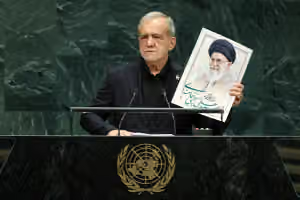
Iran's President Masoud Pezeshkian addresses the 81st United Nations General Assembly (UNGA) at UN headquarters in New York City, US, September 23, 2026.
Masoud Pezeshkian told the UN that Iran would not accept the language of force. Iranians writing to Iran International had one reply: that is the only language his government uses at home. Their messages picked apart what he said, what he left out, and how he said it.
Speaking at the 81st General Assembly on Wednesday, the president said Tehran was ready for dialogue but rejected "the language of force," called Donald Trump's words a sign of "the character of a bully and the logic of force," and held up photographs of the late Ali Khamenei and of schoolchildren killed in the strike on Minab in the war's first hours.
Three things drew the messages: the gap between the president's posture abroad and the state's conduct at home; the crackdown of January that he did not name; and the way he spoke.
The most frequent reaction set the president's words in New York beside the state's words in Iran.
"The Islamic Republic wants dialogue with anyone stronger than itself," one wrote, "and bullies its own defenseless people."
Another pointed to Pezeshkian's repeated use of the word force: inside Iran the state threatens America, he wrote, and in New York it asks "why are you bullying us."
The president's own language on the January protests was not far from writers' minds. In August he called the protests a "riot" and described those who reported the killings as "cowards and traitors," remarks that had drawn an earlier wave of messages. On January 11, days after the killings, he had called the protesters "terrorists" and demanded a "decisive" response from the security forces.
One writer put it in a single line: for 47 years the Islamic Republic has been busy with terror, and now Pezeshkian comes to play the victim.
Another watched the delivery rather than the text. "People like Pezeshkian only claim power and swagger in front of us," he wrote. "From the trembling voice, the stumbles and the level of stress in his speech, it was clear how brave he is in front of real superpowers."
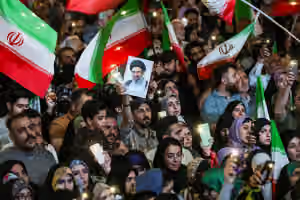
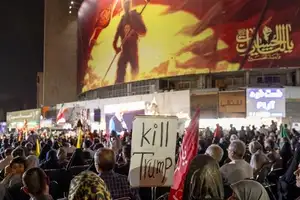
Pezeshkian never used the word protests. The Iranians he described in the streets these past seven months were the crowds at the state's own rallies, organized by the Revolutionary Guards and the Basij, out at night, in his telling, to defend the country against people "America and Israel had incited and put guns in the hands of."
The millions who came out against the state, and the tens of thousands killed, did not appear in the speech at all.
A writer from Qeshm, the island in the Strait of Hormuz, said the president had repeated the state's version of the protests instead of speaking about Iran's own victims, including those killed on January 8 and 9 and in earlier crackdowns.
Others treated the speech as an occasion to list what it omitted: the protests of December 2017 and January 2018, Bloody November in 2019, the Woman, Life, Freedom uprising of 2022, the January 2026 uprising, and the poisoning of girls' schools in 2022 and 2023.
The messages came days after the UN fact-finding mission on Iran presented its latest report. Its chair, Sara Hossain, said the January crackdown had met protests with an "extremely violent" response, and that many of the violations, including killings and imprisonment, amounted to crimes against humanity.
Several writers said that Iranians themselves had been pushed to the margins of the speech. "Pezeshkian was more a defender of the Revolutionary Guards and of Palestine," one wrote, "than someone who wanted to say anything about the people of his own country."
How he said it
The third and most personal thread was the president's manner: his walk, his delivery, his command of his own text.
Many described his bearing as a street tough's swagger and compared him to Shaban Bi-Mokh, the Tehran strongman whose mobs helped bring down the government in the 1953 coup and whose nickname means "the brainless." Writers said his grip on the speech was so weak that a passerby pulled off the street and put at the UN lectern would have spoken more fluently and said more.
A writer from Tehran said he had been ashamed to watch Pezeshkian represent Iran, in a speech he found empty of manners, culture or "any diplomatic decorum."
"Why can't he speak properly?" another asked. "He talked as if someone had a gun to his head."
One writer compared the speech to those of Mohammad Reza Shah Pahlavi and said the level of language from the president of the Islamic Republic had left him astonished.
Several concluded that the delivery reflected the office. Pezeshkian, they wrote, has no authority of his own; he reads what is written for him and handed to him.
"That is why they made him president," one wrote. "The text they write for him usually has a fixed structure, and it is on file at the foreign ministry and the presidency."
Iran's President Masoud Pezeshkian addresses the 81st United Nations General Assembly (UNGA) at UN headquarters in New York City, US, September 23, 2026.
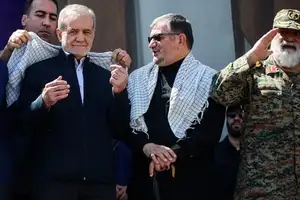
Iran's generals and hardliners spent the week warning Masoud Pezeshkian not to smile in New York. After his UN speech they lined up to praise him. He had not changed their minds about talking to Washington. He had given a speech that did not require them to.
The one voice that could settle what Tehran wants from the diplomacy under way in New York has not been heard at all. Supreme Leader Mojtaba Khamenei has said nothing publicly about the contacts with Washington, the attacks on his foreign minister, or the speech itself.
He did not receive the president before the trip. And this is the first UN General Assembly in 37 years at which his father was not Iran's supreme leader.
What changed, and what did not
Before the speech, the hardline press was hostile to the trip itself. Kayhan warned that "New York is not a place for smiles and negotiations" and that the General Assembly should be turned into "a court for US crimes." Fars, affiliated with the Revolutionary Guards, wrote that Pezeshkian should not have gone at all.
Moderates pushed the other way: the daily Etemad recalled the meetings Iranian presidents failed to hold with Bill Clinton in 2000 and Barack Obama in 2013, and the reformist Mehdi Karroubi urged Pezeshkian to meet Donald Trump.
Pezeshkian did neither. After Trump used the UN podium to threaten to "annihilate" Iran, the president said he had rewritten his speech. He held up photographs of children killed in the strike on a school in Minab in the war's first hours alongside a portrait of the late Ali Khamenei, said Iran had defended itself "powerfully," said it remained open to negotiation, and said it would not accept "the language of coercion."
There was no offer in it, no gesture toward a meeting, nothing a hardliner could call weakness.
The praise followed within hours, and it praised the defiance.
Revolutionary Guards spokesman Hossein Mohebbi said the president had "at the heart of the system of arrogance, reproduced the message of power, pride, dignity and hope of a nation," in a statement carried by IRNA.
Iran would rely on unity "from the country's highest executive official to the brave fighters in the field and the people in the streets," he said.
Mohammad Mokhber, an adviser to the supreme leader, called Pezeshkian "a worthy representative and the voice of all Iranians" who had been "decisive, reasoned and logical."
The message, he wrote on X, was clear: "we will not bow our heads before a bully, we will not forget our martyrs and we will make the aggressors regret their actions."
Ali Abdollahi, chief of staff of the armed forces and commander of the Khatam al-Anbiya Central Headquarters, Iran's wartime command, said the people "through Dr. Pezeshkian, slapped the criminal president of the United States before the eyes of the world," and that the armed forces stood "in harmony and in one voice with the people and the respected president."
Army commander Amir Hatami followed on Thursday. "Mr. President, well done. We sincerely thank you," he said, calling the address "a manifestation of the unity and coordination of all Iran against the bullying enemy."
Parliament speaker Mohammad Bagher Ghalibaf wrote that Pezeshkian "spoke not just for a government, but for a 3,000-year-old civilization."
Every one of those statements praised the speech for what it refused. None mentioned the talks.
The missing voice
In previous years, state media made a point of showing the president meeting the supreme leader before a major trip, including before the General Assembly. The meeting was the signal: the president traveled with the leader's mandate, and everyone in Tehran knew it. No such meeting was announced this year. Mojtaba Khamenei has not been seen or heard in public since he was named to succeed his father in March, and he has issued nothing on New York.
The closest anyone has come to speaking for him was Major General Yahya Rahim Safavi, one of his military advisers, on Wednesday. "If the Supreme Leader has deemed it expedient and left the government's hands open in the negotiations, that is an important act of prudence," Safavi said on state television. Even the adviser spoke in the conditional.
That leaves the generals' applause doing a job the leader's meeting used to do. Their statements told Tehran that the speech was approved. What they did not tell anyone is whether the contacts around it are.
The fight that did not stop
The argument over those contacts continued through the praise, and it is an argument about authorization, not about whether to talk.
Ebrahim Rezaei, of parliament's National Security and Foreign Policy Committee, challenged Foreign Minister Abbas Araghchi on Wednesday over his meeting in New York with US envoy Steve Witkoff. "
On the basis of which authorization and policy did the foreign minister meet the representative of the aggressor enemy?" he wrote on X. Iran's seven conditions had already been conveyed to Washington, he said, and "nothing comes from such an illegal meeting except a sign of weakness."
Tasnim, also affiliated with the Guards, called Araghchi's explanation "childish and vile" and, citing Mohsen Rezaei, the secretary of the Supreme National Security Council, said the approved plan had been to pass the conditions through mediators, not to meet Witkoff. It called the meeting "a major error." Fars argued the contact had eased pressure on Washington without securing anything.
On Thursday Ali Khezrian, another member of the Committee, said Araghchi had not been authorized to hold direct talks and that MPs had registered a motion to impeach him. "Araghchi must, after returning from his trip, answer in parliament on what basis this conversation with the American side took place," he said.
The foreign minister had defenders. MP Mojtaba Zarei said his own inquiries showed Araghchi had been authorized to meet Witkoff. "There was and is no negotiation," he wrote; the seven conditions had been delivered directly to Trump's envoy. Mohebbi, for the Guards, had already set the terms: "We don't reject diplomacy, but we impose our own conditions. Our defensive power will be proven in the field."
The man who stayed in his seat
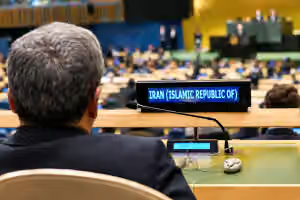
A second row concerned Nasser Asadi, a member of Iran's UN mission who remained in the hall during Trump's address. Hossein Ali Haji-Deligani, deputy head of parliament's Article 90 Committee, which handles public complaints against state bodies, called it "a source of shame and regret" and said MPs would use "all supervisory tools, including the impeachment of Araghchi." Hardline accounts contrasted Asadi with delegations that walked out.
Foreign Ministry spokesman Esmail Baghaei defended him. "Iran's seat in a place such as the United Nations General Assembly is our trench," he said. "If we are supposed to leave this trench because of the harsh words, hostility and insults of others, then we certainly have not done our duty."
Schoolchildren walk to class on the first day of the new academic year in Savadkuh, northern Iran, Sept. 23, 2026.
Iranian children returned to classrooms Wednesday for an unusually somber start to the school year, the first since young people were killed in a government crackdown on January protests and in the war with the United States.
The normally jovial ceremonies marking the first day of the Iranian school year were shadowed by the memory of children who might otherwise have returned to class this week.
Children were among those killed by Iranian security forces during the January protests, while 120 children died when a primary school in the southern city of Minab was struck on the first day of the war on Feb. 28.
More than 16.5 million students returned to over 124,000 schools across Iran for the new academic year, according to state media. Classes had been suspended after the United States and Israel launched strikes on Iran.
A United Nations fact-finding mission said last week there were reasonable grounds to believe US forces were responsible for the Minab attack and that the strike was indiscriminate and violated international law.
The mission also found that Iranian authorities committed crimes against humanity in their crackdown on the nationwide protests, including unlawful killings, torture and arbitrary detention.
War enters the classroom
But accounts sent to Iran International from several cities suggest the war and the government's response to it were following students back into school in other ways as well.
A parent in Mazandaran province said the principal of her son's school had warned students that failing to bring an Islamic Republic flag on the first day of school could negatively affect their end-of-year grades.
In Garmdareh, west of Tehran, another person said several flag-bearing vans and a vehicle equipped with loudspeakers entered Barati school on the first day, playing religious mourning music at high volume.
Military personnel were also present in the school grounds, the person said.
‘Cultural battle’
Iran's Education Ministry announced during the summer that material related to the conflict and the country’s military and nuclear capabilities would be incorporated into educational content.
The country's Organization for Educational Research and Planning has printed and distributed 12 million copies of educational materials titled “We Defend Our Iran” for older primary and secondary school students.
Officials with the student Basij have spoken of training tens of thousands of student “commanders” under a program called Yavaran-e Velayat for what they describe as a “cultural battle.”
As children filed back into classrooms across Iran, Pezeshkian was in New York addressing the UN General Assembly, where diplomacy aimed at ending the war was also gathering pace.
He held up photographs of children killed in the Minab strike as he accused the United States and Israel of attacking Iranian civilians.
For the children returning to school at home, however, the events of the past nine months were already part of the new school year.