• العربية
  • فارسی
Brand
  • Iran Insight
  • Politics
  • Economy
  • Analysis
  • Special Report
  • Opinion
  • Podcast
  • Iran Insight
  • Politics
  • Economy
  • Analysis
  • Special Report
  • Opinion
  • Podcast
  • Theme
  • Language
    • العربية
    • فارسی
  • Iran Insight
  • Politics
  • Economy
  • Analysis
  • Special Report
  • Opinion
  • Podcast
All rights reserved for Volant Media UK Limited
volant media logo
EXCLUSIVE

Khamenei sidestepped in Iran-Israel ceasefire decision

Jun 26, 2025, 16:05 GMT+1Updated: 07:58 GMT+0
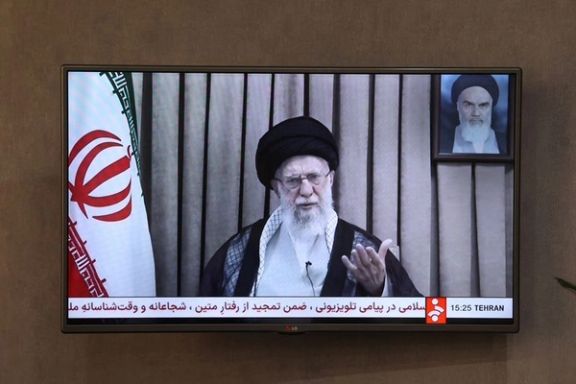
A TV broadcast of Iran’s Supreme Leader Ali Khamenei’s video message

Iran’s Supreme Leader Ali Khamenei was not involved in the negotiations or approval of the recent ceasefire agreement between Iran and Israel, according to information obtained by Iran International.

Decision-making regarding the truce was handled instead by Iran’s Supreme National Security Council and President Masoud Pezeshkian, who moved swiftly to respond to a ceasefire proposal from US President Donald Trump.

A source familiar with the details of the deliberations told Iran International that the council intended to respond quickly to the American proposal. However, at the time, there was no opportunity to contact Khamenei. The ceasefire was therefore approved and communicated without the supreme leader’s knowledge.

In recent days, Khamenei’s communication capabilities have been severely limited due to security concerns, particularly fears of an attack on his location.

Iran International previously reported that Khamenei and close family members, including his son Mojtaba, were relocated to a secure bunker in Lavizan, northeast Tehran, soon after the conflict began.

Earlier this month, Iran International reported that Khamenei had transferred key decision-making powers to the Supreme Council of the Islamic Revolutionary Guard Corps (IRGC) shortly after the start of the attacks by Israel. The transfer of authority was viewed as a precautionary step to ensure continuity of command in the event of an escalation or direct threat to the leader’s safety.

Iran has not officially confirmed the location of the Supreme Leader or the details of the internal deliberations surrounding the ceasefire.

First message after ceasefire

Earlier in the day, Khamenei released his first public message since the ceasefire took effect on Tuesday, delivering a televised address in which he declared victory over Israel and said the United States was dealt a blow during the conflict.

“The Zionist regime, with all its noise and claims, was nearly brought to its knees,” he said. “The United States gained nothing and received a harsh slap in return.”

The setting of Thursday’s video matched earlier wartime messages, suggesting he remains in the same secure location.

Trump had previously posted on Truth Social that the US knew where Khamenei was hiding, describing him as an “easy target” and warning that American patience was “wearing thin.”

However, in remarks following the ceasefire announcement, Trump adopted a more measured tone, suggesting that “regime change takes chaos,” and adding, “we don’t want to see so much chaos, so we’ll see how it does.”

He also confirmed that the US is preparing for a new round of talks with Iran in the coming week.

Most Viewed

State media slam Araghchi's Hormuz tweet, say it let Trump claim victory
1

State media slam Araghchi's Hormuz tweet, say it let Trump claim victory

2

Iran International says it won’t be silenced after London arson attack

3
INSIGHT

How Tehran bends its own red lines to boost state rallies

4
OPINION

The Hormuz get out of jail card turned to a grave

5

Iran halts petrochemical exports to supply domestic market

Banner
Banner

Spotlight

  • Too early to tell who is winning Iran war, experts say
    PODCAST

    Too early to tell who is winning Iran war, experts say

  • How Tehran bends its own red lines to boost state rallies
    INSIGHT

    How Tehran bends its own red lines to boost state rallies

  • Iran blackout cripples freelancer, small business incomes
    VOICES FROM IRAN

    Iran blackout cripples freelancer, small business incomes

  • Ideology may be fading in Iran, but not in Kashmir's ‘Mini Iran'
    INSIGHT

    Ideology may be fading in Iran, but not in Kashmir's ‘Mini Iran'

  • US blockade enters murky phase as tankers spoof signals and buyers hesitate
    ANALYSIS

    US blockade enters murky phase as tankers spoof signals and buyers hesitate

  • Why the $100 billion Hormuz toll revenue is a myth
    ANALYSIS

    Why the $100 billion Hormuz toll revenue is a myth

•
•
•

More Stories

Khamenei sidestepped in Iran-Israel ceasefire decision

Jun 26, 2025, 15:01 GMT+1

Iran’s decision to enter a ceasefire with Israel was made without the direct involvement of Supreme Leader Ali Khamenei, Iran International has learned.

According to information shared with Iran International, the process was led by the Supreme National Security Council and President Masoud Pezeshkian, who jointly informed the United States of the decision.

In an exclusive report earlier this month, Iran International reported that Khamenei had transferred key decision-making powers to the Supreme Council of the Islamic Revolutionary Guard Corps (IRGC) shortly after hostilities began.

The move came amid reports that the supreme leader, along with close family members including his son Mojtaba, had been relocated to an underground bunker in Lavizan, northeast Tehran, where he remained for days without making any public appearances.

Read more...

Khamenei claims victory over Israel and US in first public message since ceasefire

Jun 26, 2025, 11:48 GMT+1

Iran’s Supreme Leader Ali Khamenei declared victory over Israel and said the United States was dealt a blow during the conflict, in a televised message aired Thursday—his first public remarks since a ceasefire took effect on Tuesday.

Khamenei said Israel was “crushed” under Iranian strikes and claimed the US failed to achieve its goals after entering the conflict to protect its ally.

“The Zionist regime, with all its noise and claims, was nearly brought to its knees,” he said, adding that the United States “gained nothing” and received “a harsh slap” in return.

The setting of Thursday’s video appeared identical to his previous wartime address. Iran International previously reported that Khamenei and his family were moved to a secure underground bunker in Lavizan, north of Tehran, shortly after the conflict began.

Iran’s supreme leader says US ultimately seeks 'surrender and defeat of Iran'

In his message, Khamenei responded to recent remarks by US President Donald Trump, who said Iran must “surrender.” Khamenei dismissed the demand as insulting and claimed it revealed the true objective of US policy.

Khamenei said Trump’s remarks revealed that the issue was not Iran’s nuclear program or missile development, but rather a broader effort to force the Islamic Republic into submission. “It’s no longer about enrichment or missiles,” he said. “It’s about surrender. That’s what they want.” He added that such language was “beneath the dignity of a president” and would only strengthen Iran’s resolve. “A country with our history and culture will never accept this kind of humiliation,” he said.

Last week, Trump wrote on Truth Social that the US knew Khamenei’s location and called him an “easy target,” adding, “We are not going to take him out—at least not for now.” He also warned that American patience was “wearing thin.”

Days later, Trump announced a ceasefire between Iran and Israel. Speaking afterward, he appeared to soften his tone, saying, “Regime change takes chaos, and ideally, we don't want to see so much chaos, so we'll see how it does.” He added that the US is preparing for a new round of talks with Iran next week.

Ceasefire brings calm but reveals Iran's bitter divides

Jun 26, 2025, 05:14 GMT+1
•
Maryam Sinaiee

The ceasefire between Iran and Israel brought relief to millions—but also sharpened fractures within the Islamic Republic and among its opponents.

Hardliners have declared it a strategic victory—some even lamenting that it ended too soon to deliver a heavier blow. Moderates, as ever, are trying to frame the moment as a chance for national reconciliation—“reform” in their lexicon.

“Have you seen the dignity, courage, authenticity, and patriotism of the Iranian people in the face of Israel’s aggression?” journalist Ehsan Bodaghi asked the leadership.

“The most important ceasefire is a ceasefire with your own people. Any path that doesn’t go through that leads to ruin.”

But hardliners have little patience for voices like Bodaghi’s. For them, the war reaffirmed Tehran’s regional standing—and the ceasefire, if anything, came too soon.

“Let’s say hello to a new Middle East!” declared Ezzatollah Zarghami, former head of state TV. “The courage and resistance of the Iranian people changed global equations.”

Ultraconservatives went further, rejecting the truce altogether.

“You can surrender if you like, but we will continue to fight,” said cleric Mohammad Mehdytabar. “It’s just the beginning of a new phase of war,” MP Amir-Hossein Sabeti posted on X.

Relief meets suspicion

Outside the halls of power, the mood is more weary than triumphant. Many Iranians are grateful for the pause—but skeptical that anything will change.

“Mark my words: when the war ends, they will arrest women for hijab again, the internet will be filtered, cronyism and corruption will thrive,” warned entrepreneur Nima Namdari, predicting a return to the regime’s “default mode.”

The warning appears timely: judiciary officials have already proposed amendments expanding espionage laws and widening the powers of security agencies.

Others voiced frustration with exiled opposition figures who, they say, ignored the human toll in pursuit of collapse.

“It’s shameful how some Iranians abroad have reacted after the ceasefire,” wrote Mani Ghassemi, founder of tech outlet Digiato. “They’re upset the war didn’t achieve the outcome they envisioned, yet say nothing about the 700 dead—according to Iran’s health ministry.”

During the war, state media briefly softened its tone. A patriotic song by Moein—an exiled LA-based pop icon—aired on national TV for the first time in decades. Billboards swapped religious slogans for Iran’s pre-Islamic heroes like Arash the Archer.

Some moderate insiders saw in this a cue to shift course.s

“Israel is not an actor with whom one can remain in a decades-long state of ceasefire like with Iraq,” wrote former diplomat Hamid Aboutalebi, urging Tehran to rethink—or face escalation.

Polarization by design

Hours before the truce, exiled prince Reza Pahlavi announced his readiness to return and lead a peaceful transition, calling the moment the “final phase” of Iran’s struggle.

But the day after, Donald Trump made clear he does not support regime change, citing the risk of chaos. For royalists and anti-regime activists, it was a bitter reversal.

Monarchist Alireza Kiani responded by calling for more—not less—polarization.

“Revolutionary moments require it,” he wrote. “On one side are Iran nationalists seeking to overthrow the regime. On the other are its unashamed—and ashamed—supporters. This divide must be continually reinforced.”

But journalist and human rights activist Kambiz Ghafouri warned against placing hope in foreign firepower.

“The Islamic Republic will fall—sooner or later—but by the hands of the Iranian people, not through foreign attack,” he wrote.

“Neither Trump nor Netanyahu is genuinely interested in regime change. For them, a battered Islamic Republic is preferable to a strong, democratic Iran.”
Iran nuclear damage assessment divides Washington

Jun 26, 2025, 03:18 GMT+1

US President Donald Trump has rejected a cautious early assessment by his own Pentagon on damage to Iranian nuclear sites and Democrats have doubted the success of air strikes, as Iran policy increasingly divides Washington.

"(The pilots) knew the Success was LEGENDARY, and then, two days later, they started reading Fake News by CNN and The Failing New York Times," Trump posted on social media on Wednesday.

He linked the success of the strikes to his own diplomatic prowess, hitting back at news outlets which published a leaked preliminary assessment by the Defense Intelligence Agency saying the air strikes only set Iran's nuclear program by months.

Trump said a press conference on the attacks' impact would prove "irrefutable."

Secretary of State Marco Rubio appeared to acknowledge the report's veracity but said leakers had "an agenda."

"I would say that story’s a false story, and it’s one that really shouldn’t be re-reported because it doesn’t accurately reflect what’s happening," Rubio told Politico.

The spirited defense came after Trump rounded on Republican critics of his decision to attack without Congressional authorization.

Sidelined Democrats clap back

As the nuclear attack unfolded, the Trump administration briefed Capitol Hill majority leaders from his own Republican Party but not Democrats.

The president's sharing of intelligence along party lines, if confirmed, would break with precedent of most of the recent decades where the commander-in-chief shared information on bipartisan lines.

Lawmakers from the minority criticized the move and wondered aloud what the strikes had accomplished.

"Iran’s highly enriched uranium could be moved in as little as 10 carloads," Democratic Senator Mark Warner of Virginia wrote on X.

"Do we really have confidence we know where this is? Do we really have confidence it wasn’t moved before our strikes?"

During two months of US-Iran talks, Democrats had largely remained silently supportive of Trump's diplomatic effort to end Iran's nuclear ambitions.

Democratic Senator Michael Bennett of Colorado accused the Trump administration of withholding classified information on Iran from Congress.

"The nation's intelligence agency leadership must attend tomorrow's Senate briefing in addition to Secretaries Hegseth and Rubio," he posted on X.

Trump allows Iran oil sales for post-war rebuilding

Jun 26, 2025, 00:05 GMT+1

US President Donald Trump said on Wednesday he is not abandoning his maximum pressure strategy against Tehran but is also not aiming to cut off Iran’s oil sales as the country's reconstruction depends on those revenues.

“Iran just had a war. They fought it bravely,” Trump said Wednesday on the sidelines of the NATO summit.

“I’m not giving up (on the maximum pressure policy). I could stop their oil business if I wanted. (But) I don’t want to do that," he said when asked if he is easing sanctions on Iran.

"They’re going to need money to put that country back to shape. We want to see that happen. We’re not taking over the oil. We could have. But putting that country back into shape desperately needs money."

The remarks mark a notable shift in tone. Just weeks earlier, in early May, Trump had threatened to impose immediate secondary sanctions on any country buying “even small amounts of oil or petrochemicals from Iran.”

That warning was part of his administration’s revived maximum pressure campaign, reintroduced this February after a pause under the Biden administration.

On Tuesday, Trump appeared to soften his stance, posting on Truth Social: “China can now continue to purchase Oil from Iran.”

The post drew immediate speculation about a possible rollback of sanctions.

However, the Wall Street Journal cited a senior White House official as saying Trump was “simply calling attention to the fact that, because of his decisive actions to obliterate Iran’s nuclear facilities and broker a ceasefire between Israel and Iran, the Strait of Hormuz will not be impacted, which would have been devastating for China.”

The official was quoted as saying that US sanctions on countries importing Iranian oil remain fully in effect.

In his Wednesday remarks, Trump did not clarify whether he plans to formally issue a sanctions waiver or simply return to what critics described as lax enforcement of US sanctions during the Biden era.

'Uncanny ability'

Trump's Mideast envoy for talks with Iran which are due to resume next week said the move is a sign of Trump's diplomatic prowess.

"It was a signal from the President, you know, he's got this uncanny ability to take the temperature of how people are feeling about certain things," he told Fox News.

"This was a signal to the Chinese that we want to work with you, that we're not interested in hurting your economy, we're interested in in working together with you in unison, and hopefully that becomes a signal to the Iranians," he added.

During Trump’s first term, strict sanctions enforcement had nearly eliminated Iran’s legal oil exports, bringing them down to 200,000 barrels per day. Under the Biden administration, the enforcement of sanctions eased, and exports to China surged — peaking at 1.7 million barrels per day in early 2025.

China is Iran’s primary oil customer, reportedly buying around 90 percent of its exports, according to Reuters.

Iranian crude is often shipped in shadow fleets that mask the origin of the oil before it arrives at China’s independent “teapot” refineries. These facilities frequently pay in Chinese yuan, bypassing the US dollar-based global financial system.