• العربية
  • فارسی
Brand
  • Iran Insight
  • Politics
  • Economy
  • Analysis
  • Special Report
  • Opinion
  • Podcast
  • Iran Insight
  • Politics
  • Economy
  • Analysis
  • Special Report
  • Opinion
  • Podcast
  • Theme
  • Language
    • العربية
    • فارسی
  • Iran Insight
  • Politics
  • Economy
  • Analysis
  • Special Report
  • Opinion
  • Podcast
All rights reserved for Volant Media UK Limited
volant media logo

Iran’s parliament backs enrichment beyond 20% as Tehran weighs return to talks

May 21, 2025, 12:29 GMT+1Updated: 08:12 GMT+0
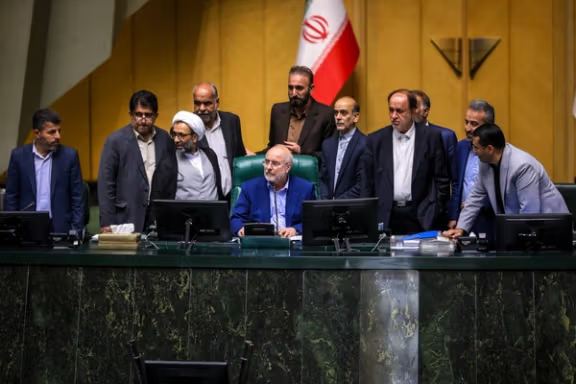
A session of the Iranian parliament on May 20, 2025

Iran’s parliament issued a firm statement on Wednesday defending the country’s nuclear program, saying that Tehran's right to uranium enrichment, including to levels beyond 20%, is non-negotiable.

The parliamentary declaration follows Supreme Leader Ali Khamenei's skepticism on Tuesday regarding the success of ongoing indirect nuclear talks with the United States, and Foreign Minister Abbas Araghchi's announcement that Iran is assessing its participation in the next round of negotiations.

The statement, read by parliamentary presidium member Mohammad Rashidi, said that Iran’s enrichment levels would not be capped at below 20% and would instead be determined by peaceful domestic demands.

It emphasized the importance of nuclear technology for non-military uses such as medicine, agriculture, energy, and desalination.

Iran is the only non-nuclear weapon state enriching uranium to 60% purity—a level the UN nuclear watchdog says has no credible civilian use and is technically close to weapons-grade 90% fissile material.

Lawmakers said Iran’s nuclear activities were fully in line with its rights under the Non-Proliferation Treaty (NPT) and the safeguards of the International Atomic Energy Agency (IAEA), calling any abandonment of the program “a betrayal of national interests and the country’s future.”

The statement came hours after Foreign Minister Abbas Araghchi said Tehran had yet to decide whether it would attend the next round of indirect nuclear negotiations with the United States.

“We are still assessing whether to participate,” Araghchi told reporters on Wednesday.

Araghchi added that uranium enrichment would continue “with or without an agreement,” and called on Western powers to lift what he described as “unjust sanctions.”

“If they make further demands and try to deprive us of our rights, there will be no room for acceptance,” he added.

Khamenei, who has the final say on state matters, warned on Tuesday that the outcome of diplomatic efforts remained unclear.

In their statement, Iranian lawmakers also said the US had no standing to dictate terms to Iran.

Following the reading of the statement, lawmakers chanted slogans against the United States and Israel.

Most Viewed

Iran International says it won’t be silenced after London arson attack
1

Iran International says it won’t be silenced after London arson attack

2
VOICES FROM IRAN

Hope and anger in Iran as fragile ceasefire persists

3

Iran halts petrochemical exports to supply domestic market

4
INSIGHT

How Tehran bends its own red lines to boost state rallies

5

US arrests Iranian national over alleged Basij-linked visa fraud

Banner
Banner

Spotlight

  • Too early to tell who is winning Iran war, experts say
    PODCAST

    Too early to tell who is winning Iran war, experts say

  • How Tehran bends its own red lines to boost state rallies
    INSIGHT

    How Tehran bends its own red lines to boost state rallies

  • Iran blackout cripples freelancer, small business incomes
    VOICES FROM IRAN

    Iran blackout cripples freelancer, small business incomes

  • Ideology may be fading in Iran, but not in Kashmir's ‘Mini Iran'
    INSIGHT

    Ideology may be fading in Iran, but not in Kashmir's ‘Mini Iran'

  • US blockade enters murky phase as tankers spoof signals and buyers hesitate
    ANALYSIS

    US blockade enters murky phase as tankers spoof signals and buyers hesitate

  • Why the $100 billion Hormuz toll revenue is a myth
    ANALYSIS

    Why the $100 billion Hormuz toll revenue is a myth

•
•
•

More Stories

US intel suggests possible Israeli strike on Iran nuclear facilities - CNN

May 21, 2025, 08:15 GMT+1

New US intelligence suggests preparations are underway for an Israeli strike on Iran’s nuclear facilities in spite of its ally being in the midst of sensitive nuclear talks with Tehran, according to CNN.

Citing intelligence sources, the report said that among the military preparations the US has observed are the movement of air munitions and the completion of an air exercise.

Additionally, CNN said intelligence had come from intercepted Israeli communications.

A source close to US intelligence told CNN that “the chance of an Israeli strike on an Iranian nuclear facility has gone up significantly in recent months and the prospect of a Trump-negotiated US-Iran deal that doesn’t remove all of Iran’s uranium makes the chance of a strike more likely.”

In a letter to Iran’s Supreme Leader Ali Khamenei in mid-March, Trump set a 60-day deadline for the resolution of a new nuclear deal to replace the JCPOA from which Trump left during his first presidency in 2018.

According to a source familiar with the communication, CNN reported that it has now been more than 60 days since that letter was delivered, and about 40 days since the first round of talks began.

Trump warned that there will be “bombing the likes of which they have never seen before” before the talks commenced.

However, after the fourth round of Oman-mediated negotiations, Khamenei on Tuesday said the discussions look likely to fail as the US insists that Iran stops all uranium enrichment.

"Saying things like 'we won’t allow Iran to enrich uranium' is way out of line," he said. "We do not think (the talks) would yield results now."

Iran is the only non-nuclear weapon state enriching uranium to 60% U-235, a level that causes "serious concern," according to International Atomic Energy Agency (IAEA) Director General Rafael Mariano Grossi.

The IAEA has consistently maintained that there is no credible civilian use for uranium enriched to this level, which is a short technical step from weapons-grade 90% fissile material. Iran's stockpile of 60% enriched uranium had increased to 275 kg, enough to theoretically make about half a dozen weapons if Iran further enriches the uranium.

Speaking to CNN, Jonathan Panikoff, a former senior intelligence official specializing in the region said that the talks have put Israel “between a rock and a hard place” as Israeli Prime Minister Benjamin Netanyahu now waits for Trump’s next moves.

“At the end of the day, the Israeli decision-making is going to be predicated on US policy determinations and actions, and what agreements President Trump does or does not come to with Iran,” Panikoff said, stressing that even Netanyahu would not be as bold as to act without tacit US approval.

Iran's air defenses were significantly weakened after Israeli bombings in October, though the country's top military commander announced renewed air defense systems this week.

The US intelligence source told CNN: “I think it’s more likely they [Israel] strike to try and get the deal to fall apart if they think Trump is going to settle for a ‘bad deal. The Israelis have not been shy about signaling that to us … both publicly and privately.”

A previous CNN report showed that according to a US intelligence assessment from February, Israel could use either military aircraft or long-range missiles to capitalize on Iran’s degraded air defense capabilities after the October strikes.

In the same month, US intelligence agencies issued warnings that Israel will likely attempt to strike facilities key to Iran’s nuclear program this year.

It has “consistently been the Israeli position that the military option is the only option to stopping Iran’s military nuclear program,” one US official told CNN.

Iranian-American lawmaker proposes law named after Christian convert

May 20, 2025, 21:47 GMT+1

A US congresswoman of Iranian descent has introduced legislation named after an Iranian Christian covert to block expedited deportations to countries where they may face persecution.

The 'Artemis Act' unveiled on Tuesday honors Artemis Ghasemzadeh, a 27-year-old asylum seeker who was expelled to Panama by the Trump administration after entering the US via its southern border.

She was denied a legally mandated interview and placed on a military flight without notice, her attorney said.

“Artemis Ghasemzadeh was denied the due process afforded to asylum seekers by law, plain and simple,” Arizona Democratic Representative Yassamin Ansari. “Returning to the Islamic Republic of Iran would mean immediate—potentially deadly—danger for her, both as a woman and a Christian convert.”

“People like Artemis who are fleeing religious persecution should not be subject to expedited removal. They deserve a chance to plead their case–that's what my bill will guarantee,” she wrote on X.

Ghasemzadeh fled Iran after members of her underground bible study group were arrested. She told Iran International she was misled about her transfer, held in a jungle detention camp in Panama, and forced to subsist on contaminated water and stale bread.

“The food just helps us stay full and not die,” she said at the time, using a shared phone before being cut off.

The proposed Artemis Act would prohibit deportations to any country listed by the US government as committing “particularly severe violations of religious freedom,” aiming to prevent removals like Ghasemzadeh’s.

Her lawyer has filed a complaint with the Inter-American Court of Human Rights against both US and Panamanian authorities.

Iran bars media from citing foreign outlets, offering analysis on US talks

May 20, 2025, 21:23 GMT+1

Iran's Supreme National Security Council issued a directive on Tuesday banning domestic media from translating or republishing foreign reports on the country’s negotiations with the United States or offering any analysis on the talks.

The SNSC directive, a copy of which was obtained by Iran International, warned that failure to comply would be considered an act of threatening national interests and security.

It instructed media outlets and editors to only rely on official statements from the Iranian Foreign Ministry—namely, the foreign minister and the ministry’s spokesperson—for any coverage related to the ongoing talks.

The directive was published hours after Iran's Supreme Leader Ali Khamenei said that the current indirect nuclear talks with the United States are unlikely to succeed.

"Translating or republishing negotiation-related news from foreign sources including foreign state or non-state media, social networks, online activists, or any other sources is strictly prohibited and considered contrary to national interests and security," the notice said.

The council also warned against publishing any analysis, interpretation or speculation—whether supportive or critical—about the content or outcome of the negotiations.

"Media outlets are also expected, in order to maintain national unity, preserve public psychological calm, support the negotiating team, and convey a unified message to both domestic and international audiences," it continued.

Outlets must "refrain entirely from publishing any analysis, prediction, interpretation, or independent commentary regarding the details of the negotiations, the positions of the opposing parties, or conclusions based on unofficial reports," it added.

The directive emphasized that the restrictions are aimed at preventing the spread of misinformation and ensuring consistency in the country’s foreign policy messaging.

The 2024 Reporters Without Borders (RSF) World Press Freedom Index ranked Iran 176th out of 180 countries assessed, citing state control of the media landscape and the arbitrary arrest and prosecution of journalists before revolutionary courts.

Iranian optimism fades after Khamenei doubts success of US talks

May 20, 2025, 19:35 GMT+1
•
Maryam Sinaiee

Optimism in Tehran about nuclear talks with Washington has waned after a stern public rebuke from Iran's Supreme Leader Ali Khamenei on Tuesday to US demand that Iran totally halt uranium enrichment.

"The American side ... should try not to spout nonsense," Khamenei said in a speech. "Saying things like 'we won’t allow Iran to enrich uranium' is way out of line," he added. "We do not think (the talks) would yield results now."

Within hours of Khamenei's speech, the Iranian rial weakened by over 3 percent, and the main index of the Tehran Stock Exchange dropped by around 2 percent.

Some supporters of a hard Iranian line said a US moratorium on Iranian enrichment, which Tehran maintains is its national right, would scupper the talks.

“The Leader stood up to America's excesses. The US will be directly responsible if the negotiations bear no result. They have no right not to recognize (Iran's) right to enrichment,” hardline cleric Ehsan Ebadi posted on X.

But the sharp speech also raised alarm about the stakes of the talks' collapse.

“The failure of the negotiations is definitely a loss for Iran, not the US. Iran should not let the negotiations fail,” Iranian teacher Ali Ghiasi-Farahani posted on X.

“What benefit has enrichment had for the Iranian people that they insist on continuing it? It has cost over a trillion dollars in direct and indirect costs so far. Be realistic!!”

Door not yet closed?

Observers from the reformist camp sought to project a cautiously hopeful tone, suggesting the door to diplomacy has not yet closed.

“Peace will come, God willing, when the fighting escalates, the uproar increases, and the pressure reaches an unbearable level. Reason: Experience,” senior reformist journalist Mohammad Sahafi posted on X.

Likewise, reformist journalist Ali-Asghar Shafieian who is close to the Pezeshkian administration emphasized that firm statements from Iranian officials did not yet mean negotiations were doomed.

“Relevant officials have given a similar and appropriate response to the other party's claim before the Leader. If required, they will again make the necessary response after him,” Shafieian posted on X. “But these responses do not mean the failure of negotiations or despair in finding innovative solutions to the problem.”

Matin Razavi, a hardline commentator, also dismissed suggestions of a diplomatic breakdown. “Iran's rejection of further talks and saying no to the US is part of Tehran's 'diplomatic performance' toward Washington. We have not yet reached the stage of failure of the talks,” he wrote.

A more nuanced interpretation was offered by a supporter of Parliament Speaker Mohammad-Bagher Ghalibaf posting as @mhmdhsyn who suggested that Khamenei’s rhetoric could be a tactical gambit.

“The Islamic Republic says no through the words of its Leader, shows its frowns through the language of its military men, and says yes by its diplomats," he wrote. “This is the Al Pacino face of Iranian diplomacy—smiling on one side and frowning on the other.”

Rubio says US won't let Iran become untouchable nuclear threshold state

May 20, 2025, 18:05 GMT+1

US Secretary of State Marco Rubio gave an expansive view of negotiations with Iran on Tuesday, telling a Senate Committee that the United States rules out Iranian enrichment and could maintain missile and terrorism related sanctions after any deal.

Iranian enrichment

"Once you know how to enrich at any level, all you need is time to be able to enrich at a higher level. And they've already proven the ability to enrich at a higher level. In fact, they have and are doing so now," Rubio said on Tuesday.

"They claim that enrichment is a matter of national pride. It is our view that they want enrichment as a deterrent, they believe that it makes them a threshold nuclear power, and as a result, becomes untouchable," Rubio told the Senate Foreign Relations Committee. "That is the crux of the situation we're facing right now."

"Our hope is that we can encourage them to show them a path towards prosperity and peace that allow them to develop their economy, that allow them, if they want, to have a civil nuclear energy program like other countries around the world have - without enrichment."

Terrorism, missile sanctions

"Obviously we're aware of their sponsorship of terrorism in the region, including the Houthis and Hezbollah and other groups such as these, the militias in Iraq and their efforts to get back into Syria. Right now, the focus at this point of (the talks) has been their enrichment capability and their insistence on enrichment capability," Rubio said.

"Ultimately, I would say that if in fact we have sanctions that are related to the sponsorship of terrorism and a violation of weapons conventions and the like, their long-range munitions—those sanctions will remain. If those aren't part of the deal, then the sanctions will remain as a result of that," he added.

"The focus of the conversations over the last few weeks with (US special envoy) Witkoff and the Iranians has been on this enrichment matter, which is by far sort of the core and most critical matter."

Maximum pressure

"The administration sanctioned 72 entities, 14 individuals, 74 vessels, as well as 18 additional entities, including two Chinese-based oil terminals, 13 vessels," Rubio said.

"I think the maximum pressure campaign is working. We're already seeing a reduction in Iran's ability to fund destabilizing operations across the region ... we're going to continue with sanctions until there's a deal," he told the Senate Foreign Relations Committee.

"The administration’s maximum pressure campaign has secured the release of the last living American hostage held by Hamas, a pledge by the Houthis to abandon attacks on American ships and forced Iran to beg for talks with the United States," Rubio said earlier in the day in prepared remarks submitted to the committee.

European sanctions

"There's a separate set of sanctions out there, which are the snapback provisions that the E3 in Europe have," Rubio said, referring to Britain, France and Germany - the European signatories to a lapsed 2015 nuclear deal with Iran.

"That's on another clock, completely different from ours ... Now, maybe we'll do a deal with Iran and they'll be satisfied with it and not impose their sanctions," he added.

"They are moving forward on their process, independent from ours."