• العربية
  • فارسی
Brand
  • Iran Insight
  • Politics
  • Economy
  • Analysis
  • Special Report
  • Opinion
  • Podcast
  • Iran Insight
  • Politics
  • Economy
  • Analysis
  • Special Report
  • Opinion
  • Podcast
  • Theme
  • Language
    • العربية
    • فارسی
  • Iran Insight
  • Politics
  • Economy
  • Analysis
  • Special Report
  • Opinion
  • Podcast
All rights reserved for Volant Media UK Limited
volant media logo

Iran summons ambassadors of E3 over closed-door UN meeting on nuclear program

Mar 13, 2025, 12:56 GMT+0
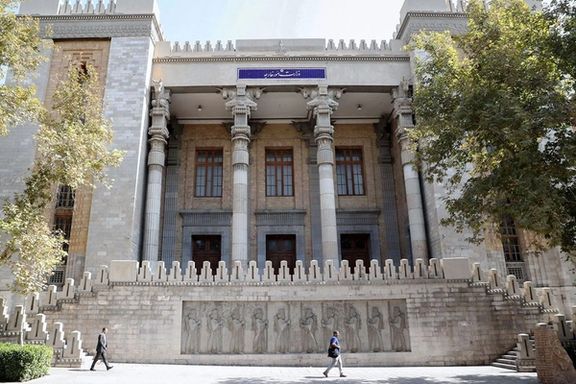
The Ministry of Foreign Affairs building in Tehran

Iran's Ministry of Foreign Affairs has summoned the ambassadors of the United Kingdom, France, and Germany in protest against their cooperation with the United States in convening a closed-door meeting of the UN Security Council regarding Iran's nuclear program.

The meeting, held on Wednesday, was criticized by Iran as an "abuse of Security Council mechanisms."

The summons was issued by Mohammad Hassan-Nejad Pirkouhi, Director-General for Peace and International Security at Iran's Foreign Ministry.

During the meeting, Pirkouhi cited the "irresponsible and provocative" actions of the three European countries, emphasizing that Iran's peaceful nuclear program complies with its obligations under the Nuclear Non-Proliferation Treaty (NPT) and does not violate the Joint Comprehensive Plan of Action (JCPOA).

He criticized the closed UN Security Council session as lacking legal and technical justification, labeling it as a politically motivated move influenced by the US's unilateral policies.

The summons comes amid rising tensions after the United States called on the UN Security Council to confront Iran over its nuclear program, accusing Tehran of violating IAEA safeguards and defying the Council.

The closed-door meeting was called by six of the council's 15 members - the US, France, Greece, Panama, South Korea and Britain.

Additionally, the United Kingdom has signaled its readiness to trigger the snapback mechanism—a process to reinstate UN sanctions if Iran does not curb its uranium enrichment.

Concerns were amplified following the February IAEA report which revealed that Iran had accumulated 275 kilograms of uranium enriched to 60% purity, a level far exceeding civilian needs.

With the UN's sanctions relief from the 2015 nuclear deal set to expire in October, European powers have indicated that they may resort to the snapback mechanism if diplomacy fails to prevent Iran from advancing its nuclear capabilities.

Most Viewed

Iran negotiators ordered to return after internal rift over Islamabad talks
1
EXCLUSIVE

Iran negotiators ordered to return after internal rift over Islamabad talks

2
ANALYSIS

US blockade enters murky phase as tankers spoof signals and buyers hesitate

3
ANALYSIS

Why the $100 billion Hormuz toll revenue is a myth

4

US tightens financial squeeze on Iran, warns banks over oil money flows

5
ANALYSIS

US blockade targets Iran oil boom amid regional disruption

Banner
Banner

Spotlight

  • Hardliners push Hormuz ‘red line’ as US blockade tests Iran’s leverage
    INSIGHT

    Hardliners push Hormuz ‘red line’ as US blockade tests Iran’s leverage

  • Ideology may be fading in Iran, but not in Kashmir's ‘Mini Iran'
    INSIGHT

    Ideology may be fading in Iran, but not in Kashmir's ‘Mini Iran'

  • War damage amounts to $3,000 per Iranian, with blockade set to add to losses
    INSIGHT

    War damage amounts to $3,000 per Iranian, with blockade set to add to losses

  • Why the $100 billion Hormuz toll revenue is a myth
    ANALYSIS

    Why the $100 billion Hormuz toll revenue is a myth

  • US blockade targets Iran oil boom amid regional disruption
    ANALYSIS

    US blockade targets Iran oil boom amid regional disruption

  • Iran's digital economy battered by prolonged blackout
    INSIGHT

    Iran's digital economy battered by prolonged blackout

•
•
•

More Stories

Iran expands crackdown on online dating, detaining organizers

Mar 13, 2025, 12:14 GMT+0

Iranian authorities have intensified their campaign against online dating content, summoning or arresting 15 people involved in organizing blind date events on social media.

The arrests, announced on February 25 by the head of Iran’s Public Security Police Majid Feyz Jafari, were carried out in coordination with the judiciary in response to what officials describe as a growing phenomenon of anonymous meet-ups facilitated through digital platforms.

"Given the rising popularity of blind dates in online spaces, this action follows numerous family complaints and intelligence monitoring," Jafari said.

Iran has faced criticism from rights groups over its sweeping internet restrictions, which have led many citizens to rely on virtual private networks (VPNs) to bypass censorship and access blocked platforms like YouTube, Twitter, and Instagram.

The issue resurfaced on Wednesday when judiciary spokesperson Asghar Jahangir revealed that a criminal case had been opened against those it had detained.

"The main defendant remains in custody, while four others are held due to an inability to post bail. The primary charge involves encouraging corruption and inciting individuals to immoral acts," Jahangir said at a press conference.

Social life via social media

While the authorities frame blind date programs as a moral threat, the concept itself is neither new nor exclusive to Iran. In Iran, such interactions were once mediated through family or traditional matchmakers, but digital platforms have reshaped how young people connect.

Sociologist Aliyeh Shekarbeigi argues that the response of Iranian authorities reflects a broader gap between official policies and evolving social norms.

"Iranian society consists of both formal and informal structures. The formal structure, represented by government policies lags behind the realities of how people live and interact," she told Sharq daily.

Public backlash and concerns over restrictions

Critics of the crackdown see it as part of a broader attempt to control digital spaces. The Iranian government has long imposed restrictions on internet use, blocking platforms such as YouTube and Twitter while tightly monitoring domestic social media activity.

Shekarbigi warns that suppressing digital spaces for communication could have unintended consequences. "If authorities attempt to silence informal social structures through force, society will simply adapt by finding alternative, often underground, means of interaction," she added.

Iran has previously targeted social media influencers and content creators for promoting what authorities deem "un-Islamic" lifestyles.

Last year, officials seized the Instagram page of Blind Date, a popular show hosted by an influencer known as Vinnie Vids, who had garnered 1.2 million followers. The show had drawn millions of views before being abruptly taken offline under judicial orders.

UN report condemns surge in executions and repression in Iran

Mar 13, 2025, 11:51 GMT+0

A new United Nations report has strongly criticized Iran for a dramatic increase in executions, systematic gender-based discrimination, and repression of minorities in 2024.

The report, presented by UN Special Rapporteur Mai Sato, revealed that Iran carried out over 900 executions last year – the highest number since 2015 – with women and ethnic minorities disproportionately affected.

“Iran remains the highest per capita user of the death penalty globally,” Sato said. “The lack of transparency surrounding Iran’s death penalty practices violates fundamental human rights principles, including the right to truth and due process.”

The report highlighted that over half of the executions were related to drug offenses, prohibited under international law, while others were linked to charges such as "premeditated murder" and vaguely defined national security offenses.

Executions of minors were also recorded, in violation of international human rights law. “Despite the absolute prohibition of the death penalty for minors under international law, Iran continues to sentence and execute individuals for crimes committed before they turned 18,” the report said.

New hijab law expands state control over women

Sato also raised concerns over the application of discriminatory legal frameworks, especially against women. While the failure to wear the hijab is already punishable with heavy penalties under the existing Islamic Penal Code, the new Law on Protecting the Family through the Promotion of the Culture of Chastity and Hijab, which was set to enter into force but still hasn't, marks a dramatic expansion in the state's regulation of personal dress codes.

The law imposes severe punishments, including prison terms of up to 15 years and, in extreme cases, capital charges for women deemed to be non-compliant.

“This law marks an unprecedented expansion of state control over women’s bodies and personal choices,” Sato warned.

Rise in femicide and 'honor killings'

The report also revealed that at least 179 femicides were reported in 2024, with many categorized as so-called “honor killings,” often carried out by male family members.

Sato criticized Iran’s legal system for enabling such violence, noting that “the differentiation between honor-related killings and other forms of murder creates a dangerous hierarchy of violence, effectively legitimizing lethal attacks on women.”

Minorities face disproportionate repression

Minority groups, including Kurds, Balochis, and Baha’is, faced disproportionate repression. Balochis, who make up around 2-4% of Iran's population, accounted for up to 13% of executions.

Sato said, “Documented patterns of discrimination within Iran’s criminal justice system raise serious concerns regarding the use of the death penalty against minority groups.”

The report further criticized Iran's crackdown on dissent, including the targeting of activists and journalists. Cases were highlighted where human rights defenders were detained, denied medical care, or sentenced to lengthy prison terms.

“Political prisoners are routinely denied medical care, effectively turning incarceration into a slow death sentence,” Sato said.

War or peace debate takes over Tehran after Khamenei rejects Trump overture

Mar 13, 2025, 10:52 GMT+0
•
Behrouz Turani

Supreme Leader Ali Khamenei rejected US President Donald Trump’s overture for a deal with Tehran even before opening Trump’s letter. Still, like commentators and diplomats in Iran and abroad, he was likely aware of its contents.

Around the same time Khamenei was speaking in Tehran on March 12, Iranian and Russian sources revealed that Trump’s proposal was not limited to the nuclear issue, as Iran had expected, but also included discussions on Iran’s regional proxy groups.

While Iranians traditionally view negotiations as a lengthy process of bargaining, much like haggling over a carpet in the bazaar, Trump’s approach appears more like a spring storm—starting with thunder and lightning, followed by a brief but intense downpour, before quickly subsiding into calm.

Former Iranian diplomat Kourosh Ahmadi, in an article in Shargh newspaper, wrote that Khamenei’s earlier refusal to engage with the United States—widely interpreted as a rejection of negotiations—was not fundamentally different from remarks by Iran’s envoy in New York, Saeed Iravani. Iravani stated that "if negotiations are meant to address concerns about the militarization of Iran’s nuclear program, such talks are possible."

Ahmadi added that Iravani’s remarks show a change and indicate a new development in Iran’s position. This comes while Khamenei had stressed that negotiation over “Iran’s defense capabilities, its international power and the range of its missiles and so on will certainly not be accepted."

Nonetheless, the former diplomat noted that “the nuclear issue is by far Trump’s most important, and possibly his only, priority” when it comes to Iran. Ahmadi argued that the United States recognizes Iran’s regional proxies have been significantly weakened and that restoring their previous strength is no longer feasible. Additionally, he pointed out that both Iran’s neighbors and Washington understand that Iran’s missiles have a limited range and that its regional presence is largely justified by the absence of a conventional air force.

In another development, centrist politician Ezzatollah Yousefian Molla told the conservative Nameh News website that "Trump will gradually retreat from his current positions." He added that Iran has no issue with logical negotiations and realistic demands but emphasized, "If the other side intends to impose its views, that can no longer be called negotiation."

Several other politicians and commentators also stated last week that most of Trump’s threats are mere "bluffs." Yousefian Molla argued that Trump will walk back his more extreme proposals, recognizing that preventing war serves everyone's interests. He also claimed that "Trump understands that engaging in an all-out war is not in the United States’ interest, as Iran would respond forcefully to any military conflict."

However, Iranian academic Kiumars Yazdanpanah warned that "both Iranian and US officials have adopted increasingly confrontational stances, making the possibility of an actual conflict quite real. At this moment, conflict appears to be the most likely outcome."

Yazdanpanah outlined three possible scenarios for the near future. First, he suggested there could be limited military exchanges between Iran and the United States, with one or two swift retaliatory actions. The second scenario, he said, is a temporary state of war, in which the US launches extensive military strikes against Iran while simultaneously working to isolate the country, incite unrest, and exploit geopolitical tensions. The third possibility, according to Yazdanpanah, is that the current standoff—whether through continued escalation or negotiation—leads to a compromise aligned with both sides’ national interests, potentially facilitated by international mediation.

He added that Saudi Arabia is best positioned to act as a mediator and help prevent a war between Iran and the United States. However, he emphasized that regardless of whether a conflict occurs, Iran must rethink its current regional strategy.

China urges diplomatic solution to Iran nuclear issue ahead of talks

Mar 13, 2025, 09:29 GMT+0

China has said it will urge Iran to avoid conflict as tensions over its nuclear program grow, ahead of a trilateral meeting with Russia and Iran on Friday, as Beijing ramps up efforts to be seen as a diplomatic power.

"In the current situation, we believe that all parties should maintain calm and restraint to avoid escalating the Iran nuclear situation, or even walking towards confrontation and conflict," said Foreign Ministry spokeswoman Mao Ning during a press briefing on Thursday.

The upcoming meeting will be chaired by Chinese Vice Foreign Minister Ma Zhaoxu and attended by Russian Deputy Foreign Minister Sergey Ryabkov and Iranian Deputy Foreign Minister Kazem Gharibabadi.

While the agenda has not been disclosed, the talks are expected to focus on reviving diplomatic efforts concerning Tehran’s nuclear program, which has faced increased scrutiny following the US withdrawal from the Joint Comprehensive Plan of Action (JCPOA) in 2018 during President Donald Trump's first term.

Now in his second term, Trump has intensified his stance by reintroducing the "maximum pressure" campaign against Iran, aimed at curbing Tehran's nuclear activities and regional influence through renewed sanctions and diplomatic isolation.

Russia, a key diplomatic actor and original signatory of the JCPOA, has expressed support for restoring the agreement. Russian Foreign Minister Sergei Lavrov recently emphasized Moscow’s position. "We are in favor of restoring the original program from which the Americans dropped during the first Trump government," Lavrov said.

However, he also expressed concern over Washington's insistence on adding political conditions to any future deal, including restrictions on Iran's support for regional groups, which he warned "is not going to fly."

Beijing echoed similar sentiments. "China sincerely hopes that all parties can work together, continuously increase mutual trust and dispel misgivings, and turn the momentum of restarting dialogue and negotiation into reality at an early date," Mao said.

The Beijing talks follow a closed-door United Nations Security Council meeting in New York on Wednesday, where concerns were raised over Iran's expanding stockpile of uranium close to weapons-grade.

Beijing, a permanent member of the Security Council, cautioned against applying further pressure on Iran. "Applying maximum pressure on a particular country will not yield the desired outcome," China's UN envoy, Fu Cong, said.

China was one of the key mediators to help revive diplomatic ties between Iran and Saudi Arabia in 2023. Russia has also offered to mediate between the US and Iran over the nuclear issue.

Dear Ayatollah: Trump makes politics personal with Khamenei letter

Mar 12, 2025, 20:56 GMT+0
•
Negar Mojtahedi

US President Donald Trump's letter to Iran's Supreme Leader Ali Khamanei urging nuclear talks may represent a bid to engage directly with the country's veteran strongman and cut out technocrats who shepherded a previous agreement.

"The main aim was to directly engage the Supreme leader because normally these negotiations take place between ministers or senior officials," said Kamran Matin, a senior lecturer in International Relations at Sussex University, "The Americans know who's wielding the actual power in Iran."

Trump announced he had sent the letter in an interview which aired on Sunday. While he did not disclose its contents, the White House confirmed he was inviting Iran to negotiate on its nuclear program.

"There are two ways Iran can be handled, militarily or you make a deal," Trump had told Fox Business. "I would prefer to make a deal, because I'm not looking to hurt Iran."

Tehran denies seeking a nuclear weapon but has rapidly stepped up nuclear enrichment in recent years and now its stockpile could in principle be refined further into six atomic bombs, according to the United Nations nuclear watchdog.

Just a day after Trump had revealed his letter gambit, Khamenei delivered another speech rejecting the idea of US talks, fulminating that Tehran will not be bullied.

On Wednesday the Supreme Leader said Trump's pullout from a 2015 nuclear deal means he cannot be trusted and that Washington would come off worst in any war.

But Khamenei's rhetoric may indicate the door is not yet completely closed , said Alex Vatanka, director of the Iran program at the Middle East Institute in Washington DC.

That deal was mostly championed by relative moderates in the Iranian government.

Khamenei's message may lie not so much what he said but what he left out.

"(The Supreme Leader) hasn't said no to talking to Trump forever and ever," said Vatanka, "He hasn't even mentioned the assassination of Qassem Soleimani. And that was supposed to kill the notion of Iran ever talking to Trump again. But we haven't heard anything about Qassem Soleimani in the last sort of signals from Khamanei."

Trump ordered the assassination of Iran's most formidable military commander Qassem Soleimani in a 2019 drone strike in Baghdad, causing Khamenei and other hardliners to seethe and vow revenge.

Trump in his first term had also sought to convey a letter to Khamenei which he refused to even accept.

Letter vs Oral Message

Iran's fortunes are far bleaker now, however, providing more of an opening for talks.

Iran, Vatanka argued, suffered a huge setback with the fall of its greatest Arab ally in Syria, while other proxies like Hamas and Hezbollah were also severely weakened by Israel. US-led sanctions have brought Iran's economy to its knees and threaten unrest.

The US president could have sent an informal message through a third country but chose to send a letter to Khamenei, as his predecessors Barack Obama and Joe Biden had done previously.

Obama, whom Trump blasted as being too lenient on Iran in the 2015 deal, reached out to Iran's Supreme leader with a direct and secret letter in 2009.

"Sending a message written rather than orally does convey greater diplomatic urgency, greater importance," said Greg Brew, an Iran analyst with the Eurasia Group.

"An official message from the president would carry more weight," he added.

All options means all options

Despite Trump's apparent desire for a diplomatic solution with Iran, he still has maintained a tough stance by reinstating the "maximum pressure" campaign of sanctions on Iran from his first term.

Trump vowed the alternative to a new deal would be a military intervention.

"American alternative exit options are, such as Israeli or even American military force," said Behnam Ben Taleblu, senior director of the Iran Program at the Washington DC-based Foundation for the Defense of Democracy. "But make no mistake, I think when the president intimates that all options are on the table, all options are on the table."

While showing the world Washington aims for a diplomatic resolution is a good thing, Taleblu said the rift between the Islamic Republic and the Trump administration may be too wide to bridge.

"Realistically today in 2025, there is no real a zone of possible agreement that gives the US everything it needs from a nonproliferation perspective," Taleblu said, "let alone all the lingering non-nuclear issues that exist between the US and Iran.