• العربية
  • فارسی
Brand
  • Iran Insight
  • Politics
  • Economy
  • Analysis
  • Special Report
  • Opinion
  • Podcast
  • Iran Insight
  • Politics
  • Economy
  • Analysis
  • Special Report
  • Opinion
  • Podcast
  • Theme
  • Language
    • العربية
    • فارسی
  • Iran Insight
  • Politics
  • Economy
  • Analysis
  • Special Report
  • Opinion
  • Podcast
All rights reserved for Volant Media UK Limited
volant media logo

Iranian officials urge self-reliance and unity as Khamenei rejects US talks

Mar 9, 2025, 07:47 GMT+0Updated: 10:18 GMT+0
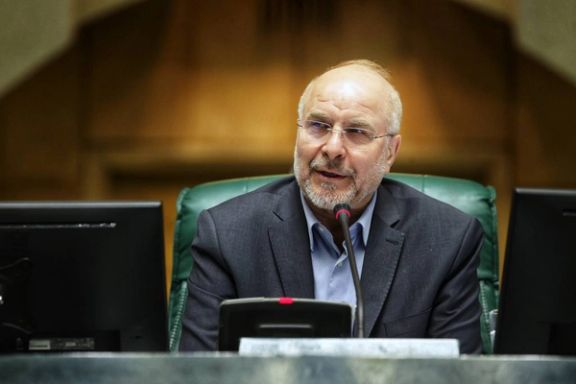
Speaker of Iran's parliament, Mohammad Baqer Qalibaf

Tehran will not wait for any letter from Washington and will instead rely on its own capabilities to reach a position where the US is forced to lift all sanctions, Speaker Mohammad Baqer Qalibaf told lawmakers in parliament on Sunday.

Iranian officials and media have threaded carefully on the issue of a letter that President Donald Trump says he sent to Supreme Leader Ali Khamenei urging talks. Tehran has not even officially acknowledged or denied the receipt of a letter, but Khamenei in a speech on Saturday rejected negotiations. No one from within the ruling circles is expected to disagree with the Supreme Leader.

“Regarding the US president’s claim about negotiations with Iran, it must be said that his behavior toward other countries clearly shows that these statements are merely a deceptive display of "negotiation" aimed at forcing Iran into disarmament—something he has already endorsed in the US policy document,” Qalibaf said, clearly repeating Khamenei’s main line of argument from the day before.

He also repeated Tehran’s rhetoric since early February that negotiating under pressure of Trump’s renewed “maximum pressure” would be “dishonorable” for Iran.

“It is obvious that no negotiation conducted under the shadow of threats and with the agenda of imposing new concessions in exchange for lifting sanctions will lead to any real outcome, except the humiliation of the proud Iranian nation,” Qalibaf told the parliament.

On Sunday, ISNA, a state-controlled news agency, ran a lead article emphasizing the need for domestic unity in the face of Trump's threats and demands for negotiations. To reinforce its message about the urgency of speaking with one voice, the agency quoted President Masoud Pezeshkian. “Unity and cohesion are the first and last word. If we are divided, we will not be able to achieve our goals. We must join hands… We are capable of overcoming all challenges.”

Since Donald Trump's election and growing expectations in Iran that he would increase pressure, a debate has emerged over the need to resolve differences with the United States to lift sanctions and rescue Iran’s crippled economy. However, for the second time in a month, Khamenei has made it clear that he will not allow negotiations—at least as long as Trump maintains his maximum pressure policy.

However, claims by Qalibaf, Pezeshkian, and others that Iran will resist Trump’s demands and rely on its own capabilities seem more like an attempt to present an alternative to Khamenei’s rejection of talks rather than a viable strategy to escape the economic crisis. Meanwhile, Trump has openly threatened military action if Tehran refuses negotiations—a scenario in which it remains unclear whether the Islamic Republic has sufficient defensive capabilities.

Most Viewed

State media slam Araghchi's Hormuz tweet, say it let Trump claim victory
1

State media slam Araghchi's Hormuz tweet, say it let Trump claim victory

2
OPINION

The Hormuz get out of jail card turned to a grave

3

Iran International says it won’t be silenced after London arson attack

4
INSIGHT

How Tehran bends its own red lines to boost state rallies

5

Iran halts petrochemical exports to supply domestic market

Banner
Banner

Spotlight

  • Too early to tell who is winning Iran war, experts say
    PODCAST

    Too early to tell who is winning Iran war, experts say

  • How Tehran bends its own red lines to boost state rallies
    INSIGHT

    How Tehran bends its own red lines to boost state rallies

  • Iran blackout cripples freelancer, small business incomes
    VOICES FROM IRAN

    Iran blackout cripples freelancer, small business incomes

  • Ideology may be fading in Iran, but not in Kashmir's ‘Mini Iran'
    INSIGHT

    Ideology may be fading in Iran, but not in Kashmir's ‘Mini Iran'

  • US blockade enters murky phase as tankers spoof signals and buyers hesitate
    ANALYSIS

    US blockade enters murky phase as tankers spoof signals and buyers hesitate

  • Why the $100 billion Hormuz toll revenue is a myth
    ANALYSIS

    Why the $100 billion Hormuz toll revenue is a myth

•
•
•

More Stories

Khamenei rejects negotiation with US in first speech after Trump's letter

Mar 8, 2025, 14:54 GMT+0

Iran's Supreme Leader Ali Khamenei on Saturday ruled out the possibility of negotiation with the United States, in his first public speech after President Donald Trump said he sent a letter to him.

"The insistence of some bullying governments on negotiations is not aimed at resolving issues but rather at asserting dominance and imposing their demands," Khamenei said in a meeting with Iranian officials in Tehran.

"The Islamic Republic of Iran will certainly not accept their demands," he added.

His comments followed Trump’s revelation that he had sent Khamenei a letter offering negotiations on Iran's nuclear program while warning that military intervention was the alternative.

Iran's Foreign Minister Abbas Araghchi said on Saturday Tehran has not yet received Trump's letter to Khamenei.

Responding to Khamenei's rejection of Trump's call to negotiate a nuclear agreement, the White House on Saturday reiterated the US president's assertion that Tehran can be dealt with either militarily or by making a deal.

"We hope the Iran regime puts its people and best interests ahead of terror," White House National Security Council spokesman Brian Hughes said in a statement.

Lebanese pro-Iranian TV channel Al Mayadeen reported Saturday Tehran had refused to enter nuclear negotiations with the United States under the conditions set by the current US administration.

No talks on missile capabilities, regional influence

Khamenei said the West's issue is not just Tehran's nuclear program. "Rather, for them, negotiations are a means to raise new demands, including restrictions on defense capabilities and international influence."

"They set expectations such as 'Do not do this,' 'Do not meet with that person,' or 'Do not extend missile range beyond a certain limit.' These demands will certainly not be accepted or fulfilled by Iran."

While Tehran maintains that its ballistic missile program is purely defensive, the West considers it a destabilizing factor in a volatile, conflict-ridden Middle East.

'Shameless Europeans'

In his Saturday remarks, Khamenei also lashed out at European countries for criticizing Tehran's non-compliance with the 2015 nuclear deal, calling them shameless.

"Those three European countries are issuing statements, claiming that Iran has not fulfilled its nuclear commitments under the JCPOA! Someone should ask them: Have you fulfilled yours? You never did from the very beginning!"

Khamenei said the E3 (France, Britain and Germany) promised to compensate after Donald Trump withdrew Washington from the nuclear deal in 2018, but they broke their promise.

"Then you made another claim and broke that second promise as well. There should be a limit to shamelessness! How can someone fail to uphold their own commitments and then turn around and accuse the other side of non-compliance?"

Iran's Supreme Leader said the Rouhani administration at the time tolerated for a year, then the Parliament stepped in and passed a bill that effectively blocked the revival of the deal.

"There was no other way. And now, the same holds true: There is no other way to stand against coercion and bullying," he added.

Holocaust denial

Khamenei further criticized what he called the Western double standards on the free flow of information, saying that no one can mention slain IRGC Quds Force Commander Qassem Soleimani, Hezbollah leader Hassan Nasrallah, or Hamas leader Ismail Haniyeh, "protest the crimes committed in Palestine and Lebanon, or deny what Hitler is claimed to have done to the Jews on Western-run social media."

The leaders of the Islamic Republic have a long history of Holocaust denial and Holocaust revisionism.

Iran's former president Mahmoud Ahmadinejad issued a number of statements claiming The Holocaust as is commonly accepted is "a myth" and "a lie".

Former President Ebrahim Raisi also cast doubt on whether the Holocaust happened in a 2022 interview with CBS News.

On January 20, 2022, the United Nations General Assembly passed a resolution that condemned the denial and distortion of the Holocaust. Iran was the only country in the world that condemned and rejected the resolution.
Tehran shoots down nuclear talks under US conditions - Al Mayadeen

Mar 8, 2025, 13:05 GMT+0

Iran has refused to enter nuclear negotiations with the United States under the conditions set by the current US administration, Lebanese pro-Iranian TV channel Al Mayadeen reported Saturday.

Although the report was published a day after President Donald Trump announced he had sent a letter to Supreme Leader Ali Khamenei, it makes no mention of the message.

The outlet cited an unnamed high-ranking Iranian diplomatic source who said that during his visit to Tehran last month, Russian Foreign Minister Sergey Lavrov expressed Moscow’s willingness to facilitate nuclear negotiations with Washington through diplomatic channels.

Tehran told Lavrov that it would never engage in talks with Washington under the conditions imposed by the Trump administration.

President Trump revealed on Friday that he had sent a letter to Khamenei, offering negotiations while warning of military consequences if talks failed. Speaking to Fox Business Network, Trump said, “There are two ways Iran can be handled: militarily or through a deal. I would prefer to make a deal.”

Iran swiftly dismissed the letter, with an official outlet of the Islamic Revolutionary Guard Corps (IRGC) calling it a psychological operation. Iran’s UN mission in New York also denied receiving any such communication.

Meanwhile, on Thursday, Russian Deputy Foreign Minister Sergei Ryabkov met with Iranian Ambassador Kazem Jalali to discuss international efforts to resolve issues surrounding Iran’s nuclear program, the Russian Foreign Ministry announced on Friday.

According to a Bloomberg report on Tuesday, later confirmed by the Kremlin, Russia has agreed to assist the US in communicating with Iran on various matters, including its nuclear program and support for regional anti-US proxies.

Kremlin spokesman Dmitry Peskov said, "Russia believes that the United States and Iran should resolve all problems through negotiations" and that Moscow "is ready to do everything in its power to achieve this." The report was subsequently picked up by Russian state media.

Last month, prior to Russia's official offer of mediation, Russian Foreign Minister Sergei Lavrov met with Iranian President Masoud Pezeshkian and Foreign Minister Abbas Araghchi in Tehran, where both sides reportedly "aligned their positions" on the 2015 Joint Comprehensive Plan of Action (JCPOA), the nuclear deal that unraveled following the US withdrawal in 2018.

Khamenei rejects negotiations with 'bullying governments'

Mar 8, 2025, 10:50 GMT+0
•
Maryam Sinaiee

The Islamic Republic will not engage in negotiations with "bullying" powers, Supreme Leader Ali Khamenei said in a speech on Saturday, a day after US President Donald Trump sent him a letter requesting nuclear talks.

Khamenei's official website quoted him as saying, "The insistence of some bullying governments on negotiations is not aimed at resolving issues but rather at asserting dominance and imposing their own demands. The Islamic Republic of Iran will certainly not accept their expectations."

President Trump revealed on Friday that he had sent a letter to Khamenei, offering negotiations while warning of military consequences if talks failed. Speaking to Fox Business Network, Trump said, “There are two ways Iran can be handled: militarily or through a deal. I would prefer to make a deal.”

Many in Iran anticipated Khamenei’s response to President Donald Trump’s letter during his speech at a meeting with top government officials on Saturday afternoon. Although the full text of his speech has not yet been released, but apparently he did not directly address Trump's letter.

Khamenei routinely meets with senior government officials, including the president, every Ramadan. This time, however, the announcement came unusually late on Friday evening Tehran time. This followed Trump’s revelation that he had sent Khamenei a letter offering negotiations on Iran's nuclear program while warning that military intervention was the alternative.

Iran has not officially acknowledged receiving Trump’s letter. On Friday, Tehran’s UN mission in New York stated that Iran had “so far” not received any such correspondence.

Speculation over Russian mediation

Highlighting the mediatory role that Russia is playing between Iran and the US, some Iranian media and pundits have speculated that the letter may have been handed to the Iranian ambassador Kazem Jalali during his meeting with the Russian Deputy Foreign Minister Sergei Ryabkov around midday Tehran time on Friday. Tehran and Moscow both said the meeting was to discuss international efforts to resolve Iran's nuclear program and Tehran-Moscow cooperation.

Hardline media predict no response

Trump sent another letter to Khamenei in 2019, after unilaterally withdrawing from the 2015 nuclear deal. Khamenei refused to accept the letter, delivered by then-Japanese Prime Minister Shinzo Abe, and insisted that Trump was untrustworthy.

An editorial in the Revolutionary Guards (IRGC) linked Javan newspaper on Saturday dismissed Trump’s latest letter as “a segment of America’s propaganda puzzle”. Referring to Khamenei’s refusal to accept Trump’s 2019 letter, the editorial suggested that Iran would once again ignore Trump’s message. “Based on the Islamic Republic’s polices; one can predict Iran's response to the letter. There will be no reply, assuming the letter is allowed to be delivered,” the article stated.

The ultra-hardliner Kayhan newspaper similarly referenced the 2019 incident and Khamenei’s rejection of the idea of negotiations with the United States in a speech in February. In its editorial on Saturday, Kayhan argued that Trump’s primary goals was to improve his own image and shift blame for lack of diplomacy onto Iran.

Backchannel diplomacy

Iran and the United States typically communicate through backchannels or intermediaries, such as Oman, which has on several occasions facilitated meetings between officials of the two countries or relayed messages.

Former President Barack Obama reportedly sent multiple letters to Khamenei between 2009 and 2015, discussing topics such as diplomacy, the nuclear deal (JCPOA), and potential cooperation against ISIS. However, there are no reports that Khamenei ever responded in writing to any of these letters.

Iran's president criticizes US sanctions, apologizes for tough winter

Mar 8, 2025, 10:40 GMT+0

On Saturday, Iran's president criticized US efforts to curb the country's energy exports but made no mention of the letter President Donald Trump said a day earlier that he had sent to Supreme Leader Ali Khamenei.

Speaking at an event marking new investments in the South Pars gas field, Masoud Pezeshkian said Iran had endured a difficult winter but managed to keep gas supplies flowing.

“We went through a tough winter,” Pezeshkian said. “Once again, I apologize to the people for power cuts and other issues. Naturally, we must also apologize to industries and producers because we could not fully support them.”

Turning to US sanctions, Pezeshkian dismissed Washington’s efforts to stifle Iranian fuel exports. “They try and say they will bring our fuel exports to zero, that we won’t be able to sell our oil,” he said. “I believe we must engage with a proper logic and not fight amongst ourselves. Their hope is in our internal divisions.”

President Trump announced on Friday that he sent a letter to Khamenei offering talks toward a deal on its nuclear program but warned that the alternative was a military intervention.

"I hope that Iran, and I've written them a letter saying, I hope you're going to negotiate because if we have to go in militarily, it's going to be a terrible thing for them," Trump said in a segment of the interview broadcast on Friday.

"There are two ways Iran can be handled, militarily or you make a deal. I would prefer to make a deal because I'm not looking to hurt Iran," Trump added. "They're great people. I know so many Iranians from this country."

Since returning to office, Trump has imposed fresh sanctions targeting companies and the so-called shadow fleet of older oil tankers transporting Iranian crude.

Despite US sanctions, Iran’s oil exports have generated more than $35 billion annually in recent years, primarily from sales to China. However, this revenue has not been enough to pull the oil-dependent economy out of the severe crisis it has faced since 2019.

Since early September, Iran’s national currency, the rial, has lost half of its value due to military and geopolitical setbacks in the region and Trump’s election, as he has pledged to significantly cut Tehran’s oil exports.

Pezeshkian praised efforts by Iran’s oil and gas sector to maintain household energy supplies but said the country must improve efficiency and expand renewable energy.

Pezeshkian announced a $17.5 billion investment in power infrastructure aimed at increasing sustainability and allowing more oil and gas to be sold abroad.

Iran needs $45 billion in investment to resolve its chronic winter energy deficit and worsening air pollution, the country's Oil Minister Mohsen Paknejad said in January.

“If we can expand electricity use for heating and cooling, relying on wind and solar energy, then we can export our resources at far better prices,” said Pezeshkian.

Successive Iranian governments have struggled to meet soaring consumption, especially during colder months when power plants are forced to burn polluting fuels that compound the problem of air quality in urban areas.

Iran possesses vast reserves of natural gas, but rising domestic demand and lack of investment to maintain and expand the infrastructure means the country is often a net-importer of energy.

Tehran signals defense preparedness as US weighs next steps

Mar 8, 2025, 08:33 GMT+0

An Iranian army commander has said the country’s military remains fully prepared for any scenario as diplomatic uncertainty deepens between Iran and the US.

Brigadier General Nozar Nemati, deputy commander of Iran’s Army Ground Forces, said that Iran’s military remains on high alert. “The armed forces, especially the Army, are always ready to defend the ideals of the Islamic Republic and protect the country’s borders,” he told IRNA on Saturday.

His comments came just hours after US President Donald Trump revealed that he had sent a letter to Iran’s Supreme Leader Ali Khamenei, offering negotiations but warning of military consequences if talks fail over Iran's nuclear program.

"I hope you're going to negotiate because if we have to go in militarily, it's going to be a terrible thing for them," Trump told Fox Business Network in a segment of the interview broadcast on Friday. "There are two ways Iran can be handled: militarily or through a deal. I would prefer to make a deal".

Later on Friday, Trump told reporters at the Oval Office, “We are at the final moments with Iran,” adding that “something’s going to happen very soon.”

The letter was swiftly rejected by an official outlet of Iran’s Islamic Revolutionary Guard Corps (IRGC), dismissing it as a psychological operation. Iran’s UN mission in New York also stated it had received no such letter.

Iran’s Foreign Minister Abbas Araghchi, speaking on Friday, had accused Israel of trying to pull the US into a regional war. “It is Israel’s desire to involve other countries in war. It is Israel’s desire to draw America into war,” Araghchi told AFP, warning that US intervention would leave Washington “extremely vulnerable.”

Amid the growing tensions, Nemati reaffirmed Iran’s border security efforts, noting that the country has reinforced its defenses and remains in coordination with IRGC forces. “Our forces are stationed across all critical border areas, working in complete harmony to ensure security,” he said.

Iran has also continued large-scale military drills, including Zolfaghar 1403, which last month showcased its naval, air, and ground combat capabilities.

Trump’s remarks come as his administration escalates its economic pressure campaign on Iran. On Thursday, US Treasury Secretary Scott Bessent outlined a renewed “maximum pressure” strategy aimed at cutting Iran’s oil revenues and further devaluing its currency.