• العربية
  • فارسی
Brand
  • Iran Insight
  • Politics
  • Economy
  • Analysis
  • Special Report
  • Opinion
  • Podcast
  • Iran Insight
  • Politics
  • Economy
  • Analysis
  • Special Report
  • Opinion
  • Podcast
  • Theme
  • Language
    • العربية
    • فارسی
  • Iran Insight
  • Politics
  • Economy
  • Analysis
  • Special Report
  • Opinion
  • Podcast
All rights reserved for Volant Media UK Limited
volant media logo

Iran to begin new army drills as US, Israel weigh next moves
Feb 21, 2025, 10:48 GMT+0
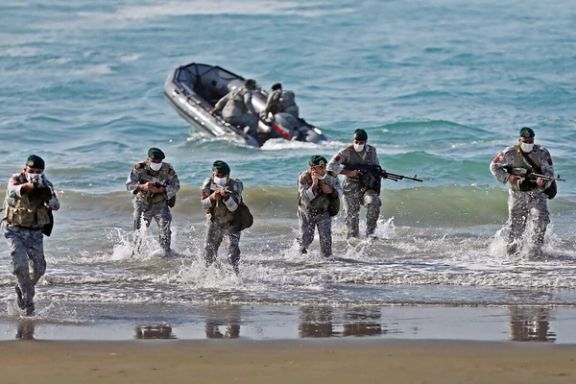
embers of the Iranian army take part in the annual military drill, dubbed “Zolfaghar 99”, in the Gulf of Oman, Iran on September 8, 2020.

Iran’s armed forces are set to begin a large-scale military exercise dubbed Zolfaghar 1403 on Saturday as tensions with Israel and the United States persist over Tehran’s nuclear program.

The drills, led by the Iranian Army, will span an area from the Makran, in southeastern Iranian coast, to the northern Indian Ocean, covering strategic waters up to the 10-degree latitude.

The Makran coast, which lies along Iran’s border with Pakistan on the Arabian Sea, is a key military and economic zone, home to the country's growing naval infrastructure.

Admiral Habibollah Sayyari, the commander of the exercise, warned that any attack on Iranian interests would not go unanswered. He said, “Any enemy that thinks it can harm our interests on land, in the air, or at sea will certainly suffer great damage.”

He added that the Zolfaghar 1403 exercise will demonstrate Iran’s latest military capabilities, showcasing the strength of ground forces, air defense, strategic naval forces, and the Joint Air Defense Headquarters.

Sayyari’s remarks come amid reports that Israel is considering launching an attack on Iranian nuclear sites as early as the first half of this year.

According to The Wall Street Journal and The Washington Post, US intelligence findings from last month indicate that Israel views Iran as vulnerable following the October 26 Israeli air strike, which reportedly knocked out large portions of Iran’s air defenses. The reports also suggest that Israel perceives increased US willingness to support military action, particularly with President Donald Trump back in the White House.

During a recent visit to Washington, Israeli Prime Minister Benjamin Netanyahu said that Israeli strikes had "crippled Iran's air defenses."

While Zolfaghar 1403 is an Army-led exercise, Iran has also recently conducted joint drills between the Iranian Army and the IRGC, focusing on defending key nuclear sites such as Natanz and Fordow.

The exercises, which are set to continue until mid-March, come after Iran unveiled the Zagros, its first signals intelligence (SIGINT) vessel for electronic surveillance. Additionally, Iran has expanded its drone fleet, receiving 1,000 new drones to bolster its capabilities.

As Iran ramps up its military posture, US Central Command (CENTCOM) and the Israeli Defense Forces (IDF) are closely coordinating on regional security.

On Wednesday, CENTCOM Commander Gen. Michael Erik Kurilla hosted IDF Chief of Staff Lt. Gen. Herzi Halevi at headquarters in Tampa, Florida, where they discussed Iran’s growing influence along with the ceasefire in Gaza, hostilities in Lebanon, and the Iran-backed Houthis in Yemen. The CENTCOM statement, published on Thursday, reaffirmed the deep US-Israel military partnership as both countries assess Tehran’s actions in the region.

Last month, 110,000 paramilitary Basij forces took part in a large-scale IRGC drill aimed at preparing for potential security threats in Tehran.

With Iran ramping up military activities across multiple fronts, the region remains on high alert as the country signals its readiness to counter any external threats. Iranian military commanders have been making frequent statements about their military capabilities, and recently have renewed direct threats against Israel.


Most Viewed

Iran negotiators ordered to return after internal rift over Islamabad talks
1
EXCLUSIVE

Iran negotiators ordered to return after internal rift over Islamabad talks

2
ANALYSIS

US blockade enters murky phase as tankers spoof signals and buyers hesitate

3
ANALYSIS

Why the $100 billion Hormuz toll revenue is a myth

4

US tightens financial squeeze on Iran, warns banks over oil money flows

5
ANALYSIS

US blockade targets Iran oil boom amid regional disruption

Banner
Banner

Spotlight

  • Hardliners push Hormuz ‘red line’ as US blockade tests Iran’s leverage
    INSIGHT

    Hardliners push Hormuz ‘red line’ as US blockade tests Iran’s leverage

  • Ideology may be fading in Iran, but not in Kashmir's ‘Mini Iran'
    INSIGHT

    Ideology may be fading in Iran, but not in Kashmir's ‘Mini Iran'

  • War damage amounts to $3,000 per Iranian, with blockade set to add to losses
    INSIGHT

    War damage amounts to $3,000 per Iranian, with blockade set to add to losses

  • Why the $100 billion Hormuz toll revenue is a myth
    ANALYSIS

    Why the $100 billion Hormuz toll revenue is a myth

  • US blockade targets Iran oil boom amid regional disruption
    ANALYSIS

    US blockade targets Iran oil boom amid regional disruption

  • Iran's digital economy battered by prolonged blackout
    INSIGHT

    Iran's digital economy battered by prolonged blackout

•
•
•

More Stories

Israel will be wiped out in a major attack ‘at the right time’, IRGC General says

Feb 21, 2025, 08:18 GMT+0

A high-ranking general in Iran’s Revolutionary Guards has said that a third large-scale missile attack on Israel will wipe out the country and destroy Tel Aviv and Haifa.

“Operation True Promise 3 will be carried out at the right time, with precision, and on a scale sufficient to destroy Israel and raze Tel Aviv and Haifa to the ground,” General Ebrahim Jabbari said.

In 2024, Iran launched two large-scale missile and drone attacks against Israel, but with limited success.

Israeli air defenses, combined with intervention from the US and other allies, intercepted most of the projectiles, preventing significant damage.

The general, who is an adviser to IRGC chief commander Hossein Salami, was speaking on Thursday to paramilitary forces during ongoing drills, dubbed “The Great Exercise of Prophet Mohammad's Power.”

Jabbari claimed that “the United States can do nothing against Yemen.” He added that the resistance fronts in Lebanon, Iraq, and Palestine are at the peak of readiness, and Supreme Leader Ali Khamenei also ordered to increase the range of missiles.

Israel's Foreign Minister Gideon Sa'ar said on X that it took the threat seriously and was prepared to defend itself.

“If the Jewish people have learned anything from history, it is this: if your enemy says his goal is to annihilate you—believe him,” Sa’ar said, citing Iran International’s original article on Jabbari’s threat.

“We are ready."

Tehran faced significant setbacks in the region in 2024, including Israeli operations that severely weakened Hezbollah in Lebanon and the overthrow of Bashar al-Assad in Syria. In October, an Israeli airstrike reportedly delivered a decisive blow to Iran’s Russian-supplied air defense system.

Since Donald Trump took office in the United States, Tehran has grown increasingly insecure, issuing repeated warnings against further attacks. It has also conducted continuous military drills since early January.

General Jabbari at length praised IRGC Quds Force former commander Qasem Soleimani and Hezbollah leader Hassan Nasrallah who was killed by a targeted Israeli air raid last September.

They were “teachers who trained a whole generation of younger commanders,” he said.

Praising what he called their devotion to Khamenei, he said, “These martyrs believed their success lay in absolute obedience to the Supreme Leader.”

Weakness on Russia empowers Iran, Macron to tell Trump

Feb 20, 2025, 18:45 GMT+0

French President Emmanuel Macron said he will travel to Washington to convince US President Donald Trump that showing weakness toward Russian President Vladimir Putin would make it harder to confront China and Iran.

"I'm going to tell (Trump), basically, 'You can't be weak in the face of President Putin...How can you then be credible in the face of China?" Macron said during a social media Q&A on Thursday.

"And you, who wants Iran not to have nuclear weapons, you can't be weak with someone (Putin) who is helping (Iran) acquire it," he added.

Macron's scheduled visit to Washington was confirmed by White House Press Secretary Karoline Leavitt.

"Next Monday, the president will host France's President Emmanuel Macron, and on Thursday the UK Prime Minister Keir Starmer will visit the White House as well," she told reporters.

Last month, Macron warned that Iran's nuclear program is nearing the point of no return, stressing the need for Paris to engage in strategic discussions with Trump's administration about Tehran.

Macron also mentioned Iran's ballistic missiles and support for Russia, labeling them threats to Europe.

“(Iran's) ballistic missile program threatens European soil and our interests. Iran is already involved in Russia's war against Ukraine through clear and fully identified military support,” he said.

President Trump's recent remarks on the war in Ukraine and the country's president, Volodymyr Zelensky has troubled European powers who seek US support in dealing with what they see as a growing Russian threat.

Palestinian Islamic Jihad chief in Tehran calls Iran 'home of resistance'

Feb 20, 2025, 16:34 GMT+0

Palestinian Islamic Jihad leader Ziyad al-Nakhalah praised Iran for its support of allied armed groups in the region, calling it a crucial factor in their military operations against Israel.

Speaking in Tehran on Thursday during a meeting with Iran’s armed forces chief Mohammad Bagheri, he called Iran the "home of the resistance."

"The victories of the resistance in Palestine and Lebanon were achieved with the support and effective role of the Islamic Republic of Iran," he said.

He also described Iran’s direct involvement in the True Promise 1 and 2 operations—missile and drone attacks launched by Iran on Israel—as a "strategic and influential shift in the spirit of the region’s nations."

Between bluffing and blessing, Khamenei maps cryptic course on Trump talks

Feb 20, 2025, 13:35 GMT+0
•
Navid Hamzavi

Iran’s supreme leader Ali Khamenei has dismissed talks with the United States but history shows that his defiance can be a strategic bluff as much as it may be a genuine rejection of negotiation.

On 7th February, Iran’s Supreme Leader unequivocally rejected negotiations with Washington, saying, “Negotiating with a government like the US is neither wise, nor intelligent, nor honorable."

Just ten days earlier, he had cautiously signaled openness to talks. This is what he said.

“We must be mindful of whom we are dealing with, whom we are trading with, and whom we are speaking to—this is something we must know. When a person understands the other party, they may still engage in a transaction, but they will know how to act. We must recognise and be aware.”

How should one interpret Khamenei’s stance on a potential engagement with the US under President Donald Trump? Two hypotheses come to mind.

First, he may secretly be open to negotiations but publicly rejects the idea to maintain a strong front. By doing so, he creates room for backchannel diplomacy while avoiding the perception of weakness.

Alternatively, he may see talks with Trump as an existential threat, believing that it would undermine Iran’s strategic position or ideological foundations. Refusing to talk, in this case, would be more than posturing but a firm line in the sand.

A Strategic Bluff

Strategic bluffing and covert negotiations with the US have long been a cornerstone of Iran's policy, stretching back to the days and weeks before the Islamic Republic was founded.

In 1979, secret negotiations between Iran’s revolutionaries and the United States helped facilitate Ruhollah Khomeini's return while preventing a military coup. Washington sought assurances for the safety of American citizens and the prospect of future cooperation.

Barely a year later, Iran’s foreign minister at the time, Sadegh Ghotbzadeh, held covert talks with President Jimmy Carter’s Chief of Staff, Hamilton Jordan, to negotiate the release of the Americans held hostage in the US embassy in Tehran.

Then came the secret arms deal widely known as the Iran-Contra affair, where the Reagan administration agreed to send American weapons to Iran via Israel.

More recently, Tehran and Washington negotiated secretly in 2013, paving the way for the eventual 2015 nuclear deal with the Obama administration.

The latest alleged instance is Elon Musk holding undisclosed discussions with Iran’s UN representative, Amir-Saeed Iravani, in New York—a reminder that, whatever the rhetoric, real negotiations often happen in the shadows.

As Supreme Leader, Khamenei remains above the law and outside the cycle of direct negotiations. Holding the title of Imam—a designation for the infallible leaders of the Islamic community after the Prophet, as recognized by the majority of Shia Muslims—he embodies both spiritual and political authority.

By positioning himself as both a sovereign and a holy figure, he can maintain consistency in his hostility toward the United States, allow negotiations with it, and when necessary, criticize Iran’s negotiators as if they weren’t under his command.

Anti-Americanism and Anti-Zionism have been cornerstones of the Islamic Republic from the outset. Khamenei’s ongoing enmity with the US is not just political; it is an ideological imperative.

And then there’s President Donald Trump’s patronizing attitude, which Khamenei may view as a direct challenge to his quasi-holy position—something he cannot afford to let pass.

A Genuine Refusal

On the very same day that he floated the idea of negotiating with Tehran, Trump also ordered a return to his so-called maximum pressure on Iran and expressed his desire to take over Gaza.

If these were to materialize, not only further Iran’s ailing economy would be crippled but the Palestinian dream of statehood would be crushed and Khamenei’s plans for a US-free Middle East would end in ruins.

Some, including the Israeli ambassador to the US, have stressed that the only effective way to halt Iran's nuclear ambitions is through a deal akin to the Libyan model, involving the total dismantling of Iran’s nuclear infrastructure.

This is perceived in Tehran as a precursor to regime change by armed force, as was the case with Libya in 2011.

Khamenei may believe he can withstand maximum pressure for another four years, holding out for an administration that’s less assertive with Tehran. The outcome of the US midterm elections could help him with that.

As a sovereign ruler above law, Khamenei grants himself the luxury of time, delaying decisions at will.

“We can only enter the dangerous game of negotiations with the United States when we have achieved the desired level of economic, political, and cultural strength, so that their pressures and propaganda cannot affect us," Khamenei said in 2018.

"However, at present, negotiations would undoubtedly be to our detriment and are strictly forbidden.”

The real danger now lies in prolonged uncertainty. With talks yet to start and the decision to negotiate still in limbo, the threat of war grows ever closer.

However, as long as Khamenei is confident that his absolute sovereignty and the sanctity of his position remain uncontested, the door to US-Iran talks may remain slightly ajar—though always at the risk of being slammed shut at any given moment.

Faced with economic woes and political rivals, Pezeshkian turns to poetry

Feb 20, 2025, 13:34 GMT+0
•
Behrouz Turani

Hardliners in Tehran keep blaming other officials for Iran’s economic crisis, despite broad recognition that US sanctions and the state-controlled economy are the main causes of inflation and currency devaluation.

The dominant hardline faction in the Iranian parliament is pushing to impeach Economy Minister Abdolnaser Hemmati just six months into his tenure, despite the economic crisis dating back to 2018, when then-President Donald Trump withdrew from the JCPOA nuclear deal and imposed strict sanctions.

In a show of support for his embattled economic team, President Masoud Pezeshkian visited Central Bank Governor Mohammad Reza Farzin on Tuesday and met with Economy Minister Abdolnaser Hemmati on Wednesday, following the formal submission of the impeachment motion against him.

Nonetheless, Pezeshkian’s appearance in parliament to defend his ministers did not stop the impeachment process from moving forward.

Although the parliamentary session was confidential, hardline lawmaker Hamid Rasai secretly recorded part of the proceedings and shared the footage on social media. The video captured Rasai sharply criticizing Hemmati, Farzin, and Pezeshkian himself.

Qasem Ravanbakhsh, an ultraconservative MP from Qom, sarcastically told reporters that during the meeting, Pezeshkian tried to blame everyone but himself for the country’s economic problems.

In response, Pezeshkian shared a video of his meeting with the economy minister, emphasizing that key economic policies were collectively decided by the country's leadership. He said, “I told the Majles that all banking, monetary, and foreign exchange policies were approved at meetings of the heads of the three branches of government, with Hemmati and Farzin also present. The minister did not set these policies. If anyone is to be blamed for the economic problems, it’s us—the heads of the three branches of government. So, come and arrest us!”

“To blame only one person is unfair,” Pezeshkian added.

Leaving some in the room perplexed, Pezeshkian continued by reciting a verse of classic Persian poetry by South Asian poet Sir Muhammad Iqbal of Lahore (1877–1938). The lines—“Open your eyes to yourself and close your eyes to others. Learn how to see and hear differently.”—did little to address the economic crisis, leaving many unsure of his intended message.

The pro-reform website Rouydad24 attributed Iran's economic troubles to US sanctions and regional tensions, including conflicts with Israel and Trump’s recent move to tighten sanctions. The site overlooked deeper structural issues within Iran’s economy and the disorganized political system that have also fueled the crisis.

Conservative politician Ali Mohammad Namazi told Nameh News that "People need to be convinced that the country's problems can be solved. However, Pezeshkian has failed to assure them that this is possible."

"Iranians are suffering from longstanding issues, and only effective solutions can restore their confidence," he added.

Namazi also warned that "people can no longer tolerate the economic hardships. They are struggling to live normal lives, and public dissent is growing. They might wait in the hope of a government solution, but this patience won’t last forever. Eventually, they will be compelled to protest."

The politician emphasized the urgency for officials to act swiftly, noting that lifting sanctions is the only way to address rising prices and inflation. He warned that without prompt action, the situation could become unpredictable if the inflation rate exceeds 50 percent.

He argued that Pezeshkian cannot claim ignorance of the country’s problems, given his extensive political experience as a multi-term parliament member and a former cabinet minister.

Pezeshkian’s main political rival is ultraconservative Saeed Jalili, who, according to Khabar Online, has obstructed nearly every initiative the president has pursued since June. This includes efforts to ease the compulsory hijab rule to gain women’s support, lift the ban on social media to appeal to young Iranians, and initiate minimal economic reforms.

Yet, despite the significance of this political rivalry, it is not Pezeshkian's biggest challenge. His primary issue is his admission during the election campaign that he had no clear plan for governing the country. This raises the question of how he managed to secure votes, even from the minority of Iranians who participated in the lackluster election, despite openly acknowledging his lack of a strategic agenda.

During the televised debates before the June election, Pezeshkian asked Jalili, “What will you do if Trump wins the US election?” Jalili confidently responded, “I have a plan. What about you?” Pezeshkian replied, “I will consult with experts.” Yet, if he has any expert advisors, they seem to have offered little in terms of solutions for the current impasse.