• العربية
  • فارسی
Brand
  • Iran Insight
  • Politics
  • Economy
  • Analysis
  • Special Report
  • Opinion
  • Podcast
  • Iran Insight
  • Politics
  • Economy
  • Analysis
  • Special Report
  • Opinion
  • Podcast
  • Theme
  • Language
    • العربية
    • فارسی
  • Iran Insight
  • Politics
  • Economy
  • Analysis
  • Special Report
  • Opinion
  • Podcast
All rights reserved for Volant Media UK Limited
volant media logo

US Treasury secretary Bessent vows to 'make Iran broke again'

Mar 6, 2025, 17:58 GMT+0Updated: 22:25 GMT+0
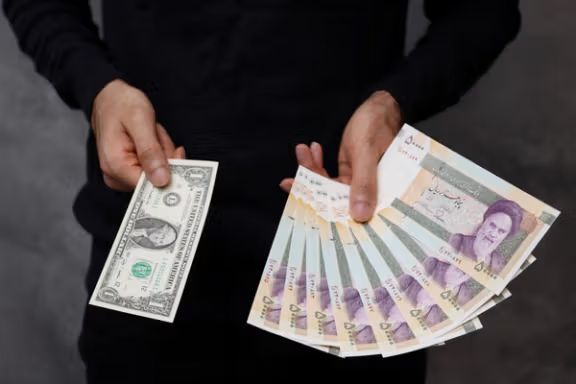
A currency dealer poses for a photo with a U.S one dollar bill and the amount being given when converting it into Iranian rials in an exchange shop in Tehran, Iran December 25, 2022

The United States aims to push Iran's economy off the cliff with more sanctions on Iranian oil, Treasury Secretary Scott Bessent said on Thursday, laying out President Donald Trump's renewed maximum pressure campaign.

"Making Iran broke again will mark the beginning of our updated sanctions policy," Bessent told members of the Economic Club of New York, highlighting the impact of US sanctions on the nation's currency.

The Iranian rial has lost half of its value in less than six months, partly because of Tehran's regional setbacks and partly due to harsh sanctions rolled out under Trump.

The President has begun an "aggressive campaign to rebalance the international economic system," Bessent added.

The so-called maximum pressure policy on Iran was introduced in Trump's first administration and renewed immediately after he returned to the White House in January.

The policy involves more sanctions and stricter enforcement on Iran's oil exports.

The Trump administration is considering a plan to inspect Iranian oil tankers under an international accord designed to curb the spread of weapons of mass destruction, Reuters reported earlier on Thursday.

The administration is exploring ways for allied countries to stop and inspect vessels in key maritime chokepoints, including the Malacca Strait in Asia, according to the agency citing six sources familiar with the matter.

Iranian President Masoud Pezeshkian, addressing parliament on Sunday, acknowledged Trump’s latest sanctions, saying Iran’s tankers now face uncertainty in unloading their cargo.

Iran's oil exports have fluctuated dramatically in recent years, depending largely on Washington's will to enforce sanctions and Tehran's ability to find new ways to get its oil to its main customer, China.

In 2017, before US sanctions were imposed, Iran exported 2.5 million barrels per day. By 2020, this figure had plummeted to around 350,000 bpd.

As Joe Biden took office in 2021, Iran’s oil exports rebounded, peaking at nearly 1.9 million bpd in the summer of 2024. After President Biden administration’s imposed sanctions on dozens of tankers involved in smuggling Iranian oil, exports dropped by 500,000 bpd in the final quarter of 2024.

Most Viewed

Iran negotiators ordered to return after internal rift over Islamabad talks
1
EXCLUSIVE

Iran negotiators ordered to return after internal rift over Islamabad talks

2
ANALYSIS

US blockade enters murky phase as tankers spoof signals and buyers hesitate

3
ANALYSIS

Why the $100 billion Hormuz toll revenue is a myth

4

US tightens financial squeeze on Iran, warns banks over oil money flows

5
ANALYSIS

US blockade targets Iran oil boom amid regional disruption

Banner
Banner

Spotlight

  • Hardliners push Hormuz ‘red line’ as US blockade tests Iran’s leverage
    INSIGHT

    Hardliners push Hormuz ‘red line’ as US blockade tests Iran’s leverage

  • Ideology may be fading in Iran, but not in Kashmir's ‘Mini Iran'
    INSIGHT

    Ideology may be fading in Iran, but not in Kashmir's ‘Mini Iran'

  • War damage amounts to $3,000 per Iranian, with blockade set to add to losses
    INSIGHT

    War damage amounts to $3,000 per Iranian, with blockade set to add to losses

  • Why the $100 billion Hormuz toll revenue is a myth
    ANALYSIS

    Why the $100 billion Hormuz toll revenue is a myth

  • US blockade targets Iran oil boom amid regional disruption
    ANALYSIS

    US blockade targets Iran oil boom amid regional disruption

  • Iran's digital economy battered by prolonged blackout
    INSIGHT

    Iran's digital economy battered by prolonged blackout

•
•
•

More Stories

US envoy to Ukraine calls Iran’s bond with adversaries a new global problem

Mar 6, 2025, 17:23 GMT+0

US President Donald Trump's envoy to Ukraine on Thursday said the informal security grouping of Iran, Russia, North Korea and China presented a challenge to global security which had not existed in his first term.

"This is a brand new arrangement ... we were not confronted with this four years ago," Keith Kellogg told the Brookings Institution thinktank in Washington DC. "This is not just a European problem. This is a global problem."

"Four years ago," he added, "the North Koreans were over here. The Iranians were over here. The Russians, you know, were over here, working, working (the Ukraine) issue, and then the Chinese were over here. Well, now they're all together," he said.

Russia suggested to the United States that the two powers should hold talks focused on Iran's nuclear program, a Kremlin spokesman said on Wednesday, in yet another sign of converging outlooks on global affairs by Washington and Moscow.

Bloomberg reported on Tuesday that Russia has agreed to assist Washington in communicating with Iran on various issues, including its support for regional groups hostile to the US.

Trump's overtures to Russia have upended international relations in recent weeks and the potential role for Moscow in addressing Tehran disputed nuclear program links the issues more closely.

Iran has provided Russia with hundreds of drones for its full-scale invasion of Ukraine as the two powers heavily sanctioned by the United States have drawn closer.

The potential realignment of Russia and the United States in opposition to Iran's nuclear program might deprive Iran of a key ally - a possibility President Masoud Pezeshkian appeared to acknowledge on Thursday.

"If Russia, the United States, or any other country wants to take action, when our hope is in God and our reliance is on our own beliefs, we will find a way," Pezeshkian said according to a readout of his speech published on the president’s website.

"Today, someone may rebuke us, someone may not cooperate with us, or we may run into conflicts with each other. If we rely on anyone other than God, we will face problems," he added.

Kellogg said Washington's Eurasian adversaries had been disunited previously, adding, "(Trump) kept them all segmented,"

"It's sort of like the game of Whac-A-Mole, that every time a mole would come up, you whack it down. Well, all the moles came up, and now we've got to figure out, okay, how do we do this?"
Rights group urges recognition of 'gender apartheid' in Iran

Mar 6, 2025, 16:39 GMT+0

A US-based rights group has urged governments to recognize what it called gender apartheid in Iran as a crime against humanity, arguing that the Islamic Republic systematically oppresses women.

"The oppression of women in Iran is not just discrimination—it is a deliberately designed, institutionalized system of domination intended to enforce the subjugation of women to maintain the state’s grip on power," said Center for Human Rights in Iran (CHRI) director of communications, Bahar Ghandehari.

"This state-sanctioned systemic subjugation amounts to nothing less than gender apartheid, which fully meets the threshold of a crime against humanity," she added in the press release on Thursday.

Unlike racial apartheid, which is explicitly banned under international law, gender apartheid is not yet recognized as a distinct crime.

CHRI called on governments to support its inclusion in the proposed Crimes Against Humanity treaty, impose sanctions on officials enforcing discriminatory policies, and back UN investigations into rights abuses in Iran.

Earlier this year, Nobel laureate Narges Mohammadi called on France's Senate to support the criminalization of gender apartheid and prioritize the fight for human and women's rights in Iran.

Tehran postponed implementing the controversial hijab law in December following a backlash from the public and the international community.

President Masoud Pezeshkian said on Wednesday he cannot implement the law due to popular opposition, after hardliners largely thwarted his agenda by pushing out top aides and rejecting his overtures to Washington.

The remarks, quoted by the head of his office in a post on X, were the strongest yet against a dormant law to tighten Islamic morality restrictions on women.

Popular opposition to hijab enforcement exploded in September 2022 when a young woman named Mahsa Jina Amini died in morality police custody, sparking nationwide protests dubbed the Woman Life Freedom movement.

The unrest was quashed with deadly force and opposition to the theocracy festered, but hardliners still drafted the new hijab law in May 2023.


Three more Iranian ministers face possible impeachment, lawmaker says

Mar 6, 2025, 13:55 GMT+0

Three Iranian ministers are facing potential impeachment proceedings, according to a member of Iran's parliament, who also dismissed the recent impeachment of the economy minister as politically motivated.

"A group is seeking to impeach reformist ministers in the cabinet, including Labor Minister Ahmad Meydari, Health Minister Mohammad-Reza Zafarghandi, and Culture Minister Reza Salehi Amiri," said Abdolreza Sepahvand on Thursday.

Sepahvand criticized the impeachment of the economy minister, saying that "the issue of the exchange rate and the dollar was a deception" and driven by personal motived related to appointments.

He also accused certain political groups of being unwilling to compromise with the government.

Last week, President Masoud Pezeshkian's Economy Minister Abdolnaser Hemmati was impeached by Parliament while Vice President for Strategic Affairs Javad Zarif was forced to resign.

US weighs halting tankers at sea to squeeze Iran oil trade

Mar 6, 2025, 13:46 GMT+0

The administration of US President Donald Trump is considering a plan to inspect Iranian oil tankers under an international accord designed to curb the spread of weapons of mass destruction, six sources familiar with the matter told Reuters.

The move would be part of US President Donald Trump’s renewed "maximum pressure" campaign, aimed at cutting Iran’s oil exports to zero.

More than half of the tankers sanctioned three days ago by the United States for carrying Iran's oil have ceased operations outside Chinese or Iranian terminals, an investigation by Iran International last month revealed.

Since returning to office, Trump has imposed fresh sanctions targeting companies and the so-called shadow fleet of older oil tankers transporting Iranian crude without Western insurance.

Sources said the administration is exploring ways for allied countries to stop and inspect vessels in key maritime chokepoints, including the Malacca Strait in Asia.

“You don’t have to sink ships or arrest people to have that chilling effect that this is just not worth the risk,” one source said. Another added: “The delay in delivery … instills uncertainty in that illicit trade network.”

The US is examining whether the inspections could be carried out under the Proliferation Security Initiative, signed by over 100 countries, a 2003 multinational framework aimed at stopping the trafficking of weapons of mass destruction.

John Bolton, who helped establish the initiative, said: “It would be fully justified” to use it against Iranian oil shipments, arguing that Tehran relies on crude revenue to fund nuclear activities and militant groups.

Two sources said the White House National Security Council is reviewing the proposal, but it remains unclear if Washington has approached any governments to gauge their willingness to participate. The National Security Council declined to comment as reported by Reuters. Iran's oil and foreign ministries also did not respond.

Iranian President Masoud Pezeshkian, addressing parliament on Sunday, acknowledged Trump’s latest sanctions, saying Iran’s tankers now face uncertainty in unloading their cargo. Iran has previously retaliated when its oil shipments were seized.

In 2023, the US tried to interdict two Iranian oil cargoes under Biden, prompting Iran to seize foreign vessels, including one chartered by Chevron.

Despite past US sanctions, Iran’s oil exports brought in over $50 billion annually in recent years, largely from sales to China. Meanwhile, European countries have raised concerns about environmental risks from tankers but have taken little action to inspect Iranian oil shipments.

Since early September, Iran’s national currency, the rial, has lost half of its value due to military and geopolitical setbacks in the region and Trump’s election, as he has pledged to significantly cut Tehran’s oil exports.

US to attend Baghdad talks in bid to curb Iranian oil exports

Mar 6, 2025, 13:24 GMT+0

A US diplomat will attend a meeting in Baghdad Thursday focusing on resuming Kurdish oil exports via Turkey, sources told Reuters, as Washington pushes Iraq to boost global supply while curbing Iranian oil exports.

The talks, hosted by Iraq's oil ministry, come as the US increases pressure to restart the pipeline, seeking to reduce Iranian oil's market share while Iran views Iraq as a key economic lifeline.

US President Donald Trump's administration is pressuring Iraq to allow Kurdish oil exports to restart to help offset a potential fall in Iranian oil exports, Reuters reported last month, citing eight sources with direct knowledge of the matter.

In early February, Trump reinstated the so-called maximum pressure campaign on Iran from his first term, with the stated aim of pushing down Tehran's oil sales to zero.

Meanwhile, during a meeting in Tehran on Wednesday, Iran’s Oil Minister Mohsen Paknejad and Iraq’s Electricity Minister Ziyad Ali Fadel voiced their commitment to expanding energy cooperation across oil, gas, petrochemicals, and electricity sectors.

Iraq’s oil minister announced late in February that exports from the Kurdistan region would resume next week.

Sources cited by Reuters said Trump’s administration was a key force behind the announcement.

Reuters cited two US administration officials confirming that the US had asked the Iraqi government to resume Kurdish exports. One of them said the move would help dampen upward pressure on oil prices, the report added.

Iran has been a major recipient of cut-price Kurdish oil. Last July, a Reuters report detailed how the closure of the pipeline transporting Kurdish crude to Turkey in 2023 led to an increase in oil smuggling to Iran, with an estimated 200,000 barrels per day being transported by truck.

In December 2024, Reuters also reported on a fuel oil smuggling network generating at least $1 billion annually for Iran and its military allies, which had flourished in Iraq since Prime Minister Mohammed Shia al-Sudani took office in 2022.







