• العربية
  • فارسی
Brand
  • Iran Insight
  • Politics
  • Economy
  • Analysis
  • Special Report
  • Opinion
  • Podcast
  • Iran Insight
  • Politics
  • Economy
  • Analysis
  • Special Report
  • Opinion
  • Podcast
  • Theme
  • Language
    • العربية
    • فارسی
  • Iran Insight
  • Politics
  • Economy
  • Analysis
  • Special Report
  • Opinion
  • Podcast
All rights reserved for Volant Media UK Limited
volant media logo

Iranian president’s popularity waning, warns commentator

Behrouz Turani
Behrouz Turani

Iran International

Feb 28, 2025, 06:48 GMT+0Updated: 10:27 GMT+0

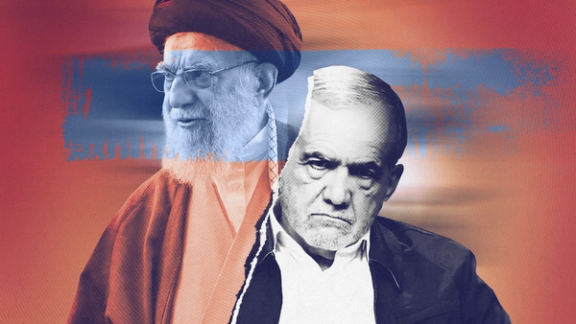
Ahmad Zeidabadi, prominent commentator close to the Reformist camp in Tehran, has raised the alarm that President Masoud Pezeshkian's popularity is declining and that is dangerous for the country.

Zeidabadi's remarks came after Pezeshkian reaffirmed his commitment to the promises he made during his June 2024 election campaign. Pezeshkian frequently repeats this claim when confronted with accusations of breaking or neglecting his promises.

The commentator remarked, “Pezeshkian explicitly promised to lift sanctions on Iran, guarantee social liberties, and end the ban on social media. He now needs to clarify which of these promises he still stands by.”

Although Pezeshkian has consistently advocated for negotiations with President Donald Trump’s administration, Supreme Leader Ali Khamenei prohibited such talks in early February. As a result, Pezeshkian aligned with this stance, stating that negotiating with Trump is not a realistic option.

He added: "When I talk with the people, I realize that Pezeshkian's popularity is declining and those who had voted for him feel frustrated. We have not seen any initiative from him for a long time now, and this is dangerous for him and the country."

Earlier, Iranian media on both ends of the country's political spectrum had summed up what Pezeshkian had promised to voters.

Mehr News Agency, affiliated with conservative clerics, highlighted that Pezeshkian made 10 promises to revive Iran's struggling economy. These included preventing gasoline price hikes, stabilizing the stock exchange, reducing inflation, addressing deteriorating living standards, establishing a unified exchange rate, permitting the import of foreign vehicles, and promoting social justice.

Mehr also highlighted Pezeshkian’s promise to guarantee freedom and dignity for Iranian women. He had stated, “Just as pre-1979 governments failed to eliminate the hijab, we cannot impose it on women.” However, mandatory hijab remains a deeply contentious social and political issue in Iran.

Even Reformist newspaper Etemad, which backs the president, drew attention to Pezeshkian’s economic promises under six key areas: dismantling the centralized government-controlled economy, opening up to international trade and diversifying trading partners, combating economic cronyism and ending special privileges for the well-connected, fostering a competitive market, enhancing living standards, and supporting the stock exchange to encourage public participation in the economy.

Other media outlets also highlighted Pezeshkian’s civil rights promises, including protecting women from harassment by hijab enforcers, promoting women to key government positions, ending government censorship of the internet and social media, safeguarding university students and professors from dismissal, allowing Sunni Muslims to hold top positions, encouraging political participation by ethnic minorities, lifting censorship on books and the press, and combating discrimination and injustice.

Critics have increasingly pointed out that most of Pezeshkian's promises remain unfulfilled, with minimal progress on key issues such as the hijab and internet censorship.

For example, Zeidabadi noted that while the controversial Hijab Enforcement Bill has been suspended, it has not been fully abolished.

Meanwhile, addressing remarks from both critics and supporters who argue that resolving Iran’s nuclear and other disputes with the United States is essential for tackling the economic crisis, Zeidabadi urged Pezeshkian to clarify his stance. He asked, “If negotiating and reaching a deal with Trump is impossible, then what is your alternative solution?”

The commentator also criticized Pezeshkian’s administration for its lack of strategy and decisiveness, questioning, “If the government lacks the authority to address these issues, why should it continue to exist?”

Most Viewed

Hardliners push Hormuz ‘red line’ as US blockade tests Iran’s leverage
1
INSIGHT

Hardliners push Hormuz ‘red line’ as US blockade tests Iran’s leverage

2

Iran International says it won’t be silenced after London arson attack

3
VOICES FROM IRAN

Hope and anger in Iran as fragile ceasefire persists

4

US sanctions oil network tied to Iranian tycoon Shamkhani

5

Iran halts petrochemical exports to supply domestic market

Banner
Banner

Spotlight

  • Hardliners push Hormuz ‘red line’ as US blockade tests Iran’s leverage
    INSIGHT

    Hardliners push Hormuz ‘red line’ as US blockade tests Iran’s leverage

  • Ideology may be fading in Iran, but not in Kashmir's ‘Mini Iran'
    INSIGHT

    Ideology may be fading in Iran, but not in Kashmir's ‘Mini Iran'

  • War damage amounts to $3,000 per Iranian, with blockade set to add to losses
    INSIGHT

    War damage amounts to $3,000 per Iranian, with blockade set to add to losses

  • Why the $100 billion Hormuz toll revenue is a myth
    ANALYSIS

    Why the $100 billion Hormuz toll revenue is a myth

  • US blockade targets Iran oil boom amid regional disruption
    ANALYSIS

    US blockade targets Iran oil boom amid regional disruption

  • Iran's digital economy battered by prolonged blackout
    INSIGHT

    Iran's digital economy battered by prolonged blackout

•
•
•

More Stories

Pezeshkian’s government under fire for not supporting ethnic languages cause

Feb 26, 2025, 16:18 GMT+0
•
Maryam Sinaiee

Masoud Pezeshkian's government is facing criticism for failing to support a motion that would have allowed limited ethnic literature courses in secondary schools. The Parliament rejected the motion on Wednesday.

President Pezeshkian speaks both Torki (a Turkic language spoken in northwestern Iran and several other provinces) and Kurdish, his parents' native languages. He has been one of the few officials to advocate for granting official status to ethnic languages under Article 15 of the Constitution. In 2016, he was elected chairman of a parliamentary faction consisting of Torki-speaking lawmakers, with approximately 100 of the 290 members of Parliament joining the group at the time.

However, during Wednesday's debate, Pezeshkian's government representative, Kazem Delkhosh, sided with lawmakers opposing the motion. Delkhosh argued that the proposed plan would create challenges for the educational system, including hiring specialized teachers, and could spark disputes in ethnically diverse regions.

The motion, put forward by the Parliament’s Education Committee, sought to introduce two hours of ethnic literature studies in secondary schools on an optional basis. The proposal was rejected by 130 lawmakers, with 104 voting in favor and five abstaining.

Supporters of the motion cited the Iranian Constitution, which designates Persian as the official language but also guarantees the right to use regional and tribal languages in the media and to teach literature in schools. However, opponents expressed concerns about national unity. Mohammad-Mehdi Shahriari, one of the lawmakers who spoke against the motion, warned that it could "threaten the country’s territorial integrity and national unity.”

Conversely, Alireza Novin, a lawmaker from Tabriz—the capital of East Azerbaijan Province and a majority-Torki-speaking city—strongly criticized the notion that promoting ethnic languages could deepen divisions or endanger national security. During a fiery speech in Parliament, he denounced the argument as baseless.

In an interview with the local news outlet Asr-e Tabriz, Novin further accused presidential candidates of making empty promises regarding the constitutional recognition of ethnic languages. He argued that Pezeshkian's administration, at the very least, should have refrained from opposing the motion.

Amir Karimzad, the managing director of another local media outlet, also took to X (formerly Twitter) to criticize the stance expressed by the government's representative in the Parliament. He claimed that Parliament's rejection of the plan reflected "extremists' fear of the power of ethnic groups."

The decision sparked widespread outrage on social media, with many non-Persian speakers and advocates for mother-tongue education expressing frustration over Parliament's refusal to allow even a limited form of ethnic literature instruction in schools.

The debate over the motion took place just days after the UN-designated International Mother Language Day. On February 21, activists in several Torki- and Kurdish-speaking cities marked the occasion by distributing children’s books and leaflets to raise awareness of the importance of native-language education.

Meanwhile, some others have reported the arrest of Mohammad Asadi in Maragheh for handing out books written in Torki to children. Reports also surfaced that security forces summoned the administrators of a private school in Tabriz after they organized a children’s musical performance featuring songs in Torki at a shopping mall on February 21. Social media users reported that authorities had warned the school against such activities.

Ethnic language activists in Iran are frequently accused of promoting separatism and often face prosecution or imprisonment. Advocates argue that the exclusive use of Persian in education erodes cultural heritage and disadvantages children who do not speak Persian fluently or at all when they begin school.

There are no official statistics on the number of speakers of ethnic languages in Iran. However, languages such as Torki, Kurdish, and Balochi are spoken by millions across the country.

Cronyism stifles Iran's economy, ex-minister says

Feb 26, 2025, 13:47 GMT+0

Iran’s former communications minister has sharply criticized the government-controlled economy, arguing that a system favoring insiders stifles creativity and productivity.

“The reality is that in an economy built on rent-seeking, where wealth depends on political connections, creativity has no place,” Mohammad-Javad Azari-Jahromi, who served as telecommunications minister under the Rouhani administration, told a gathering of fintech experts in Tehran.

As Iran’s oil-dependent economy has plunged into crisis over the past five years, local economists, some media outlets, and politicians have increasingly criticized the underlying system while also attributing the downturn to US sanctions.

The term “rent-seeking economy” is increasingly used in Iran to describe a system where politically influential individuals and entities secure economic privileges—such as government subsidies, lack of oversight, and market monopolies—to generate profits without contributing significantly to productivity.

A clear example is the Revolutionary Guard receiving over 30% of Iran’s crude oil for export, rather than relying solely on government budget allocations.

Jahromi implicitly referred to that when he said, “Certain entities can obtain oil under the pretext of bypassing sanctions and then decide whether or not to bring the revenue back. This approach is far easier than putting in the effort to create markets and provide services.”

The former minister explained that “In this rent-seeking environment, there is no incentive for individuals to pursue creativity. Ultimately, the system operates through intermediaries.”

Nearly all of Iran’s banks, automakers, petrochemical plants, steel producers, and various other industries are either government-owned or quasi-public, managed by a politically connected elite. Despite their inefficiency and mounting debts, these industries are deemed essential and remain heavily reliant on continuous government support.

Jahromi noted that banks use their capital to engage in the real estate sector instead of helping new industries. They also own many companies and lend money to their own enterprises instead of others.

“The economy is facing fundamental and obvious obstacles. In this situation, the workforce is migrating, and investment is scarce due to the high level of risk involved,” Jahromi said.

Lavrov brought no US message to Tehran, Iranian FM says

Feb 26, 2025, 09:14 GMT+0

Iranian Foreign Minister Abbas Araghchi said that Russian Foreign Minister Sergey Lavrov did not deliver a message from the United States during his visit to Tehran and added that no such message was anticipated.

Speaking to reporters on the sidelines of a cabinet meeting, Araghchi also addressed Iran’s ongoing negotiations with European countries, saying that a new round of talks began in Geneva two days ago, focusing on nuclear issues and other matters.

Earlier in the day, former lawmaker Heshmatollah Falahatpisheh said on X that Lavrov came to Tehran with a message: “Russia and the United States have drawn common red lines for Iran in Riyadh."

Earlier this month, President Donald Trump announced the revitalization of sanctions under his “maximum pressure” policy. He underlined that his main demand is for Iran never to acquire nuclear weapons.

Iran, facing a serious economic crisis, needs to reach an agreement with the Trump administration if it wants to reduce or eliminate the sanctions, but Supreme Leader Ali Khamenei this month banned talks with Washington. Iranian officials insist that they will not negotiate under Trump’s pressure.

Araghchi added that discussions with Europe would continue despite their complexities, as several key questions remain unresolved.

Regarding his talks with Lavrov, Araghchi described them as extensive, covering a wide range of bilateral and regional issues.

He added that the Russian diplomat provided a detailed report on Moscow’s negotiations with Washington and other regional players.

Lavrov’s visit to Tehran sparked speculation in Iranian media about whether he is carrying a message from Washington or pushing Moscow’s own agenda at Iran’s expense.

Iranian media, analysts, and the public had closely scrutinized recent visits by high-ranking foreign officials to Tehran, including Lavrov and the Emir of Qatar, Sheikh Tamim bin Hamad Al Thani, who met with Iran's Supreme Leader Ali Khamenei last week. These visits are widely interpreted as potential mediation efforts between Tehran and Washington or as channels for delivering messages from the Trump administration.

Iran advocates closer ties with Russia as Lavrov visits Tehran

Feb 25, 2025, 18:25 GMT+0

Iran's President Masoud Pezeshkian said Tehran is committed to boosting ties with Moscow in a meeting with Russian Foreign Minister Sergei Lavrov on Tuesday, as both powers weigh how to deal with new US President Donald Trump.

"Iran and Russia have appropriate capacities to strengthen cooperation with each other, and we are determined to strengthen the interactions between Tehran and Moscow," Pezeshkian said.

"Iran and Russia have similar views on regional issues and seek to strengthen their regional and international cooperation", he added.

Moscow was dealt a boost this month as Washington under Trump emphasized the swift ending of the war Ukraine and restoration of bilateral ties.

Tehran, mired in economic malaise, faces a trickier choice dealing with Trump, who has ruled out allowing Iran acquiring a nuclear bomb and said he wants a deal which Iran's Supreme Leader Ali Khamenei has ruled out.

Pezeshkian also urged for expediting the implementation of agreements, especially a Comprehensive Strategic Agreement between the two countries.

Tehran and Moscow signed a long-term agreement in March 2001 which was initially set for a ten-year term but was extended twice, each time for five years. Despite prior discussions, similar promises to finalize a renewed treaty have remained unfulfilled.

Lavrov, who conveyed Russian President Vladimir Putin’s greetings to Pezeshkian, said: “Iran and Russia have many common interests in continuing effective regional cooperation with each other.”

In a press conference following separate discussions with Lavrov, Iranian Foreign Minister Abbas Araghchi ruled out direct negotiations with the United States over the country’s nuclear program.

"Regarding Iran's nuclear issue, we will move forward and coordinate our positions in cooperation with our friends in Russia and China," Araghchi said.

"Iran's position in the nuclear talks is completely clear, and we will not negotiate under pressure and sanctions. There is no possibility of direct negotiations between us and the US as long as maximum pressure is being applied in this manner," he added.

Tehran’s envoy to Moscow, Kazem Jalali, also said the discussions specifically covered the nuclear issue and joint approaches in the field.

Why is the Russian foreign minister visiting Iran now?

Feb 25, 2025, 13:14 GMT+0
•
Maryam Sinaiee

Russian Foreign Minister Sergei Lavrov’s visit to Tehran has sparked speculation in Iranian media about whether he is carrying a message from Washington or pushing Moscow’s own agenda at Iran’s expense.

Tehran and Moscow say Lavrov and his Iranian counterpart, Abbas Araghchi, will discuss mutual relations, trade, and economic cooperation, as well as key international issues, including the situation in Syria, during the one-day visit.

The visit follows discussions in Ankara on Monday and comes just a week after his meeting with US Secretary of State Marco Rubio in Riyadh.

Delivering a message from the United States to Iran?

Iranian media, analysts, and the public have closely scrutinized recent visits by high-ranking foreign officials to Tehran, including Lavrov and the Emir of Qatar, Sheikh Tamim bin Hamad Al Thani, who met with Iran's Supreme Leader Ali Khamenei last week. These visits are widely interpreted as potential mediation efforts between Tehran and Washington or as channels for delivering messages from the Trump administration.

A commentary published Tuesday by Iran’s official news agency, IRNA, acknowledged that the purpose of Lavrov’s visit might extend beyond the official agenda. However, it argued that many experts doubt Lavrov is carrying a direct message from the Trump administration. Instead, it suggested that Lavrov might share his assessment of Washington’s approach to Iran and relay Iran’s desired roadmap back to the US in a similar manner.

The commentary also speculated that Lavrov could be conveying Moscow’s own message to Tehran, warning against shifting Iran’s nuclear doctrine or withdrawing from the Nuclear Non-Proliferation Treaty (NPT), as some Iranian ultra-hardliners advocate.

Speaking to the reformist Etemad daily, foreign policy analyst Abdolreza Faraji-Rad cast doubt on the likelihood of Lavrov delivering a direct US message to Tehran.

If such a message were being conveyed, he suggested it might involve Washington offering a temporary reduction in “maximum pressure” sanctions—reimposed by Trump’s executive order on January 20—in exchange for Iran agreeing to direct negotiations over its nuclear program.

Others suggested that Lavrov is simply planning to inform the Islamic Republic about its changing relations with the Trump administration and Ukraine negotiations.

Concerns about Iran being used by Russia as a bargaining chip

Some Iranian media and analysts warned that Iran could be betrayed by Russia and become a bargaining chip in potential negotiations between the Trump and Putin administrations, particularly regarding the Ukraine conflict.

A commentary published Tuesday by Khabar Online, a news outlet close to former conservative Parliament Speaker Ali Larijani, compared Lavrov’s recent meeting with US Secretary of State Marco Rubio in Riyadh, Saudi Arabia, and the planned Trump-Putin meeting compared by some to the Yalta Conference of February 1945, which reshaped global geopolitics. The article warned that “Iran is also in danger.”

Khabar Online also quoted former chairman of the Iranian Parliament’s National Security and Foreign Policy Commission, Heshmatollah Falahatpisheh, who argued that Iran is merely a bargaining chip in these negotiations. “I am concerned that Iran may be sacrificed for peace [in Ukraine],” he stated.

Reza Taghizadeh, a Glasgow-based Iranian political commentator, echoed similar concerns on X, speculating that “Lavrov's goal in Tehran is to convince the Islamic Republic to surrender its nuclear program and disband the ‘axis of resistance’ in exchange for avoiding an Israeli military attack and blocking [its] oil exports! … Are the Russians securing [concessions from the US over] Ukraine while offering up Iran [in return]?”