• العربية
  • فارسی
Brand
  • Iran Insight
  • Politics
  • Economy
  • Analysis
  • Special Report
  • Opinion
  • Podcast
  • Iran Insight
  • Politics
  • Economy
  • Analysis
  • Special Report
  • Opinion
  • Podcast
  • Theme
  • Language
    • العربية
    • فارسی
  • Iran Insight
  • Politics
  • Economy
  • Analysis
  • Special Report
  • Opinion
  • Podcast
All rights reserved for Volant Media UK Limited
volant media logo

US talks impossible under Trump's maximum pressure policy, Iran says
Feb 25, 2025, 11:47 GMT+0Updated: 15:39 GMT+0
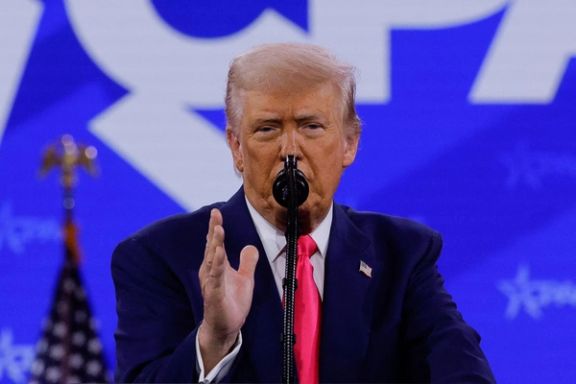
US President Donald Trump addresses the Conservative Political Action Conference (CPAC) annual meeting in National Harbor, Maryland, February 22, 2025.

Iran's Foreign Minister said on Tuesday that direct talks with the US will not happen as long as maximum pressure policies continue under President Donald Trump.

"Iran's position in the nuclear talks is completely clear, and we will not negotiate under pressure and sanctions. There is no possibility of direct negotiations between us and the US as long as maximum pressure is being applied in this manner," Abbas Araghchi said.

He was speaking at a joint press conference with Russia's foreign minister, Sergei Lavrov, on a visit to Tehran.

"Regarding Iran's nuclear issue, we will move forward and coordinate our positions in cooperation with our friends in Russia and China," Araghchi added as the trio grow ever closer.

In 2018, during his first term, Trump pulled out of the 2015 nuclear deal known as the Joint Comprehensive Plan of Actions or JCPOA, and imposed 'maximum pressure' sanctions on Tehran, practically reducing Iran’s oil exports to less than 500,000 barrels per day and blocking the revenues in foreign banks. 

Lavrov's visit also follows a new wave of US sanctions targeting Iran’s oil industry, the country’s primary source of revenue.

He arrived in Tehran for discussions with his counterpart a few days after Moscow and Washington held talks in Saudi Arabia.

Earlier this month, Trump reinstated his "maximum pressure" campaign, aiming to reduce Iran’s oil exports to zero—reviving Washington’s hardline approach from his first term.

However, in spite of Tehran's position, Lavrov remained optimistic. "The capacity for diplomacy regarding Iran's nuclear program still exists," state-media quoted him as saying.

Moscow and Tehran have deepened their defense ties since the outbreak of the Ukraine war in 2022, a partnership that has increasingly drawn Western ire. China too, has become an ever stronger ally, the three conducting multiple military drills together.

Last week, US Secretary of State Marco Rubio met Lavrov as a follow up to President Donald Trump’s conversation with Russian President Vladimir Putin on negotiations to broker a ceasefire in Ukraine, according to a statement by the US State Department spokeswoman Tammy Bruce.

"President Trump wants to stop the killing; the United States wants peace and is using its strength in the world to bring countries together," Bruce said. "President Trump is the only leader in the world who can get Ukraine and Russia to agree to that."


Most Viewed

Iran negotiators ordered to return after internal rift over Islamabad talks
1
EXCLUSIVE

Iran negotiators ordered to return after internal rift over Islamabad talks

2
ANALYSIS

US blockade enters murky phase as tankers spoof signals and buyers hesitate

3
ANALYSIS

Why the $100 billion Hormuz toll revenue is a myth

4

US tightens financial squeeze on Iran, warns banks over oil money flows

5
ANALYSIS

US blockade targets Iran oil boom amid regional disruption

Banner
Banner

Spotlight

  • Hardliners push Hormuz ‘red line’ as US blockade tests Iran’s leverage
    INSIGHT

    Hardliners push Hormuz ‘red line’ as US blockade tests Iran’s leverage

  • Ideology may be fading in Iran, but not in Kashmir's ‘Mini Iran'
    INSIGHT

    Ideology may be fading in Iran, but not in Kashmir's ‘Mini Iran'

  • War damage amounts to $3,000 per Iranian, with blockade set to add to losses
    INSIGHT

    War damage amounts to $3,000 per Iranian, with blockade set to add to losses

  • Why the $100 billion Hormuz toll revenue is a myth
    ANALYSIS

    Why the $100 billion Hormuz toll revenue is a myth

  • US blockade targets Iran oil boom amid regional disruption
    ANALYSIS

    US blockade targets Iran oil boom amid regional disruption

  • Iran's digital economy battered by prolonged blackout
    INSIGHT

    Iran's digital economy battered by prolonged blackout

•
•
•

More Stories

Experts, politicians warn of protests as Iran’s economic crisis deepens

Feb 25, 2025, 11:16 GMT+0
•
Behrouz Turani

A prominent sociologist in Tehran has warned that Iran could face widespread protests if the government fails to improve the country’s worsening financial situation and curb rising prices.

Taghi Azad Armaki told Etemad, a pro-reform newspaper supporting President Masoud Pezeshkian, that without lifting US sanctions a wave of protests over socio-economic issues is likely.

He criticized the government for converting social and economic problems into security issues by criminalizing actions such as protests and opposition to social media censorship, rather than addressing the underlying problems.

Armaki emphasized that soaring prices, especially in housing and healthcare, along with the rapid depreciation of the Iranian currency and widespread poverty, are placing immense pressure on Iranians. He noted that while government officials occasionally acknowledge these issues, they have yet to propose any meaningful solutions.

The sociologist warned, “If this situation continues, protests are likely to erupt in the near future.” He criticized the government for downplaying serious issues in energy, housing, poverty, and social delinquency.

He urged the government to acknowledge its limitations and focus its resources on meeting the nation’s basic needs, such as ensuring the proper distribution of essentials like bread, water and energy.

Former Interior Minister Abdolreza Rahmani Fazli echoed these concerns, telling the press that “the extent of accumulated demands and dissent in Iran is a serious cause for concern.” He noted that the current situation is even more troubling than in 2019, when hundreds of thousands protested against rising fuel prices.

During that sudden wave of unrest in over 100 cities, the government swiftly responded with military and vigilante forces, resulting in the deaths of 1,500 protesters, according to a Reuters estimate.

Meanwhile, the IRGC-linked newspaper Javan criticized hardliners in the parliament (Majles), warning that “while protests more intense than those of 2019 loom on the horizon, opponents of President Pezeshkian and even some who backed him in the election are wasting time and energy trying to unseat him and his ministers.”

Javan warned that this could trigger a series of deep-rooted political crises in the upcoming Iranian year, which begins in about four weeks. The newspaper suggested that the situation could worsen if combined with “foreign operations,” likely referring to potential Israeli attacks on Iran’s nuclear sites.

In a similar vein, conservative commentator Mohammad Mohajeri criticized hardline lawmakers for pushing to impeach Economy Minister Abdolnaser Hemmati, accusing him of “failing to improve the country’s economic situation.”

Mohajeri criticized the hardline lawmakers, saying, “The MPs think that dismissing the minister will improve the economic situation, but their approach is like an ugly man trying to calm a crying baby by making faces—his appearance only made the baby cry even harder.” He added, “You are the problem. It’s your actions that have created these insurmountable challenges.”

Several reports in Iranian media on Monday highlighted the severity of Iran’s economic crisis and the financial struggles facing its citizens. The conservative Nameh News website noted, “The government's inefficiency is worsening the economic crisis, compounded by significant shortcomings in sectors such as energy, housing, and healthcare.”

Economic expert and a well-known businessman, Majid Reza Hariri, told Nameh News that when he questioned some MPs about their push to impeach the economy minister, they admitted, “The situation might get worse, but we need to show our voters that we are just as dissatisfied with the current state of affairs.”

Commenting on the Pezeshkian administration's weaknesses, Hariri remarked, “I believe we effectively have no government, as no one is willing to take responsibility for the economic problems.”

Top general calls for privatization to solve Iran's economic crisis

Feb 24, 2025, 15:30 GMT+0

Iran's highest-ranking military officer has publicly advocated for privatization as the nation faces chronic energy shortages and rampant inflation.

“The model for the country's salvation is to turn to the people. If we want to solve the economy, the solution is to turn to the private sector and entrust work to the people," Major General Mohammad Bagheri said.

Iran's armed forces, the Islamic Revolution Guard Corps (IRGC) in particular, have benefited from previous waves of privatisation, taking over fully or in part the companies and businesses that the government puts up for sale.

Bagheri's call comes amid reports that the Iranian Armed Forces, including the IRGC, will receive a substantial 51% (approximately €12 billion) of the government's €24 billion oil and gas export revenues in the upcoming budget.

The budget bill for the next Iranian year (starting March 21) details that while 37.5% of oil and gas revenue goes to the government, over half of that portion funds the military.

Last year, a Reuters report indicated that the IRGC already controls up to half of Iran's oil exports, funding military operations and allies.

Recent Central Bank statistics also show a significant decline in private sector involvement in foreign trade, replaced by government entities that receive the majority of foreign currency.

Customs data further shows that government-controlled petrochemical, steel, oil, and gas products dominate exports.

The country’s new budget allows the Oil Ministry to contract with third parties for oil and gas field operations to settle debts, raising fears that these contracts will fall into the hands of the so-called "Khosoulati" entities—quasi-state organizations controlled by insiders of the ruling system, rather than genuine private sector businesses.

HamMihan newspaper warned last year that such a policy risks transferring national resources to entities lacking the necessary capacity and resources, further entrenching government-linked organizations in the economy.

Energy shortages force Iran to cut workweek to two, three days

Feb 24, 2025, 12:09 GMT+0

Government offices, banks, and schools across most of Iran remained closed on Monday as a worsening energy crisis forced authorities to shut down public services in at least 22 of Iran's 31 provinces.

The closures, driven by severe gas shortages and electricity cuts, have left Iranians accustomed to working weeks of just two or three days.

With snow, rain, and plunging temperatures further straining the country’s already fragile energy infrastructure, provincial officials announced the shutdowns late Sunday, impacting regions including Tehran, Mazandaran, Gilan, Golestan, Isfahan, Markazi, Kerman, Hamedan, etc.

In Tehran, schools, courts, and government offices suspended operations entirely, with authorities mandating that all heating systems be turned off to conserve fuel.

“This isn’t about bad weather,” said Nima, a wholesaler of car spare parts in the capital. “The government announces these closures to cover up its energy failures. They know if they don’t shut things down, people will protest over the lack of heating and electricity,” he told Iran International.

A large number of Iranians said on social media that in some provinces, schools were declared closed without arrangements for online classes. However, many said that virtual education is unreliable anyway, as power outages also disrupt internet access.

The country’s aging telecommunications infrastructure lacks backup battery systems, further limiting connectivity.

The frequent shutdowns have hit businesses hard, particularly as Iran nears Nowruz, the Persian New Year, when many retailers rely on a seasonal surge in consumer spending. Hamid, 38, who runs a clothing boutique in Tehran’s Gisha neighborhood, said sales have plummeted.

“We wait 11 months for this last stretch before Nowruz to make a profit, but every week, we lose two or three working days,” he told Iran International. “This morning, I sold just two pairs of pants and a shirt, which were already discounted. Meanwhile, my bounced checks are piling up.”

Iran’s work week has long been out of sync with the global economy, with weekends falling on Thursday and Friday instead of Saturday and Sunday. Nima said the latest wave of shutdowns has made the situation even worse.

“Iranian businesses already struggle because we only overlap with the international market for three days a week,” he said. “Now, with these extra closures, we’re essentially shut down half the month. How can there be an economy in a country that’s closed for business?”

Compounding the crisis, the Iranian rial continues to weaken against the US dollar amid economic pressures from US sanctions. The falling currency has further eroded purchasing power, leaving many consumers unable to afford even discounted goods.

Public sector closures have become a frequent occurrence in Iran, with schools and offices repeatedly shut in recent months due to pollution, dust storms, cold weather, and fuel shortages.

While officials cite weather conditions for the latest round of shutdowns, weather tracking services have not predicted subzero temperatures or heavy snowfall for many of the affected provinces.

For business owners like Hamid and Nima, the pattern is clear. “It’s not about the cold,” Nima said. “It’s about the country running on empty.”

World must prepare for revolution in Iran, exiled crown prince tells Telegraph

Feb 23, 2025, 21:30 GMT+0

Iran is on the cusp of a possible revolution, exiled crown prince Reza Pahlavi said in an interview with The Telegraph published Sunday, calling on Western countries to brace for the historic change.

“Iran is in a revolutionary, or at the very least, a pre-revolutionary fervor," the son of Iran's last monarch said.

"It’s escalating every day. All the chants you hear on the streets, all the protests, all the demonstrations that specifically call for an end to this regime, death to the dictator, death to the Islamic Republic.”

"There is a critical window of opportunity to change history. It may only be open for a few months,” he added, calling on Western governments to support the momentum seen in Iran as the government faces its lowest legitimacy since the founding of the Islamic Republic in 1979.

Pahlavi rejected military intervention, arguing that Western powers should instead apply pressure on the Iranian government and the people's movement.

“What we’ve been saying to the Americans, the Europeans, is let’s not jump directly from failed diplomacy to contemplating conflict and war,” he said. “There’s a third option and [it is] the best option – the Iranian people.”

Pahlavi also emphasized the importance of defections from within the Iranian state, including military and security personnel, to ensure a transition with minimal bloodshed.

“We don’t want to encourage a scenario that leads to anarchy, rather a controlled implosion,” he said. “But it cannot happen unless you have the tacit collaboration of military and paramilitary forces.”

He said justice will be brought to the people involved in Iran's mass crackdowns which have seen record numbers of executions since 2022 and hundreds killed in protests sparked by the death in custody of Mahsa Amin.

“Those who have their hands soiled with the blood of the people will have to face justice one day. But I’m not talking about kangaroo trials,” he said.

Pahlavi also said he supports US President Donald Trump’s “maximum pressure” policy on Iran but believes it should be paired with “maximum support” for opposition movements.

“Is there a historic opportunity for change to happen? We believe yes,” he said. “But I think that the failure of Western policymakers to catch up to where Iran is now could impede our success in finding a resolution to the ultimate problem.”

Iran is ‘peace-seeking,’ says intel chief while warning US, Israel

Feb 23, 2025, 13:09 GMT+0

Iran is a ‘peace-seeking nation,’ the intelligence minister said, warning of a strong response to any hostile act from the US or Israel as threats against its nuclear facilities increased under the new Trump administration.

“The Iranian nation is peace-seeking and has no enmity with any country,” Esmail Khatib said during a ceremony Saturday marking the 40th anniversary of the Intelligence Ministry’s establishment.

“However, in the face of adventurism, malicious actions, and unwarranted interference—particularly from the US and the Zionist regime—we will adhere to the strategy of threat for threat and aggression for aggression.”

While US President Donald Trump has said he prefers diplomatic channels to deal with Iran, he has not ruled out military action against its nuclear facilities, having vowed that Iran must not obtain nuclear weapons.

President Masoud Pezeshkian, Judiciary Chief Gholamhossein Mohseni-Ejei, and other security and military officials attended the ceremony.

Khatib was sanctioned by the US Treasury Department for his role in cyber operations and human rights abuses, designating both him and the ministry in 2022 saying they were involved in cyber activities against the US and its allies.

Iran’s intelligence services, particularly the Revolutionary Guard’s intelligence arm, have played a central role in suppressing dissent in recent years, detaining protesters and opposition figures in its own detention facilities.