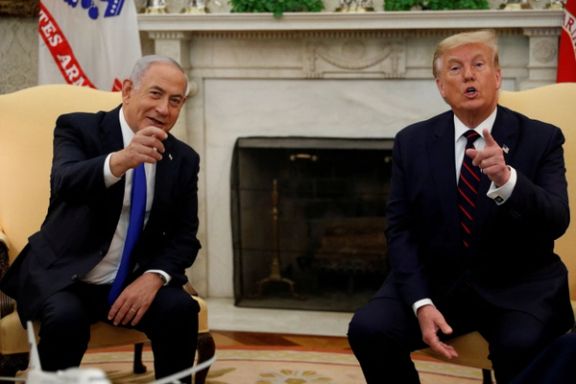
President Donald Trump and Israeli Prime Minister Benjamin Netanyahu in the White House
A radical vigilante group leader in Tehran has suggested that Iran should carry out an operation against the United States similar to its missile attacks on Israel last year.
The conservative Tehran-based website Tabnak quoted Hossein Allah-Karam, leader of the vigilante group Ansar Hezballah, as saying that US President Donald Trump and Israeli Prime Minister Benjamin Netanyahu cannot follow through on their threats against Iran.
Tabnak described Allah-Karam as a political science professor at the University of Tehran and quoted him as asserting that Trump has failed to back his threats against Hamas. He concluded, “His other threat about bombing Iran if we do not sign a paper for him also cannot materialize.”
The hardline figure further claimed, “Trump’s performance has forced the United States and Israel to kneel before Gaza.”
He added, "We have achieved this with the capabilities we already have, so why should we challenge ourselves by opting to upgrade our capabilities?" This was perhaps a veiled reference to producing nuclear weapons and more potent ballistic missiles.
Allah-Karam’s remarks align with recent statements from Supreme Leader Ali Khamenei and some IRGC commanders suggesting Iran is prepared for conflict with Israel.
In a recent speech, Khamenei called for upgrading Iran's ballistic missiles. Meanwhile, IRGC deputy commander Ali Fadavi said on Monday that a third direct attack on Israel will happen in due course. "Operation True Promise 3 will occur at the right time," Fadavi said.
Fadavi made these remarks in response to statements by Israeli and US officials regarding Iran’s perceived weakness, as well as Trump’s threat that Israel would bomb Iran if Tehran refused to negotiate with the United States over its controversial nuclear program.
He stated, “Not a single day has passed without the world's evildoers—the Great Satan, America, and its allies—waging war against us.”
Reformist political commentator Ahmad Zeidabadi warned on Telegram that "Netanyahu has already made preparations for attacking Iran in the coming months." He appeared to be referring to Trump's backing of the plan, possibly alluding to the shipment of US-made bunker buster bombs to Israel and stationing of US B-52 bombers somewhere in the region.
Zeidabadi added that "all official statements and both direct and indirect remarks from Israeli and US officials suggest that such an attack is imminent." He cautioned that "while it might be a limited strike, its consequences could be extremely destructive and uncontrollable."
On Monday, Canadian-based military analyst Houshang Hassanyari and German-based political analyst Ali Sadrzadeh, both Iranian-born, stated on Iran International TV that the Islamic Republic appears to be preparing for war against Israel. Both analysts agreed that Iranian officials and military commanders' claims about the country's military capabilities are based on illusion rather than reality.
Hassanyari warned that "the Islamic Republic is under a dangerous illusion. Khamenei believes his forces can defend Iran and deliver heavy blows to Israeli and US forces. Even if he is not actively planning a war against Israel, his rhetoric is pushing Iran toward one."
He added that Iran lacks strong military capabilities and is destined for a major defeat in any war. If a conflict with Israel breaks out, the United States will undoubtedly intervene to support Israel.
Sadrzadeh, however, expressed skepticism about the likelihood of war. "I do not believe Iran is preparing for a war with Israel, as its commanders and top officials must have at least a basic understanding of their forces' limitations. US officials say Iran has no effective air defense, and as far as I know, Tehran no longer has allies or strategic depth in the Middle East."
He also noted that the situation has changed since the Iran-Iraq war of the 1980s. Given the protests in Iran in recent years, it is inconceivable that Iranians would rally behind Khamenei’s idea of war against Israel.
Iran-made missiles on display in front of a huge mural of Iran's Supreme Leader
A senior commander in Iran's Islamic Revolution Guard Corps (IRGC) said any attack on Iran's nuclear sites would spark an unprecedented regional conflagration and provided detailed threats of retaliation to Israeli and US interests.
"If Iran’s nuclear facilities are attacked, a fire will erupt in the region with dimensions beyond imagination," IRGC Aerospace Force Commander Amir Ali Hajizadeh said, days after US newspapers said Israel was mulling strikes this year.
The remarks were the clearest delineation in months by a senior Iranian military official of a potential response to an attack which US intelligence assessments see Israel as more willing to carry out after military setbacks for Tehran.
“If we engage in conflict with the US, we have enough targets in the region that we can strike with low-cost missiles,” Hajizadeh said. “If instead of 150 drones, we use 500 or even 1,000 drones, what can they possibly do?” he added.
The Wall Street Journal and The Washington Post reported last week cited US intelligence findings from last month that Israel saw an opening for an attack on Iranian nuclear sites as early as the first of this year.
Israel is basing its assessment, the papers reported, on Iran's weakness after an Oct. 26 Israeli attack knocked out much of its air defenses and a greater perceived receptiveness to military action from US President Donald Trump.
Hajizadeh added Supreme Leader Ali Khamenei had repeatedly personally followed up on Iran's anti-ballistic missile defenses, which he said would soon be ready.
“Some say that if we do not negotiate, they might attack. No one should worry; they can do absolutely nothing,” Hajizadeh said. Iran is working on extending its missile range to 2,000 km, he added, saying that US interests could be handily struck with less high-tech ordnance.
"The US has nearby targets around us that can be hit with low-cost missiles—there is no need to use intercontinental missiles from here."
'True Promise 3'
The senior commander also became the second high-ranking IRGC official in as many days to vow another direct attack on Israel, ratcheting up rhetoric against its Mideast adversary.
“Iran’s third attack on Israel, True Promise 3, will definitely take place, but officials have planned for it and will use it strategically—we will not waste it,” Hajizadeh added.
Vows of retaliation following Oct. 26 Israeli airstrikes on Iranian military targets in Tehran, Khuzestan and Ilam provinces had largely subsided weeks after the attack.
Iran condemned the operation, which killed five people including four military officers and a civilian. Tehran said air defenses intercepted most of the incoming strikes.
Without detailing the losses the Islamic Republic has suffered in previous Israeli attacks, the IRGC Aerospace commander added, “Warfare is not just about striking; we must also be prepared to take hits."
"In fact, these attacks have not been entirely bad for us because they made officials pay more attention and allocate more funds and resources to us,” he added.
His remarks come after Khamenei has rejected US President Donald Trump's overtures for a nuclear deal, deepening a standoff with Washington.
Khamenei said on Monday that Iran could fend off an attack by its enemies and added the next day that Trump's plan to seize Gaza and displace Palestinians - now a key plank of US Mideast policy - was 'stupid' and doomed to failure.
US senators visiting Israel this week advocated for a forceful stance toward Iran, and a senior lawmaker among them said Arab-Israeli reconciliation was Tehran's worst nightmare and a key motivation behind recent regional turmoil.
"October 7 was meant to stop normalization," Senator Lindsey Graham said, referring to a 2023 attack by Iran-backed Hamas militants on Israel which triggered a 15-month war.
"Iran's worst nightmare was Arabs and Israelis' reconciliation and solving the Palestinian problem in perpetuity."
The South Carolina Republican said that just before the attacks, Saudi Crown Prince Mohammed bin Salman was enthusiastic about an imminent breakthrough in normalization efforts.
Graham added the United States would soon have to choose between military action and negotiations, with his preference being to "help Israel deliver a decisive blow against Iran nuclear infrastructure."
On Trump's mooted desire for a deal with Iran over its disputed nuclear program, Graham suggested a "Libyan model" involving setting clear goals and timelines, and if talks fail, providing Israel with the capabilities to strike Iran's nuclear program.
Libya agreed to shutter a weapons program criticized by Western powers but veteran leader Muammar Qadaffi was still overthrown and killed in a US and European-backed rebel uprising in 2011.
Iran should 'pay hell'
Senator Richard Blumenthal referred to Iran's regional setbacks, saying Israel had broken what he called Iran's axis through successes against Hezbollah and Hamas, along with the fall of President Bashar al-Assad in Syria.
Referring to the Israeli hostages held by Hamas, the Connecticut Democrat said, "Iran ought to be the one to pay hell because, ultimately, they are responsible … They are the head of the snake.”
Senator Joni Ernst warned, "Iran, listen very clearly. We will put maximum pressure on you and work with our Israeli partners to make sure you do not succeed economically, militarily or politically in this region.
"There is no daylight between Israel and the USA,” the Iowa Republican added.
The Wall Street Journal and The Washington Post reported last week citing US intelligence assessments from last month that Israel saw an opening for an attack on Iranian nuclear sites as early as the first of this year.
Earlier this month, US President Donald Trump signed a directive restoring the so-called maximum pressure policy of his first term and warned of "catastrophic" consequences if Tehran does not make a deal on its nuclear program.
On Monday, Iranian Foreign Minister Abbas Araghchi said Washington's maximum pressure campaign and mooting of military force will not force Iran to negotiate about its nuclear program.
A session of the Iranian parliament on February 18, 2024
The dramatic fall in the value of the Iranian currency over the past few months, particularly since President Donald Trump took office in the United States, is likely to claim victims from among the president's cabinet members.
The rial has depreciated by approximately 50% against the US dollar since September, a sharp decline that is expected to further drive up Iran’s already high inflation by increasing the cost of both domestic production and imports.
Iran’s hardliner-dominated parliament (Majles) appears determined to impeach Economy Minister Abdolnasser Hemmati and push Pezeshkian to dismiss Central Bank Governor Alireza Farzin. Energy Minister Aliabadi is also on the impeachment list, facing scrutiny over his ministry’s failure to secure adequate fuel for power plants during the winter months.
Amid Supreme Leader Ali Khamenei’s repeated calls for unity within the government and his criticism of discord between the president and parliament, lawmakers held a closed-door meeting on Tuesday to brief Pezeshkian on the rial’s depreciation—despite the president already being well aware of the deeper causes of Iran’s chronic economic crisis.
“The Majles has vowed to hasten Hemmati’s impeachment if he and Pezeshkian fail to convince parliament that they are taking effective action to address the crisis and improve people’s livelihoods,” Iranian media quoted parliamentary officials as saying on Monday.
A session of the Iranian parliament on February 18, 2024
Media outlets in Tehran, including Khabar Online, reported that while the primary reasons for the motions against Aliabadi and Farzin are power shortages and rising exchange rates, respectively, some in parliament may also be pushing for their removal due to their ties to former President Ebrahim Raisi’s administration.
Pezeshkian has faced repeated criticism from the media for reinstating officials from the previous government. Given this, it is easy to conclude that he might not oppose their dismissal, as it could help project the appearance of the much-sought "change" in his administration.
However, Hemmati presents a different challenge. His outspoken approach, as demonstrated in the past, has the potential to create problems for both parliament and the president. During Raisi’s three-year tenure, he frequently criticized the government's economic performance, making him a persistent and vocal opponent.
Analysts and commentators in Iran have long argued that chronic inflation and declining economic indicators stem from US sanctions imposed since 2018 and the state-controlled nature of the economy. While officials occasionally attribute economic hardships to sanctions, they more often emphasize Iran’s ability to circumvent them through innovative measures. Less frequently discussed, however, is the country’s unique and intertwined political-economic system, which fosters monopolies and enables corruption among insiders.
Regarding Aliabadi’s case, Pezeshkian has acknowledged that he himself bears responsibility for the fuel and power shortages, admitting to mistakes in assessing the issue.
Hemmati, meanwhile, has partly attributed the rial’s decline to "regional developments." However, according to Khabar Online, most Iranian media outlets place the blame on Pezeshkian and his appointment of ultraconservatives to key positions as the main drivers of the country’s financial and energy crises.
The Rouydad24 website has noted that Trump's return to power has intensified Iran’s economic crisis. It reported that his renewed threats of "maximum pressure" on Tehran have contributed to rising exchange rates and soaring gold prices in the Iranian market.
Fathollah Tavassoli, a member of the Majles economic committee, insisted that "those pushing for Hemmati’s impeachment are independent MPs" and that the move is not driven by political or factional motives. However, another lawmaker, Mohammad Mehdi Shahryari, countered that "hardliners are pressuring independent MPs to support the impeachment motion."
So far, 89 lawmakers out of 290 have signed the motion—far exceeding the 10 signatures required for the Majles presidium to proceed with impeachment.
A photo of seized Iranian weapons shipment bound for Houthis released by released by US CENTCOM on Feb. 15, 2024.
Iran's foreign ministry denied allegations by US Central Command (CENTCOM) which said its forces seized an advanced Iranian-made weapons shipment near Yemen, en-route to the Tehran-backed Houthi militant group.
Esmail Baghaei called the allegations "false and baseless." He emphasized that "Iran has no military presence in Yemen, and the weapons in the country have no connection to the Islamic Republic."
A confidential report seen by Reuters in September said that Yemen’s Houthis had grown into a powerful military organization with external support from Iran’s Revolutionary Guard Corps (IRGC), Hezbollah, and Iraqi specialists.
Last Thursday, CENTCOM said its forces intercepted the shipment on January 28 in the Arabian Sea.
The cargo included over 200 packages containing medium-range ballistic missile components, explosives, unmanned underwater and surface vehicle parts, military-grade communication equipment, and anti-tank guided missile launcher assemblies.
Since the Gaza war began, following the Hamas attack on Israel on October 7, 2023, the Houthis have launched around 320 UAVs toward Israel, with over 100 intercepted by the Israeli Air Force.
The group, which controls roughly one-third of Yemen, has aligned itself with Hamas in an effort to pressure for a ceasefire in Gaza, imposing a blockade in the Red Sea region, significantly disrupting global shipping routes.
In January, Israeli Prime Minister Benjamin Netanyahu said that Yemen's Houthis are advancing Iran's regional agenda and will face continued military action for their attacks on Israel. “The Houthis are an extension of Iran, and they serve the terrorist goals of the Iranian axis in the Middle East."
Mahmoud Nabavian, Hamid Rasaei, and Amir-Hossein Sabeti, three ultra-hardliner lawmakers of the Iranian Parliament
The Paydari Party, positioned at the far right of the Islamic Republic's political spectrum, remains relatively small but has significantly expanded its influence in Parliament and key state institutions in recent years.
Who leads the Paydari Party?
Since its official registration with the Interior Ministry in October 2020, the Paydari Party has been led by Sadegh Mahsouli.
Yet, Mahsouli—a former Islamic Revolutionary Guard Corps (IRGC) officer and business tycoon—rarely makes public statements or represents the party in the media. He previously served in Mahmoud Ahmadinejad’s administration, first as Minister of Interior and later as Minister of Welfare and Social Security.
The party’s Central Council Chairman, Morteza Agha-Tehrani, is a mid-ranking cleric (Hojjat ol-Eslam) who has been a lawmaker multiple times since 2008. A former close associate of Ahmadinejad, Agha-Tehrani was once appointed as the president’s “ethics advisor.” Currently, he chairs the Parliament’s Cultural Committee and has played a key role in pushing controversial hardline bills, including the Hijab and Chastity Law.
What are the party’s origins?
The Paydari Party traces its roots to the Islamic Revolution’s Paydari Front, an electoral alliance formed ahead of the 2012 parliamentary elections. It emerged as a hardline faction that split from Ahmadinejad’s camp after his power struggle with Supreme Leader Ali Khamenei over the dismissal of intelligence minister Heydar Moslehi.
After Ahmadinejad refused to acknowledge Khamenei’s reinstatement of Moslehi, his once-loyal allies who later formed the Paydari Party turned against him, branding him and his inner circle as “the deviant current.”
What does the Paydari Party stand for?
The Paydari Party and its affiliates promote a radical, apocalyptic interpretation of Shiism, centering on the belief in the Mahdi, the Twelfth Imam. According to their doctrine, this messianic figure—believed to have been in occultation since 941 CE—will eventually reappear to rid the world of sin and corruption.
Mesbah-Yazdi, often considered the spiritual father of the Islamic Republic's ultraconservatives, was held in very high esteem by Supreme Leader Ali Khamenei.
Politically, the party is staunchly opposed to:
Any nuclear agreement with world powers
Diplomatic engagement with the United States and other Western countries
Iran’s accession to Financial Action Task Force (FATF) anti-money laundering conventions
Lifting of internet restrictions and censorship
Leniency in the enforcement of hijab rules
Despite its hardline ideology, the Paydari Party has successfully expanded its grip on Iranian politics, shaping policies that increasingly isolate Iran on the international stage while tightening domestic repression.
How powerful is the Paydari Party?
In the current Parliament (inaugurated May 27, 2024), the Paydari Party and its allies—including the Iran Morning Front (Jebhe-ye Sobh-e Iran), led by ultra-hardliner Ali-Akbar Raefipour—form one of the three dominant factions.
The party frequently clashes with other conservatives aligned with Parliament Speaker Mohammad-Bagher Ghalibaf, as well as the much smaller faction of “independent” and “reformist” lawmakers who were permitted to run for office by the Guardian Council.
The March 2024 parliamentary elections, along with the May runoffs, saw historically low voter turnout amid widespread public and political boycotts following the 2022–2023 Women, Life, Freedom protests. The Guardian Council faced accusations of mass disqualifications—including some conservatives—allegedly to pave the way for Paydari-backed candidates.
In Tehran, for example, Mahmoud Nabavian, a Paydari candidate, secured the first place with less than six percent of eligible votes.
The party also backed former nuclear negotiator Saeed Jalili in the June 2024 snap presidential elections, another vote marked by boycotts and low turnout. Jalili ultimately lost to Masoud Pezeshkian, winning 44.3 percent of the vote in the runoff.
The party currently wields great influence in many state organizations including the state broadcasting organization, the IRIB. Vahid Jalili, Saeed Jalili’s brother, is the cultural deputy of IRIB.