• العربية
  • فارسی
Brand
  • Iran Insight
  • Politics
  • Economy
  • Analysis
  • Special Report
  • Opinion
  • Podcast
  • Iran Insight
  • Politics
  • Economy
  • Analysis
  • Special Report
  • Opinion
  • Podcast
  • Theme
  • Language
    • العربية
    • فارسی
  • Iran Insight
  • Politics
  • Economy
  • Analysis
  • Special Report
  • Opinion
  • Podcast
All rights reserved for Volant Media UK Limited
volant media logo

Iran denies sending weapons to Yemen after US interception

Feb 18, 2025, 11:39 GMT+0Updated: 13:31 GMT+0
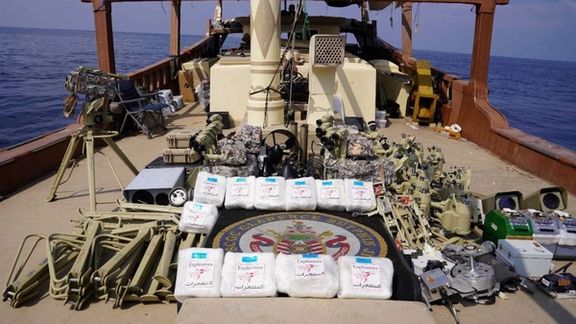
A photo of seized Iranian weapons shipment bound for Houthis released by released by US CENTCOM on Feb. 15, 2024.

Iran's foreign ministry denied allegations by US Central Command (CENTCOM) which said its forces seized an advanced Iranian-made weapons shipment near Yemen, en-route to the Tehran-backed Houthi militant group.

Esmail Baghaei called the allegations "false and baseless." He emphasized that "Iran has no military presence in Yemen, and the weapons in the country have no connection to the Islamic Republic."

A confidential report seen by Reuters in September said that Yemen’s Houthis had grown into a powerful military organization with external support from Iran’s Revolutionary Guard Corps (IRGC), Hezbollah, and Iraqi specialists.

Last Thursday, CENTCOM said its forces intercepted the shipment on January 28 in the Arabian Sea.

The cargo included over 200 packages containing medium-range ballistic missile components, explosives, unmanned underwater and surface vehicle parts, military-grade communication equipment, and anti-tank guided missile launcher assemblies.

Since the Gaza war began, following the Hamas attack on Israel on October 7, 2023, the Houthis have launched around 320 UAVs toward Israel, with over 100 intercepted by the Israeli Air Force.

The group, which controls roughly one-third of Yemen, has aligned itself with Hamas in an effort to pressure for a ceasefire in Gaza, imposing a blockade in the Red Sea region, significantly disrupting global shipping routes.

In January, Israeli Prime Minister Benjamin Netanyahu said that Yemen's Houthis are advancing Iran's regional agenda and will face continued military action for their attacks on Israel. “The Houthis are an extension of Iran, and they serve the terrorist goals of the Iranian axis in the Middle East."

Most Viewed

US blockade enters murky phase as tankers spoof signals and buyers hesitate
1
ANALYSIS

US blockade enters murky phase as tankers spoof signals and buyers hesitate

2
INSIGHT

Ideology may be fading in Iran, but not in Kashmir's ‘Mini Iran'

3
INSIGHT

Hardliners push Hormuz ‘red line’ as US blockade tests Iran’s leverage

4
VOICES FROM IRAN

Hope and anger in Iran as fragile ceasefire persists

5

US sanctions oil network tied to Iranian tycoon Shamkhani

Banner
Banner

Spotlight

  • Hardliners push Hormuz ‘red line’ as US blockade tests Iran’s leverage
    INSIGHT

    Hardliners push Hormuz ‘red line’ as US blockade tests Iran’s leverage

  • Ideology may be fading in Iran, but not in Kashmir's ‘Mini Iran'
    INSIGHT

    Ideology may be fading in Iran, but not in Kashmir's ‘Mini Iran'

  • War damage amounts to $3,000 per Iranian, with blockade set to add to losses
    INSIGHT

    War damage amounts to $3,000 per Iranian, with blockade set to add to losses

  • Why the $100 billion Hormuz toll revenue is a myth
    ANALYSIS

    Why the $100 billion Hormuz toll revenue is a myth

  • US blockade targets Iran oil boom amid regional disruption
    ANALYSIS

    US blockade targets Iran oil boom amid regional disruption

  • Iran's digital economy battered by prolonged blackout
    INSIGHT

    Iran's digital economy battered by prolonged blackout

•
•
•

More Stories

Tehran police arrest suspect in student murder that sparked protests

Feb 18, 2025, 10:28 GMT+0

Tehran police have arrested the main suspect in the murder of a University of Tehran student killed during a mugging, along with an accomplice and three others accused of trading stolen goods, authorities said on Tuesday.

Tehran police chief Abbasali Mohammadian said the arrests took place early on Tuesday, and that both the main suspect and his accomplice had confessed to their crimes.

Amir Mohammad Khaleghi, an undergraduate in business management at the University of Tehran, was fatally attacked by robbers with a cold weapon near the university dormitory last Thursday. The victim died from his wounds in hospital.

The prosecutor's office identified the main suspect as a 23-year-old man named only as Ahmad, who was riding as a passenger on a motorcycle, while the driver, named only as Amir, was also involved in the robbery.

Mohammadian said that disclosing the suspects' full identities requires judicial approval. Iranian media outlets published pixelated images and videos of the two suspects with their eyes covered, describing them as showing their "transfer to their interrogation session."

Mohammad Shahriari, head of the criminal prosecutor’s office, said the suspects confessed during initial investigations to robbing and killing Khaleghi.

He said investigations revealed that the suspects killed him with the intent of robbery. Tehran police chief Abbasali Mohammadian confirmed this, adding that further details would be released after a crime scene reconstruction.

Iranian media reported that both suspects "explicitly confessed" during interrogations, detailing how the robbery escalated into murder.

One of the suspects was quoted as saying: "We spotted the victim in a deserted area and attempted to rob him. After taking his phone and bag, I stabbed him two or three times and immediately got on the motorcycle and left."

He said he only realized two days later, on Saturday, that Khaleghi had died.

Khaleghi's death sparked student protests at The University of Tehran, accusing university officials of failing to ensure their safety, with students staging sit-ins and demanding accountability.

The demonstrations continued for four consecutive days, with tensions escalating after security forces and plainclothes officers surrounded the campus and briefly detained several students.
China’s private ports receive sanctioned Iranian, Russian oil – Bloomberg

Feb 18, 2025, 10:07 GMT+0

Private ports in China are receiving oil from US-sanctioned tankers, allowing major buyers of Iranian and Russian crude to avoid restrictions at larger ports, Bloomberg reported on Tuesday.

Dongying, a port in eastern Shandong province, has become a key entry point for sanctioned oil after state-run Shandong Port Group sold at least one terminal to a private company, the report said citing traders familiar with the matter.

The Si He, a tanker blacklisted by the US on January 10, discharged over 744,000 barrels of Russian ESPO crude at Dongying last week, the report added citing the traders and data from commodities-tracking firm Kpler.

Other recently privatized berths, including in Yangshan near Shanghai and Huizhou in Guangdong province, have also handled shipments of sanctioned oil. Last month, Huizhou’s Huaying Petrochemical terminal received nearly 1 million barrels of Iranian crude from Suezmax Nichola, which in turn took them from an Iran-owned tanker Salina, according to Bloomberg citing ship-tracking data.

The shift toward private operators follows Shandong Port Group’s recent move to block sanctioned tankers under US pressure. However, Bloomberg said the continued use of blacklisted vessels highlights both the financial pressures on China’s independent refiners and Beijing’s apparent willingness to allow the trade to continue.

China’s imports of Russian and Iranian crude accounted for a quarter of its total crude imports in 2024, Bloomberg calculated based on official customs data.

Findings by Iran International show that while Iran’s oil sales to China dropped sharply last month, the decline in export revenues began months earlier, coinciding with US sanctions on dozens of tankers carrying Iranian crude.


Russia says talks with US will not affect cooperation with Iran

Feb 18, 2025, 09:45 GMT+0

The start of talks between Russia and the United States will not impact Moscow’s cooperation with Tehran, Russia's TASS news agency reported citing Kremlin spokesman Dmitry Peskov.

Peskov added that Russia is ready to assist Iran in addressing issues related to its nuclear program.

"Moscow attaches great importance to good relations with Iran and intends to develop them comprehensively, including providing assistance in solving the main problems, including the nuclear program," he said.

Last week, Russia's envoy in Tehran said that Western countries are trying to marginalize Russia and China in discussions regarding Iran's nuclear program.

"Without Russia and China, such negotiations will never achieve their goal and will not be productive," Alexey Dedov said in an interview with RIA Novosti on Tuesday.

Russia remains a critical partner in Iran’s nuclear infrastructure, spearheading projects such as the expansion of the Bushehr Nuclear Power Plant.

Tehran's political establishment is divided over the country's relationships with Russia and China. While some prioritize the economic benefits of trade with both nations, others, particularly the Reformist faction, express concern about Moscow potentially exploiting US-Iranian tensions.

Reformist politician Mahmoud Mirlohi, in an interview with the Didban Iran website, argued that Iran must maintain an independent foreign policy. He emphasized leveraging ties with Russia and China as a means to improve relations with the United States, warning, "We should not allow Russia to use Iran as a pawn in its dealings with the United States."

Mirlohi also expressed concern about the repercussions of Iran's military support for Russia in the Ukraine war, calling it "a serious cause for concern" and stressing that cooperation with Russia should not jeopardize relations with other countries.

The war in Ukraine has directly impacted the stalled negotiations to revive the 2015 JCPOA nuclear agreement, of which Russia is a signatory. These talks, which had been ongoing in Vienna for 12 months under the Biden administration, were abruptly halted in March 2022 following the Russian invasion.

Iran and Russia earlier this year signed a major treaty aimed at deepening bilateral ties. However, this agreement stopped short of establishing a formal military alliance or imposing binding obligations on either side, suggesting a cautious approach to solidifying their relationship.

Threats will not push Iran to negotiating table, top diplomat says

Feb 17, 2025, 19:26 GMT+0

Washington's so-called maximum pressure campaign of sanctions and mooting of military force will not force Iran to negotiate about its nuclear program, Foreign Minister Abbas Araghchi said on Monday.

"Iran’s position is clear and explicit: We will not negotiate under pressure and threats," Araghchi told reporters in Tehran after a meeting with his Sudanese counterpart. "The presidential order for maximum pressure speaks for itself."

The remarks appear to represent a hardening line by Tehran to the suggestion by US President Donald Trump that Iran come to a deal with Washington about its disputed nuclear program or potentially face military strikes.

"Maximum pressure and resolutions have never been effective against Iran … We will not negotiate under threat," Araghchi added.

Trump this month signed a directive reviving his maximum pressure policy on Iran from his first term aimed at driving the Islamic Republic's oil exports to zero. After signing the memorandum, he said he would prefer a deal with Tehran to an Israeli attack on their nuclear sites.

"I would love to make a deal with them without bombing them," he later said on Fox News, drawing ire in Iran.

Iranian Supreme Leader Ali Khamenei appeared to reject the idea of talks with the hawkish Trump administration and senior leaders have fallen in with the position.

The Emir of Qatar Sheikh Tamim bin Hamad Al Thani is due to visit Tehran for a bilateral visit, Araghchi added, saying that there was no indication he carried a message or would be playing any mediating role.

A key go-between in regional conflicts, Qatar maintains good relations with both Tehran and Washington.

Al Thani's visit represents one of the most high-level foreign visits to Iran as it has been locked in over a year of direct and regional combat with Israel.

The Wall Street Journal and The Washington Post reported last week citing US intelligence assessments from January that Israel saw an opening for an attack on Iranian nuclear sites as early as the first of this year with Iran weakened and Trump seen as sympathetic to a strike.

Israel accuses Turkey of helping Iran get cash to Hezbollah

Feb 17, 2025, 19:22 GMT+0

Israel on Monday accused Turkey of cooperating with Iran to get much-needed money to Hezbollah to rebuild itself after the overthrow of the Assad dynasty in Syria deprived Tehran and the Lebanese group of an ally.

“There is an increased Iranian effort to smuggle money to Lebanon for Hezbollah in order to restore its power and status, including via Turkey and through its cooperation,” Israel’s foreign minister Gideon Sa’ar told a visiting delegation of US senators and Deputy Middle East Special Envoy Morgan Ortagus.

The allegations of cash deliveries to Hezbollah led to a suspension of flights between Iran and Lebanon last week, which met with harsh reaction from the Tehran-backed group.

“Hezbollah demands that the Lebanese government reverse its decision of preventing the Iranian plane from landing at Beirut airport and take serious measures to prevent the Israeli enemy from imposing its dictates and violating sovereignty,” a statement read on pro-Hezbollah outlet Al-Mayadeen.

Tehran denies that Iranian passenger flights have been used to ship cash to Hezbollah, but the Lebanese government has so far refused to back down, announcing on Monday that the suspension of flight from Iran has been extended.

Shortly after, Iran’s foreign minister Abbas Araghchi said he had discussed the issue with his Lebanese counterpart Abdallah Bou Habib.

“He emphasized that the decision in this matter was not political but rather technical and legal,” Araghchi quoted Bou Habib as saying.

Sa’ar’s accusations against Turkey could complicate matters as Tehran and Beirut try to find a solution to resume flights. Turkey has not publicly responded to the claims.

In his meeting with the American delegation, Sa’ar asserted that Iran is seeking to compensate for its recent regional setbacks by advancing its nuclear program, not elaborating on what those advances were and if his assessment was based on public or classified information.

Israel is said to have decided on a military attack on Iran if no agreement is reached between Tehran and Washington, according to Al-Hadath citing a senior European diplomat.