• العربية
  • فارسی
Brand
  • Iran Insight
  • Politics
  • Economy
  • Analysis
  • Special Report
  • Opinion
  • Podcast
  • Iran Insight
  • Politics
  • Economy
  • Analysis
  • Special Report
  • Opinion
  • Podcast
  • Theme
  • Language
    • العربية
    • فارسی
  • Iran Insight
  • Politics
  • Economy
  • Analysis
  • Special Report
  • Opinion
  • Podcast
All rights reserved for Volant Media UK Limited
volant media logo

Riyadh seeks to mediate between Trump and Tehran on nuclear deal – CNN
Feb 16, 2025, 09:48 GMT+0
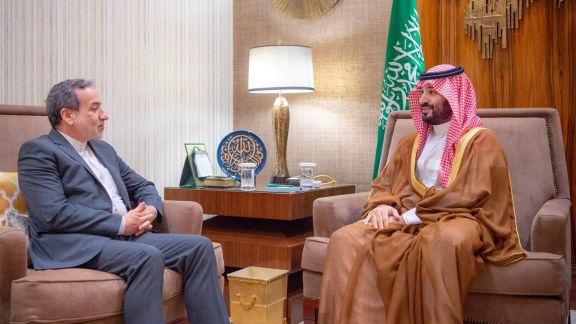
Iranian Foreign Minister Abbas Araqchi in a meeting with Saudi Crown Prince Mohammed bin Salman, Saudi Arabia on October 9

Saudi Arabia is open to mediating between the Trump administration and Iran in pursuit of a new agreement to limit Tehran’s nuclear program, CNN reported on Sunday.

The report said that Riyadh is concerned that Iran may be more inclined to pursue nuclear weapons after the weakening of its allied forces in the Middle East, which had long been seen as a deterrent against Israeli attacks.

Saudi Arabia hopes to leverage its ties with US President Donald Trump to provide Iran with a diplomatic channel to the White House, according to the report.

CNN added that it remains unclear whether Saudi Arabia has made a formal offer, but said the move highlights Riyadh’s efforts to build on its improving relations with Iran and secure a role in any future negotiations.

On Saturday Al-Hadath cited a senior European diplomat saying that if Tehran fails to reach an agreement with the Trump administration before October, Israel will launch a military attack on Iran.

The director general of the UN's nuclear watchdog on Friday said the international community should not waste any more time and should finalize a deal on Iran's nuclear program before it is too late.

Speaking to reporters on the sidelines of the Munich Security Conference, Rafael Grossi said Iran would likely have about 250 kg of uranium enriched to up to 60% by the time of the agency's next report in the coming weeks.

On February 4, Trump signed a directive reviving his so-called maximum pressure policy on Iran from his first term aimed at driving the Islamic Republic's oil exports to zero. After signing the memorandum, he said he would prefer a deal with Tehran to an Israeli attack on their nuclear sites.

"I would love to make a deal with them without bombing them," he said on Fox News.

Following weeks of ambivalent signals regarding negotiations and a struggle in Tehran's political scene, Khamenei finally voiced his opposition to negotiations on February 7, saying talks with the US are "not smart, wise, or honorable."

Iran's President Masoud Pezeshkian also said the country would not yield to external threats.

During last week's state rally marking the anniversary of the 1979 Islamic Revolution, Pezeshkian accused the US of duplicity, saying that Trump called for negotiations while continuing sanctions.

Iran’s Supreme Leader praised the president for rejecting talks with the United States and said Tehran must continue its military progress after Trump’s threat to stop Iran's nuclear program by force.


Most Viewed

US blockade enters murky phase as tankers spoof signals and buyers hesitate
1
ANALYSIS

US blockade enters murky phase as tankers spoof signals and buyers hesitate

2
INSIGHT

Ideology may be fading in Iran, but not in Kashmir's ‘Mini Iran'

3
INSIGHT

Hardliners push Hormuz ‘red line’ as US blockade tests Iran’s leverage

4
VOICES FROM IRAN

Hope and anger in Iran as fragile ceasefire persists

5

US sanctions oil network tied to Iranian tycoon Shamkhani

Banner
Banner

Spotlight

  • Hardliners push Hormuz ‘red line’ as US blockade tests Iran’s leverage
    INSIGHT

    Hardliners push Hormuz ‘red line’ as US blockade tests Iran’s leverage

  • Ideology may be fading in Iran, but not in Kashmir's ‘Mini Iran'
    INSIGHT

    Ideology may be fading in Iran, but not in Kashmir's ‘Mini Iran'

  • War damage amounts to $3,000 per Iranian, with blockade set to add to losses
    INSIGHT

    War damage amounts to $3,000 per Iranian, with blockade set to add to losses

  • Why the $100 billion Hormuz toll revenue is a myth
    ANALYSIS

    Why the $100 billion Hormuz toll revenue is a myth

  • US blockade targets Iran oil boom amid regional disruption
    ANALYSIS

    US blockade targets Iran oil boom amid regional disruption

  • Iran's digital economy battered by prolonged blackout
    INSIGHT

    Iran's digital economy battered by prolonged blackout

•
•
•

More Stories

Iran urges regional ownership of Indian Ocean

Feb 16, 2025, 09:39 GMT+0

Iran says the future of the Indian Ocean must be decided by its own nations rather than shaped by external powers as Tehran tries to gain further control in the key waterway on its southern coast.

“We cannot allow global geopolitical rivalries to determine the future of this region,” said Foreign Minister Abbas Araghchi at the 8th Indian Ocean Conference in Muscat on Sunday.

He said that some extra-regional actors are exploiting political and security vulnerabilities to disrupt natural cooperation between nations in the region.

“Decisions about the fate of the Indian Ocean must be made by the countries in the region and for the benefit of its people.”

For centuries, the Indian Ocean region has been an important trade arena, stretching from Africa’s eastern coast to Australia’s western coast. It remains critical today for the security and stability of shipping lanes and trade routes.

According to the Carnegie Endowment for International Peace, the area, home to 33 nations and 2.9 billion people, accounts for over one-third of the world’s bulk cargo traffic and two-thirds of the world’s oil shipments and ensures global access to food, precious metals, and energy resources.

Araghchi also spoke about the strategic significance of Iran’s southern coastline, describing the Makran coast as an opportunity that must evolve into an economic hub for both Iran and the region.

Last month, Iran’s government spokesperson announced an ambitious plan to relocate its capital to the southern coastal region of Makran, aiming to address Tehran’s persistent issues of overpopulation, power shortages, and water scarcity. However, the proposal was later denied following extensive criticism.

Araghchi also added that Tehran plays a significant role in combating piracy, drug trafficking, and other threats to trade routes insisting that regional security should be maintained through cooperation among Indian Ocean countries.

His comments of promoting maritime security are contested by incidents like the 2019 tanker attacks near the Strait of Hormuz -- attributed to Iran by the US, UK and Saudi Arabia -- and its seizure of vessels such as the Stena Impero in 2019 and Hankuk Chemi in 2021, which were seen as politically motivated.

Iran-backed Houthis of Yemen are behind most of the attacks on ships in the Red Sea, while Tehran has time and again threatened to close the Strait of Hormuz. Iran was also implicated in incidents like the Israeli-owned Mercer Street tanker attack in 2021.

Iranian politicians, media say talks depend on Trump’s tone

Feb 16, 2025, 09:35 GMT+0

Some Iranian politicians and media are attempting to soften Iran’s stance on negotiations with the United States after Supreme Leader Ali Khamenei’s rejection of talks, framing it as a call for President Donald Trump to change his public tone.

Meanwhile, several politicians and commentators have maintained a defiant stance, while others, including President Pezeshkian, have remained in denial about the talks, insisting they can address Iran's problems without the need to lift sanctions.

For the second time in less than a week, Jomhouri Eslami—a daily linked to Khamenei's office but often critical of hardline policies—argued in a February 15 article that negotiations between Tehran and Washington remain possible if Trump moderates his tone toward the Islamic Republic.

The daily accused Trump of "naivety," stating, "The responses he received from Iranian officials should have shown him that arrogant rhetoric does not work with Iran." It also addressed Trump directly, asserting, "Iran is not opposed to negotiations—it is opposed to blackmail."

Meanwhile, former Justice Minister and security official Mostafa Pourmohammadi told Entekhab news website on February 15 that "Khamenei has never forbade negotiations with the United States." However, this statement was in a clear and sharp contrast with Khamenei's latest remarks.

Pourmohammadi commented, "Khamenei has never closed the door to negotiations. On the contrary, it is US officials who want to portray Iran as unwilling to negotiate. In reality, we are a rational state with a strong foundation and an educated nation always ready for dialogue with the world."

Elsewhere in the interview, he contradicted himself, saying, "We would never negotiate with arrogant individuals who first slap us in the face and then say, 'Let's kiss and talk.'" His remarks closely echoed Pezeshkian’s February 10 speech on the anniversary of the 1979 revolution, where he dismissed negotiations with Trump and called his behavior "unmanly."

The conservative Nameh News website quoted ultraconservative commentator Foad Izadi, frequently presented by Iranian state TV as a US politics expert, as saying, "Trump will attack Iran if he believes the cost will be low or manageable. However, if he sees that such an attack would come at a high price, he will never go through with it."

Nameh News described Tehran and Washington as being at a historic turning point in their relations. The outlet noted that Pezeshkian had hoped to engage in talks with Trump under the conditions set by his administration in 2018. However, Trump’s latest stance—implying that Iran could avoid Israeli airstrikes if it agreed to negotiate—has left Tehran in a state of uncertainty.

The Iranian Labor News Agency (ILNA) quoted Iran's security chief, Ali Ahmadian, as saying that Iran has no ideological opposition to negotiating with the United States. However, he asserted that Tehran refuses to engage with Washington due to its "arrogant behavior" before and during the 2015 nuclear negotiations, as well as its failure to uphold commitments after the deal was reached.

Meanwhile, some Iranian politicians and commentators, including conservative figure Nasser Imani, have advocated strengthening ties with China and Russia instead of engaging with the United States. The Rouydad24 website quoted Imani as saying, "There is no point in making a deal with America. We have to pivot toward China and Russia."

At the same time, Ahmad Bakhshayesh Ardestani, a member of the parliament's national security committee, addressed US concerns over Iran’s potential nuclear weaponization. In what appeared to be support for developing nuclear weapons, he stated, "Whether we have a bomb or not, US sanctions will continue." However, echoing moderate politicians and media, Ardestani added, "We will negotiate with America if Trump adopts a softer tone and rhetoric."

Mother of slain protester attempts suicide in prison, her daughter says

Feb 15, 2025, 21:41 GMT+0

Nahid Shirpisheh, an Iranian prisoner whose son Pouya Bakhtiari was killed during the 2019 protests, has attempted suicide in Zanjan Central Prison after enduring weeks of abuse and neglect, her daughter announced.

“Today, after three weeks without any news from my mother, we learned that she attempted suicide in prison on Tuesday and has since been transferred to solitary confinement instead of a hospital,” Mona Bakhtiari wrote Saturday on Instagram.

She also expressed concern for her mother’s life, demanding her immediate release and holding the Islamic Republic responsible for any harm that may come to her.

This comes just months after Mona Bakhtiari reported that her mother had been physically assaulted in prison.

In June, Mona said that Nahid Shirpisheh was beaten by inmates, either unauthorized or state-affiliated, with prison officials failing to intervene. She also highlighted a previous incident from 2022 when Shirpisheh faced violence shortly after being transferred to Zanjan prison.

Nahid Shirpisheh, who has been vocal in demanding justice for her son Pouya’s death at the hands of security forces during the 2019 Bloody November protests, has endured ongoing persecution.

She was sentenced to five years in prison by the Revolutionary Court of Karaj after being arrested during a wave of detentions in 2022 targeting the families of slain protesters.

Pouya’s father, Manouchehr Bakhtiari, was also sentenced to 18 years in prison and 74 lashes over his calls for accountability following his son’s death.

Additionally, this year he was sentenced to 13 months and 15 days in prison for 'spreading false information online', plus another 6 months for 'insulting the leader.'

Iran arrests father of slain judges’ assassin for alleged complicity

Feb 15, 2025, 21:30 GMT+0

Iran's Ministry of Intelligence agents have arrested the father of the assailant who killed two Supreme Court judges notorious for human rights violations in Tehran in January, Iran International has learned.

According to sources familiar with the case who spoke to Iran International on condition of anonymity, the Ministry of Intelligence has accused the father of conspiring with his son in the assassinations.

The assailant, whose identity remains undisclosed, had 10 years of experience working within the Supreme Court before allegedly taking his own life while being pursued by security forces.

Supreme Court judges Ali Razini and Mohammad Moghiseh were gunned down in their offices in a secure government building.

In the aftermath, Iranian security forces launched a widespread crackdown, arresting several former political prisoners. One such detainee is Bijan Kazemi, a former political prisoner whose home was raided on January 21.

All electronic devices belonging to Kazemi and his family were confiscated, and he was transferred to Ward 209 of Tehran's notorious Evin Prison. A source close to the matter revealed to Iran International that Kazemi is being tortured in an attempt to force a confession that he provided the weapon used in the assassinations.

Kazemi, who had previously served two years in prison after a 2020 arrest due to alleged ties with the Mojahedin-e Khalq (MEK), has been subjected to beatings by Intelligence Ministry agents. The MEK has been repeatedly blamed by Iranian authorities for orchestrating attacks against Tehran authorities, including this high-profile assassination.

Both Razini and Moghiseh were infamous for their harsh rulings against political dissidents, particularly during the 1988 mass executions of political prisoners. Critics had long referred to them as the "hanging judges" due to their roles in issuing death sentences during the regime's brutal crackdowns.

The assassination of the two judges has sent shockwaves across the country, particularly among former political prisoners who have recounted their encounters with the judges' severe punishments.

Despite multiple arrests, including that of Kazemi, the Islamic Republic has provided conflicting narratives about the motive and details of the attack. Authorities such as Ebrahim Rezaei, the spokesperson for the National Security Commission, and Jafar Ghadiani, the Disciplinary Prosecutor for Judges, have pointed fingers at the MEK. However, the lack of transparency and the use of torture to extract confessions have cast doubt on these claims.

Iran says ready for constructive talks to restore Tehran-Beirut flights

Feb 15, 2025, 19:44 GMT+0

Iran's foreign minister said Saturday the country was prepared for constructive talks with Lebanon on restoring Tehran-Beirut flights.

In a phone call on Saturday, the two countries’ foreign ministers discussed “how to resolve the problem of civil flights” and “confirmed their readiness to hold constructive talks in good faith”, after a decision to bar two flights from landing triggered violent protests in Beirut.

Iran reciprocated by barring two Middle East Airlines flights from landing in Tehran to evacuate Lebanese citizens, Lebanon's An-Nahar reported.

Iran's ambassador to Beirut Mojtaba Amani told state media that the Islamic Republic will allow Lebanese flights to land in Tehran only if Iranian flights are permitted to land in Beirut.

Tensions between the two countries started when Lebanon halted flights by Iranian carriers, including Mahan Air and Iran Air.

Saeed Chalondari, CEO of Imam Khomeini Airport City, said Lebanon had announced a suspension of Iranian flights until February 18, directing passengers to use Lebanese carriers instead.

The dispute follows accusations from Israel that Iran’s IRGC Quds Force has been using civilian flights to smuggle funds to Hezbollah via Beirut International Airport. Israeli military spokesperson Avichay Adraee said on X that Iran and Hezbollah were exploiting commercial flights to transfer money for attacks on Israel.

The flight ban has sparked tensions in Lebanon. Images circulating on social media showed Hezbollah supporters blocking roads to Beirut Airport in protest against the refusal to allow Mahan Air to land.