• العربية
  • فارسی
Brand
  • Iran Insight
  • Politics
  • Economy
  • Analysis
  • Special Report
  • Opinion
  • Podcast
  • Iran Insight
  • Politics
  • Economy
  • Analysis
  • Special Report
  • Opinion
  • Podcast
  • Theme
  • Language
    • العربية
    • فارسی
  • Iran Insight
  • Politics
  • Economy
  • Analysis
  • Special Report
  • Opinion
  • Podcast
All rights reserved for Volant Media UK Limited
volant media logo

Republican senator doubts Trump's idea of 'verifiable' Iran deal

Feb 5, 2025, 19:42 GMT+0Updated: 07:42 GMT+0
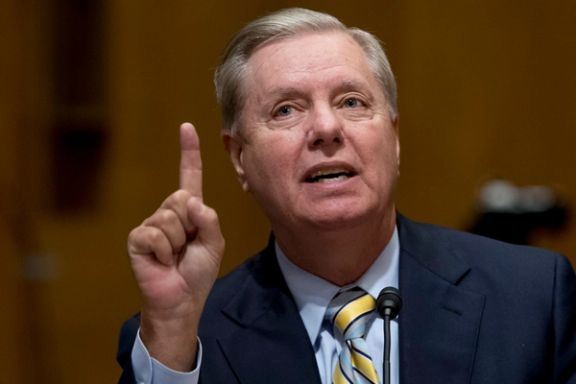
Lindsey Graham
Lindsey Graham

A hawkish Republican senator has expressed doubts about the feasibility of Donald Trump's idea of clinching a verifiable nuclear deal with Tehran, arguing that such a deal would not be possible as Iran's leaders are not trustworthy.

"In my humble opinion, there is no such thing as a verifiable nuclear peace agreement with the Iranian Regime, who are religious Nazis," Republican Senator Lindsey Graham, a close Trump ally, said on Wednesday.

"The ayatollah and his henchmen are not trustworthy on the nuclear front," the hawkish senator from South Carolina said in a post on his X account.

Earlier in the day, Trump said he "would much prefer a Verified Nuclear Peace Agreement, which will let Iran peacefully grow and prosper."

"We should start working on it immediately, and have a big Middle East Celebration when it is signed and completed. God Bless the Middle East!" he said in the post on his Truth Social platform.

Graham, however, said the Islamic Republic's "ambitions to obtain a nuclear weapon are crystal clear based on decades of lies and deceit. When the Iranian Regime says death to Israel and America, they mean it."

Iran has denied seeking a nuclear weapon, but Israel has long contended Tehran wants a bomb and that its arch-enemy poses an existential threat.

Most Viewed

US blockade enters murky phase as tankers spoof signals and buyers hesitate
1
ANALYSIS

US blockade enters murky phase as tankers spoof signals and buyers hesitate

2

US tightens financial squeeze on Iran, warns banks over oil money flows

3
INSIGHT

Ideology may be fading in Iran, but not in Kashmir's ‘Mini Iran'

4
INSIGHT

Hardliners push Hormuz ‘red line’ as US blockade tests Iran’s leverage

5
VOICES FROM IRAN

Hope and anger in Iran as fragile ceasefire persists

Banner
Banner

Spotlight

  • Hardliners push Hormuz ‘red line’ as US blockade tests Iran’s leverage
    INSIGHT

    Hardliners push Hormuz ‘red line’ as US blockade tests Iran’s leverage

  • Ideology may be fading in Iran, but not in Kashmir's ‘Mini Iran'
    INSIGHT

    Ideology may be fading in Iran, but not in Kashmir's ‘Mini Iran'

  • War damage amounts to $3,000 per Iranian, with blockade set to add to losses
    INSIGHT

    War damage amounts to $3,000 per Iranian, with blockade set to add to losses

  • Why the $100 billion Hormuz toll revenue is a myth
    ANALYSIS

    Why the $100 billion Hormuz toll revenue is a myth

  • US blockade targets Iran oil boom amid regional disruption
    ANALYSIS

    US blockade targets Iran oil boom amid regional disruption

  • Iran's digital economy battered by prolonged blackout
    INSIGHT

    Iran's digital economy battered by prolonged blackout

•
•
•

More Stories

Trump advisor says all options on the table for preventing a nuclear Iran

Feb 5, 2025, 18:39 GMT+0

All options are on the table for the United States to prevent Iran from acquiring a nuclear weapon, Trump's national security advisor Michael Waltz said in a Space conversation on X.

Waltz added that the US and Israel are on the same page when it comes to Iran not acquiring a nuclear weapon.

His comments came one day after Israeli Prime Minister Benjamin Netanyahu said in a joint press conference with Trump that the two leaders see eye to eye when it comes to the threat posed by their common enemy.

"We're both committed to rolling back Iran's aggression in the region and ensuring that Iran never develops a nuclear weapon," Netanyahu continued.

He made the remarks after Trump signed a directive restoring the so-called maximum pressure policy on Iran of his first term and warned of "catastrophic" consequences if Tehran does not make a deal on its nuclear program.

Trump said he hoped for an agreement denying Iran nuclear weapons "so that it doesn't end up in a very catastrophic situation," but sounded a dovish note by saying he was prepared to speak with his Iranian counterpart.

Iran says 'not difficult' to assure Trump it does not seek nuclear arms

Feb 5, 2025, 16:20 GMT+0

Demonstrating to US President Donald Trump that Iran does not seek nuclear weapons will not be difficult and is achievable, foreign minister Abbas Araghchi said on Wednesday, in an apparent olive branch to Tehran's main adversary.

"If the main issue is ensuring that Iran does not pursue nuclear weapons, this is achievable and not a difficult matter," Araghchi said.

Trump said on Tuesday he hoped for an agreement denying Iran nuclear weapons.

"They cannot have a nuclear weapon," he told reporters at a press conference held after signing a memorandum to restore his so-called maximum pressure policy against Iran.

"If ... they can convince us that they won't, and I hope they can," Trump continued, "It's actually very easy to do, I think they're going to have an unbelievable future."

The US President's directive on squeezing Tehran on Tuesday seeks to deny Iran nuclear weapons, limit its ballistic missile program and halt support for terrorism.

The head of Iran's Atomic Energy Organization, Mohammad Eslami, also weighed in on Trump's directive, saying Tehran has not and will never pursue nuclear weapons.

While Tehran has maintained its nuclear program is for peaceful purposes, it has accelerated its uranium enrichment to up to 60% — close to the 90% threshold that is considered weapons-grade, according to the UN nuclear watchdog.

The Iranian foreign minister's latest comments did not directly address Trump's sanctions directive but instead appeared to signal Tehran's openness to negotiations on the nuclear issue.

Trump on Wednesday expressed hope for a nuclear agreement, telling reporters that he would be willing to engage in talks with his Iranian counterpart.

Iran's First Vice President Mohammad Reza Aref said that although a meeting between "two human beings" is not impossible, engaging in talks with Trump is not currently on the Islamic Republic's agenda.

Fatemeh Mohajerani, the spokesperson for the presidential administration, also reacted to the US president's remarks regarding his readiness to negotiate with the Iranian president, saying, "Our country's foreign policy has always been based on a set of fixed principles."

"We follow three key principles: the dignity of the country and its people, wisdom in understanding underlying issues, and expediency. All national matters, particularly relations with other countries, are pursued based on these principles."

Trump’s National Security Presidential Memorandum (NSPM) did not mention any meetings or immediate negotiations.

'A failed experience'

In his Wednesday remarks, Araghchi dismissed Trump’s renewal the previous day of the so-called maximum pressure strategy of his first term aiming to reduce Iranian oil exports to zero.

"Maximum pressure is a failed experiment, and trying it again will only lead to another failure," Araghchi told Iranian media on Wednesday.

In Trump's first term in office, Iran's oil exports were reduced to near zero by re-imposing sanctions. Under former US President Joe Biden, however, Iran's oil exports increased starting in 2021 as Tehran found ways to circumvent those sanctions.
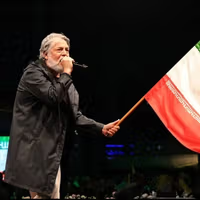
Iranian MP says he would not hesitate to kill Trump

Feb 5, 2025, 15:59 GMT+0

An Iranian lawmaker said he would kill Donald Trump after the US president threatened to obliterate Iran if it sought to assassinate him.

"For my part, I would say that whenever I get the opportunity, I will not hesitate for a moment to kill you, Donald Trump," said Mojtaba Zarei, a member of the Iranian Parliament's Foreign Policy Commission.

"And I am a political official speaking this diplomatically," he said in a post on Iranian social media platform Eitaa.

While signing a sanctions directive on Tuesday to increase pressure on Tehran, Trump was asked about the potential fallout for Iran if it made an attempt on his life.

US law enforcement last year accused Iran's Islamic Revolutionary Guard Corps, a powerful paramilitary organization, of organizing a plot to kill Trump in retaliation for his order to assassinate its foreign operations chief Qassem Soleimani in 2020.

"If they did that, they would be obliterated," Trump said.

"That would be the end. I've left instructions - if they do it, they get obliterated. There won't be anything left."

Iranian foreign ministry spokesperson Esmail Baghaei reacted to the remarks on Wednesday, saying, “Tehran reserves its right to pursue a legal process for achieving justice regarding the killing of national champions and senior officials to achieve results in domestic and international courts.”

Iran's president downplays US oil sanctions, stays silent on Trump talks

Feb 5, 2025, 15:50 GMT+0

Iran's president on Wednesday played down a memorandum signed by US President Donald Trump aimed at reducing Tehran's oil exports to zero but offered no reaction after Trump said he was willing to speak with his Iranian counterpart.

"The US says it is sanctioning Iran, but if we manage our resources well and maintain good relations with our neighbors, how can a country with such capacity and longstanding ties with its neighbors be easily sanctioned?" President Masoud Pezeshkian said in an event held at the country's energy ministry.

His comments came one day after the US president restored his so-called maximum pressure policy on Iran with a presidential memorandum signed ahead of his meeting with Israeli Prime Minister Benjamin Netanyahu in Washington DC.

In Trump's first term in office, Iran's oil exports were reduced to near zero after he re-imposed the sanctions that had been lifted under a 2015 nuclear deal between Tehran and world powers. Under former US President Joe Biden, however, Iran's oil exports increased starting in 2021 as Tehran found ways to circumvent the curbs.

"They think everything we have depends on oil and want to block our oil exports, while there are many ways to neutralize their objectives," Pezeshkian said Wednesday.

However, he did not address Trump's mooted openness to engage in conversations with his Iranian counterpart after signing the directive.

"I would reach out (to Iranians). I'm the one that doesn't care whether I reach out or they reach out. A lot of people say let them reach out," Trump told reporters on Tuesday. "To me it doesn't matter. It's just talks. I want to see peace in the Middle East and elsewhere."

Iran's First Vice President Mohammad Reza Aref said that although a meeting between "two human beings" is not impossible, engaging in talks with Trump is not currently on the Islamic Republic's agenda.

The Iranian government spokeswoman also reacted to Trump's remarks regarding his readiness to negotiate with the Iranian president.

"Our country's foreign policy has always been based on a set of fixed principles. We follow three key principles: the dignity of the country and its people, wisdom in understanding underlying issues, and expediency," Fatemeh Mohajerani said.

"All national matters, particularly relations with other countries, are pursued based on these principles."

Tehran calls Trump’s threat over assassination plot ‘provocative’

Feb 5, 2025, 13:27 GMT+0

Tehran dismissed US President Donald Trump’s warning that any attempt by Iran to assassinate him would result in the country’s destruction, calling the remarks "provocative".

While signing a sanctions directive on Tuesday to increase pressure on Tehran, Trump was asked about a reported plot by the IRGC, Iran's powerful military and intelligence force, to assassinate him in retaliation for the killing of General Qasem Soleimani.

"If they did that, they would be obliterated. That would be the end. I've left instructions if they do it, they get obliterated. There won't be anything left," the US President said in response.

Iranian foreign ministry spokesperson Esmail Baghaei responded to the statement on Wednesday, saying that, “Tehran reserves its right to pursue a legal process for achieving justice regarding the killing of national champions and senior officials to achieve results in domestic and international courts.”

During his first term, in 2020, Trump ordered the killing of Soleimani in Iraq. Soleimani led the Islamic Revolutionary Guard Corps’ Quds Force and Iran's influence and proxy efforts in the Middle East.

Since then, US authorities have tracked several threats against Trump and former officials linked to Soleimani's assassination.

A threat to Trump’s life from Iran led to heightened security ahead of a July campaign rally in Pennsylvania, where Trump was shot in the ear, according to US officials. At the time, officials stated they did not believe Iran was involved in the assassination attempt. In November 2024, the US Justice Department revealed that an Iranian plot to kill Trump before the presidential election had been thwarted.

“Iran did not plot President-elect Donald Trump’s assassination,” President Masoud Pezeshkian told NBC last month, adding, “All the assassinations and acts of terror we see happening in Europe and elsewhere, can we see the footsteps of Iranian nationals or other nationals?”

Before the President's denial, Supreme Leader Ali Khamenei's official account on X shared an image of Trump under the shadow of a drone in 2021. The Farsi tweet, which included the word "vengeance" in red, read: "Soleimani's murderer and he who ordered it will have to pay." The post was later deleted.

The following year, the Supreme Leader's website published an animation showing IRGC forces killing Trump on a golf course.