• العربية
  • فارسی
Brand
  • Iran Insight
  • Politics
  • Economy
  • Analysis
  • Special Report
  • Opinion
  • Podcast
  • Iran Insight
  • Politics
  • Economy
  • Analysis
  • Special Report
  • Opinion
  • Podcast
  • Theme
  • Language
    • العربية
    • فارسی
  • Iran Insight
  • Politics
  • Economy
  • Analysis
  • Special Report
  • Opinion
  • Podcast
All rights reserved for Volant Media UK Limited
volant media logo

Iran hardliners blame economic woes on cabinet, push for impeachments

Behrouz Turani
Behrouz Turani

Iran International

Jan 5, 2025, 10:48 GMT+0Updated: 11:56 GMT+0
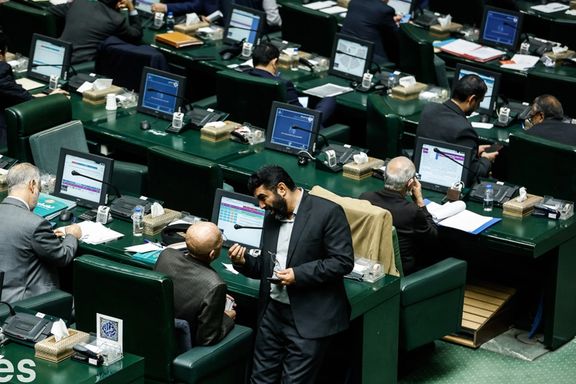
A session of the Iranian parliament on December 31, 2024

With Iran's economic outlook growing increasingly grim, ultraconservative lawmakers are calling for the impeachment of the economy and oil ministers, barely four months into their tenure.

Ultraconservatives have tabled a motion in parliament (Majles) to impeach Economy Minister Abdolnasser Hemmati for failing to control the fall of the Iranian currency. However, Mohammad Taqi Naqdali, an MP who is a member of the ultraconservative Paydari Party emphasized that "Staunch supporters of the government are among those who have called for Hemmati's impeachment."

Three other prominent ultraconservative lawmakers have also backed Naqdali's claim in interviews with Khabar Online website in Tehran.

One of these lawmakers, Mojtaba Yousefi, who is a member of the parliament’s presidium, said: "A cabinet minister who refuses to pay attention to the people's priorities should be impeached. The Majles will not ignore its supervisory role and will question the minister on behalf of the people."

Iran’s currency has plunged by approximately 30 percent since early September, following significant Israeli strikes against Hezbollah, Tehran’s main regional proxy, and the collapse of Bashar Assad’s rule in Syria. This decline is likely to exacerbate the country’s already soaring inflation and deepen the poverty crisis, which has been worsened by years of US sanctions and domestic mismanagement.

Hardline ultraconservatives, however, avoid criticizing the Revolutionary Guard or Supreme Leader Ali Khamenei for regional and economic setbacks. Instead, they focus their attacks on the government, which has limited authority over military and major policy decisions.

Political activists backing President Masoud Pezeshkian’s administration have pointed out that Khamenei has explicitly voiced opposition to early impeachments. They cited his remarks from June 2023: "Why should a cabinet minister be impeached just three or four months after receiving a vote of confidence from the Majles? Why an impeachment? What could the minister have possibly done in such a short time to warrant this?"

In at least one instance, some ultraconservative MPs demonstrated that they do not always follow Khamenei's orders and advice. This occurred shortly after the current Majles convened in 2024, when Khamenei urged members to refrain from factional infighting over the parliament's leadership. Despite this, outspoken ultraconservative MP Hamid Rasaei and members of the Paydari faction persisted in their smear campaign against Mohammad Bagher Ghalibaf. Ultimately, Ghalibaf secured the Speakership, thanks to an alliance with other conservative factions in parliament.

In recent days, Ghalibaf has spoken out against the impeachment push, describing it as "a factionally motivated act" rather than a sound or prudent decision. It remains unclear whether this reflects Ghalibaf's personal stance or if he is acting as a conduit for Khamenei's message to the parliament.

Critics of the ultraconservatives on social media accused them of overusing the parliament's supervisory powers and questioned whether they would heed Khamenei's advice or defy it.

Ghalibaf criticized the ultraconservatives' actions as a political spectacle amid the country's currency crisis, stating in the Majles, "Unfortunately, some MPs exploit the people's demands to advance their factional interests." He warned that "if the impeachment motion proceeds, there will be no one in the government to manage exchange rates."

One of the advocates of impeachment said this was "the Speaker's personal opinion and the MPs are adamant to pursue the impeachment motion." Another lawmaker added that "It is not only the currency crisis that motivated the impeachment. There are also problems about fuel and inflation rate."

Another parliamentarian, Javad Hosseini Kia said: "There is a major problem with exchange rates, which is caused by the inefficiency of the Ministry of Economy and the Central bank. If the officials in charge cannot do their jobs they should step down."

According to Khabar Online, while quoting Khamenei as saying that "The Majles should help the government," Yousefi said: "We helped the government by giving our vote of confidence to all of cabinet ministers and passing their budget bill. Yes, we should help the government but at what price? Should not we use our supervisory tools despite the currency crisis and unemployment? We are using our supervisory role on behalf of the people."

Most Viewed

Ghalibaf defends Iran-US talks amid hardline backlash
1
INSIGHT

Ghalibaf defends Iran-US talks amid hardline backlash

2
VOICES FROM IRAN

Bread shortages, soaring prices strain households in Iran, residents say

3
ANALYSIS

From instability to influence: Pakistan’s pivotal role in US-Iran diplomacy

4
ANALYSIS

100 days on: why Iran’s January protests spread across social classes

5

War-hit homeowners feel abandoned as Iran’s reconstruction aid fades

Banner
Banner

Spotlight

  • Iran crackdown reaches cemeteries as graves of slain protesters defaced
    EXCLUSIVE

    Iran crackdown reaches cemeteries as graves of slain protesters defaced

  • Iran diplomacy wobbles as factions compete to avoid looking soft on US
    INSIGHT

    Iran diplomacy wobbles as factions compete to avoid looking soft on US

  • The politics of pink: how Iran uses cuteness to rebrand violence
    ANALYSIS

    The politics of pink: how Iran uses cuteness to rebrand violence

  • Bread shortages, soaring prices strain households in Iran, residents say
    VOICES FROM IRAN

    Bread shortages, soaring prices strain households in Iran, residents say

  • 100 days on: the anatomy of Iran’s January crackdown
    INSIGHT

    100 days on: the anatomy of Iran’s January crackdown

  • Ghalibaf defends Iran-US talks amid hardline backlash
    INSIGHT

    Ghalibaf defends Iran-US talks amid hardline backlash

•
•
•

More Stories

Iran’s FM says diplomacy moves in tandem with the battlefield

Jan 5, 2025, 10:30 GMT+0

Iranian Foreign Minister Abbas Araghchi has said that diplomacy and battlefield strategies must align as Tehran seeks to maintain its military power despite significant regional setbacks.

“Diplomacy moves in tandem with the battlefield, complementing each other,” Araghchi said. “The battlefield paves the way for diplomacy, and diplomacy turns the achievements of the battlefield into national security, national interests, national pride, and national dignity.”

Referring to Iran’s approach as the “diplomacy of resistance,” he insisted that military and diplomatic efforts must move forward together to secure the country’s objectives.

Araqchi, without mentioning the developments in Syria and the fall of Bashar al-Assad, said: "The enemies think that if they inflict damage on the Axis of Resistance, it will be a victory for them. They must know that this marks the beginning of their defeat."

According to Iran’s Foreign Minister, "What has transpired over the past few months for the region, the Resistance, and Iran was a renewed manifestation of the complete coordination between the field and diplomacy."

The Islamic Republic’s officials’ reference to the battlefield and the Axis of Resistance pertains to the presence of Iran’s proxy forces in Iraq, Syria, Lebanon, and Yemen.

Araghchi expanded on these themes during his recent interview with China’s state-run CCTV, aired Saturday. Addressing the prospect of further Israeli strikes on Iranian targets, he struck a defiant tone.

“We are fully prepared for the possibility of further Israeli attacks,” he said. “I hope Israel will refrain from taking such reckless action, as it could lead to a large-scale war.”

Amid speculation that Israel may escalate its response to ballistic missile and drone attacks by Iran's allies, Araghchi cautioned against the potential consequences of such actions. However, he underscored Iran’s preference for diplomacy, highlighting the importance of reason in preventing conflict. “We believe that reason will ultimately prevail and prevent actions that could have serious consequences,” he told the broadcaster.

The interview, conducted during Araghchi’s late-December visit to Beijing, also highlighted Iran’s efforts to strengthen ties with China. Araghchi discussed regional security and the nuclear deal, reaffirming Tehran’s interest in fostering international alliances to counter US sanctions and Israeli military actions.

Araghchi’s remarks come amid increasing geopolitical and economic pressures on Iran. Israeli airstrikes have repeatedly targeted Iranian-backed forces in Syria, while ballistic missile and drone attacks by Yemen’s Houthi rebels—armed by Tehran—have added to regional instability.

At the same time, Iran faces internal criticism over its setbacks in Syria and the broader region.

It seems Iran’s rhetoric of resistance aims to project strength even as its regional position has weakened. By tying military successes to diplomatic gains, Tehran seeks to sustain its influence in Syria and counter perceptions of weakness.

Araghchi’s remarks also reflect Iran’s broader narrative of perseverance. Whether through alliances with powers like China or the fusion of battlefield and diplomatic strategies, Tehran appears determined to adapt to shifting regional dynamics without conceding defeat.

Iran, Russia to sign cooperation deal soon, spokesperson says

Jan 4, 2025, 16:05 GMT+0

Iran expects to sign a comprehensive cooperation agreement with Russia on January 17 during President Masoud Pezeshkian's visit to Moscow, government spokesperson Fatemeh Mohajerani told Sputnik Saturday.

Referring to earlier discussions, Mohajerani noted that Iran's president met with Vladimir Putin on the sidelines of the BRICS summit in Kazan, Russia, in October, and expressed optimism about finalizing the deal.

"Specifically with Russia, we anticipate the president's visit to Moscow, during which we hope to see progress on two key issues: the North-South Corridor, which is already underway, and the plan to transfer Russian gas to Iran—both of which have been key points of agreement between the two sides," Mohajerani said.

Tehran and Moscow initially signed a long-term agreement in March 2001, officially called the Treaty of the Foundation of Mutual Relations and the Principles of Cooperation between the Islamic Republic of Iran and the Russian Federation Act. The agreement was originally set for ten years but was extended twice for five-year terms. However, similar promises have been made in the past without finalizing a renewed treaty.

According to Iran’s ambassador to Russia, the countries agreed in 2021 to extend the agreement for another five years, setting its expiration for 2026.

In 2023, reports surfaced about possible challenges in developing the new agreement with Russia, though few details about its content have been disclosed publicly.

Khamenei daily opposes US talks, labels advocates 'naive or insane'

Jan 4, 2025, 13:32 GMT+0

Hossein Shariatmadari, the firebrand editor of the flagship Khamenei-funded hardline newspaper Kayhan, wrote in a Saturday editorial that those proposing negotiations with the US are either "asleep, drunk, or insane."

Shariatmadari argued that the advocates of talks are either "naive" or "inefficient" and are using negotiations with the US as a cover for their inability to solve problems. He also accused them of "having ties with the enemy out of deceit or greed."

His comments come as on Friday, Abbas Araghchi, Iran's Minister of Foreign Affairs, said in an interview with China's CCTV network that Tehran is ready for "constructive and prompt" negotiations over its nuclear program.

In recent days, some officials in Masoud Pezeshkian's administration and insider political figures have called for talks with Donald Trump, who will officially assume the US presidency on January 20.

Among them, Ali Abdolalizadeh, Pezeshkian's special representative for maritime economy and head of his campaign during the 2024 presidential election, said on Tuesday that negotiations with Trump are necessary.

"We cannot keep the country's issues suspended," Abdolalizadeh said, adding, "The entirety of the ruling system has also reached [the necessity] of face-to-face negotiations."

Iranian MPs file impeachment motions against economy and oil ministers

Jan 4, 2025, 13:27 GMT+0

Motions for the impeachment of Iran's economy and oil ministers have been officially submitted to parliament's leadership, lawmaker Ahmad Naderi told Tasnim News Agency on Saturday.

"So far, the impeachment of Mohsen Paknejad, the Minister of Oil, with 23 signatures, and the impeachment of Abdolnaser Hemmati, the Minister of Economy, with over 70 signatures, have been officially registered in the parliament system," Naderi said.

Meanwhile, on the same day, President Masoud Pezeshkian criticized corruption in Iran's economy, which is mostly controlled and regulated by the government.

"In a situation where the allocation of preferential currency rates to certain individuals in both the public and private sectors has turned into quotas and insider privileges, leaving others at a disadvantage, how can such a market be considered competitive? This process certainly needs reform," he said.

Iran is grappling with a dire economic situation, with its currency, the rial, depreciating by over 30% since September. This decline has been driven by regional conflicts and setbacks in Syria and Lebanon.

In late December, business owners and workers in Tehran’s historic bazaar staged a rare strike to protest runaway inflation and soaring foreign currency rates. The strike sparked similar demonstrations in other commercial hubs across the capital.

Unrest in the historic heart of Iran’s commerce reflects the grim state of the country’s economy. In 1979, protests in the bazaar were a precursor to the Islamic Revolution that overthrew the monarchy, underscoring the political significance of such discontent.

Former diplomat urges Iran to appoint envoy to mend ties with US

Jan 4, 2025, 11:33 GMT+0

A former Iranian diplomat has suggested that Tehran appoint a special representative to engage with the Trump administration and work toward resolving disputes with Washington.

Speaking to the Faraz Daily website in Tehran, Nosratollah Tajik noted that the 2020 killing of IRGC commander Qasem Soleimani remains a significant factor shaping Iran’s adversarial stance. However, he stressed that "Tehran should not allow this issue to harm Iran's national interests." Tajik also highlighted that, unlike Trump’s first term (2017–2021), Iran cannot afford to ignore him once he takes office at the White House.

The most significant point raised by Tajik, one rarely addressed by other Iranian politicians, was his suggestion that President Massoud Pezeshkian appoint a special representative to focus on restoring Iran's ties with the United States and initiating efforts to ease tensions between Tehran and Washington.

Tajik also cautioned the West that Iran retains significant assets in the Middle East despite the fall of Bashar al-Assad in Syria. He pointed out that Iran remains capable of exploiting the fragile situation in eastern Syria to its advantage.

In a controversial statement, Tajik claimed that "the perception that Iran is on the verge of acquiring nuclear weapons serves as its strongest bargaining chip" in negotiations with the West.

However, he acknowledged that factors such as the prolonged war in Gaza, escalating tensions between Iran and Israel, and Assad's fall have created a highly complex environment for any potential negotiations between Iran and the US.

Tajik remarked, "Trump and Iran are well-acquainted with each other. However, the US President-elect has yet to fully unveil his policies toward Iran for his new term." Reflecting on Trump’s 2018 withdrawal from the JCPOA nuclear deal, which severely impacted Iran’s economy, Tajik noted, "The exit also harmed US interests, as Iran significantly scaled back its commitments under the agreement."

He warned that if Trump has learned from that experience, it could reshape future relations between the two countries. "If not, no positive outcome can be expected," Tajik concluded.

In a related development, Eghtesad News in Tehran highlighted remarks from several Iranian politicians regarding the prospects for talks between Iran and the Trump administration. The outlet noted Trump’s recent statement indicating that he does not wish to harm Iran but seeks to contain its nuclear ambitions to prevent Tehran from reaching the point of no return and acquiring nuclear weapons.

Eghtesad News quoted Hamid Aboutalebi, an advisor to former President Hassan Rouhani, who, in an open letter to President Massoud Pezeshkian, urged Iran not to miss what he called a "historic opportunity" to redefine relations with the United States. In the letter, Aboutalebi also suggested that Pezeshkian congratulate Trump on his election victory. The website also pointed out that several Iranian newspapers have recently advocated for improved relations with the United States.

The website also quoted conservative analyst Reza Salehi as saying that "Compared to his Democratic predecessor, Trump can take more positive steps to mend Washington's ties with Iran." Salehi reiterated: "Trump wants to make a deal. He wishes to end wars and prevent any new war."

Eghtesad News then quoted former Vice President Mohamad Ali Abtahi as saying that "Iran needs to benefit from the opportunity as Trump wishes to win the credit for resolving the dispute with Iran.”

Meanwhile, Heshmatollah Falahatpisheh, the former head of the Iranian parliament's national security and foreign relations committee, stated in a commentary that "Iran is not a priority for Trump." He dismissed Tehran’s efforts to signal readiness for talks with the incoming Trump administration as "futile."