• العربية
  • فارسی
Brand
  • Iran Insight
  • Politics
  • Economy
  • Analysis
  • Special Report
  • Opinion
  • Podcast
  • Iran Insight
  • Politics
  • Economy
  • Analysis
  • Special Report
  • Opinion
  • Podcast
  • Theme
  • Language
    • العربية
    • فارسی
  • Iran Insight
  • Politics
  • Economy
  • Analysis
  • Special Report
  • Opinion
  • Podcast
All rights reserved for Volant Media UK Limited
volant media logo

Iran’s FM says diplomacy moves in tandem with the battlefield
Jan 5, 2025, 10:30 GMT+0Updated: 11:56 GMT+0
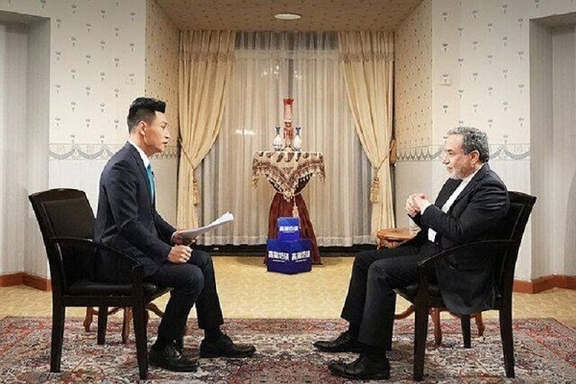
Iran FM Abbas Araghchi speaking in an exclusive interview with China's CCTV network

Iranian Foreign Minister Abbas Araghchi has said that diplomacy and battlefield strategies must align as Tehran seeks to maintain its military power despite significant regional setbacks.

“Diplomacy moves in tandem with the battlefield, complementing each other,” Araghchi said. “The battlefield paves the way for diplomacy, and diplomacy turns the achievements of the battlefield into national security, national interests, national pride, and national dignity.”

Referring to Iran’s approach as the “diplomacy of resistance,” he insisted that military and diplomatic efforts must move forward together to secure the country’s objectives.

Araqchi, without mentioning the developments in Syria and the fall of Bashar al-Assad, said: "The enemies think that if they inflict damage on the Axis of Resistance, it will be a victory for them. They must know that this marks the beginning of their defeat."

According to Iran’s Foreign Minister, "What has transpired over the past few months for the region, the Resistance, and Iran was a renewed manifestation of the complete coordination between the field and diplomacy."

The Islamic Republic’s officials’ reference to the battlefield and the Axis of Resistance pertains to the presence of Iran’s proxy forces in Iraq, Syria, Lebanon, and Yemen.

Araghchi expanded on these themes during his recent interview with China’s state-run CCTV, aired Saturday. Addressing the prospect of further Israeli strikes on Iranian targets, he struck a defiant tone.

“We are fully prepared for the possibility of further Israeli attacks,” he said. “I hope Israel will refrain from taking such reckless action, as it could lead to a large-scale war.”

Amid speculation that Israel may escalate its response to ballistic missile and drone attacks by Iran's allies, Araghchi cautioned against the potential consequences of such actions. However, he underscored Iran’s preference for diplomacy, highlighting the importance of reason in preventing conflict. “We believe that reason will ultimately prevail and prevent actions that could have serious consequences,” he told the broadcaster.

The interview, conducted during Araghchi’s late-December visit to Beijing, also highlighted Iran’s efforts to strengthen ties with China. Araghchi discussed regional security and the nuclear deal, reaffirming Tehran’s interest in fostering international alliances to counter US sanctions and Israeli military actions.

Araghchi’s remarks come amid increasing geopolitical and economic pressures on Iran. Israeli airstrikes have repeatedly targeted Iranian-backed forces in Syria, while ballistic missile and drone attacks by Yemen’s Houthi rebels—armed by Tehran—have added to regional instability.

At the same time, Iran faces internal criticism over its setbacks in Syria and the broader region.

It seems Iran’s rhetoric of resistance aims to project strength even as its regional position has weakened. By tying military successes to diplomatic gains, Tehran seeks to sustain its influence in Syria and counter perceptions of weakness.

Araghchi’s remarks also reflect Iran’s broader narrative of perseverance. Whether through alliances with powers like China or the fusion of battlefield and diplomatic strategies, Tehran appears determined to adapt to shifting regional dynamics without conceding defeat.


Most Viewed

Iran negotiators ordered to return after internal rift over Islamabad talks
1
EXCLUSIVE

Iran negotiators ordered to return after internal rift over Islamabad talks

2
ANALYSIS

US blockade enters murky phase as tankers spoof signals and buyers hesitate

3
ANALYSIS

Why the $100 billion Hormuz toll revenue is a myth

4

US tightens financial squeeze on Iran, warns banks over oil money flows

5
ANALYSIS

US blockade targets Iran oil boom amid regional disruption

Banner
Banner

Spotlight

  • Hardliners push Hormuz ‘red line’ as US blockade tests Iran’s leverage
    INSIGHT

    Hardliners push Hormuz ‘red line’ as US blockade tests Iran’s leverage

  • Ideology may be fading in Iran, but not in Kashmir's ‘Mini Iran'
    INSIGHT

    Ideology may be fading in Iran, but not in Kashmir's ‘Mini Iran'

  • War damage amounts to $3,000 per Iranian, with blockade set to add to losses
    INSIGHT

    War damage amounts to $3,000 per Iranian, with blockade set to add to losses

  • Why the $100 billion Hormuz toll revenue is a myth
    ANALYSIS

    Why the $100 billion Hormuz toll revenue is a myth

  • US blockade targets Iran oil boom amid regional disruption
    ANALYSIS

    US blockade targets Iran oil boom amid regional disruption

  • Iran's digital economy battered by prolonged blackout
    INSIGHT

    Iran's digital economy battered by prolonged blackout

•
•
•

More Stories

Fuel tax dispute escalates tensions between Iran and Turkey

Jan 5, 2025, 09:40 GMT+0

A trade dispute between Iran and Turkey has escalated, with both nations imposing retaliatory measures over fuel taxes on trucks. The tensions come amid Turkey's recent strategic gains in Syria and a decline in Iran's regional influence.

Turkey’s decision to revoke fuel tax exemptions for Iranian vehicles, effective December 29, has left hundreds of Iranian trucks stranded at border crossings, sparking outcry among drivers and escalating tensions between the two regional powers.

Turkey recently introduced a policy requiring Iranian trucks to pay a fuel tax equivalent to 155% of its special consumption tax. The Turkish newspaper Cumhuriyet reported that the tax “applies to all commercial vehicles with Iranian license plates, excluding buses.”

Hundreds of Iranian trucks cross into Turkey on weekly basis as their main transit route to European countries.

Turkish officials argue that the measure is a response to Iran’s Full Tank Plan, which mandates foreign trucks transiting Iran to pay a fuel surcharge for using Iran's extremely cheap diesel. Fuel in Iran is almost 20-fold cheaper than in other regional countries, because the government subsidizes gasoline and diesel. In addition to the subsidized fuel, Iran's rial has dropped to historic lows against foreign currencies, making fuel even cheaper for Turkish truckers.

Now, Iran has retaliated by halting fuel supplies to Turkish trucks as of January 3. The move has caused widespread disruptions, with Turkish drivers protesting what they see as unjust penalties.

Iranian truck drivers are also affected. Drivers report paying penalties of up to 27 liras per liter of diesel under Turkey’s new regulations.

One Iranian driver told Iran International that he earned 1.7 billion rials (over $2100) for transporting a load across Turkey, but incurred 2.7 billion rials (around $3400) in costs due to the new Turkish tax.

Economic and geopolitical implications

The trade dispute is compounded by the broader geopolitical rivalry between the two nations. Despite ambitious goals to increase annual bilateral trade to $30 billion, trade volume has remained at around $7.5–10 billion, reflecting persistent tensions.

These economic pressures mirror political divisions. Turkey's support for Syrian opposition groups and its backing of efforts to oust Bashar al-Assad stand in stark contrast to Iran’s investments in propping up Assad’s government. Recent Turkish gains in northern Syria have drawn criticism from Iran, with Supreme Leader Ali Khamenei accusing unnamed neighbors of pursuing territorial ambitions in the region.

This trade dispute is not an isolated event but part of a broader pattern of actions perceived as hostile to Iranian trade. Turkey’s ally Azerbaijan recently blocked Iranian trucks from transiting through a key route, further restricting Iran’s access to European markets.

The escalating conflict has disrupted vital trade networks and exacerbated economic challenges for both nations. Without resolution, the row could deepen political and economic divides, setting a concerning precedent for regional trade and stability.

Italian PM raises concerns over detained journalist in Iran with Trump - Italian Media

Jan 5, 2025, 09:22 GMT+0

Italian Prime Minister Giorgia Meloni raised the case of detained Italian journalist Cecilia Sala during a meeting with President-elect Donald Trump at his Mar-a-Lago resort in Florida on Saturday, Italian media reported.

The New York Times reported that one person briefed on the meeting said Meloni had pressed aggressively for it.

While details of their talks were not officially disclosed, Meloni reportedly sought Trump's support on the issue, alongside discussions on Russia's war in Ukraine, trade, and the Middle East.

Newspaper journalist and podcaster Cecilia Sala, 29, was arrested on unspecified charges last month and placed in solitary confinement despite working in the country on a valid press pass.

Tehran made clear to Rome that the freedom of an Italian reporter detained in Iran depends on Italy's release of an Iranian arrested at Washington's behest, a source familiar with discussions between the journalist's family and the Italian government told Iran International.

Mohammad Abedini Najafabadi, 38, was arrested by Italian authorities at the behest of the United States for his alleged role in providing technology used to kill three US soldiers in a drone attack in Jordan.

Iran, the source said, is prepared to free Sala “on humanitarian grounds" if the Italian government drops the extradition proceedings against Abedini and grants his release from Milan's brooding La Opera prison.

The Italian foreign ministry has demand Sala's “immediate release ... (and) full assurances regarding her conditions of detention.”

Sala told her family in New Year’s Day calls that her prescription glasses had been confiscated, her cell is barely longer than her own height and that she is forced to sleep on a blanket spread on the floor, according to Italian media.


Israeli military on high alert amid concerns over Iran's potential actions - Walla News

Jan 5, 2025, 08:08 GMT+0

The Israeli military is on high alert following a directive from IDF Chief of Staff Herzi Halevi, amid fears Iran may take extreme actions against the Jewish state, Israeli news outlet Walla reported.

Security officials warn that changes in the regional strategic situation could push Iran to act against Israel.

Along with the decline in the rial exchange rate and internal protests, Walla wrote that the Revolutionary Guards are transferring funds to Hezbollah via civilian aircraft, leading to the Chief of Staff ordering heightened vigilance.

Israel and Hezbollah in Lebanon are in the midst of a 60-day ceasefire but both sides have reported dozens of breaches amid the US-brokered truce.

The report's sources also highlighted uncertainty over Iran's stance ahead of Donald Trump's return to the White House later this month.

Iran providing Houthis with more arms after collapse of other armed allies - Telegraph

Jan 4, 2025, 18:58 GMT+0

Iran is sending more weapons to the Houthis following the collapse of its other armed allies across the Middle East, The Telegraph reported Saturday citing a spokesman for Yemen’s army.

Tehran has given the Yemeni militia group enough supplies to keep up its strikes on Israel and attacks on global shipping for “years to come”, the report said citing Abdul Basit Al-Baher, the spokesman for Yemen’s military in the governorate of Taiz.

The recent escalation of Houthi attacks against Israel is “clear evidence that Iran is increasing its support for the Houthis after the weakening of Hamas and Hezbollah and the fall of the Assad regime in the region”, the Yemeni spokesman said.


Iran sold 2 billion barrels of oil during Biden’s presidency

Jan 4, 2025, 17:57 GMT+0
•
Dalga Khatinoglu

Data from oil tanker tracking firms reveal that during Joe Biden's presidency, Iran exported approximately 2 billion barrels of oil—a significant increase compared to the volumes recorded between 2019 and 2021.

Details from Kpler, a commodity intelligence company, reveal that Iran, whose daily oil exports had fallen below 400,000 barrels in January 2021, at the start of the Biden Administration, exported 1.6 million barrels daily last year.

Similarly, the United Against Nuclear Iran (UANI) organization, which also tracks oil tankers carrying Iranian oil, says “In 2024, Iran exported 587 million barrels of oil, an increase of 10.75% compared to 2023’s 530 million barrels. Over the four years since the start of the Biden Administration, with less than one month remaining in its term, Iran has exported a cumulative total of nearly 1.98 billion barrels of oil.”

Kpler's data indicates that Iran exported approximately 1.64 billion barrels of crude oil and gas condensates during the four years of the Biden administration. Furthermore, Iran's daily fuel oil (mazut) exports averaged around 230,000 barrels during this period, consistent with figures reported by UANI.

100%

The total value of Iran’s crude oil and condensate exports during Joe Biden’s presidency, excluding the costs associated with bypassing sanctions, is estimated at around $135 billion. The value of Iran’s exported fuel oil during this period is approximately $25 billion.

Iran keeps the pricing of its oil exports to its primary customer, China, undisclosed. Estimates suggest discounts of $10 to $30 per barrel, which would substantially lower the $135 billion revenue estimate. Additionally, Tehran allocates funds to obscure the oil's origin before delivery to China, and it remains unclear how much of the payment is in actual cash versus barter arrangements.

Last year, China accounted for 91% of Iran’s total exports of crude oil, condensates, and fuel oil.

100%

Although Iran’s oil exports continued to rise last year, the volume dropped to below 1.3 million barrels per day in the final two months of the year. This decline is partly attributed to recent US sanctions on 35 tankers carrying Iranian oil and Donald Trump’s victory in the US presidential elections, which has increased the likelihood of re-implementing the “maximum pressure” policy against the Islamic Republic.
Moreover, Iran’s only oil customers in China, small independent refineries, known as “teapots,” are under pressure from the Chinese government to either modernize or shut down due to high pollution levels and low efficiency. At least three Chinese teapots were decommissioned in recent months.

Over the past few years, alongside the Biden Administration’s leniency, Iran has used hundreds of oil tankers, known as the “ghost fleet,” to covertly sell oil. UANI identified 132 new vessels engaged in smuggling Iranian oil in 2024, bringing the total number of ghost fleet tankers tracked to 477 vessels: “In 2024, the organization’s intelligence led to over 330 flag revocations and contributed to the designation of 139 vessels by the US government.

Notably, out of the 139 tankers sanctioned this year, 110 were previously identified by UANI on its Ghost Armada list, showcasing UANI’s pivotal role in preemptive tracking.”

The decline in Iran’s daily oil exports to below 1.3 million barrels in November and December last year comes as President Masoud Pezeshkian’s government has set a target of exporting 1.85 million barrels of crude oil and condensates daily in the next Iranian fiscal year, which begins on March 21.






